

The administrative system of the Satavahanas was simple and was largely based on the Mauryan model,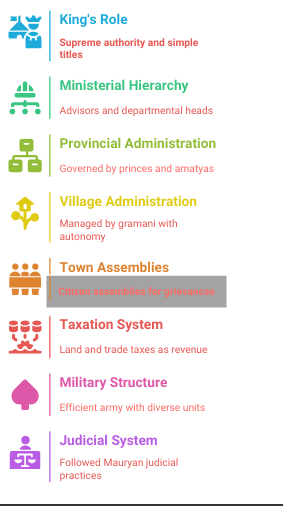 with modifications to suit local needs. Information about their administration comes from coins, inscriptions, and literary sources.
Kingship and Central Administration
- The king enjoyed supreme authority and succession was hereditary.
- The kings took simple titles like Raja or Maharaja.
- The Visvasa Amatya was the highest-ranking minister, advising the king on important matters.
- The Rajamatyas were next in rank, forming the king’s advisory body.
Important Officials
Several officials assisted the king in governance:
- Mahamatras – In charge of various departments.
- Bhandagarika – Superintendent of stores.
- Heranika – Treasurer.
- Mahasenapati – Commander of forces.
- Mahataraka – Chamberlain.
- Nibandhakara – Drafting official for State records.
- Prathiharas & Dutas – Messengers.
- Ganapaka – Accountant.
- Lekhaka – Officer in charge of document registration.
- Pattikapalaka – Director of archives.
- Uparakshita – Official responsible for constructing caves for monks.
The princes were trained in warfare and governance. The kings undertook royal tours to stay connected with public opinion and ensure efficient administration.
1. Provincial and Local Administration
- The empire was divided into provinces called Aharas for administrative convenience.
- Important Aharas: Govardhana (Nasik), Sopara, Mamala (Pune).
- These provinces were ruled by royal princes, Amatyas, Maharathis, and Mahabhojas, who could issue inscriptions, coins, and land grants.
- The village was the smallest administrative unit, headed by a Gramani (Gramika). Villages and towns enjoyed considerable autonomy.
- Towns were governed by a Nigama Sabha (citizens’ assembly), as mentioned in the Bhattiprolu inscription.
2. Revenue and Economy
- Land revenue was the chief source of income.
- Two main taxes:
- Rajabhoga (Regular tax).
- Deyameya (Special tax).
- The state collected 1/6th of agricultural produce as revenue.
- Other sources of income: taxes on roads, ports, professions, mines, and markets.
3. Military and Judiciary
- The army consisted of infantry, cavalry, and elephants.
- The judicial system followed Mauryan traditions.
- The king was the highest judicial authority, but he respected laws recommended by judicial experts.
- Civil and criminal cases were handled separately.
4. Society and Matrilineal Traces
- Though the Satavahanas followed patriarchy, some later kings had matronymic names (derived from their mother’s name).
- However, this did not indicate matriarchal lineage.
