SARVAI PAPANNA (1695- 1710 CE)
- After the end of the Qutb Shahi rule, Srrvai Papanna strived to liberate the people of Telangana from the
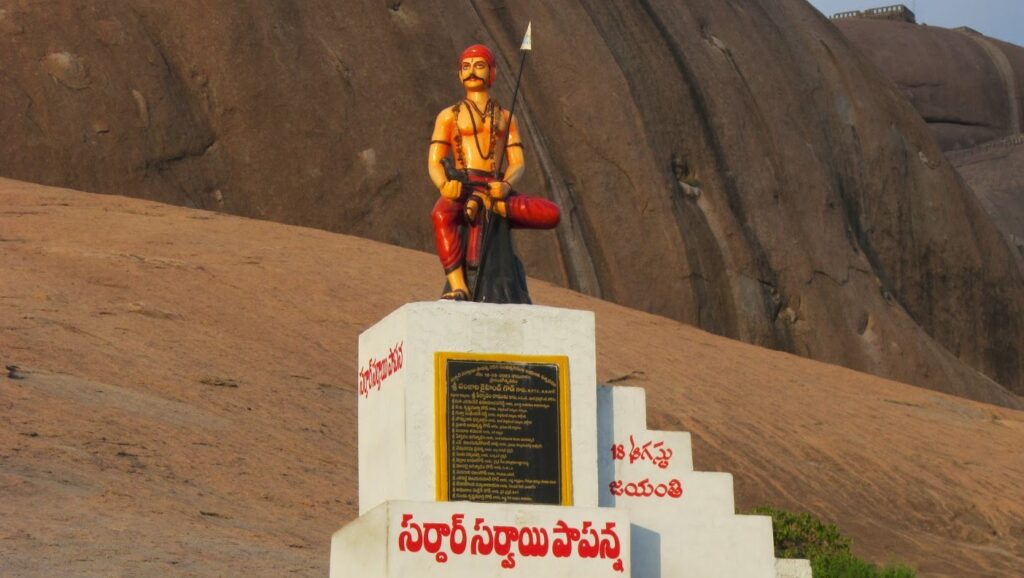 rule of the Mughal Viceroys between 1695 and 1710 CE. He had chosen Khalishpur which is located in the north-east of Warangal and is 50Okms from Hyderabad in Golconda kingdom as his main center for actívities. His struggle was mainly focused against the dominant social groups and ruling classes. Sarvai Papanna’s native village was Tarikonda”. It is located 25 kms from Warangal in the north-west direction. Papanna belongs to ‘Kallu gita’ or Goud caste. From the very beginning, his aim was not to take up his caste based profession.
- This is evident from the Telugu folk literature, in which Papanna addressing his mother said thus :
- “Tying toddy pots to the palm trees, getting them down and getting a share is not my taste. My hand should fall on the walls of the Golconda fort.'(*Richard M. Eaton, A social History of the Deccan’, Cam- bridge, 2005,p. 160). From this it is clear that his main ambition was to become the ruler. In a similar way, a Telugu verse written in the first half of the 20h century (ibid.p.160) mentions that Papanna considers Toddy tapper as a resemblance of hard work, who possess good leadership qualities and knows very well the proper utilization of resources and such a person can only occupy the Golconda fort and is eligible to rule and rise as the leader of various castes’, Various heroic acts of Sarvai Papanna a rebel against the Mughal mle, in the aftermath of the fall of Golconda kingdom are mentioned in the historic literature, folklore and oral traditions. Aurangazeb’s contemporary Khafi-Khan also gives some valuable information about Sarvai Papanna in his work, Munkalab-ul-Lubab.
- Papanna’s activities began shortly after the Mughal army occupied the Golconda kingdom. He con- structed a small fort at Tarikonda. He opposed the fauzdars and zamindars who supported the Mughal emperor. He also worked for sometime, along with his followers, in the army of Venkata Rao, the zamindar ofKaulas.
- Later, zamindar attacked Papanna and arrested him. But later, the zamindar released him along with his followers. By l1701 CE, Zamindar Venkata Rao accepted Aurangazabe’s authority and gave away his army. For this act, he was given the position of ‘Mansabdar’ in the Mughal emperor’s army. Thus Venkat Rao became the first Tealugu zamindar to join the Mughal army. Under these circumstances, Aurangazabe ap- pointed Qasim Khan, the faujdar of Kolanupaka to suppress Sarvai Papanna.
- In the battle that ensured be- tween the forces of Papanna and Mughal fauzdar Qasim Khan at Kolanupaka, the latter lost his life. Thus, the rise of Papanna in Telangana has become an important issue for the Mughal empires.
- In 1702 CE, the deputy governor of Hyderabad suba, ‘Rustumdil Khan’ confronted Papanna with a huge army. Papanna and his key follower ‘Sarvadu’ escaped and the fort constructed by Papanna was partially destroyed and the Mughals failed to achieve complete victory. After the return of Rustumdil Khan to Hyderabad. Papanna reached Khilashapur along with his followers and built a new stone fort in place of the old fort. In this program Papanna was helped by Sarvadu and Purdhil Khan.
- Shortly after that, both of them turned out to be enemies and killed each other. After this, Sarvai Papanna was recognized as the sole opponent of the Mughal authority in the Telangana region. In 1706 CE, Rustumdil Khan made another futile attempt to Suppress Sarvaí Papanna. After the death of Aurangazeb in February 1707 CE, there broke out a war of succes- sion among his sons.
- Considering this as an opportune time, Sarvai Papanna occupied the forts of Warangal in Anril 1 708. CE and Bhuvanagiri in June 1708 CE. During this period, he also greatly encouraged agriculture in the Khilashapur region. This has increased his profits and replenished his treasury.
- By January 1 707, Hyderabad had become an epicenter for Mughal politics. Both Kambaksh and Bahadur Shah I contested for the Mughal throne. In the combat that followed, Kambaksh was defeated and was killed. Bahadur Shah I was crowned as the Mughal emperor. Soon after his coronation, the new emperor organized a people’s Darbar in 1707 CE and invited several zamindars, including Sarvai Papanna.
- The emperor not only recognized Sarvai Papanna as a king but also honored him by gifting ‘Robe of Honor.’ In return, Papanna offered to the emperor vast wealth. The local high class Muslims (Shah-i-Nayath) could not digest the way Sarvai Papanna was honored by the Mughal emperor in Hyderabad.