

Bogatha Waterfall – The Niagara of Telangana
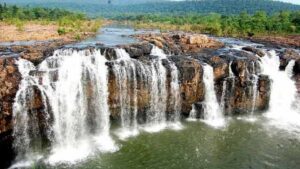 The Bogatha Waterfall is situated 120 km from Bhadrachalam and 329 km from Hyderabad. It is often called the “Niagara of Telangana” and is renowned as the second-largest waterfall in the state. The falls are set against a picturesque backdrop of lush, green, rocky terrain that creates an awe-inspiring scene. Because there is no road leading directly to the site, visitors must hike for a short distance to reach the falls, making it a good destination for trekking and adventure enthusiasts. The construction of the Eturnagaram Bridge on National Highway 202 has significantly reduced travel times to this remote waterfall, making it more accessible than in years past.
Laknavaram Lake
 70 km away from Warangal, in Govindaraopet Mandal, lies the pristine and picturesque Laknavaram Lake, a water body that is ensconced in forested hills. This spectacular water body was discovered and expanded in the 13th century A.D. by the Kakatiya dynasty, serving as a crucial irrigation source and part of their watershed command. The lake achieved its current size only after three narrow valleys were dammed in the ways that still serve today. Nature provided the Kakatiya engineers with necessary topographic advantages: the valleys and hills act as completely natural dam walls. Visitors to the lake nowadays can find a number of attractions, including some mini-islands that are best reached by the suspension bridge that is a lake visit in itself.
Hemachala Lakshmi Narasimha Swamy Temple
Ninety kilometers from Bhadrachalam and 130 km from Warangal, this ancient temple sits deep in the forest, adding to its mystical allure. The main deity, or Moolavirat, of Sri Lakshmi Narasimha Swamy is an astonishing 10 feet tall, with a belly that is soft to the touch, and might make one wonder whether anyone else but God could pull off such a prank. But it gets better. The temple’s flagstaff is 60 feet high, which ought to make it plain for all and sundry that this is one impressive place. Ugra Anjaneya Swamy is said to be the rock-formed insignia of this temple, the first of its kind in South India, believed to date back to the Ramayana and to have His name because He is FIERCE (Ugra). Añjal (hands folded in prayer) is what makes this image of Anjaneya so special. And the water near the temple doesn’t just flow—it gushes out, creating a natural swimming pool that looks like someone dropped the Spanish Influenza during some reconstruction of the Grand Hotel.
Medaram Jathara – The Largest Tribal Festival in India
 The largest tribal festival in India, Medaram Jathara, also known as Sammakka Saralamma Jathara, takes place in Medaram, Tadvai Mandal, in the Mulugu district. Millions of people gather there to honor the ancient tribal goddesses Sammakka and Saralamma—two women who fought an oppressive ruler to protect their people. Over 10 million people attended the festival in 2012, and it has been estimated that this recent figure could be closer to 20 million. The festival occurs biennially during the month of February and has a unique format that connects the participants to nature through the event’s deep association with the Eturnagaram Wildlife Sanctuary and Dandakaranya forest belt. This event is a remarkable celebration where the local tribal community and millions of its friends pay homage to the goddesses in a rich explosion of allegorical stories, songs, dance, and drumming.
Jampanna Vagu – A Tributary with a Story of Sacrifice
The Godavari River has tributaries. One of them is Jampanna Vagu, which is tied closely to tribal folklore. A story is told about a man named Jampanna, who was the son of a goddess called Sammakka. He was a kind of local hero, and he died while fighting the Kakatiya rulers. The people say that when Jampanna fell in battle, the water in the stream ran red with the blood of this son of a goddess. Devotees of the Medaram goddess come to the stream on pilgrimage. A bridge has taken the place of the former wooden pathway that led to the stream. Nevertheless, the stream remains a sacred spot where people go to honor the gods and bid a good life to the spirits of their ancestors.
Ramappa Temple – A UNESCO World Heritage Site
 The Palampet Ramappa Temple represents some of the finest Kakatiya architecture. Built in the 13th century A.D. under the reign of the Kakatiya King Ganapati Deva, this temple was constructed with the most refined materials and is dedicated to the worship of Lord Shiva. No place is it more evident than here that the Kakatiyas were not just great conquerors but also remarkable patrons of Shiva and of temple architecture. What makes the temple so visually stunning are the multitude of intricately carved stone pillars and above all, the profusion of almost life-sized sculptures both inside and outside the temple, many of which are probably meant to represent the Shiva’s celestial retinue of Ganas.
