
Gussadi Dance

Gussadi dance is performed by the men of the Gond tribe in Adilabad district. It is an important cultural expression conducted before Deepavali, starting from Ashwayuja Shuddha Pournami till Ashwayuja Bahula Chaturdasi. The performers dress in colorful costumes, wear ornaments, and travel in troupes to neighboring villages, singing and dancing. A troupe typically consists of 15 to 20 members, known as Dandari troupes. From these large troupes, five members from each group form Gussadi troupes. The dancers wear elaborate costumes, including peacock feather turbans (Mal Boora/Maljilina Cap), deer horns, artificial mustaches, and beards. They also apply ash all over their bodies and carry Gussadi Rokhhari. This dance is prominently performed during the Nagoba Jatara.
Dhemsa Dance
Dhemsa dance is a traditional folk dance performed by both males and females of the Raj Gond clan. It is primarily danced during festivals and marriages, following the rhythm of traditional music. The musical instruments used in this performance include Pepre, Dhol, Kalikom, and Tamak.
Koya Dance (Bison-Horn Dance or Permakoki Play)
Koya dance, also known as the Bison-Horn Dance, is performed by the Koya tribe during festivals and marriages. Male dancers wear colorful costumes and large bison-horn headgears, making the performance visually striking. This dance is commonly seen in the tribal regions of Warangal and Khammam and is a significant part of the Sammakka-Sarakka Jatara in the Mulugu region. The dance is performed by both men and women, with a troupe consisting of 30 to 40 members, and is also referred to as Dorala Sattam.
Kurru Dance
Kurru dance is performed by the males of the Koya tribe in Warangal district. This dance is mainly associated with the Sammakka-Sarakka Jatara, a prominent tribal festival in Telangana.
Lambadi Dance
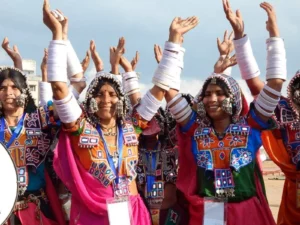 Lambadi dance is performed by Banjara women, inspired by planting, sowing, and harvesting activities. The dance movements reflect the daily agricultural tasks of the Banjaras. It is commonly performed during marriages, Teej festival, Holi, and Sankranthi. During Holi, Banjara women form a circle around the Kamudi Manta (burning of Kama) and dance while holding hands in synchronization with the music.
Mango Dance of Konda Reddy’s
The Konda Reddy/Bison Reddy tribe in Khammam district performs the Mango Dance as part of a ceremonial festival before plucking mangoes. The dance is dedicated to Mutyalamma and Konda Devatha, and is performed in groups with rhythmic beats played on the Dappu musical instrument.
Goravayya Dance
Goravayya dance is performed by Golla caste members at Inavolu Mallanna temple (Warangal) and Komaravelli Mallanna temple (Siddipet). The dancers wear blankets (Kambali/Gongadi), and a member of the Kuruma family is chosen as Goravayya. The Goravayya dancer carries a deer-skin bag (Bandaru) filled with turmeric, dances with a Dhamarukam in one hand and Kambali in the other, and wears a necklace made of small shells. Uniquely, during this dance, performers bark like dogs, calling themselves “Lord Mallanna’s Dogs”, and after the performance, they lick and drink milk like a dog.
Siddi Dance (Khadga Nrityam)
Siddi dance is performed using weapon tools and is a traditional dance of the Siddi community, whose ancestors migrated from Abysinia (Africa) to Hyderabad. In Hyderabad, the Siddi community performs this dance during festivals and marriages, which resembles Sword Fight (Kathi Samu). The performers wear desi-style attire and wield swords, creating an energetic and fierce performance.
Garaga Dance
Garaga dance involves balancing a clay pot (Ghatam) on the head while performing rhythmic dance movements. This dance is a significant part of the Bonalu festival in Telangana.
Perini Sivatandavam
Perini Sivatandavam is an ancient warrior dance dedicated to Lord Shiva. It is performed in front of Nataraja statues or inside Shiva temples. This dance was traditionally performed by soldiers before heading to battle to invoke Shiva’s blessings and strength. It is a historically significant dance from Warangal, revived by Nataraja Ramakrishna.
Veera Natyam (Heroic Dance)
Veera Natyam is a heroic dance form performed in Veerabhadra temples at Korivi and Kothakonda in Telangana. It is associated with Lord Shiva and performed by Verra Mushti, Jangams, Balijas, and Devangas. The dance is a key attraction during the Shivaratri festival, symbolizing Shiva’s cosmic energy.
Dappu Natyam
Dappu Natyam is a high-energy percussion-based dance performed using Dappu drums, made from animal hides and beaten with sticks. The dance is performed by 15-20 members in a group, wearing anklet bells, and is typically seen during processions and feasts.
Chindu Bhagavatam
Chindu Bhagavatam is a folk theatrical art performed by the Madiga community, blending music, storytelling, and dance. This performance is known for its leaps, jumps, and humorous dialogues, often depicting stories from Hindu Puranas and Ithihasas. The Dakkali caste, dependent on the Madiga community, primarily performs this art, with the Jamba Puranam play being one of their major performances.
Chindu Yellamma
Chindu Yellamma, originally named Saraswati, was born in 1923 in Basara and became a legendary performer of Yakshaganam and Chindu Bhagavatam. She was known for her ability to transform her expressions from a delicate woman into a ferocious Narasimha Swamy, captivating audiences. She earned recognition from Nataraja Ramakrishna and other prominent artists.
