

Bonalu: The Grand Festival of Goddess Mahakali
Bonalu is a major Hindu festival celebrated in the Indian state of Telangana, especially in the capital city of Hyderabad and its twin city Secunderabad. It is dedicated to the worship of Goddess Mahakali, and it has been observed as an annual tradition that dates back over a century. The festival is normally held in July or August, coinciding with the lunar month of Ashada. Devotees engage in a series of rituals to offer prayers and express their thanks to the Goddess for making their wishes come true.
Women prepare a special meal during Bonalu. It consists of rice, milk, and jaggery, cooked in a new earthen or brass pot. The pot is decorated with neem leaves, turmeric, and vermilion, and a lit lamp is placed on top. Women carry these pots on their heads in a grand procession to the temple, where they offer Bonam, along with bangles and sarees, to the Mother Goddess. The festival also entails the worship of multiple forms of Kali, including Mysamma, Pochamma, Yellamma, Dokkalamma, Pedamma, Poleramma, Ankalamma, Maremma, and Nookalamma.
The Origin of Bonalu
The auspicious festival of Bonalu is celebrated in Telangana, especially in the twin cities of Hyderabad and Secunderabad. It is a festival dedicated to the worship of Goddess Mahakali, who is believed to be the presiding deity of the Jagadamba Shakti Peethams (Shakti shrines) throughout the world. The festival is celebrated in honor of the presiding deity of the Mahakali Temple in Secunderabad. Devotees believe that offering Bonalu during the month of Ashad (July-August) to the goddess will bring them good fortune. Celebrating Bonalu is a way for the local populace to both exorcise evil spirits and seek blessings from the goddess for prospective good fortune. The origins of the festival remain somewhat murky.
The Rituals of Bonalu
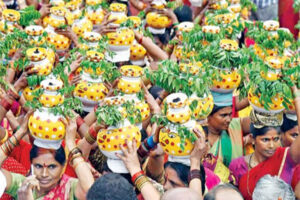 The festival of Bonalu is celebrated throughout the city of Hyderabad over three consecutive Sundays. These street festivities commence at the Golconda Fort on the first Sunday of Ashadam; at the Ujjaini Mahakali Temple in Secunderabad and the Balkampet Yellamma Temple on the second Sunday; and at the Pochamma and Katta Maisamma Temple near Chilkalguda and the Matheshwari Temple at Lal Darwaza in Old City, Hyderabad, on the third Sunday. Also, the Bonalu festival is carried out at the Akkanna Madanna Temple in Haribowli and at the Muthyalamma Temple in Shah Ali Banda.
Ladies wear traditional sarees and adorn themselves with jewelry, while young girls wear half-sarees, the very essence of traditional and graceful femininity. While in procession, some of the ladies go into a trance, dancing and balancing pots on their heads, to the beat of the drums. They are believed to be possessed by the Goddess, and water is sprinkled on their feet to soothe the spirit whose possession can make a person a bit too aggressive. And as devotees of the fair lady make their way through the streets, they offer up Thottelu, small, colorful structures made of paper and mounted on sticks, as gifts to the Goddess.
Pothuraju: The Protector of Bonalu
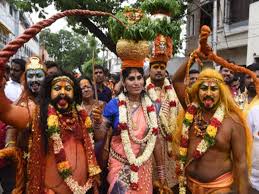 A distinctive aspect of celebrating Bonalu is the presence of Pothuraju, the divine brother of the Mother Goddess. He is portrayed by a half-naked, muscular man who wears a tight red dhoti, has anklets that jingle like tambourines, and a torso that is painted with turmeric. The man who plays Pothuraju is hardly a silent figure; he leads the procession with maximum energy and enthusiasm, his power dance almost drowning out the sounds of the drums that accompany the Palaharam Bandi.
The Feast and Family Celebrations
Bonalu is a festival that contains not just delightful religious offerings but also grand family feasts. The special meal offered to the Goddess is shared among family members and guests, and it’s not at all unusual for the family to be hosting several different kinds of parties for the occasion. Bonalu is a big event, and part of what makes it so delightful is the huge variety of foods served.
Rangam:
 Bonalu’s ritual of Rangam performed the morning after the festival is absolutely spellbinding. A woman invokes the spirit of Goddess Mahakali and enters a trance, predicting the events of the upcoming year. This is what happens. Devotees come and gather around to listen. She stands before the crowd, her body shivering, undulating in a serpent-like fashion, as the goddess takes over her mind. Then, the writhing woman gives out the predictions. She prophesies about the fortune of the devotees in his or her near future, and, in her2511 grandmotherly way, she says that these prophecies will hold not only for the individuals who have consulted the goddess, but also for the community at large. She foretells what will happen in the areas of agriculture and husbandry, the weather, and more terminally, what will happen to the health and well-being of the community.
Ghatam: The Sacred Procession
The Ghatam is a copper pot shaped in the form of the Mother Goddess and carried by a priest in traditional dress. For the length of the festival, the priest leads a procession with the Ghatam, accompanied by drums and the singing of devotees. The Akkanna Madanna Temple in Haribowli is known for leading the grand Ghatam procession. The Ghatam is placed on an elephant and accompanied by horses, signifying the royal honor given to the Goddess. On the final day, the Ghatam is immersed in a river, at Nayapul, marking the conclusion of the Bonalu festival.
