
The Bactrians
- Bactria and Parthia became independent from the Syrian empire in the middle of the third century B.C. Demetrius, the Greek ruler of Bactria invaded Afghanistan and Punjab and occupied them.
- From Taxila, he sent two of his commanders, Appolodotus and Menander for further conquests. Appolodotus conquered the Sindh and marched up to Ujjain. Menander extended his rule up to Mathura and from there he made attempts to capture Pataliputra. But he was stopped by the army of Vasumitra, the grandson of Pushyamitra Sunga.
- Menander was also known as Milinda and the capital of his kingdom was Sakala (Sialcot). He evinced much interest in Buddhism and his dialogues with the Buddhist monk Nagasena was compiled in the Pali work, Milindapanho (Questions of Milinda).
- He also embraced Buddhism. A Greek ambassador Heliodorus became a Vaishnavite and erected the Garuda Pillar at Besnagar.The Greek influence in India lasted for more than a century after the death Menander.
The Shakas
- Shaka is the Indian term used for the people called Scythians, who originally belonged to central Asia. Defeated by their neighbours the Yueh-chis (the tribal stock to which the Kushanas belonged) they gradually came to settle in northwestern India around Taxila in the first century B.C Under the successive Shaka rulers their territories extended up to Mathura and Gujarat.
- The most famous of all the Shaka rulers was Rudradaman who ruled in the middle of second century AD. His empire was spread over almost whole of western India. His achievements are known through the only inscription that he got engraved on a boulder at Girnar or Junagarh. This inscription happens to be the first royal inscription of early India composed in chaste Sanskrit.
The Parthians
- The Parthians were of Iranian origin and because of strong cultural connection with the Shakas, these groups were referred to in the Indian sources as Shaka-Pahlava.
- The important inscription indicating the Parthian rule in northwestern area of Pakistan is the famous Takht-i-Bahi inscription recovered from Mardan near Peshawar. The inscription, dated in 45 AD, refers to Gondophernes or Gondophares as a Parthian ruler. Some literary sources associate him with St. Thomas, who is said to have converted both, the king and his brother, to Christianity.
The Kushanas
- The Kushanas, originally belonged to western China. They are also called Yueh-chis. The Kushanas after defeating Shakas and Pahlavas created a big empire in Pakistan.
- The founder of the Kushana dynasty was Kujula Kadphises or Kadphises I. He occupied the Kabul valley and issued coins in his name. His son Wima Kadphises or Kadphises II conquered the whole of northwestern India as far as Mathura. He issued gold coins with high-sounding titles like the ‘Lord of the Whole World’. He was a devotee of Lord Siva.
Kanishka (78 – 120 A.D.)
- Kanishka was the most important ruler of the Kushana dynasty. He was the founder of the Saka era which starts from 78 A.D.
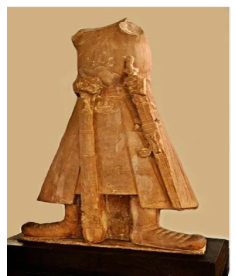 He was not only a great conqueror but also a patron of religion and art.
 - At the time of his accession, Afghanistan, Gandhara, Sind, and Punjab were all parts of his empire. He afterwards took control of Magadha and further consolidated his hold on Pataliputra and Bodh Gaya. Kalhana claimed that Kanishka occupied Kashmir after invading it. Since his coinage have been discovered in numerous locations, including Mathura, Sravasti, Kausambi, and Benares, he could have controlled the majority of the Gangetic plain.
- Polity and Administration
- The whole empire was divided into provinces, each ruled by a mahakshatrapa ( a military governor), who was assisted by a kshatrapa. Sources indicate that Kushana horsemen wore trousers while riding. A headless statue of Kanishka found at Mathura reflects the same. A prominent feature of Kushana polity was the title of devaputra, i.e., son of God, used by the Kushana kings. It indicates the claim to divinity by the Kushana kings.
- The empire of Kanishka was a vast one extending from Gandhara in the west to Benares in the east, and from Kashmir in the north to Malwa in the south. His capital was Purushapura or modern day Peshawar. Mathura was another important city in his empire.
