THE AGE OF THE SATAVAHANAS
- Satavahana empire in 220 B.C. is an important mile-stone in the history of the Deccan. Before the foundation of the Satavahana empire, the Deccan was covered with a large number of petty kingdoms, which were often at war with one another. The Satavahanas for the first time wielded the Deccan into a powerful State and gave a cohesion and integrity to its history. Satavahanas are also known as the Andhras in the Puranas.
- The term “Satvahana” originated from the Prakrit which means ” driven by seven” which is an implication of the Sun God’s chariot that is driven by seven horses as per Hindu mythology. The first king of the Satavahana dynasty was Simuka.
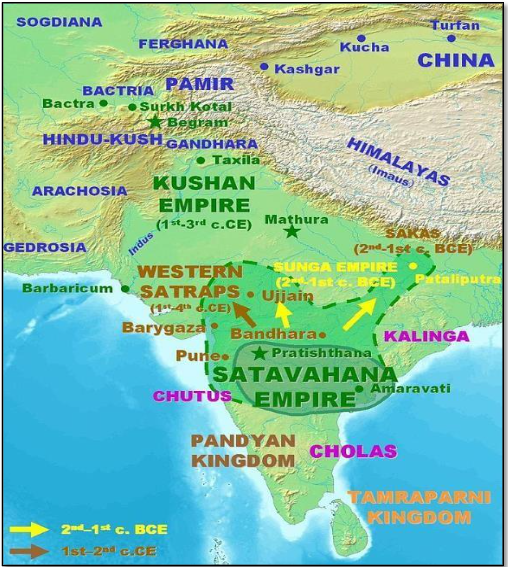
- Present-day Andhra Pradesh, Maharashtra, and Telangana made up the majority of the Satavahana monarchy. At times, their rule also included parts of Gujarat, Karnataka as well as Madhya Pradesh. The capital of the kingdom changed over time. Amaravati and Pratishthana (Paithan) were the two capitals of the empire.
- The Satavahana kingdom primarily included the regions of present-day Andhra Pradesh, Maharashtra, and Telangana. At various times, their rule also extended to parts of Gujarat, Karnataka, and Madhya Pradesh. The Satavahanas were Brahmanas who worshipped deities such as Vasudeva Krishna.
- Despite not being a matriarchal or matrilineal society, Satavahana kings often used matronyms, such as Gautamiputra and Vaishishthiputra, in their names. They adopted the title “Dakshinapatha Pati,” meaning “Lord of Dakshinapatha.”
- The Satavahanas originally appear to have been a tribe from the Deccan region. However, they became highly Brahmanized and claimed to be Brahmanas. The most renowned Satavahana king, Gautamiputra, asserted his Brahman status and saw it as his duty to uphold the four-fold varna system.
- The Satavahanas were pioneers in making land grants to Brahmanas, and there are also records of grants made to Buddhist monks, particularly those of the Mahayana tradition. Under the Satavahanas and their successors, the Ikshvakus, significant Buddhist sites developed in regions such as Nagarjunakonda and Amravati in Andhra Pradesh, and Nasik and Junar in Maharashtra.

