
Pushyabhutis
- The founder of the Vardhana dynasty was Pushyabhuti who ruled from Thaneswar. He served as a military general under the imperial Guptas and rose to power after the fall of the Guptas. With the accession of Prabakara Vardhana (580–605 CE), the Pushyabhuti family became strong and powerful. Rajavardhana (605-606 CE), the eldest son of Prabhakaravardhana, ascended the throne after his father’s death. He was treacherously murdered by Sasanka, the Gauda ruler of Bengal. This resulted in his younger brother Harshavardhana becoming the king of Thanesar.
Harsha’s Military Conquests
- In his first expedition, Harsha drove out Sasanka from Kanauj. He made Kanauj his new capital. This made him the most powerful
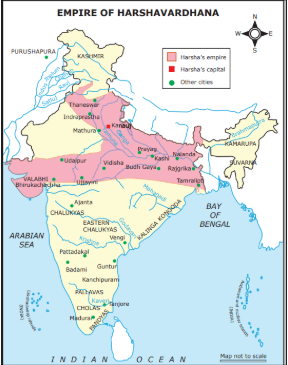 ruler of north India The most important military campaign of Harsha was against the Western Chalukya ruler Pulakesin II. Both the accounts of Hiuen Tsang and the inscriptions of Pulakesin II provide the details of this campaign. Harsha established his control over Kashmir and its ruler sent tributes to him. He also maintained cordial relations with Bhaskaravarman, the ruler of Assam. Harsha’s last military campaign was against the kingdom of Kalinga in Orissa and it was a success.
 - Thus Harsha established his hold over the whole of north India. The regions modern Rajasthan, Punjab, Uttar Pradesh, Bihar and Orissa were under his direct control.
Administration
- Harsha’s administration was structured similarly to that of the Guptas. Hiuen Tsang provides a detailed image of this.
- administration and prompt in his duties. Throughout his domain, he made frequent inspection visits. For him, the day was too short. Taxation was also minimal, and forced labor was uncommon. Land tax was levied on one-sixth of the production. Cruel punishments from the Mauryan period persisted during Harsha’s reign. The trials, according to Hiuen Tsang, were barbaric and superstitious. Harsha’s army was divided into four divisions: foot, horse, chariot, and elephant. The cavalry numbered over a lakh, while the elephants were more than sixty thousands.
