
- The first ruler of the Gupta Empire was Sri Gupta (240–280 CE) who was succeeded by his son Ghatotkacha (280–319 CE). Both Sri Gupta and Ghatotkacha are mentioned as Maharajas in inscriptions.
Chandragupta I (320 – 330 A.D.)
- Chandragupta I, the son of Ghatotkacha, ruled from 319 to 335 CE and is considered to be the first great king of the Gupta Empire. Chandragupta held the title of maharajaadhiraja (great king over other kings). He strengthened his position by a matrimonial alliance with the Licchavis. He married Kumaradevi, a princess of that family. This added to the power and prestige of the Gupta family.
Samudragupta (330-380 A.D.)
- Samudragupta was the greatest of the rulers of the Gupta dynasty. The Allahabad Pillar inscription provides a detailed account of his reign. It refers to three stages in his military campaign:
- Against some rulers of North India
- His famous Dakshinapatha expedition against South Indian rulers
- A second campaign against some other rulers of North India.
- After these military victories, Samudragupta performed the asvamedha sacrifice. He issued gold and silver coins with the legend ‘restorer of the asvamedha’. It is because of his military achievements Samudragupta was hailed as ‘Indian Napoleon’.
- Samudragupta patronised scholars and poets like Harisena and thus promoted Sanskrit literature. Though an ardent follower of Vaishnavism, he also patronised the great Buddhist scholar Vasubandhu. As a lover of poetry and music, he was given the title “Kaviraja”. His coins bear the insignia of him playing the vina.
Extant of Samudragupta’s Empire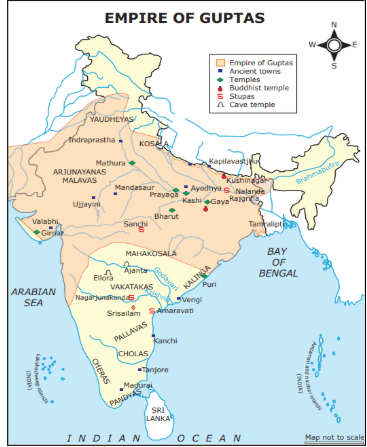
- Samudragupta’s authority gradually extended the upper Gangetic valley, the majority of modern-day Uttar Pradesh, a significant portion of central India, and the southwest corner of Bengal. He had direct control over the administration of these areas. There were tributary states in the south. His sphere of power included the Saka and Kushana states in the west and northwest. His sovereignty was recognized by all of the Deccan’s eastern kingdoms, all the way to the Pallava Kingdom.
Chandragupta II (AD 375–414)
| Visit of Fahien
During the time of Chandragupta II Vikramaditya, a Chinese Buddhist monk named Fahien traveled to India. In the book Fu-Kuo-Ki, he wrote about his experiences. Fahien provides a thorough account of the Gupta Empire’s governance. He saw the Chandalas living apart, each pounding a wooden plank as a warning to others not to enter towns |
- Samudragupta was succeeded by his son Chandragupta II also known as Chandragupta Vikramaditya, he not only extended his father’s empire but also consolidated his position through matrimonial alliances with other royal dynasties of the period.
- He married Kuvernaga, the Naga princess and had a daughter Prabhavati from her. Prabhavati was given in marriage to Rudrasena II of the Vakataka dynasty ruling in Deccan.
- The control of Vakataka territory proved very beneficial to Chandragupta II, as he was now able to target his other enemies better. His greatest military achievement was his victory over the Shaka kings who were ruling in western India for the last three hundred years.
- This conquest made Gupta empire reach up to the western coast. An iron pillar inscription at Mehrauli in Delhi indicates that his empire included even north-western India and Bengal. He took the title of Vikramaditya i.e. the one who is as powerful as the sun.
- His court had nine jewels or navaratnas, that is, nine eminent people in various fields of art, literature and science. This included the great Sanskrit poet Kalidasa, the Sanskrit scholar Harisena, the lexicographer Amarasimha, and the physician Dhanvantari. Fahien, the Buddhist scholar from China, visited India during his reign. He records the prosperity of the Gupta Empire. Chandragupta II was the first Gupta ruler to issue silver coins. His rule thus formed the peak period of Gupta’s territorial expansion.
Kumargupta I (414 CE – 455 CE)
- The inscriptions at Karamdanda (Fyzabad), Mandsor (referring to the ruler of the entire globe), and Damodarpur (referring to the copper plate inscription as “Maharajadhiraj”) all mention King Kumaragupta I as the lord of four oceans.
- The inscription from Bilsad (Etah) also references Kumaragupta I.
- Ashwamedha yajna was performed by Kumaragupta I, who also adopted the titles Ashwamedha-Mahendra and Mahendraditya.
- Being a follower of Shiva himself, Kumargupta I produced coins in the style of Kartikeya that featured a peacock.
- Although there was a growing danger of the Hunas crossing Hindukush during Kumargupta I’s reign, overall calm prevailed.
- Nalanda University was founded during his rule.
Skandagupta (455 CE – 467 CE)
- During his lifetime, Skandgupta, the son of Kumargupta I, valiantly fought and vanquished the Hunas on the North-Western boundary.
- The inscription at Bhitari Pillar marks his victory over Pushyamitra.
- Got the Sudarshan Lake repaired (Junagadh inscription).
- After Skandagupta’s death in 467 CE, the empire was unable to be sustained by his inept heirs.
Decline of the empire
- Chandragupta II was succeeded by his son Kumara Gupta I, who founded the Nalanda University. He was also called Sakraditya. The last great king of the Gupta dynasty, Skanda Gupta, was the son of Kumara Gupta I. He was able to repulse an attack by the Huns, but the recurrence of Huns’ invasion strained his empire’s coffers. The Gupta Empire declined after the death of Skanda Gupta in 467 CE. He was followed by many successors who hastened the end of the Gupta Empire. The last recognised king of the Gupta line was Vishnu Gupta who reigned from 540 to 550 CE.
