
Introduction to Harappan Town Planning
The town planning of the Harappan Civilization is a remarkable example of ancient urban engineering and organization. This early Bronze Age civilization, flourishing between 2600 BCE and 1900 BCE, developed an intricate system of city layout, infrastructure, and public utilities, far ahead of its time. Unlike the monumental architecture seen in Egypt or Mesopotamia, Harappan urbanism focused on functionality, hygiene, and standardization.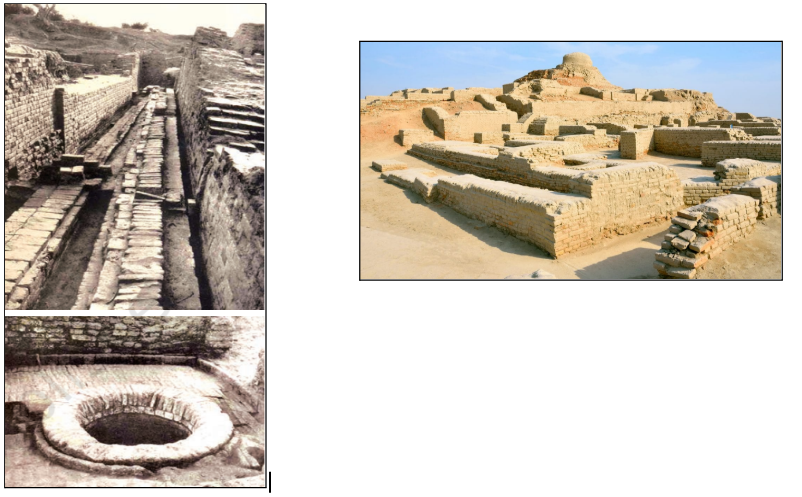
Grid Pattern and Street Layout
Harappan cities were laid out on a well-defined rectangular grid pattern, with streets running in north-south and east-west directions, intersecting at right angles. This planning created neatly divided rectangular blocks, ensuring smooth traffic movement and logical spatial distribution. Streets were wide and often connected by narrower lanes, and doors of houses typically opened onto these side lanes rather than the main roads. Some streets were as wide as 10 meters, demonstrating an advanced understanding of urban flow and spatial design.
Division of City: Citadel and Lower Town
Each Harappan city was broadly divided into two parts: the Citadel and the Lower Town. The Citadel, located on an elevated mud-brick platform in the western part of the city, housed important structures such as granaries, administrative buildings, and ritualistic complexes. It was likely occupied by the ruling elite or used for public functions. The Lower Town, situated to the east and at a lower elevation, contained residential buildings made of baked bricks and was inhabited by the common people. This division reflects both social hierarchy and organized urban zoning.
Drainage and Sanitation System
One of the most outstanding features of Harappan town planning was its advanced drainage system. Every house was connected to covered drains that ran along the streets. These drains, made of bricks and sealed with stone slabs, were regularly spaced with inspection holes for maintenance. The use of materials like lime and gypsum in construction indicates a sophisticated understanding of waterproofing and sanitation. This urban sanitation model is unparalleled among contemporary ancient civilizations.
Building Materials and Standardization
Harappans used standardized bricks with a fixed ratio of 1:2:4 for thickness, width, and length. This uniformity extended to both residential and public structures, ensuring stability and efficient construction. While mud bricks were commonly used for houses, burnt bricks were used in drainage, granaries, and important buildings. Interestingly, there is a complete absence of stone structures, highlighting the unique architectural style of the civilization.
Residential Architecture and Urban Design
Harappan houses were typically built around a central courtyard, with multiple rooms, proper ventilation, private wells, and tiled bathrooms. Many houses were double-storied, suggesting advanced construction techniques. Most houses had no windows facing the street, which ensured privacy and security. The presence of bathrooms connected to drainage systems indicates the importance given to personal hygiene and water management.
Key Public Structures: The Great Bath and Granaries
The Great Bath at Mohenjo-Daro is among the most iconic Harappan structures. It was a large, watertight tank built with gypsum mortar and burnt bricks, likely used for ritualistic bathing. Surrounding rooms and staircases on both ends added to its functionality. Granaries, discovered in cities like Harappa and Kalibangan, were built with air ducts for ventilation and thick walls for storage efficiency. These public buildings emphasize the organized economic and religious life of the people.
Water Management and Wells
Harappan cities had numerous wells, water tanks, and stormwater drains. The city of Dholavira stands out for its sophisticated water reservoir system, which included large tanks, check dams, and channelized stormwater collection. These systems ensured a regular water supply even in semi-arid regions and highlight the civilization’s capability in sustainable water management.
Commercial Zones and Economic Planning
Designated commercial areas existed within Harappan cities where artisans, craftsmen, and traders operated. Evidence from sites like Chanhudaro and Lothal suggests the presence of specialized workshops such as bead-making units, pottery kilns, and bread-making shops. This points to a well-organized urban economy with functional zoning of economic activities.
Maritime Infrastructure: Lothal Dockyard
The city of Lothal features the earliest known dockyard in human history, located along the Sabarmati River. The structure reflects deep understanding of tidal movements, hydraulics, and marine engineering. Lothal was a major center for maritime trade and is considered one of the finest examples of Indus Valley maritime infrastructure.
Uniformity Across Cities
A notable aspect of Harappan urbanism is the uniformity observed across different cities. Whether it was the grid layout, drainage system, brick size, or architectural style, there was a remarkable degree of consistency. This indicates the presence of a centralized planning authority or shared cultural norms, suggesting a high level of administrative control and communication among settlements.
Influence on Modern Urbanization
The legacy of Harappan town planning is evident in modern urban development. Features like zoning, grid-based layouts, sanitation infrastructure, and use of standardized construction materials reflect the influence of Harappan practices. Cities like Chandigarh, designed in modern times, show striking similarities in urban organization. The emphasis on public spaces such as the Great Bath also finds echoes in today’s city planning.
Q. The ancient civilisation in the Indian sub-continent differed from those of Egypt, Mesopotamia and Greece in that its culture and traditions have been preserved without a breakdown to the present day. Comment. (UPSC Mains 2015)
Q. Which one of the following is not a Harappan site?
(UPSC Prelims 2019)
(a) Chanhudaro
(b) Kot Diji
(c) Sohgaura
(d) Desalpur
Answer: (c)
