
Harappan Civilization
- The Indus Valley Civilization flourished between 2600 BC and 1900 BC on the banks of the river Indus. This is also called Harappan Civilization after the first city to be excavated, Harappa (Punjab, Pakistan). The Indus Valley was home to the largest of the four ancient urban civilizations of Egypt, Mesopotamia, India and China.
- The abundance of sculptures, seals, pottery, jewelry, and other artifacts discovered at the excavation sites were a defining characteristic of this ancient civilization.
- One of the earliest and best examples of urban civic planning can be found at the two main sites of this civilization, Harappa and Mohenjo-daro.
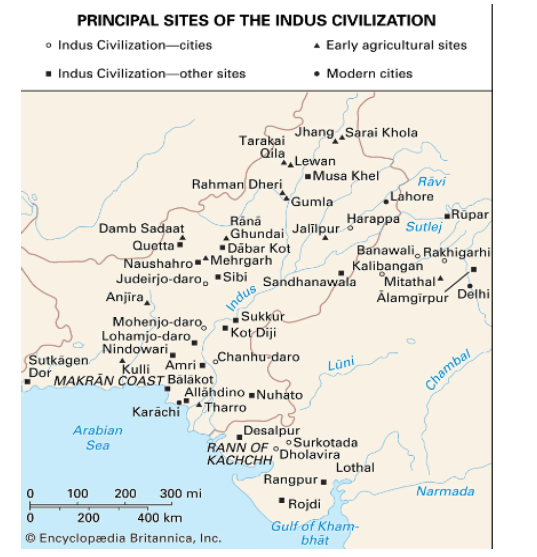
Q. Indus Valley civilization was spread over (1985) UPSC
(a) Baluchistan, Sind, Punjab and Rajasthan
(b) Sind, Punjab and Kashmir
(c) Afghanistan, Sind, Punjab, Rajasthan, Gujarat and Kashmir
(d) None of these
ANSWER: A
Q. Consider the following pairs: (UPSC 2021)
| No. | Historical Place | Well-known For |
|---|---|---|
| 1 | Burzahom | Rock-cut shrines |
| 2 | Chandraketugarh | Terracotta art |
| 3 | Ganeshwar | Copper artefacts |
Which of the pairs given above is/are correctly matched?
(a) 1 only
(b) 1 and 2
(c) 3 only
(d) 2 and 3
Correct: D
Q. To what extent has the urban planning and culture of the Indus Valley Civilization provided inputs to the present day urbanization? Discuss. UPSC (2014)
