

Urbanization in India
Urbanization is the process by which populations shift from rural to urban areas, leading to a decrease in the proportion of people living in rural areas and a corresponding increase in urban populations. This phenomenon is accompanied by significant changes in how societies adapt to these demographic shifts.
Causes of Urbanization
Natural Increase of Population:
- Definition:Happens when the birth rate surpasses the death rate within a population.
- Impact: This leads to an overall increase in population, contributing to urban growth as more people move to cities in search of better opportunities.
Rural to Urban Migration:
- Pull Factors: These are aspects of urban areas that attract people, including:
- Employment Opportunities: Greater job prospects in various sectors.
- Educational Institutions: Better access to educational facilities and institutions.
- Urban Lifestyle: Modern amenities, improved living standards, and enhanced quality of life.
- Push Factors: These are conditions in rural areas that drive people to migrate, including:
- Poor Living Conditions: Lack of basic infrastructure and services.
- Lack of Educational and Economic Opportunities: Limited access to quality education and job prospects.
 Poor Health Care Facilities: Inadequate health services in rural areas.
Global Urbanization Trends
- Northern America: 82% urbanized (as of 2018).
- Latin America and the Caribbean: 81% urbanized.
- Europe: 74% urbanized.
- Oceania: 68% urbanized.
- Asia: Approximately 50% urbanized.
- Africa: 43% urbanized, with the majority remaining rural.
Urbanization in India
Urbanization Prospects:
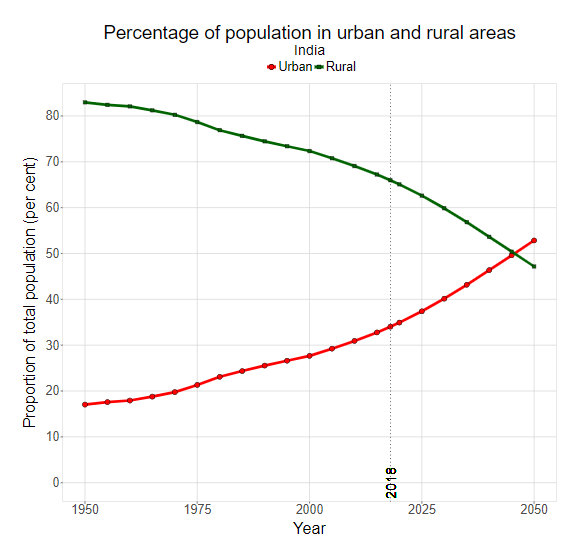
- Future Growth: The 2018 World Urbanization Prospects report by UN DESA predicts that the expansion of the global urban population will primarily be concentrated in a few countries, particularly India, China, and Nigeria.
- Projected Urban Growth in India: By 2050, it is projected that India will add approximately 416 million urban dwellers.
Current Urbanization Statistics:
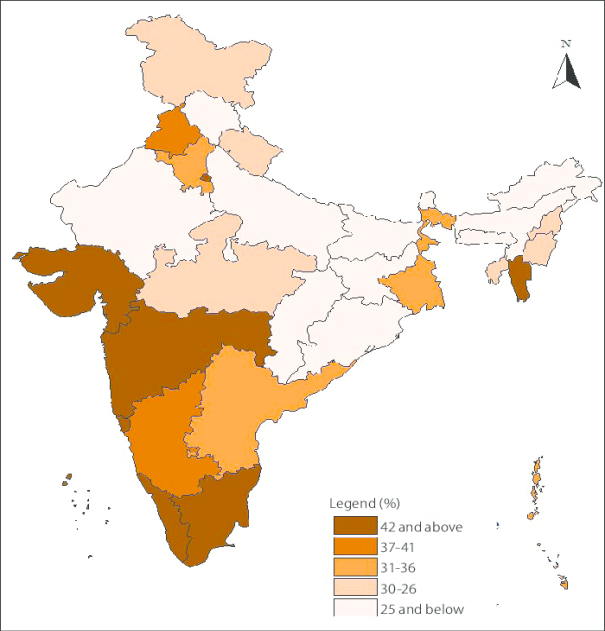
- Population (2011 Census): India’s population stood at 1.21 billion with an urbanization level of 31.1%.
State-Wise Urbanization Scenario:
High Urbanization States:
- Goa: Most urbanized state with 62.2% urban population.
- Tamil Nadu, Kerala, Maharashtra, and Gujarat: All have urbanization levels exceeding 40%.
- Mizoram: Highest urbanization rate among North-Eastern States at 51.5%.
Major Urban Population States:
- Maharashtra: Leads with 50.8 million urban residents, making up 13.5% of India’s urban population.
- Uttar Pradesh: 44.4 million urban residents.
- Tamil Nadu: 34.9 million urban residents.
Low Urbanization States:
- Bihar, Odisha, Assam: These states have urbanization levels below the national average.
Union Territories:
- NCT of Delhi: Most urbanized with 97.5% urban population.
- Chandigarh: 97.25% urbanized.
- Daman and Diu, Lakshadweep: Both above 75% urbanization.
Implications of Urbanization
- Economic Growth: Urban areas are key drivers of economic growth, contributing significantly to GDP and providing diverse employment opportunities.
- Infrastructure and Services: Rapid urbanization places pressure on infrastructure, necessitating improvements in transportation, housing, sanitation, and public services.
- Social Changes: Urbanization leads to changes in social structures and lifestyles, often resulting in increased social mobility but also potential challenges such as social stratification and increased inequality.
- Environmental Impact: Urbanization can lead to environmental challenges including increased pollution, loss of green spaces, and greater resource consumption.
- Planning and Development: Effective urban planning and development strategies are crucial to manage the growth and ensure sustainable development in urban areas.
India’s Global Commitments and Initiatives in Urban Development
Global Commitments:
- Sustainable Development Goals (SDGs) Goal 11:
- Objective: Encourages sustainable urban development to ensure cities and human settlements are inclusive, safe, resilient, and environmentally sustainable.
- Relevance: Encourages countries to adopt policies and practices that enhance the sustainability and resilience of urban areas.
- UN-Habitat’s New Urban Agenda (Habitat III, 2016):
- Principles: Focuses on principles for urban planning, construction, development, management, and improvement of urban areas.
- Recommendations: Emphasizes creating spatial conditions that enhance social, economic, and environmental value and well-being.
- Paris Agreement:
- India’s National Determined Contributions (NDCs): Aims to reduce emission intensity of GDP by 33% to 35% by 2030 from 2005 levels.
- Goal: Supports climate actions that contribute to sustainable urban development and reduce carbon footprints.
India’s Initiatives for Urbanization:
Schemes and Programs:
-
- Smart Cities Mission: To develop 100 smart cities across India by enhancing urban infrastructure, promoting sustainable practices, and improving quality of life.
- AMRUT Mission (Atal Mission for Rejuvenation and Urban Transformation):Aims to enhance the quality of life in urban areas by ensuring the availability of essential services such as water supply, sewerage systems, and urban transport infrastructure.
- Swachh Bharat Mission-Urban: Aims to achieve a Clean India by improving urban sanitation, waste management, and promoting cleanliness.
- HRIDAY (Heritage City Development and Augmentation Yojana): To preserve and revitalize the heritage cities by enhancing their infrastructure and ensuring sustainable development.
- Pradhan Mantri Awas Yojana-Urban (PMAY-U): To provide affordable housing for all by 2022 through the construction of new houses and the provision of subsidies for housing.
Government Initiatives for Slum Dwellers/Urban Poor:
-
- Pradhan Mantri Garib Kalyan Yojana: Provides financial and other support to the poor during economic distress, including subsidies and direct transfers.
- Atmanirbhar Bharat Abhiyan: Aims to boost the economy through self-reliance, including support for the urban poor and slum dwellers to become economically independent.
Significance of Urban Living:
Access to Facilities:
- Urban areas offer improved access to media and information channels, which can raise public awareness regarding health and social issues.
- Example: Increased awareness of family planning contributes to smaller family sizes and better health outcomes.
Access to Information:
-
- Urban areas provide better access to media and information sources, which can improve public awareness on health and social issues.
- Example: Enhanced family planning awareness leading to reduced family size and improved health outcomes.
Individualism:
- Urban settings offer greater opportunities for personal choice and career advancement due to increased social diversity and reduced familial control.
Issues Associated with Urbanization:
- Excessive Population Pressure: Slum formation, crime, unemployment, urban poverty, pollution, and congestion.
- Overflowing Slums:
- Statistics: Approximately 13.7 million slum households sheltering 65.49 million people.
- Issue: 65% of Indian cities have adjoining slums with highly congested living conditions.
- Inadequate Housing: Many urban households live in poor shelter conditions, often occupying single rooms with high occupancy rates.
- Unplanned Development: Results in inequality and poor infrastructure planning, exacerbating the divide between rich and poor.
- Pandemic-Induced Problems: COVID-19 lockdowns severely impacted slum dwellers’ livelihoods, highlighting the vulnerability of the urban poor.
- Non-Inclusive Welfare Schemes: Welfare schemes often fail to reach all intended beneficiaries, particularly those in unrecognized slum areas.
Way Forward:
- Sustainable Urbanization for Successful Development: Focus on managing urban growth sustainably, especially in low-income and rapidly urbanizing countries.
- Improving Access to Health Facilities & Welfare Schemes: Enhance the efficiency of welfare schemes and ensure access to health services, food security, and adequate shelter for the urban poor.
- New Approaches for Urbanization: Adopt innovative urban planning and governance methods. Emphasize bottom-up approaches to better understand and address the unique challenges faced by urban poor communities.
Previous year questions
Prelims
Q. The 2004 Tsunami made people realize that mangroves can serve as a reliable safety hedgeagainst coastal calamities. How do mangroves function as a safety hedge? (2011)
(a) The mangrove swamps separate the human settlements from the sea by a wide zone in which people neither live nor venture out.
(b) The mangroves provide both food and medicines which people are in need of after any natural disaster.
(c) The mangrove trees are tall with dense canopies and serve as an excellent shelter during a cyclone or Tsunami.
(d) The mangrove trees do not get uprooted by storms and tides because of their extensive roots.
Answer: d)
Mangroves act as a natural barrier against coastal calamities like tsunamis and cyclones due to their extensive root systems, which help stabilize the soil and dissipate wave energy. Their dense roots and vegetation slow down the force of incoming water, reducing the impact on inland areas. This makes them an effective natural defense mechanism against storms and tidal surges.
Q. In Mizoram, the settlement pattern is mostly of “linear type’ along the ridges, because (1993)
a) the valleys are cooler than the ridges
b) accessibility is easier on the ridge tops
c) the ridges are cooler than the valleys
d) the valleys are densely forested
Answer: b)
In Mizoram, the settlement pattern tends to be of a “linear type” along ridges primarily because ridge tops provide easier accessibility and construction compared to the densely forested and steep valleys. Building infrastructure like roads and settlements is more practical on the flatter, higher ridges, making them favorable for habitation.
Q. Consider the following statements about the megacities of India: (2000)
1) Population of each megacity is more than 5 million.
2) All the megacities are important sea ports.
3) Megacities are either national or State capitals.
Which of these statements are correct?
(a) 1, 2 and 3
(b) 1 and 2
(c) 2 and 3
(d) 1 and 3
Answer: d)
Megacities in India typically have populations exceeding 5 million people.While some megacities like Mumbai and Chennai are ports, others like Delhi are not.Most megacities are national or state capitals, though not exclusively sea ports.
Previous Year Mains
Q. What are the environmental implications of the reclamation of the water bodies into urban land use? Explain with examples.(2021)
Ans: Solution
| Introduction | The reclamation of water bodies into urban land use involves converting lakes, ponds, rivers, and wetlands into land for construction and other urban activities. This practice has significant environmental implications, often leading to adverse effects on ecosystems, biodiversity, and human well-being. |
| Body | 1. Loss of Biodiversity
2. Increased Flood Risk
3. Decreased Water Quality
4. Disruption of the Water Cycle
Loss of Ecosystem Services
Increased Urban Heat Island Effect Water bodies help moderate temperatures in urban areas by providing cooling effects. Reclaiming these areas for development increases the urban heat island effect, where urban regions become significantly warmer than their rural surroundings due to human activities and built environments. The reclamation of lakes and ponds in cities like Chennai, India, has contributed to rising temperatures and the urban heat island effect, making the city increasingly uncomfortable during the summer months. |
| Conclusion | The reclamation of water bodies into urban land use has profound environmental implications, including the loss of biodiversity, increased flood risk, decreased water quality, disruption of the water cycle, loss of ecosystem services, and the exacerbation of the urban heat island effect. These consequences highlight the need for sustainable urban planning practices that protect and integrate natural water bodies into the urban landscape. Efforts to restore and preserve these vital ecosystems are crucial for maintaining environmental balance and ensuring the well-being of urban populations. |
Q. “The ideal solution to depleting ground water resources in India is the water harvesting system”. How can it be made effective in urban areas?(2018)
Ans: Solution
| Introduction | By 2030, India’s water demand is projected to outstrip supply by twice the available amount, leading to severe water scarcity affecting hundreds of millions and potentially causing a 6% loss in GDP. Currently, around 75% of households lack drinking water at home, 84% of rural households do not have access to piped water, and 70% of the country’s water is contaminated. India ranks 120 out of 122 countries on the water quality index, underscoring a critical need for effective solutions. |
| Body | Solutions for Water Harvesting in India
|
| Conclusion | Effective implementation of water harvesting systems is crucial for conserving water and mitigating groundwater depletion. Collaboration between governments, local authorities, and individuals is essential for a sustainable water future. |
Q. With a brief background of the quality of urban life in India, introduce the objectives and strategy of the ‘Smart City Programme.’(2016)
Ans: Solution
| Introduction | The quality of urban life in India faces significant challenges, particularly in terms of infrastructure, sanitation, housing, and access to basic services. Rapid urbanization, without adequate planning, has resulted in overcrowded cities, insufficient public transport, poor waste management, and rising pollution levels. Slum dwellings, strained public amenities, and limited green spaces are common issues in urban areas. Additionally, many cities are grappling with deteriorating air quality and rising inequality. |
| Body | Objectives of the Smart City Programme
The Smart City Programme was designed with the following key objectives:
Strategy of the Smart City Programme
|
| Conclusion | The Smart City Programme represents a comprehensive attempt to address the multiple challenges facing India’s urban spaces. By focusing on infrastructure development, sustainability, technological advancements, and inclusivity, the initiative aims to improve the quality of life for urban residents. Successful implementation requires careful planning, strong citizen engagement, and collaboration between public and private stakeholders. |
Q. Smart cities in India cannot sustain without smart villages. Discuss this statement in the backdrop of rural urban integration.(2015)
Ans: Solution
| Introduction | India’s ambitious Smart Cities Mission aims to promote sustainable and inclusive cities that provide core infrastructure, a decent quality of life, and a clean and sustainable environment through the application of ‘smart’ solutions. However, the sustainable development of these smart cities is closely linked with the development of rural areas or ‘smart villages.’ This interdependence is crucial for achieving holistic urban-rural integration. |
| Body | 1. Economic Integration:
2. Technological and Infrastructural Spillovers:
3. Environmental and Resource Management:
4. Social Implications:
5. Policy Integration and Challenges:
|
| Conclusion | The concept of smart cities in India cannot be isolated from the broader socio-economic and environmental landscape of the country, which includes rural areas. For smart cities to be truly sustainable and effective, the development of smart villages is imperative. This integrated approach not only ensures the efficient use of resources but also fosters a balanced socio-economic development, preventing rural areas from being mere peripheries to urban centers. Thus, policies aimed at urban innovation should simultaneously address rural challenges, creating a synergy that benefits the entire spectrum of the population. |
