
Major East Flowing Rivers
East flowing rivers flow from west to east due to the natural gradient of the land and eventually drain into the Bay of Bengal.
- These rivers carry large amounts of sediment, leading to the formation of deltas on the eastern coast (while west-flowing rivers typically form estuaries).
Mahanadi
 Origin:
- Near Sihawa, Raipur district, Chhattisgarh
Course:
- Flows through Odisha and discharges into the Bay of Bengal
- Initially flows northward through Raipur district
- Shifts to an easterly direction, joined by Jonk and Hasdeo rivers before entering Odisha
- Enters the Bay of Bengal via several channels near Paradeep at False Point, Jagatsinghpur, Odisha
Length:
- Approximately 851 km
Drainage Basin:
- Shared by Maharashtra, Chhattisgarh, Jharkhand, and Odisha
Major Dam:
- Hirakud Dam (Located near Sambalpur, Odisha), the largest earthen dam in the world, constructed to control the river and mitigate flooding
Godavari
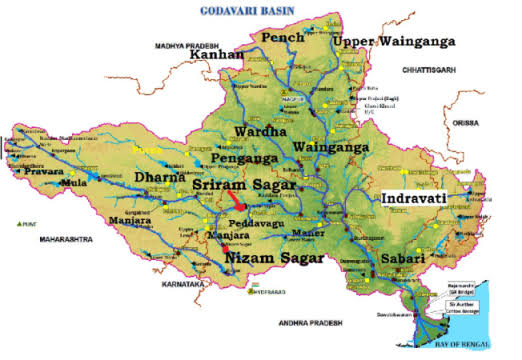
Significance:
- Largest Peninsular river system, Also known as the Dakshin Ganga (Ganga of the South)
Origin:
- Western Ghats, near Nashik, Maharashtra
Course:
- Flows eastwards into Telangana (Nizamabad district)
- Continues southeast, flows through a gap in the Eastern Ghats
- Crosses Andhra Pradesh
- After Rajahmundry, splits into several branches, forming a large delta along the Bay of Bengal coast
Delta:
- The delta, along with the Krishna river delta, is known as the Rice Granary of South India
Length:
- Approximately 1,465 km
Drainage Basin:
- Shared by Maharashtra, Madhya Pradesh, Chhattisgarh, Odisha, and Andhra Pradesh
Major Dam:
- Sir Arthur Thomas Cotton’s Dam: Constructed below Rajahmundry in Andhra Pradesh in the mid-19th century; first major irrigation project on the Godavari
Principal Tributaries:
- Penganga, Indravati, Pranhita, Manjra
Krishna
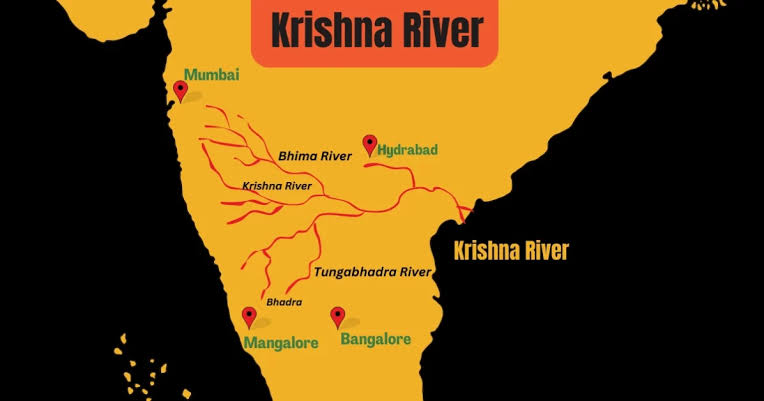 Origin:
- Near Mahabaleshwar, Sahyadri Range, Maharashtra
Course:
- Flows eastward and empties into the Bay of Bengal at Hamsaladeevi, near Koduru in Andhra Pradesh
Length:
- Approximately 1,401 km
Drainage Basin:
- Shared by Maharashtra, Karnataka, Andhra Pradesh, and Telangana
Important Tributaries:
- Tungabhadra, Dudhganga, Koyna, Ghatprabha, Musi, Bhima
Kaveri/Cauvery
Origin:
- Brahmagiri Range, Western Ghats, Kodagu district, Karnataka
Course:
- Flows through Karnataka and Tamil Nadu
Length:
- Approximately 800 km
Basin:
- Shared by Tamil Nadu, Karnataka, Kerala, and Puducherry
Significant Features:
- Shivasamudram Falls: Second biggest waterfall in India, located on the Kaveri River. The hydroelectric power generated here supplies Mysore, Bengaluru, and the Kolar Gold Fields.
Rainfall and Flow:
- Receives rainfall during summer monsoon, retreating monsoon, and winter monsoon. This ensures a steady flow throughout the year with comparatively less fluctuation than other Peninsular rivers.
Important Tributaries:
- Kabini, Bhavani, Amravati, Hemavati
East-Flowing Small Rivers
- Subarnarekha: Originates in Jharkhand, flows through Odisha and West Bengal before draining into the Bay of Bengal.
- Baitarani: Rises in Odisha and flows eastwards into the Bay of Bengal.
- Brahmani: Formed by the confluence of the Sankh and South Koel rivers in Odisha, flowing into the Bay of Bengal.
- Vamsadhara: Originates in Odisha, flows through Andhra Pradesh, and empties into the Bay of Bengal.
- Penner: Starts in Karnataka, flows through Andhra Pradesh into the Bay of Bengal.
- Palar: Originates in Karnataka and flows southeast through Tamil Nadu into the Bay of Bengal.
- Vaigai: Rises in the Western Ghats, flowing through Tamil Nadu before emptying into the Palk Strait.
