

Transport and recent developments
India boasts the world’s second-largest road network, stretching over 6.4 million kilometers and encompassing national and state highways as well as urban and rural roads. Investment in road infrastructure is crucial for ensuring connectivity to even the most remote areas. Every year, highways handle approximately 85% of passenger travel and 70% of freight transport, making them essential for short-distance travel.
Road Infrastructure in India
India’s reliance on pathways and unpaved roads dates back to ancient times. Over the years, advancements in technology and the economy have led to the construction of metalled roads and railways, facilitating the efficient movement of people and goods. Roads are now the primary mode of transportation, with the country’s road network being the most utilized for travel and freight.
Recent growth in road mobility has been driven by a rapidly expanding economy, increased vehicle ownership, and enhanced road connectivity. From 2001-02 to 2012-13, car registrations in India surged from 58.9 million to 182.4 million.
Despite this progress, there are challenges to address. The rise in personal vehicle use, especially in urban areas, has led to increased road congestion, longer travel times, and elevated levels of air and noise pollution. Public transportation also faces issues, with demand for buses significantly outstripping supply. In FY 2017, there was a need for about 340,000 buses, but only around 100,000 were available. Improving access to and the quality of public transportation remains a key priority.
Classification of Roads
The following categories are used to classify roads:
- National Highways
- State Highways
- District Roads
- Rural Roads
National Highways
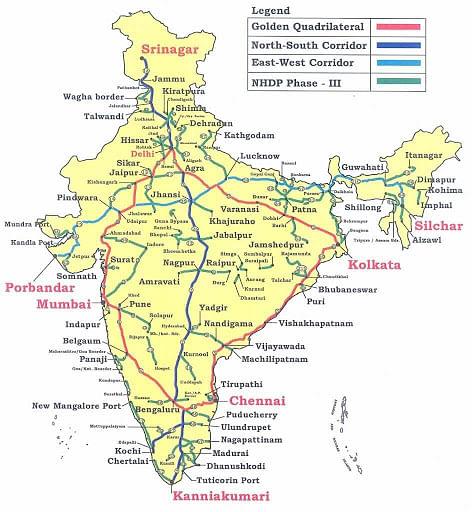 The National Highways are the main road networks constructed and managed by the central government.
- These routes are intended for inter-state transportation as well as the mobility of defense personnel and equipment in strategic locations.
- These highways connect state capitals, major cities, important ports, railway hubs, and other key locations.
- As of April 2019, India had a total of 142,126 kilometers (88,313 miles) of National Highways. Although they make up only 2% of the total road network, they handle 40% of the country’s traffic.
Golden Quadrilateral:
- This 5,846-kilometer high-density transport corridor links India’s four major metropolitan cities—Delhi, Mumbai, Chennai, and Kolkata. Its completion has significantly reduced travel time and costs between these key urban centers.
- North-South and East-West Corridors: The 4,076-kilometer North-South Corridor connects Srinagar in Jammu and Kashmir to Kanyakumari in Tamil Nadu, including the Kochi-Salem Spur. The 3,640-kilometer East-West Corridor links Silchar in Assam to Porbandar, a port city in Gujarat.
Important National Highways
| National Highway | Extension |
| NH-1 | Delhi-Amritsar |
| NH-2 | Delhi-Kolkata |
| NH-3 | Agra-Mumbai |
| NH-4 | Chennai-Thane |
| NH-5 | Chennai-Cuttack |
| NH-6 | Surat-Kolkata |
| NH-7 | Varanasi-kanyakumari |
| NH-8 | Delhi-Mumbai |
| NH-9 | Pune-Machlipatnam |
| NH-15 | Samakhali(kutch)-Pathankot |
State Highways
- State governments create and maintain these structures (PWDs). They connect state capitals with district headquarters and other significant cities.
- The National Highways are connected to these roads.
- These roads account for 4% of the country’s total road length.
| Name | Responsibility of | Connects |
| National Highways | Central Government | State capitals |
| State Highways | State Government | State Capital to District HQ |
| District roads | Zila Parishad | District HQ to tehsil and Blocks |
| Village roads | Gram Panchayat | Villages to neighbouring towns |
District Roads
- These highways connect district headquarters with other key locations within the district.
- They make up 14% of the country’s total road length.
Rural Roads
- Rural roads play a crucial role in linking remote communities.
- They make up nearly 80% of India’s overall road network. The density of these roads varies across regions due to differences in terrain.
- These roads are important for connecting rural communities
