

Overview of Population Distribution and Growth in India
India, the second-most populous country in the world after China, had a population of approximately 1.21 billion as of the 2011 Census. This population exceeds the combined total of North America, South America, and Australia. The distribution and growth of India’s population are influenced by a variety of physical, socioeconomic, and historical factors.
Population Distribution
India’s population distribution is highly uneven, with significant regional disparities:
High Population States:
- Uttar Pradesh: The most populous state.
- Maharashtra, Bihar, and West Bengal also have large populations.
Low Population States:
- Jammu & Kashmir: Accounts for only 1.04% of the country’s population.
- Arunachal Pradesh: Represents 0.11% of the total population.
- Uttarakhand: Contributes 0.84% of the population.
Geographical Influence:
- North Indian Plains, deltas, and coastal plains have higher population densities compared to interior districts of southern and central India, the Himalayas, and certain northeastern and western states.
Factors Influencing Population Distribution
Physical Factors:
- Climate: Favorable climates, such as those in the North Indian Plains, support higher population densities.
- Topography: Flat plains and fertile river valleys support more people compared to rugged or mountainous regions.
Socioeconomic and Historical Factors:
- Agricultural Development: Regions with well-developed irrigation, such as Rajasthan, have higher population densities.
- Resource Availability:Regions abundant in minerals and energy resources, such as Jharkhand, tend to attract a higher population.
- Transport Development: Improved transportation networks, particularly in the Peninsular States, support higher population densities.
- Historical Settlement Patterns: The long history of settled agriculture in northern India has led to high population concentrations despite resource degradation.
- Urbanization: Major cities such as Delhi, Mumbai, Kolkata, Bengaluru, Pune, Ahmedabad, Chennai, and Jaipur experience high population densities due to industrialization and urban migration.
Population Density
Population density provides insight into the spatial distribution of people relative to land area:
Physiological Density:
- Formula: Total population / Net cultivated area.
- Purpose: Measures the pressure on agricultural land.
Agricultural Density:
- Formula: Total agricultural population / Net cultivable area.
- Purpose: Indicates the number of people engaged in agriculture per unit of cultivated land.
Population Growth
Population growth reflects changes in the number of people living in a specific area over time. It is expressed as a percentage and includes:
Natural Growth:
- Components: Crude birth rate and crude death rate.
- Impact: Determines the rate at which the population increases or decreases due to births and deaths alone.
Induced Growth:
- Components: Migration (inward and outward movement of people).
- Impact: Affects population size based on people moving in and out of an area.
Growth Rates:
- Annual Growth Rate (2011): 1.64%.
- Trends: Over the last century, India has experienced high and increasing growth rates due to factors such as high birth rates and improved healthcare, which has reduced mortality rates.
Four Distinct Phases of Population Growth in India
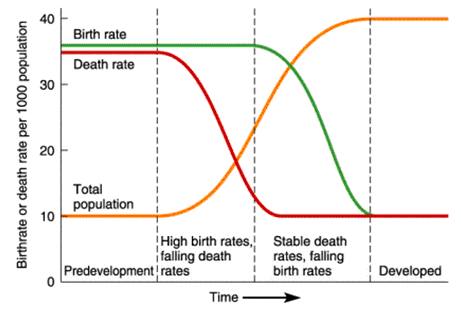
India’s demographic history can be divided into four distinct phases based on the changes in population growth rates and contributing factors. Each phase reflects different socio-economic and health conditions affecting the population dynamics.
Phase One: Stagnant or Stationary Phase (1901-1921)
Characteristics:
- Growth Rate: Very low, with a negative growth rate recorded during 1911-1921.
- Birth and Death Rates: Both rates were high, which kept the population growth rate low.
Reasons for Stagnation:
- Poor Health Services: Limited access to healthcare and inadequate medical facilities led to high mortality rates.
- Illiteracy: Low levels of education contributed to poor health practices and high birth rates.
- Inefficient Distribution Systems: Poor distribution of food and basic necessities resulted in higher death rates and limited population growth.
Phase Two: Steady Growth (1921-1951)
Characteristics:
- Growth Rate: Improved compared to the previous phase, with a steady increase in population.
- Mortality Rate: Significant reduction due to improvements in health and sanitation.
- Birth Rate: Remained high, contributing to overall population growth.
Factors Contributing to Growth:
- Health and Sanitation: Better healthcare facilities and improved sanitation reduced mortality rates.
- Transport and Communication: Enhanced transportation and communication systems improved the distribution of resources and medical services.
- Economic Conditions: Despite challenges like the Great Depression and World War II, progress in health and infrastructure contributed to steady population growth.
Phase Three: Population Explosion (1951-1981)
Characteristics:
- Growth Rate: High, with an average annual growth rate of about 2.2%.
- Mortality Rate: Continued to fall sharply.
- Fertility Rate: Remained high, contributing to a rapid population increase.
Factors Contributing to Explosion:
- Developmental Activities: Centralized planning and economic development led to improvements in living standards and healthcare.
- High Fertility Rate: Despite falling mortality rates, high birth rates contributed to the population explosion.
- International Migration: Influx of migrants from Tibet, Bangladesh, Nepal, and Pakistan added to the population growth.
Phase Four: Slowing Growth (1981-Present)
Characteristics:
- Growth Rate: Continued to be high but has started to slow down gradually.
- Crude Birth Rate: Declining, which has contributed to a slower rate of population growth.
- Age at Marriage: Increased mean age at marriage has affected birth rates.
- Education: Improved education, particularly among females, has contributed to reduced birth rates and slower population growth.
Current Trends:
- Declining Birth Rate: Efforts in family planning and increased awareness about birth control have led to a reduction in birth rates.
- Improved Quality of Life: Better living standards, higher educational attainment, and increased access to healthcare have contributed to slower population growth.
- Projected Population: According to the World Development Report, India’s population is expected to reach approximately 1,350 million by 2025.
