- Energy Resources
- Non-Conventional Sources of Energy
- Solar Energy
- Hydro energy
- Wind power
- Biogas
- Tidal Energy
- Geo Thermal Energy
- Nuclear or Atomic Energy
- Radioactivity
- Nuclear mechanism- Fusion & Fission
- Nuclear Reactor
- Fuelling a Nuclear Reactor
- Types of Nuclear Reactors
- Nuclear Energy in India
- India’s Three Stage Nuclear Program
- Innovative and Advanced Reactor Technologies in India
- Nuclear Fuel Cycle Facilities & Nuclear Waste Management
- Government Initiatives for Enhancing India’s Nuclear Capacity
- Advanced Energy Technologies & Storage
- Hydrogen Energy and Hydrogen Technology
- Fuel Cell
- Energy Storage Technologies
- Waste to Energy Plants
- Energy Security, Policies, and Government Initiatives
- Broader Energy Management & Grid Initiatives
- National Green Hydrogen Mission (NGHM)
- Green Energy Corridor
- Smart Meter National Programme (SMNP)
- Advanced Metering Infrastructure (AMI)
- Net Metering
- Pradhan Mantri Janjati Adivasi Nyaya Maha Abhiyaan (PM-JANMAN)
- Pradhan Mantri Sahaj Bijli Har Ghar Yojana (SAUBHAGYA)
- Production Linked Incentive (PLI) Scheme
- World Energy Investment Report 2025
- Electric Mobility Transition (FAME-1 &FAME-2)
- ENERGY RESOURCES Prelims Previous Year Questions
- Mains Previous Year Questions –ENERGY RESOURCES
Types of Nuclear Reactors
Globally, nuclear reactors are classified based on the combination of their coolant, moderator, and fuel type. Understanding the structural differences between these reactors is a frequent and highly important topic in UPSC examinations.
Below are the four main types of commercial nuclear reactors in operation today:
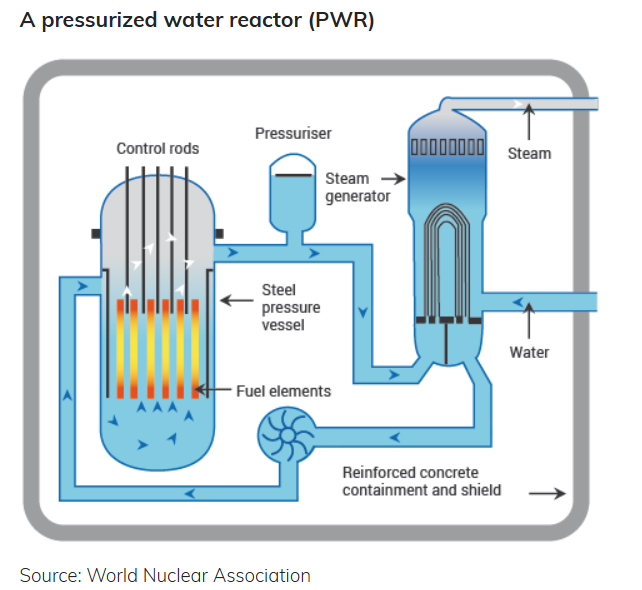
1. Pressurized Water Reactor (PWR)
The PWR is by far the most common type of reactor in the world, originating from designs used for nuclear submarine propulsion. In Russia, these are known as VVER reactors (like the ones installed at India’s Kudankulam plant).
- Coolant and Moderator: Uses ordinary light water for both.
- Fuel: Enriched Uranium oxide.
- Key Structural Feature (Two Circuits): The Primary Circuit flows directly through the radioactive reactor core. To prevent this water from boiling at 325°C, it is kept under extreme pressure (about 150 times atmospheric pressure) using a ‘pressurizer’.
- This superheated water travels to a heat exchanger (Steam Generator), where it heats a completely separate Secondary Circuit of water. The water in this secondary circuit boils into steam and drives the turbine.
- Safety Advantage: Because the water driving the turbine never actually touches the nuclear core, the turbine hall is not radioactive.
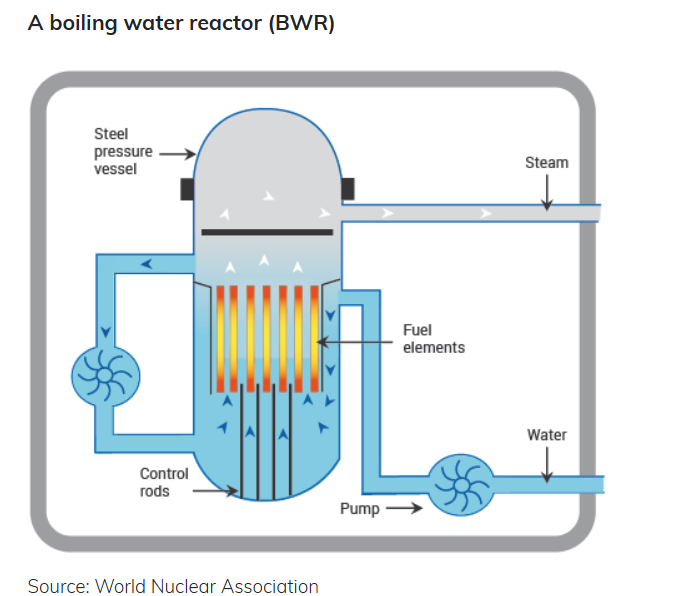
2. Boiling Water Reactor (BWR)
The BWR is the second most common type and shares many similarities with the PWR, but its plumbing is much simpler.
- Coolant and Moderator: Ordinary light water.
- Key Structural Feature (Single Circuit): Unlike the PWR, a BWR operates at a lower pressure (about 75 times atmospheric pressure). This lower pressure allows the water to boil directly inside the reactor core.
- The steam produced in the core passes through separators and travels directly to the turbines.
- Disadvantage: Because the water driving the turbine circulates directly through the nuclear core, the steam contains traces of short-lived radioactive isotopes. This means the actual turbine must be heavily shielded, and maintenance requires strict radiological protection.
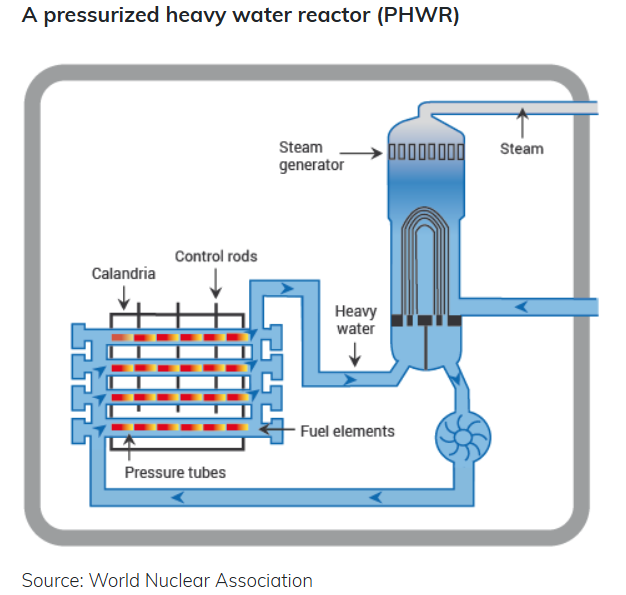
3. Pressurized Heavy Water Reactor (PHWR)
Developed originally in Canada as the CANDU reactor, this design was heavily adopted and localized by India from the 1980s onwards. It forms the absolute backbone of Stage 1 of India’s Nuclear Programme.
- Coolant and Moderator: Uses Heavy Water ($D_2O$).
- Fuel: Uses Natural Uranium (0.7% U-235). Because heavy water is such an incredibly efficient moderator, the expensive process of Uranium enrichment is completely bypassed.
- Key Structural Feature (Pressure Tubes): * Instead of placing the entire core inside one massive, expensive steel pressure vessel (like a PWR), the PHWR uses a large tank called a Calandria.
- Hundreds of individual horizontal pressure tubes run through this tank. The fuel bundles sit inside these tubes, and the pressurized heavy water coolant flows through them.
- Major Advantage (On-Load Refuelling): Because the fuel is in separate tubes, operators can disconnect and refuel individual tubes while the reactor is still running at full power. It does not require a complete shutdown to refuel.
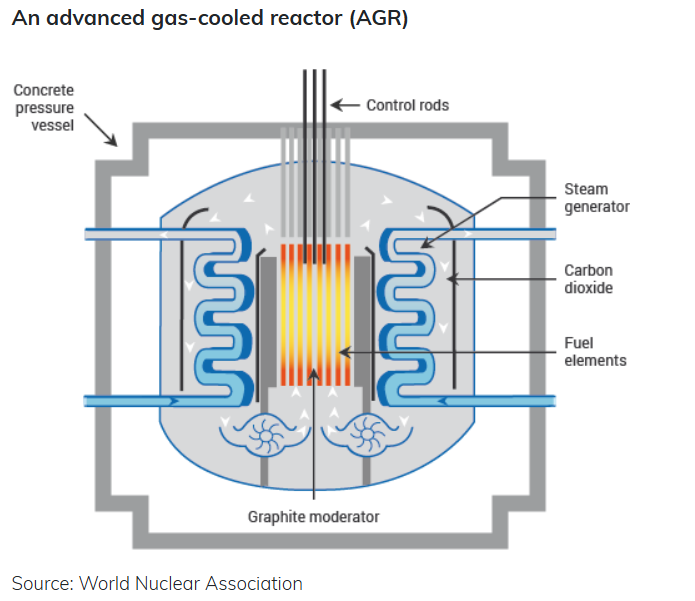
4. Advanced Gas-Cooled Reactor (AGR)
This is a second-generation reactor design primarily developed and used in the United Kingdom.
- Coolant: Carbon Dioxide ($CO_2$) gas.
- Moderator: Solid Graphite blocks.
- Fuel: Enriched Uranium oxide pellets encased in stainless steel tubes.
- Key Features: The carbon dioxide gas circulates through the extremely hot core, reaching temperatures of 650°C. Because it operates at such high temperatures, the AGR achieves a very high thermal efficiency (about 41%, compared to ~33% for water reactors). Like the PHWR, it is designed for on-load refuelling.