- Energy Resources
- Non-Conventional Sources of Energy
- Solar Energy
- Hydro energy
- Wind power
- Biogas
- Tidal Energy
- Geo Thermal Energy
- Nuclear or Atomic Energy
- Radioactivity
- Nuclear mechanism- Fusion & Fission
- Nuclear Reactor
- Fuelling a Nuclear Reactor
- Types of Nuclear Reactors
- Nuclear Energy in India
- India’s Three Stage Nuclear Program
- Innovative and Advanced Reactor Technologies in India
- Nuclear Fuel Cycle Facilities & Nuclear Waste Management
- Government Initiatives for Enhancing India’s Nuclear Capacity
- Advanced Energy Technologies & Storage
- Hydrogen Energy and Hydrogen Technology
- Fuel Cell
- Energy Storage Technologies
- Waste to Energy Plants
- Energy Security, Policies, and Government Initiatives
- Broader Energy Management & Grid Initiatives
- National Green Hydrogen Mission (NGHM)
- Green Energy Corridor
- Smart Meter National Programme (SMNP)
- Advanced Metering Infrastructure (AMI)
- Net Metering
- Pradhan Mantri Janjati Adivasi Nyaya Maha Abhiyaan (PM-JANMAN)
- Pradhan Mantri Sahaj Bijli Har Ghar Yojana (SAUBHAGYA)
- Production Linked Incentive (PLI) Scheme
- World Energy Investment Report 2025
- Electric Mobility Transition (FAME-1 &FAME-2)
- ENERGY RESOURCES Prelims Previous Year Questions
- Mains Previous Year Questions –ENERGY RESOURCES
Microbial Fuel Cells (MFCs)
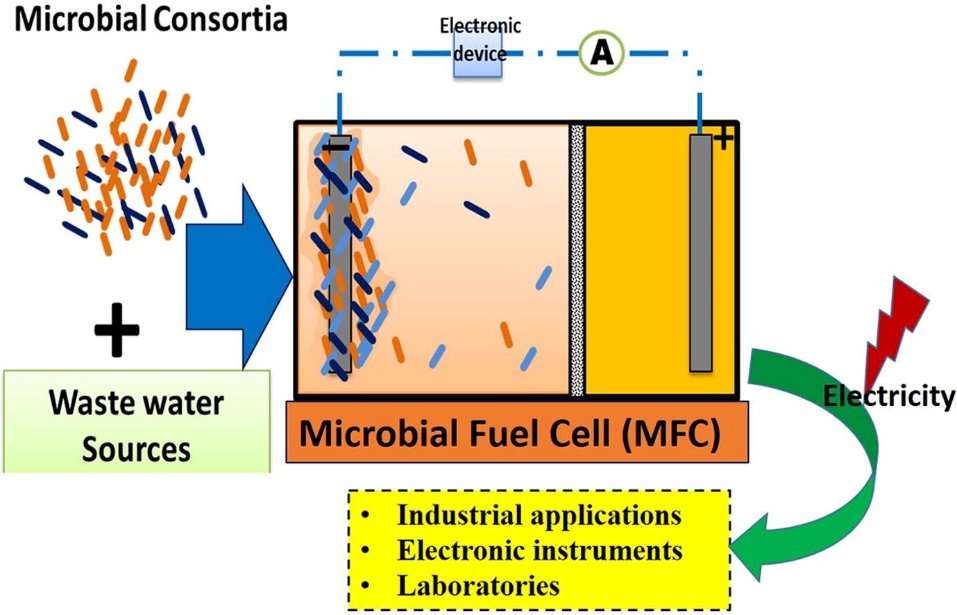
A Microbial Fuel Cell (MFC) is a bioelectrochemical device that produces electricity using the metabolic activities of microorganisms such as bacteria. These microorganisms break down organic matter and release electrons during their metabolic processes. The electrons are captured by an electrode and flow through an external circuit, generating electric current.
Working Principle
A typical microbial fuel cell consists of two chambers, an anode chamber and a cathode chamber, separated by a proton exchange membrane.
- In the anode chamber, microorganisms break down organic substances such as wastewater, biomass, or biodegradable waste. During this process, electrons (e⁻) and protons (H⁺) are released.
- The electrons move through an external circuit, producing electricity.
- The protons pass through the membrane to the cathode chamber.
- In the cathode chamber, oxygen reacts with electrons and protons to form water.
Thus, electricity is generated from the biological activity of microorganisms.
Applications
Microbial fuel cells have several potential applications:
- Wastewater treatment with simultaneous electricity generation
- Bioenergy production from organic waste
- Environmental monitoring using biosensors
- Small-scale power supply in remote areas
Significance
Microbial Fuel Cells provide a sustainable method of generating electricity while treating organic waste. Although the power output is currently low, ongoing research is improving their efficiency and practical applications.