

- Energy Resources
- Non-Conventional Sources of Energy
- Solar Energy
- Hydro energy
- Wind power
- Biogas
- Tidal Energy
- Geo Thermal Energy
- Nuclear or Atomic Energy
- Radioactivity
- Nuclear mechanism- Fusion & Fission
- Nuclear Reactor
- Fuelling a Nuclear Reactor
- Types of Nuclear Reactors
- Nuclear Energy in India
- India’s Three Stage Nuclear Program
- Innovative and Advanced Reactor Technologies in India
- Nuclear Fuel Cycle Facilities & Nuclear Waste Management
- Government Initiatives for Enhancing India’s Nuclear Capacity
- Advanced Energy Technologies & Storage
- Hydrogen Energy and Hydrogen Technology
- Fuel Cell
- Energy Storage Technologies
- Waste to Energy Plants
- Energy Security, Policies, and Government Initiatives
- Broader Energy Management & Grid Initiatives
- National Green Hydrogen Mission (NGHM)
- Green Energy Corridor
- Smart Meter National Programme (SMNP)
- Advanced Metering Infrastructure (AMI)
- Net Metering
- Pradhan Mantri Janjati Adivasi Nyaya Maha Abhiyaan (PM-JANMAN)
- Pradhan Mantri Sahaj Bijli Har Ghar Yojana (SAUBHAGYA)
- Production Linked Incentive (PLI) Scheme
- World Energy Investment Report 2025
- Electric Mobility Transition (FAME-1 &FAME-2)
- ENERGY RESOURCES Prelims Previous Year Questions
- Mains Previous Year Questions –ENERGY RESOURCES
Tidal Energy
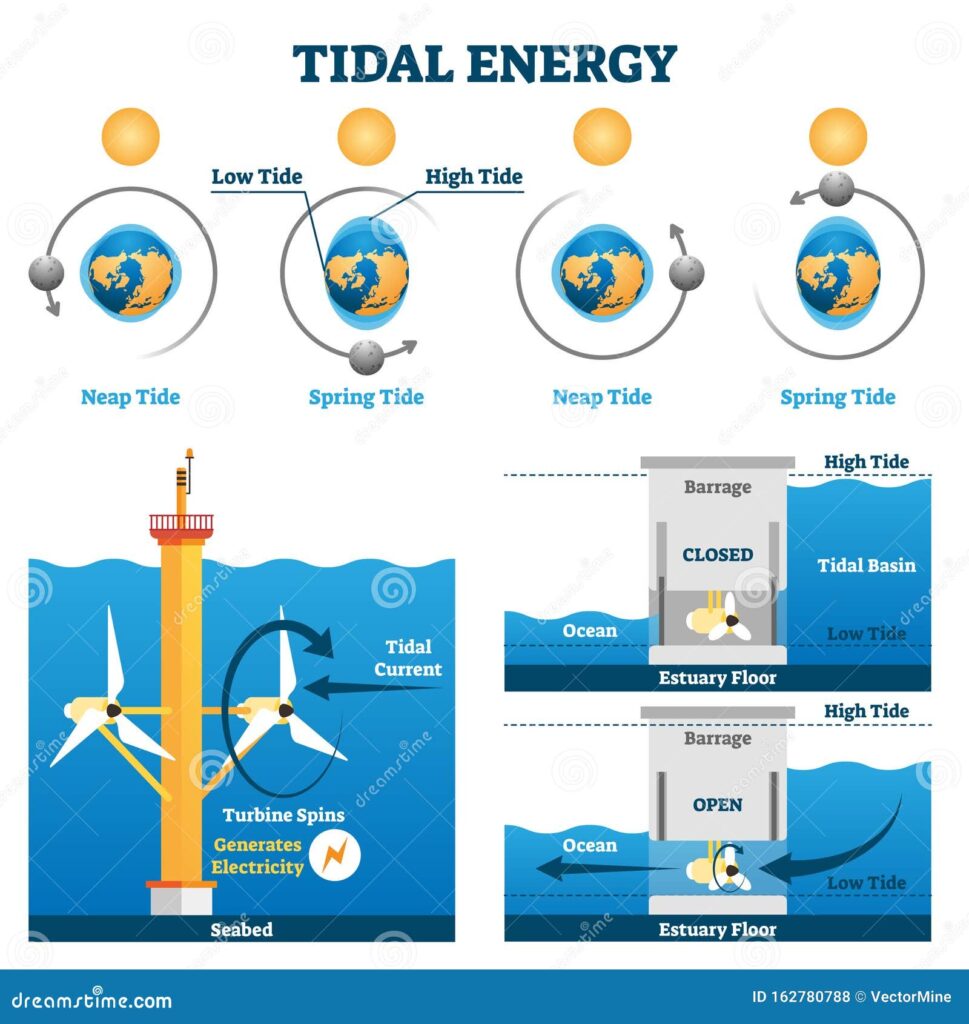
Tidal energy is a highly predictable and renewable form of power generated by harnessing the natural surge of ocean waters during the rise and fall of tides. This continuous rise and fall is caused by the gravitational interaction between the Earth, the Sun, and the Moon. The immense intensity and volume of this water movement create kinetic energy, which can be efficiently captured and converted into electricity.
Working Mechanism and Generation Process
Ocean tides represent the continuous movement of water rushing in (flood tide) and drawing out (ebb tide) of coastal areas like bays and estuaries. The process of generating electricity from this movement generally involves the following components:
- Tidal Barrages (Dams): The most common method of harnessing tidal power is by building massive wall-like structures with sluice gates, known as barrages, across coastal inlets where the sea meets the land.
- Trapping and Flow: When the gates are opened during a high tide, the incoming water flows in and fills the basin behind the dam. Once the water reaches its highest level, the gates are closed, trapping the water. As the ocean tide recedes outside the gate, creating a drop in water level, the trapped water is forcefully released back into the sea through a pipe.
- Power Generation: This fast-moving released water passes through heavy, specialized turbines. The spinning turbines drive a generator to produce electricity.
- Geographical Requirements: To utilize tidal energy effectively and economically, the geographical location must have a significant tidal range. The high tide must be at least five meters (16 feet) higher than the low tide.
Tidal Energy Potential in India
Because of its expansive coastline, India has a substantial estimated tidal energy potential of around 8,000 to 9,000 Megawatts (MW). India is one of the few places in the world possessing coastal inlets where tides are high enough to meet the strict 5-meter height difference requirement.
This potential is heavily concentrated in three specific regions:
- Gulf of Cambay (Gujarat): Holds the absolute maximum potential in the country, estimated at 7,000 MW, featuring an extraordinary maximum tidal range of 11 meters.
- Gulf of Kutch (Gujarat): Holds an estimated potential of 1,200 MW, with a highly suitable average tidal range of 8 meters.
- Sunderbans (West Bengal): The intricate creek systems of the Gangetic delta hold approximately 100 MW of potential.
Government Initiatives and Current Status
Over the years, the Ministry of New and Renewable Energy (MNRE) and state governments have explored several pilot projects to harness this energy:
- Gujarat Projects (2011): The state government attempted to develop a 250 MW tidal power project in the Gulf of Kutch in partnership with international developers. A smaller 50 MW phase was also initiated in Mandavi.
- Sunderbans Project (2008): A 3.75 MW demonstration plant was sanctioned at Durgaduani Creek in West Bengal.
- Current Status: Despite these early efforts, India has not achieved a commercial breakthrough in its 40 years of evaluating tidal power. Both the Gujarat and West Bengal projects were ultimately put on hold due to astronomical construction costs and financial barriers.
Advantages and Limitations of Tidal Energy
Advantages:
- Highly Reliable: Unlike wind or solar power, tides are entirely driven by gravitational forces, making them steady, predictable, and measurable months or even years in advance.
- Coastal Protection: The heavy concrete structures of tidal barrages and lagoons can absorb massive ocean waves, helping to protect vulnerable coastlines from severe flooding and storm surges.
- Longevity: Tidal power equipment is built to withstand harsh ocean conditions and generally has a much longer lifespan than other renewable energy infrastructure.
Challenges and Limitations:
- Prohibitive Costs: Building massive underwater dams and turbines requires extremely high initial capital costs, which remains the biggest hurdle to global adoption.
- Environmental Risks: Tidal barrages drastically alter natural marine ecosystems. They disrupt sediment flow, destroy natural habitats, create underwater noise pollution, and pose a physical strike risk to marine life passing through the turbines.
- Intermittent Supply: Although predictable, tidal energy is only actively generated for about 10 hours a day (during the shifting of the tides), requiring significant energy storage systems to provide round-the-clock power.
- Geographical Constraints: Power is generated strictly at the coast, making it highly difficult and expensive to lay transmission lines to heavily populated inland areas.
Global Examples of Tidal Energy
While India is still exploring its potential, a few nations have successfully built large-scale tidal plants:
- South Korea: The Sihwa Lake facility, constructed in 2011, currently stands as the largest tidal power plant in the world, boasting an installed capacity of 254 MW.
- North America: The Annapolis Royal generating station in Nova Scotia, Canada, successfully utilizes the famously strong tides of the Bay of Fundy.
- Europe: Other historically notable and highly successful sites include the La Rance estuary in France and the Severn Estuary located between England and Wales.
