- Energy Resources
- Non-Conventional Sources of Energy
- Solar Energy
- Hydro energy
- Wind power
- Biogas
- Tidal Energy
- Geo Thermal Energy
- Nuclear or Atomic Energy
- Radioactivity
- Nuclear mechanism- Fusion & Fission
- Nuclear Reactor
- Fuelling a Nuclear Reactor
- Types of Nuclear Reactors
- Nuclear Energy in India
- India’s Three Stage Nuclear Program
- Innovative and Advanced Reactor Technologies in India
- Nuclear Fuel Cycle Facilities & Nuclear Waste Management
- Government Initiatives for Enhancing India’s Nuclear Capacity
- Advanced Energy Technologies & Storage
- Hydrogen Energy and Hydrogen Technology
- Fuel Cell
- Energy Storage Technologies
- Waste to Energy Plants
- Energy Security, Policies, and Government Initiatives
- Broader Energy Management & Grid Initiatives
- National Green Hydrogen Mission (NGHM)
- Green Energy Corridor
- Smart Meter National Programme (SMNP)
- Advanced Metering Infrastructure (AMI)
- Net Metering
- Pradhan Mantri Janjati Adivasi Nyaya Maha Abhiyaan (PM-JANMAN)
- Pradhan Mantri Sahaj Bijli Har Ghar Yojana (SAUBHAGYA)
- Production Linked Incentive (PLI) Scheme
- World Energy Investment Report 2025
- Electric Mobility Transition (FAME-1 &FAME-2)
- ENERGY RESOURCES Prelims Previous Year Questions
- Mains Previous Year Questions –ENERGY RESOURCES
Distribution of Coal in India and the World
Coal is not distributed evenly across the globe or within India. Its presence depends heavily on the geological history of a region. Understanding this distribution is crucial for analyzing a country’s energy security and industrial capacity.
Top Coal Producing States in India
India is endowed with significant coal reserves, primarily located in the central and eastern parts of the country. While some states have the largest underground reserves, others lead in the actual annual extraction and production of coal.
Below is the distribution of the top coal-producing states in India based on recent trends (2023–2024):
Rank | State | Key Features & Major Coalfields |
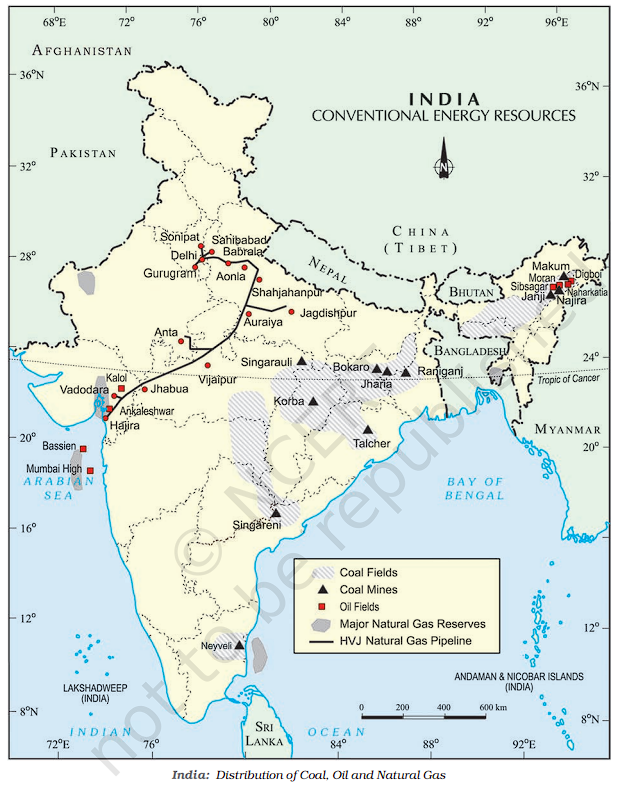
1 | Odisha | Currently the highest coal-producing state by volume, contributing nearly a quarter of India’s total production. It is rich in thermal coal. Major Field: Talcher. |
2 | Chhattisgarh | One of the world’s largest coal mining regions. It is home to Asia’s largest open-cast mines. Major Mines: Gevra and Kusmunda. |
3 | Jharkhand | Holds the largest overall coal reserves in India and is the primary producer of high-grade coking coal (essential for steel plants). Major Fields: Jharia, Bokaro. |
4 | Madhya Pradesh | A consistent contributor to the nation’s coal output, largely supporting central India’s thermal power needs. Major Field: Singrauli. |
5 | Telangana | The key supplier of coal to southern India. Mining operations here are exclusively managed by the Singareni Collieries Company Limited (SCCL). Major Field: Godavari Valley. |
Major Coal Producers in India (2023–24)
Producer | Contribution (FY 2023–24) | |
Coal India Limited (CIL) | 773.81 million tonnes (MT) | Largest coal producer in India |
Singareni Collieries Company Limited | 70.02 MT | Key supplier for southern India |
Captive and Private Players | Increasing post-reforms | Boosted by coal sector liberalization reforms |
Top Coal Producers in the World
Globally, the demand for coal remains high, particularly in developing nations where it fuels rapid industrialization and electricity generation.
The table below outlines the top coal-producing countries and their global standing:
Global Rank | Country | Share & Characteristics |
1 | China | The undisputed global leader, producing over 3.7 billion tonnes annually (roughly 50% of the world’s total coal output). China is both the largest producer and the largest consumer of coal. |
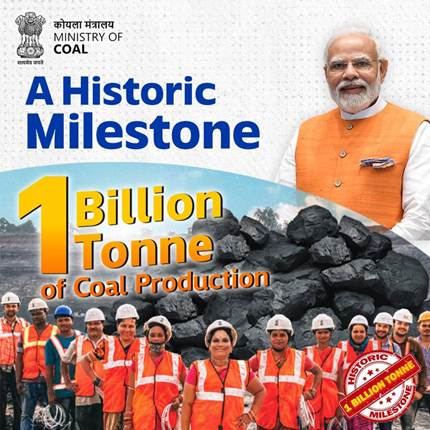
2 | India | The second-largest producer. Driven by rising domestic power demands, India recently achieved a historic milestone by crossing 1 billion tonnes in domestic coal production (FY 2023–24/2024–25). |
3 | United States | Holds the largest proven coal reserves in the world. However, its actual production is steadily declining as the country transitions toward natural gas and renewable energy sources. |
4 | Indonesia | A major global player and one of the world’s top exporters of thermal coal. Production has grown rapidly to meet strong energy demands from other Asian nations. |
5 | Australia | Possesses vast reserves of high-quality metallurgical (coking) coal. A large percentage of Australia’s production is exported globally, particularly to steel manufacturers in Asia. |
6 | Russia | Holds massive reserves in regions like Siberia. It remains a significant producer and exporter, though production levels face logistical and geopolitical challenges. |
Recent Update (2025)
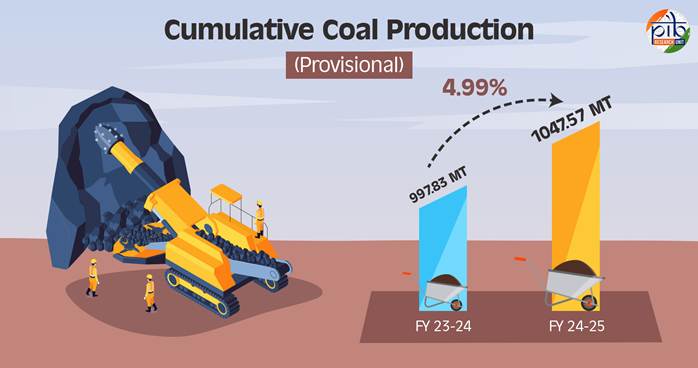
- India has achieved a historic milestone by surpassing one billion tonnes of coal production in FY 2024-25, with a 4.99% growth in output compared to the previous year.
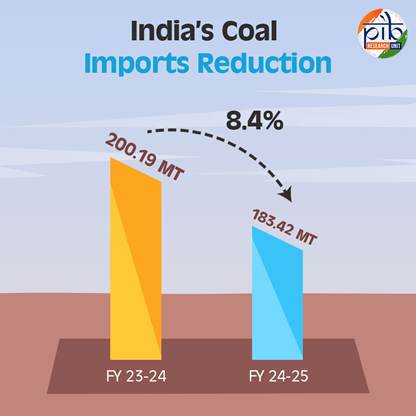
- The country’s coal imports decreased by 8.4%, leading to substantial foreign exchange savings and a reduction in import dependency.
- The coal sector remains a crucial contributor to India’s energy mix, powering over 74% of the country’s electricity and sustaining key industries like steel and cement.
- A focus on coal gasification is positioning India to leverage syngas for producing methanol, fertilizers, and synthetic natural gas, promoting environmental sustainability.
India achieved a historic milestone by surpassing one billion tonnes (BT)of coal production on 20 March 2025, in FY 2024-25—11 days ahead of last year’s 997.83 million tonnes (MT). With the fifth-largest coal reserves and as the second-largest consumer, coal remains crucial, contributing 55% to the national energy mix and fuelling over 74% of total power generation. The coal sector’s success is attributed to the tireless efforts of Coal Public Sector Undertakings (PSUs), private players, and the dedicated workforce of around 5 lakh mine workers across more than 350 coal mines. These coal miners, who have defied numerous challenges with unmatched dedication, have played a pivotal role in achieving this historic milestone.
Growth in Coal Production and Dispatch and Reduction in Coal Import