
- Human Health &Diseases
- Fundamentals of Health and Nutrition
- Understanding Diseases and Pathogens
- Major Communicable Diseases
- Major Non-Communicable and Genetic Diseases
- Emerging Diseases and Public Health Threats
- The Human Immune System
- Vaccination and Vaccine Technologies
- History of Diseases in India: From Ancient Times to the Modern Era
- Diseases Prelims Previous Year Questions
Primary and Secondary Immune Responses
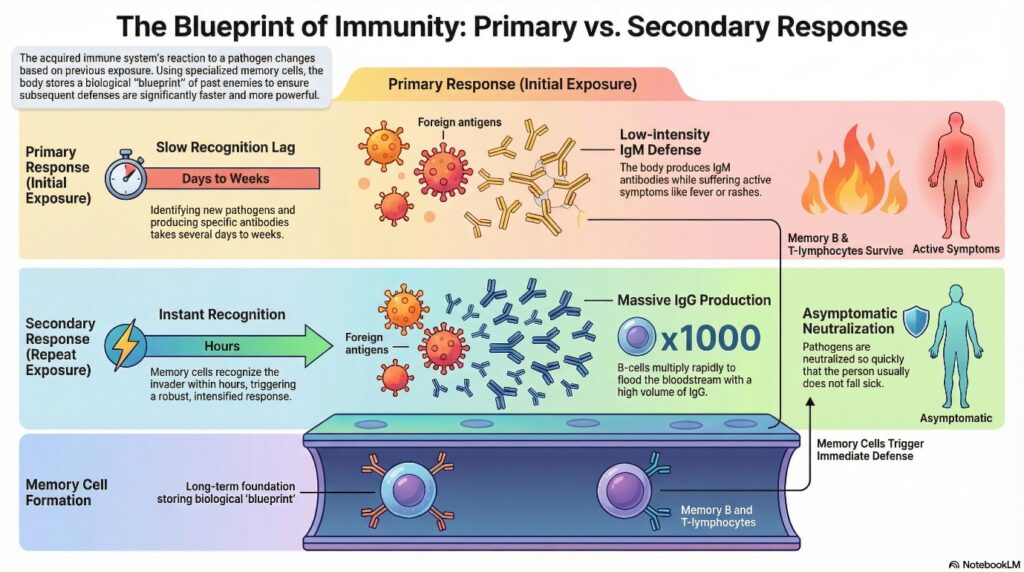
The acquired immune system does not react to pathogens in the same way every time. Its response depends entirely on whether it is encountering a specific germ for the first time or if it has seen it before. This varying reaction is categorized into the primary and secondary immune responses.
The entire foundation of this mechanism is based on a unique biological feature called immunological memory.
1. Primary Immune Response
The primary response occurs when the human immune system encounters a specific, new antigen (pathogen) for the very first time.
- Speed and Intensity: Because the immune system has never seen this pathogen before, it takes time to identify the enemy, find the correct B-cells, and start producing the specific antibodies required to defeat it. Therefore, the primary response is slow and of low intensity.
- Antibody Production: It can take several days to weeks to produce a sufficient amount of antibodies. The primary antibody produced during this phase is IgM.
- Clinical Result: During this slow lag period, the pathogen multiplies, and the person suffers from the disease and exhibits active symptoms (e.g., getting a high fever and rash when catching chickenpox for the first time).
2. The Role of Memory Cells (The Bridge)
Once the primary infection is defeated, the immune response does not just vanish. While most of the active fighting cells die off, a small fraction of the B-lymphocytes and T-lymphocytes transform into highly specialized Memory Cells.
These memory cells remain circulating in the blood and lymphatic system for years, or even for the rest of the person’s life. They carry a perfect biological “blueprint” or memory of the specific antigen they just defeated.
3.Secondary (Anamnestic) Immune Response
The secondary response occurs when the immune system encounters the exact same pathogen for a second, third, or subsequent time.
- Speed and Intensity: Because the memory cells immediately recognize the familiar invader, the response is incredibly rapid, robust, and of highly intensified capacity.
- Antibody Production: Within hours, the memory B-cells multiply massively and flood the bloodstream with a huge volume of antibodies. The predominant antibody produced during this rapid phase is IgG.
- Clinical Result: The massive army of antibodies neutralizes the pathogen almost instantly, completely stopping it from multiplying. Consequently, the person does not fall sick and usually does not even realize that the pathogen had entered their body again.
The Principle of Vaccination
Understanding the primary and secondary immune responses is crucial because it forms the biological basis of all vaccination programs.
When a vaccine is administered, a dead, weakened, or partial form of a pathogen is deliberately introduced into the body. This harmless version cannot cause the actual disease, but it is enough to trick the body into launching a Primary Immune Response and generating Memory Cells.
Later in life, if the actual, dangerous, live pathogen attacks the body, the pre-existing memory cells instantly recognize it and launch a massive Secondary Immune Response, destroying the germ before it can cause any illness.
