Relevance: TGPSC Group I: Telangana Economy, Rural Development, Panchayati Raj Institutions.
For Prelims:
- 16th Finance Commission, Rural Local Bodies, Gram Panchayats, Mandal Parishads, Zilla Parishads, Part IX of the Constitution, e-GramSwaraj Portal, Tied Grants, Untied Grants.
For Mains:
- Fiscal Devolution, Panchayati Raj Empowerment, Rural Infrastructure, Decentralised Planning, Local Governance, Gram Sabha Accountability, Own Revenue Sources, Performance-linked Grants.
Why in News?
The 16th Finance Commission has allocated ₹9,968 crore to Telangana for strengthening rural local bodies during the five-year period from 2026–27 to 2030–31.
The grant is part of the total ₹4,35,236 crore recommended for rural local bodies across all States. The funds will support gram panchayats, mandal parishads and zilla parishads in improving rural infrastructure and public services.
About the Allocation
- Telangana will receive ₹9,968 crore for rural local bodies.
- The grants are meant for the five-year period from 2026–27 to 2030–31.
- The funds will be transferred to the State government treasury account.
- The State must release the funds to rural local bodies within 10 working days.
- Only duly elected local bodies constituted under Part IX of the Constitution will be eligible for uninterrupted release of funds.
Basis of Fund Allocation
The allocation to Telangana was calculated using two main criteria:
- 90% weightage for rural population
- 10% weightage for geographical area
Telangana’s share was based on:
- 1.92% of India’s rural population
- 0.37% of India’s geographical area
Based on this formula, Telangana received ₹9,968 crore from the total rural local body grants.
Distribution of Funds
| Rural Local Body | Share of Funds |
| Gram Panchayats | 80% |
| Mandal Parishads | 10% |
| Zilla Parishads | 10% |
- The grants will be released in two equal instalments every year.
- The first instalment will be released in June.
- The second instalment will be released in October.
Conditions for Release
- The State must submit budget allocations made for Panchayat Raj and Rural Development departments.
- Audit reports of local bodies for the financial year 2025–26 must be submitted to receive the first instalment.
- The second instalment will be released only after submission of:
- Utilisation certificates
- Progress reports
- Details of expenditure of the first instalment
- The Centre will also consider the performance of States in providing financial resources to local bodies.
Performance-linked Grants
- 20% of grants will be linked to performance.
- Gram panchayats will be assessed based on:
- Tax collections
- Improvement of own revenue sources
- Proper use of funds
- Submission of reports
- Compliance with guidelines
This aims to encourage local bodies to improve financial discipline and accountability.
Permitted Use of Grants
The funds must be used only for rural infrastructure and public services such as:
- Waste management
- Drinking water supply
- Sanitation
- Rural roads
- Street lighting
- Other village-level public services
The grants must not be used for payment of:
- Salaries
- Pensions
Tied and Untied Grants
- Tied grants must be used only for the specific purposes for which they are given.
- Untied grants provide some flexibility to local bodies.
- However, not more than 20% of untied funds can be spent on construction and maintenance of roads.
- Fund utilisation must be approved through:
- Gram Sabha resolutions
- Mandal Parishad meetings
- Zilla Parishad meetings
- All details must be uploaded on the e-GramSwaraj portal.
Accountability and Monitoring
- Local bodies must submit quarterly and annual progress reports to the State government.
- The State government must submit consolidated reports to the Centre.
- Expenditure details must be made available to the public regularly.
- Audit deficiencies must be corrected immediately.
- Legal action must be taken if misuse of grants or irregularities are found.
Challenges
- Timely transfer of funds within 10 working days may require strong administrative coordination.
- Many local bodies may have weak capacity for planning and execution.
- Audit compliance and reporting may be uneven across districts.
- Own revenue mobilisation by gram panchayats may remain limited.
- Misuse or diversion of funds can affect outcomes.
- Strict restrictions on salary and pension payments may create pressure where administrative costs are high.
- Performance-linked grants may disadvantage weaker panchayats if they lack capacity.
Way Forward
- Build technical and financial capacity of rural local bodies.
- Train gram panchayat officials in budgeting, accounting and e-GramSwaraj use.
- Ensure timely State-level transfer of grants.
- Strengthen Gram Sabha participation in project approval.
- Improve own revenue sources through local tax collection and user charges.
- Conduct regular social audits and public disclosure of expenditure.
- Prioritise drinking water, sanitation, waste management and basic rural services.
- Provide handholding support to weaker panchayats.
- Ensure legal action in cases of misuse or irregularities.
Conclusion
The allocation of ₹9,968 crore to Telangana’s rural local bodies is an important step towards strengthening Panchayati Raj institutions and rural infrastructure. The grants can improve drinking water, sanitation, waste management, roads, street lighting and other basic services.
Their success will depend on timely fund release, Gram Sabha-based planning, transparent reporting, proper audits and strong local capacity. If used effectively, these funds can deepen grassroots democracy and support inclusive rural development in Telangana.
CARE MCQ
Q. With reference to the 16th Finance Commission grants for Telangana’s rural local bodies, consider the following statements:
- Telangana has been allocated ₹9,968 crore for rural local bodies.
- The grants are meant for gram panchayats, mandal parishads and zilla parishads.
- The grants can be used for payment of salaries and pensions.
Which of the above statements are correct?
A. 1 and 2 only
B. 2 and 3 only
C. 1 and 3 only
D. 1, 2 and 3
Answer: A
Explanation:
- Statement 1 is correct: Telangana has been allocated ₹9,968 crore.
- Statement 2 is correct: The funds are meant for rural local bodies such as gram panchayats, mandal parishads and zilla parishads.
- Statement 3 is incorrect: The grants cannot be used for salaries or pensions.
Q. With reference to the distribution of rural local body grants in Telangana, consider the following pairs:
| Rural Local Body | Share of Funds |
| Gram Panchayats | 80% |
| Mandal Parishads | 10% |
| Zilla Parishads | 10% |
How many of the above pairs are correctly matched?
A. Only one
B. Only two
C. All three
D. None
Answer: C
Explanation:
- Pair 1 is correct: Gram Panchayats will receive 80%.
- Pair 2 is correct: Mandal Parishads will receive 10%.
- Pair 3 is correct: Zilla Parishads will receive 10%.
FAQs
1. How much grant has Telangana received for rural local bodies?
Telangana has been allocated ₹9,968 crore by the 16th Finance Commission.
2. What is the period of this allocation?
The allocation covers five years from 2026–27 to 2030–31.
3. Which rural local bodies will receive the funds?
The funds will go to gram panchayats, mandal parishads and zilla parishads.
4. What share will gram panchayats receive?
Gram panchayats will receive 80% of the total allocation.
5. What share will mandal parishads and zilla parishads receive?
Mandal parishads and zilla parishads will receive 10% each.
6. What can the funds be used for?
The funds can be used for waste management, drinking water, sanitation, rural roads, street lighting and other public services.
7. Can the grants be used for salaries or pensions?
No. The grants cannot be used for payment of salaries or pensions.
8. What is e-GramSwaraj?
e-GramSwaraj is an online platform used for planning, accounting and monitoring of Panchayati Raj activities.
Relevance: UPSC: GS Paper III – Indian Economy, Maritime Trade, Ports, Infrastructure, Disaster Preparedness.
For Prelims:
- Salaya Port, Gulf of Kutch, Mechanised Sailing Vessels, MSVs, Strait of Hormuz, Immigration Check Post, Porbandar ICP, Bureau of Immigration, Indian Sailing Vessels Association, Merchant Shipping Act.
For Mains:
- Maritime Trade, Coastal Economy, Monsoon Risk, Port Infrastructure, Regulatory Flexibility, Small Vessel Trade, Gulf Trade, Immigration Governance, Maritime Safety.
Why in News?
A regulatory change has allowed mechanised sailing vessels belonging to Salaya and Okha ports in Gujarat to complete crew sign-on and sign-off formalities at the Porbandar Immigration Check Post.
This change has helped many Indian-flagged sailing vessels return safely to Gujarat before the rough monsoon season. It has also helped avoid a possible maritime trade crisis at a time when vessels were facing risks due to conflict in West Asia and insecurity near the Strait of Hormuz.
What are Mechanised Sailing Vessels?
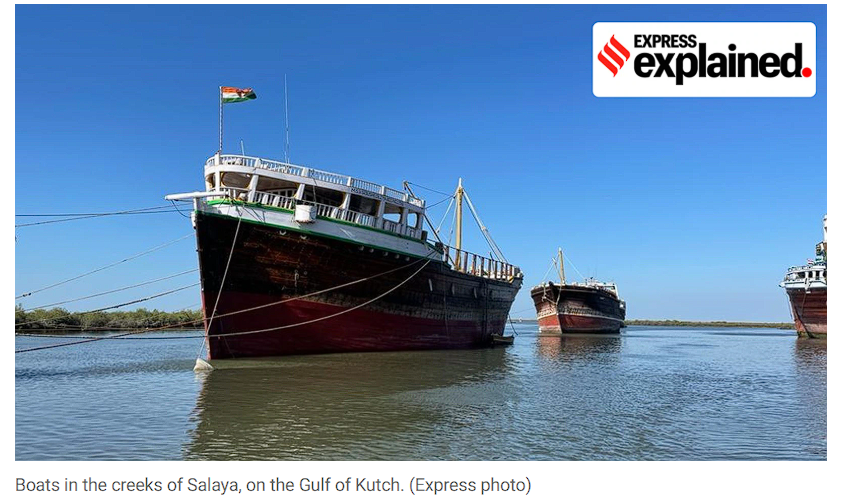
- Mechanised Sailing Vessels, or MSVs, are small merchant cargo vessels.
- They are often called traditional dhows.
- They carry goods between India and countries in:
- Gulf region
- Middle East
- Indian Ocean region
- East Africa
- These vessels usually run on diesel.
- Their carrying capacity ranges from around 200 MT to 3,000 MT.
- Most such vessels carry around 1,000 MT of cargo.
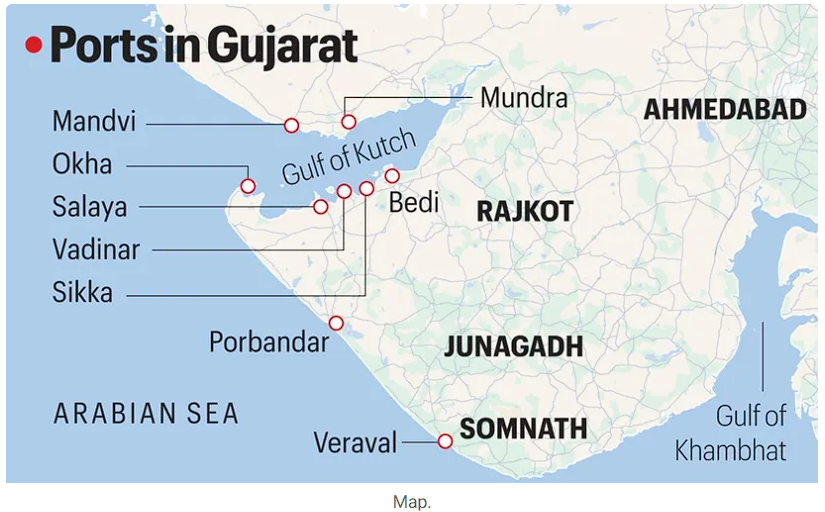
Port is Important
- Salaya is located in the Gulf of Kutch in Gujarat.
- It is one of the most important home ports for Indian-flagged MSVs.
- Salaya is a tidal port with creeks and mangroves.
- These natural features protect vessels from rough sea conditions.
- It can accommodate and beach a large number of boats during the monsoon season.
- It is also known for:
- Boat repair
- Painting
- Cleaning
- Dry-dock work
- Seaworthiness inspection
- Repair costs are also lower at Salaya compared to many other ports.
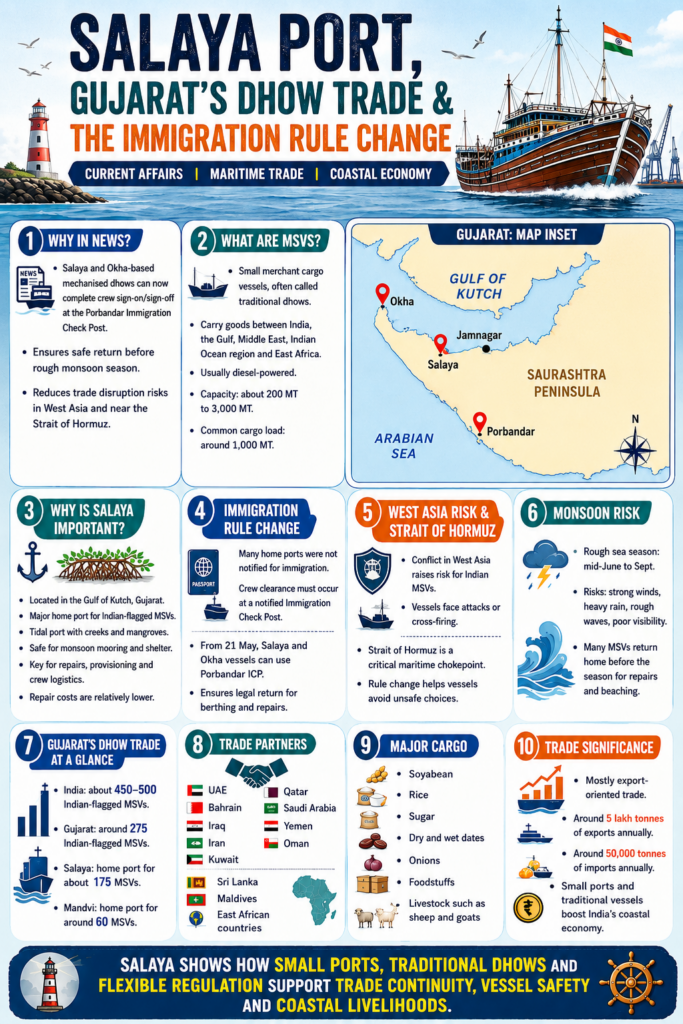
Immigration Rule Change
- Earlier, many MSVs faced problems because their home ports were not notified for immigration.
- Crew members must complete immigration formalities at a notified Immigration Check Post.
- From May 21, MSVs whose home ports are Salaya and Okha were allowed to complete crew sign-on and sign-off at Porbandar ICP.
- This helped vessels legally return to Salaya and Okha for berthing and repairs.
- Police and immigration authorities can now process the crew at Porbandar while the vessels berth at their home ports.
Link with Iran War and Strait of Hormuz
- The conflict in West Asia created safety concerns for Indian MSVs operating in Gulf waters.
- Some vessels were reportedly hit or caught in cross-firing.
- The Strait of Hormuz is a critical maritime chokepoint connecting the Gulf region with global sea routes.
- For small Indian vessels, sailing through conflict zones became risky.
- The rule change allowed vessels to avoid unsafe choices and return to Gujarat before the monsoon.
Monsoon and Rough Sea Risk
- The rough sea season generally lasts from mid-June to September.
- During this period, small vessels are at high risk due to:
- Strong winds
- Heavy rainfall
- Rough waves
- Poor visibility
- Under maritime practice, many MSVs return to home ports for beaching and repairs before the rough season.
- If they had been forced to dock at crowded or exposed ports, they could have suffered major damage.
Gujarat’s Dhow Trade
- India has around 450–500 Indian-flagged MSVs.
- Around 275 Indian-flagged MSVs are based in Gujarat.
- Salaya is the home port for around 175 MSVs.
- Mandvi is the home port for around 60 MSVs.
- MSVs trade with UAE, Bahrain, Iraq, Iran, Kuwait, Qatar, Saudi Arabia, Yemen, Oman, Sri Lanka, Maldives
- East African countries
- Major cargo includes:
- Soyabean
- Rice
- Sugar
- Dry and wet dates
- Onions
- Foodstuffs
- Livestock such as sheep and goats
- The trade is mostly export-oriented.
- Indian MSVs carry around 5 lakh tonnes of exports and about 50,000 tonnes of imports annually.
Significance
- Protects small Indian merchant vessels during the monsoon season.
- Supports Gujarat’s traditional maritime economy.
- Helps avoid damage to vessels during rough sea conditions.
- Provides regulatory flexibility during emergency conditions.
- Supports export trade with Gulf, Indian Ocean and East African regions.
- Reduces pressure on crowded ports such as Porbandar, Okha, Sikka and Mundra.
- Shows the importance of smaller ports in India’s maritime trade.
- Strengthens coastal livelihood security for vessel owners, crews and repair workers.
Challenges
- Many traditional home ports do not have notified immigration facilities.
- Sudden legal changes can disrupt maritime trade.
- Small vessels are vulnerable to geopolitical risks in Gulf waters.
- Monsoon conditions create serious safety risks.
- Crowded and exposed ports may not provide enough protection.
- Docking at foreign ports is costly for small vessel owners.
- Regulatory delays can create uncertainty for crew and traders.
- Port infrastructure for small vessels remains limited.
Way Forward
- Notify more traditional sailing vessel ports for immigration facilities.
- Create permanent digital immigration support for MSVs.
- Improve coordination between the Bureau of Immigration, DG Shipping, port authorities and vessel associations.
- Develop Salaya and other traditional ports with better repair and safety facilities.
- Prepare a standard emergency protocol for vessels affected by war, weather or maritime insecurity.
- Strengthen maritime safety advisories for small vessels operating near conflict zones.
- Support traditional dhow trade as part of India’s coastal and export economy.
- Improve insurance, tracking and communication systems for MSVs.
Conclusion
The temporary immigration facility at Porbandar for vessels headed to Salaya and Okha helped prevent a possible maritime crisis. It allowed several Indian MSVs to return safely before the rough monsoon season and avoid dangerous routes near conflict-affected Gulf waters.
Salaya’s creeks, mangroves and repair facilities make it critical for Gujarat’s dhow trade. The episode shows that small ports and traditional vessels remain important to India’s maritime economy. A balanced policy must combine security, immigration control, port infrastructure and protection of coastal livelihoods.
CARE MCQ
Q. With reference to Salaya port, consider the following statements:
- It is located in the Gulf of Kutch.
- It is important for mechanised sailing vessels.
- It is known for sheltering vessels during the monsoon season.
Which of the above statements are correct?
A. 1 and 2 only
B. 2 and 3 only
C. 1 and 3 only
D. 1, 2 and 3
Answer: D
Explanation:
- Statement 1 is correct: Salaya is located in the Gulf of Kutch in Gujarat.
- Statement 2 is correct: It is a major home port for mechanised sailing vessels.
- Statement 3 is correct: Its creeks and mangroves help shelter vessels during rough sea conditions.
FAQs
1. Where is Salaya port located?
Salaya port is located in the Gulf of Kutch in Gujarat.
2. Why is Salaya important?
It is important because it provides shelter, repair and beaching facilities for mechanised sailing vessels during the monsoon season.
3. What are MSVs?
MSVs are Mechanised Sailing Vessels, small merchant cargo vessels used for trade with Gulf, Indian Ocean and East African countries.
4. What regulatory change helped MSVs?
MSVs belonging to Salaya and Okha were allowed to complete crew sign-on and sign-off at the Porbandar Immigration Check Post.
5. Why was this change needed?
It was needed because many home ports did not have notified immigration facilities, and vessels had to return safely before the monsoon.
6. How did the Iran war affect these vessels?
The conflict in West Asia increased risks for vessels operating near Gulf waters and the Strait of Hormuz.
7. What goods do Indian MSVs carry?
They carry goods such as rice, sugar, soyabean, dates, onions, foodstuffs and livestock.
8. Why are mangroves important at Salaya?
Mangroves and creeks help absorb wave energy and protect vessels from rough sea conditions.
Relevance: UPSC: GS Paper III – Indian Economy, Banking, Corporate Governance, Financial Sector Reforms, Ease of Doing Business.
For Prelims:
- Insolvency and Bankruptcy Code, 2016, IBBI, NCLT, NCLAT, CIRP, Committee of Creditors, Moratorium, Resolution Professional, Liquidation, Section 53 Waterfall.
For Mains:
- Creditor-driven Resolution, Time-bound Insolvency, Financial Discipline, Corporate Debt Resolution, Ease of Doing Business, Asset Value Maximisation, Banking Sector Recovery.
Why in News?
India’s insolvency framework has undergone a major transformation through the Insolvency and Bankruptcy Code, 2016. The Code introduced a unified, creditor-driven and time-bound mechanism for resolving financial distress.
Building on nearly a decade of implementation experience, the Insolvency and Bankruptcy Code (Amendment) Act, 2026 introduces several reforms to reduce delays, strengthen creditor oversight and improve procedural clarity. The amendment seeks to make insolvency resolution and liquidation more efficient, predictable and resolution-oriented.
Background: Need for Insolvency Reform
- Before the IBC, India’s insolvency resolution system was fragmented.
- Companies facing financial distress were dealt with under different laws and forums.
- These included:
- Companies Act
- Sick Industrial Companies Act
- Debt recovery mechanisms
- SARFAESI framework
- Secured creditor laws
- Multiple laws created overlapping jurisdiction and delays.
- Resolution processes often remained pending for years.
- Delay reduced asset value and weakened creditor confidence.
- There was no unified, time-bound and predictable framework.
- To address these problems, the Government introduced the Insolvency and Bankruptcy Code, 2016.
What is Insolvency and Bankruptcy Code?
- The Insolvency and Bankruptcy Code, 2016 is India’s principal insolvency law.
- It provides a unified framework for resolving insolvency of:
- Companies, Partnership firms, Individuals
- It shifted the system from a debtor-controlled model to a creditor-driven resolution framework.
- The main focus of the Code is:
- Timely resolution, Value maximisation, Protection of viable businesses Balanced treatment of stakeholders, Improved credit discipline
Corporate Insolvency Resolution Process
- The Corporate Insolvency Resolution Process is the main mechanism for resolving corporate insolvency.
- It is supervised by the National Company Law Tribunal.
- A Resolution Professional manages the affairs of the distressed company during the process.
- The Committee of Creditors evaluates and approves resolution plans.
- The CIRP was designed to be completed within 180 days, extendable up to 330 days in specified cases.
- If resolution fails, the company may move into liquidation.
Institutional Structure under IBC
- Insolvency and Bankruptcy Board of India:
It is the regulator of the insolvency ecosystem. It frames regulations and supervises insolvency professionals and related institutions. - Insolvency Professionals:
They manage distressed companies, protect assets and conduct meetings of creditors. - National Company Law Tribunal:
It acts as the adjudicating authority for corporate insolvency cases. - National Company Law Appellate Tribunal:
It hears appeals against NCLT decisions. - Together, these institutions create a structured and legally enforceable insolvency resolution system.
Success of IBC
- The IBC has strengthened India’s credit and recovery ecosystem.
- Till March 2026, 8,987 CIRPs had been admitted.
- 1,419 corporate debtors were resolved through approved resolution plans.
- Creditors realised nearly ₹4.32 lakh crore through approved resolution plans.
- Recoveries exceeded 116.85% of liquidation value and more than 94.56% of fair value.
- The RBI’s Report on Trends and Progress of Banking in India for 2024–25 highlighted that IBC contributed significantly to recoveries by scheduled commercial banks.
- Studies also show that resolved firms witnessed improvement in:
- Sales growth, Employment expenses, Asset growth, Market valuation Profitability, Liquidity
Legislative Progression of IBC
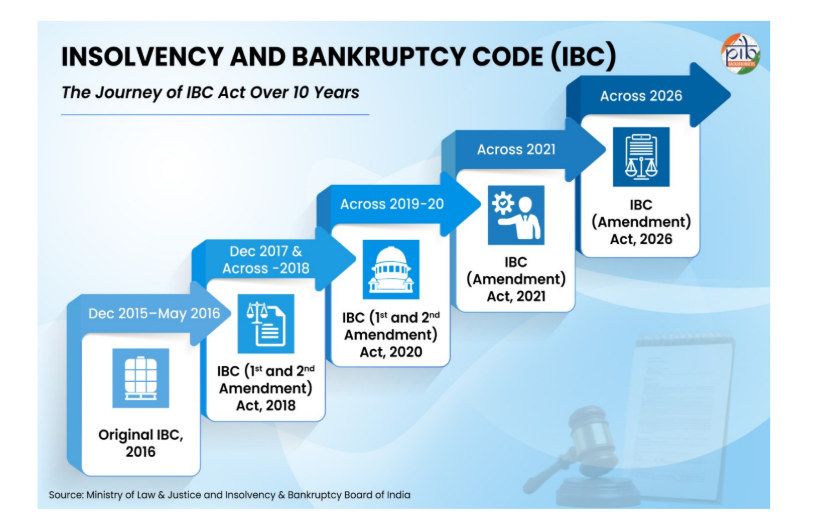
The IBC has evolved through several amendments.
- IBC, 2016:
Introduced a unified insolvency framework. - 2018 Amendment:
Strengthened creditor participation, changed voting thresholds and modified eligibility criteria under Section 29A. - 2019 Amendment:
Introduced an overall time limit of 330 days for completion of the process. - 2020 Amendment:
Added safeguards such as immunity for corporate debtors after resolution and suspension of proceedings for specified defaults during COVID-19. - 2021 Amendment:
Introduced pre-packaged insolvency resolution process for MSMEs. - 2026 Amendment:
Introduces reforms to improve timelines, creditor oversight, liquidation process and procedural clarity.
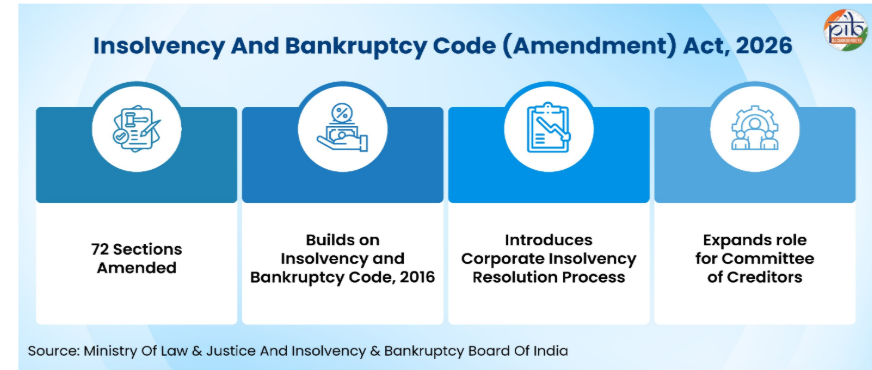
Insolvency and Bankruptcy Code Amendment Act, 2026
The IBC Amendment Act, 2026 builds on the experience of the 2016 Code. It seeks to address delays, legal ambiguities and operational challenges in insolvency resolution and liquidation.
It introduces reforms across different stages of the insolvency process. The amendment strengthens timelines for admission and approval of cases, expands the role of the Committee of Creditors during liquidation and clarifies provisions relating to security interests, avoidance transactions and resolution plans.
Benefits of IBC Amendment Act, 2026
- Eases burden on judicial system:
Clearer rules, better timelines and structured procedures can reduce unnecessary litigation and repeated delays. - Establishes a time-bound framework:
The amendment strengthens timelines for admission, resolution, liquidation and approval of cases. - Protects interests of stakeholders:
It balances the interests of creditors, debtors, guarantors, dissenting creditors and other stakeholders. - Ensures efficient resolution process:
Faster appointment of resolution professionals, improved cooperation and better information access can improve resolution quality. - Promotes ease of doing business:
A predictable insolvency system improves investor confidence and strengthens India’s business environment. - Strengthens credibility and speed:
Clear definitions, creditor oversight and procedural safeguards make the process faster and more credible. - Improves chances of recovery:
Inclusion of guarantor assets, continuation of avoidance transaction proceedings and stronger creditor supervision can improve recovery for lenders. - Balances interests of creditors:
The amendment protects dissenting creditors and strengthens the role of the Committee of Creditors across resolution and liquidation stages.
Major Changes in the Amendment Act
1. Clearer Definitions
- The amendment defines important terms such as:
- Service provider
- Avoidance transaction
- Fraudulent trading
- Wrongful trading
- A service provider includes insolvency professionals, insolvency professional agencies, information utilities and other notified persons registered with IBBI.
- The amendment also clarifies the meaning of security interest.
- Security interest will exist only where it arises through an agreement or arrangement between parties.
2. Faster Entry into Insolvency Process
- The Adjudicating Authority must decide insolvency applications within 14 days.
- If the timeline is not followed, reasons must be recorded.
- This creates greater accountability and protects the time-bound nature of the Code.
3. Discipline in Withdrawal of Cases
- Earlier, cases could be withdrawn even at advanced stages.
- The amendment restricts withdrawal:
- It cannot happen before the Committee of Creditors is constituted.
- It is barred after resolution plans are invited.
- This prevents disruption and protects stakeholder interests.
4. Stronger Moratorium Protection
- The amendment clarifies that moratorium protection will apply in situations involving guarantees.
- This prevents creditors from bypassing the insolvency process through parallel actions.
- It gives the company under resolution a stable environment.
5. Better Access to Information
- The amendment simplifies the appointment of resolution professionals.
- It expands the obligation of cooperation.
- Employees, promoters and associated persons must assist the resolution professional.
- This can reduce delays and improve information flow.
6. Larger Role for Creditors
- The role of the Committee of Creditors is extended into the liquidation stage.
- Creditors can supervise liquidation and replace the liquidator where required.
- This ensures continuity of creditor oversight throughout the insolvency lifecycle.
7. Accountability for Past Transactions
- Proceedings relating to avoidance transactions and fraudulent or wrongful trading can continue even after resolution or liquidation.
- Creditors, members or partners may approach the Adjudicating Authority if such transactions are not reported.
- This strengthens accountability for past misconduct.
8. Expansion of Asset Base
- The amendment allows assets of guarantors to be included in the resolution process in specified cases.
- This can improve recovery in complex financial structures involving guarantees.
9. Fair Treatment of Creditors
- The amendment protects dissenting creditors.
- Dissenting creditors must receive at least the lower of:
- Liquidation value
- Amount receivable under the resolution plan as per Section 53 waterfall
- This reduces disputes and improves confidence in resolution plans.
10. Practical and Enforceable Resolution Plans
- The amendment allows phased approval of resolution plans.
- It protects licences, permits and regulatory approvals in specified cases.
- It clarifies treatment of past claims.
- This makes resolution plans more practical and business-friendly.
11. Flexibility Before Liquidation
- The amendment allows one-time restoration of the resolution process within defined timelines before liquidation is finalised.
- This gives viable businesses another chance for revival.
12. Structured Liquidation
- The amendment introduces clearer timelines and better supervision for liquidation.
- Even when resolution fails, the exit process becomes more orderly and time-bound.
13. New Creditor-led Insolvency Process
- A new mechanism allows creditors to initiate insolvency directly.
- It is subject to defined approval thresholds and procedural safeguards.
- It reduces dependency on formal admission stages and makes the system more responsive.
Challenges
- Delays in adjudication may still continue if tribunal capacity is weak.
- NCLT and NCLAT require adequate judges, staff and digital infrastructure.
- Complex corporate structures may create difficulty in including guarantor assets.
- Creditor-led processes need safeguards against misuse.
- Protection of small operational creditors remains important.
- Resolution professionals need stronger capacity and accountability.
- Excessive litigation can still delay realisation of value.
- Coordination with sectoral regulators may be difficult where licences and permissions are involved.
Way Forward
- Strengthen NCLT and NCLAT capacity.
- Improve digital case management in insolvency proceedings.
- Train insolvency professionals and improve regulatory supervision.
- Ensure fair treatment of operational and dissenting creditors.
- Reduce unnecessary litigation through clearer procedural rules.
- Improve coordination between IBBI, courts and sectoral regulators.
- Promote early warning systems for financial distress.
- Ensure that the creditor-led process is transparent and not misused.
- Maintain the balance between recovery, revival and stakeholder protection.
Conclusion
The IBC, 2016 transformed India’s insolvency system by creating a unified, creditor-driven and time-bound framework. The IBC Amendment Act, 2026 strengthens this system by improving timelines, creditor oversight, legal clarity and practical resolution. Its success will depend on tribunal efficiency, institutional capacity, fair treatment of stakeholders and reduced litigation.
UPSC PYQ
Q. The Insolvency and Bankruptcy Board of India (IBBI) was established in the year
A. 2014
B. 2015
C. 2016
D. 2017
Answer: C
Explanation
Option C is correct: The Insolvency and Bankruptcy Board of India (IBBI) was established on 1 October 2016.
It is a statutory body established under the Insolvency and Bankruptcy Code, 2016.
The IBBI acts as the regulator of India’s insolvency ecosystem. It regulates:
- Insolvency Professionals
- Insolvency Professional Agencies
- Information Utilities
- Insolvency resolution process for companies, partnership firms and individuals
Additional Information
The Insolvency and Bankruptcy Code, 2016 was enacted to create a single, time-bound and creditor-driven insolvency resolution framework in India.
It replaced the earlier fragmented system involving multiple laws and forums.
CARE MCQ
Q. With reference to the Insolvency and Bankruptcy Code, 2016, consider the following statements:
- It created a unified insolvency framework in India.
- It shifted the process towards a creditor-driven resolution model.
- It completely removed the role of adjudicating authorities.
Which of the above statements are correct?
A. 1 and 2 only
B. 2 and 3 only
C. 1 and 3 only
D. 1, 2 and 3
Answer: A
Explanation:
- Statement 1 is correct: IBC consolidated multiple insolvency laws into a unified framework.
- Statement 2 is correct: It made creditors central to the resolution process.
- Statement 3 is incorrect: NCLT continues to act as the adjudicating authority.
Mains Practice Question
Question
The Insolvency and Bankruptcy Code has transformed India’s financial distress resolution framework. Discuss the significance of the IBC Amendment Act, 2026 in strengthening this framework.
FAQs
1. What is the Insolvency and Bankruptcy Code?
The Insolvency and Bankruptcy Code, 2016 is India’s main law for resolving insolvency of companies, partnership firms and individuals in a structured and time-bound manner.
2. Why was the IBC introduced?
IBC was introduced to replace multiple fragmented laws with a single insolvency framework. It aimed to reduce delays, improve recovery for creditors and revive viable businesses.
3. What is CIRP?
CIRP stands for Corporate Insolvency Resolution Process. It is the process through which a financially distressed company is resolved under the IBC.
4. What is the role of the Committee of Creditors?
The Committee of Creditors evaluates resolution plans and takes major commercial decisions regarding the future of the distressed company.
5. What is the role of IBBI?
The Insolvency and Bankruptcy Board of India regulates the insolvency ecosystem, including insolvency professionals and related institutions.
6. What is the role of NCLT under IBC?
The National Company Law Tribunal acts as the adjudicating authority for corporate insolvency cases.