Table of Contents
Relevance: TGPSC Group I: Telangana Economy, Rural Development, Panchayati Raj Institutions.
For Prelims:
- 16th Finance Commission, Rural Local Bodies, Gram Panchayats, Mandal Parishads, Zilla Parishads, Part IX of the Constitution, e-GramSwaraj Portal, Tied Grants, Untied Grants.
For Mains:
- Fiscal Devolution, Panchayati Raj Empowerment, Rural Infrastructure, Decentralised Planning, Local Governance, Gram Sabha Accountability, Own Revenue Sources, Performance-linked Grants.
Why in News?
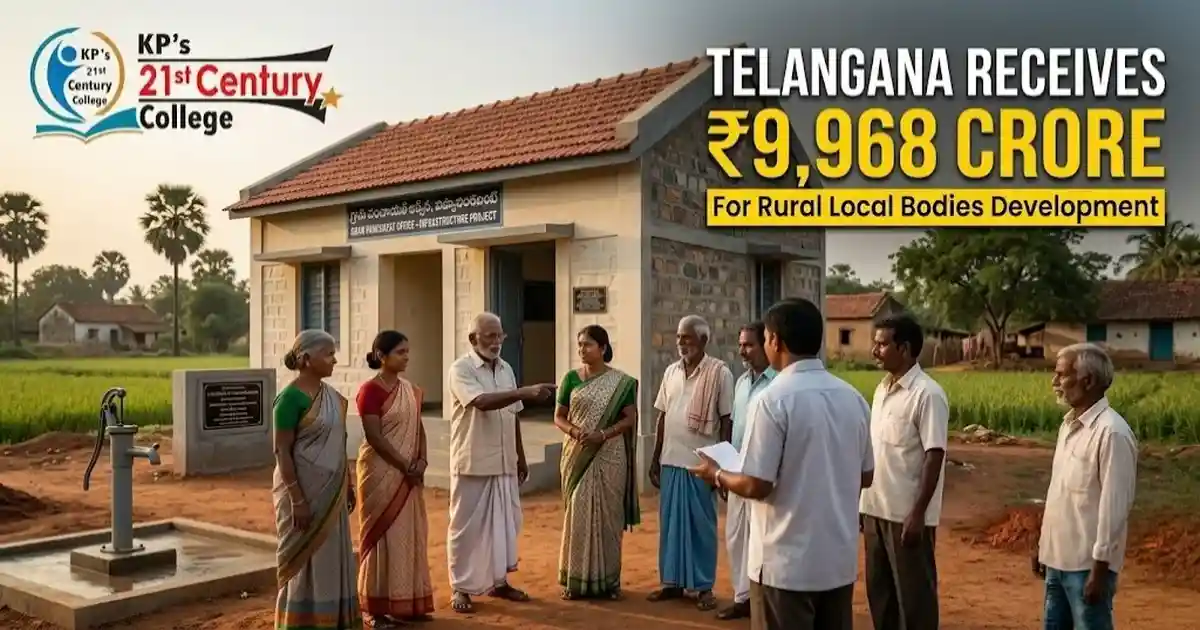
The 16th Finance Commission has allocated ₹9,968 crore to Telangana for strengthening rural local bodies during the five-year period from 2026–27 to 2030–31.
The grant is part of the total ₹4,35,236 crore recommended for rural local bodies across all States. The funds will support gram panchayats, mandal parishads and zilla parishads in improving rural infrastructure and public services.
About the Allocation
- Telangana will receive ₹9,968 crore for rural local bodies.
- The grants are meant for the five-year period from 2026–27 to 2030–31.
- The funds will be transferred to the State government treasury account.
- The State must release the funds to rural local bodies within 10 working days.
- Only duly elected local bodies constituted under Part IX of the Constitution will be eligible for uninterrupted release of funds.
Basis of Fund Allocation
The allocation to Telangana was calculated using two main criteria:
- 90% weightage for rural population
- 10% weightage for geographical area
Telangana’s share was based on:
- 1.92% of India’s rural population
- 0.37% of India’s geographical area
Based on this formula, Telangana received ₹9,968 crore from the total rural local body grants.
Distribution of Funds
| Rural Local Body | Share of Funds |
| Gram Panchayats | 80% |
| Mandal Parishads | 10% |
| Zilla Parishads | 10% |
- The grants will be released in two equal instalments every year.
- The first instalment will be released in June.
- The second instalment will be released in October.
Conditions for Release
- The State must submit budget allocations made for Panchayat Raj and Rural Development departments.
- Audit reports of local bodies for the financial year 2025–26 must be submitted to receive the first instalment.
- The second instalment will be released only after submission of:
- Utilisation certificates
- Progress reports
- Details of expenditure of the first instalment
- The Centre will also consider the performance of States in providing financial resources to local bodies.
Performance-linked Grants
- 20% of grants will be linked to performance.
- Gram panchayats will be assessed based on:
- Tax collections
- Improvement of own revenue sources
- Proper use of funds
- Submission of reports
- Compliance with guidelines
This aims to encourage local bodies to improve financial discipline and accountability.
Permitted Use of Grants
The funds must be used only for rural infrastructure and public services such as:
- Waste management
- Drinking water supply
- Sanitation
- Rural roads
- Street lighting
- Other village-level public services
The grants must not be used for payment of:
- Salaries
- Pensions
Tied and Untied Grants
- Tied grants must be used only for the specific purposes for which they are given.
- Untied grants provide some flexibility to local bodies.
- However, not more than 20% of untied funds can be spent on construction and maintenance of roads.
- Fund utilisation must be approved through:
- Gram Sabha resolutions
- Mandal Parishad meetings
- Zilla Parishad meetings
- All details must be uploaded on the e-GramSwaraj portal.
Accountability and Monitoring
- Local bodies must submit quarterly and annual progress reports to the State government.
- The State government must submit consolidated reports to the Centre.
- Expenditure details must be made available to the public regularly.
- Audit deficiencies must be corrected immediately.
- Legal action must be taken if misuse of grants or irregularities are found.
Challenges
- Timely transfer of funds within 10 working days may require strong administrative coordination.
- Many local bodies may have weak capacity for planning and execution.
- Audit compliance and reporting may be uneven across districts.
- Own revenue mobilisation by gram panchayats may remain limited.
- Misuse or diversion of funds can affect outcomes.
- Strict restrictions on salary and pension payments may create pressure where administrative costs are high.
- Performance-linked grants may disadvantage weaker panchayats if they lack capacity.
Way Forward
- Build technical and financial capacity of rural local bodies.
- Train gram panchayat officials in budgeting, accounting and e-GramSwaraj use.
- Ensure timely State-level transfer of grants.
- Strengthen Gram Sabha participation in project approval.
- Improve own revenue sources through local tax collection and user charges.
- Conduct regular social audits and public disclosure of expenditure.
- Prioritise drinking water, sanitation, waste management and basic rural services.
- Provide handholding support to weaker panchayats.
- Ensure legal action in cases of misuse or irregularities.
Conclusion
The allocation of ₹9,968 crore to Telangana’s rural local bodies is an important step towards strengthening Panchayati Raj institutions and rural infrastructure. The grants can improve drinking water, sanitation, waste management, roads, street lighting and other basic services.
Their success will depend on timely fund release, Gram Sabha-based planning, transparent reporting, proper audits and strong local capacity. If used effectively, these funds can deepen grassroots democracy and support inclusive rural development in Telangana.
CARE MCQ
Q. With reference to the 16th Finance Commission grants for Telangana’s rural local bodies, consider the following statements:
- Telangana has been allocated ₹9,968 crore for rural local bodies.
- The grants are meant for gram panchayats, mandal parishads and zilla parishads.
- The grants can be used for payment of salaries and pensions.
Which of the above statements are correct?
A. 1 and 2 only
B. 2 and 3 only
C. 1 and 3 only
D. 1, 2 and 3
Answer: A
Explanation:
- Statement 1 is correct: Telangana has been allocated ₹9,968 crore.
- Statement 2 is correct: The funds are meant for rural local bodies such as gram panchayats, mandal parishads and zilla parishads.
- Statement 3 is incorrect: The grants cannot be used for salaries or pensions.
Q. With reference to the distribution of rural local body grants in Telangana, consider the following pairs:
| Rural Local Body | Share of Funds |
| Gram Panchayats | 80% |
| Mandal Parishads | 10% |
| Zilla Parishads | 10% |
How many of the above pairs are correctly matched?
A. Only one
B. Only two
C. All three
D. None
Answer: C
Explanation:
- Pair 1 is correct: Gram Panchayats will receive 80%.
- Pair 2 is correct: Mandal Parishads will receive 10%.
- Pair 3 is correct: Zilla Parishads will receive 10%.
FAQs
1. How much grant has Telangana received for rural local bodies?
Telangana has been allocated ₹9,968 crore by the 16th Finance Commission.
2. What is the period of this allocation?
The allocation covers five years from 2026–27 to 2030–31.
3. Which rural local bodies will receive the funds?
The funds will go to gram panchayats, mandal parishads and zilla parishads.
4. What share will gram panchayats receive?
Gram panchayats will receive 80% of the total allocation.
5. What share will mandal parishads and zilla parishads receive?
Mandal parishads and zilla parishads will receive 10% each.
6. What can the funds be used for?
The funds can be used for waste management, drinking water, sanitation, rural roads, street lighting and other public services.
7. Can the grants be used for salaries or pensions?
No. The grants cannot be used for payment of salaries or pensions.
8. What is e-GramSwaraj?
e-GramSwaraj is an online platform used for planning, accounting and monitoring of Panchayati Raj activities.