Relevance: APPSC: Polity & Governance, Judiciary, Governance, Digital Administration, E-Courts, Legal Reforms.
For Prelims:
- Andhra Pradesh Electronic Processes Rules 2025, Electronic Summons, Digital Warrants, WhatsApp Summons, Email Service, Digital Signature, Encryption, e-Courts, NSTEP.
For Mains:
- Judicial Efficiency, Speedy Trial, Digital Justice, Procedural Reform, Access to Justice, Due Process, Data Security, Court Modernisation.
Why in News?
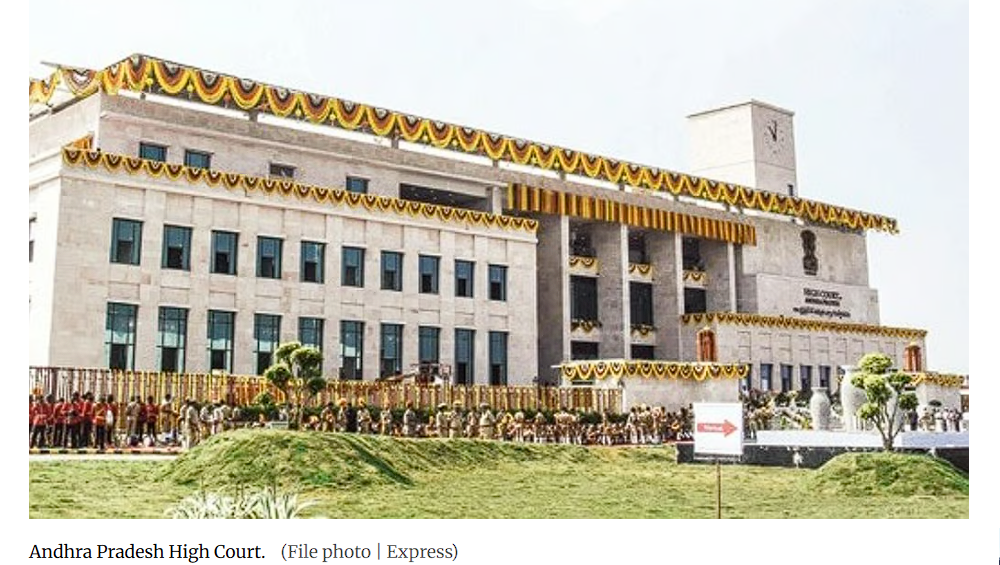
The Andhra Pradesh High Court has introduced the Andhra Pradesh Electronic Processes (Issuance, Service and Execution) Rules, 2025 to modernise the service of court summons, warrants and other notices through electronic platforms. The rules were published in the Andhra Pradesh Gazette through G.O.Ms.No.107, Home (Courts-B), dated 22 May 2026.
The reform allows courts to use digital modes such as email and messaging applications for faster communication with accused persons, witnesses, victims and other parties involved in legal proceedings.
What are Electronic Process Rules?
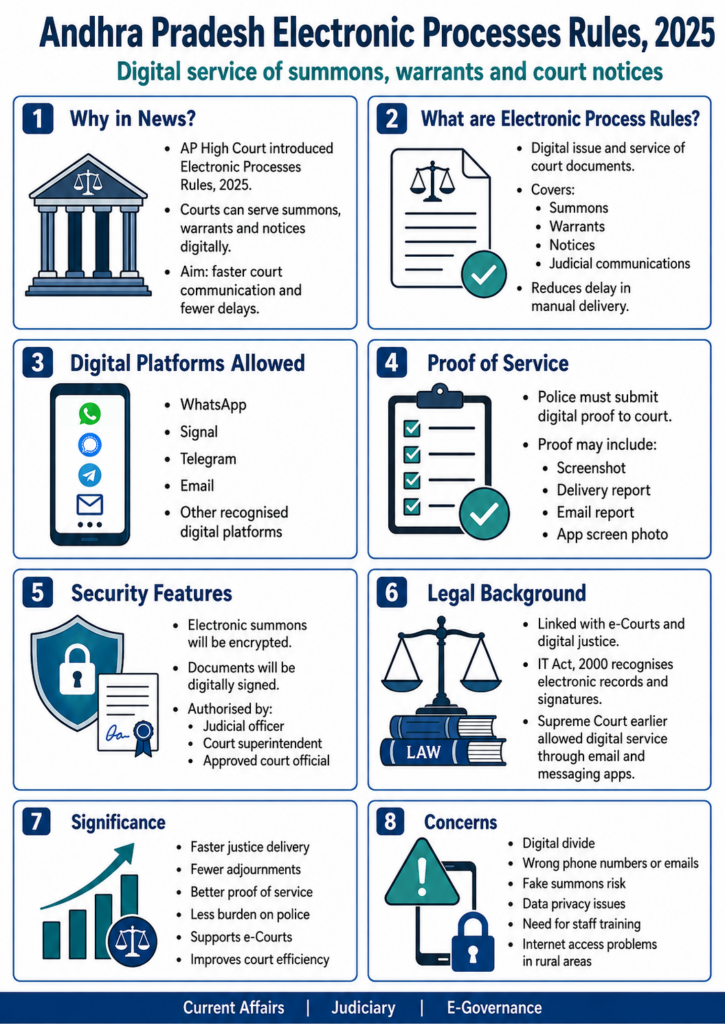
- Electronic process refers to the digital issue, service and execution of court processes.
- Court processes include:
- Summons
- Warrants
- Notices
- Other judicial communications
- The new rules allow courts and police to use electronic platforms for delivering these documents.
- The aim is to reduce delays caused by manual delivery of court notices.
Major Features
- Courts can issue summons, warrants and notices through electronic platforms.
- The rules apply to the issue, service and execution of court processes.
- The system is expected to reduce delays in criminal and other legal proceedings.
- Existing physical methods of service will continue where electronic service is not possible.
- Police officers must record and submit proof of service before the court.
Digital Platforms Allowed
The new process allows delivery through:
- Signal
- Telegram
- Other recognised electronic communication platforms
Electronic communication can help courts deal with excuses such as non-receipt of summons or absence from station, which often delay proceedings.
Proof of Service
- Police officials must submit digital proof of successful delivery to the court.
- Proof may include:
- Screenshot of the message
- Photo of the application screen
- Delivery report
- Email service provider report
- If electronic service fails or bounces back, the officer must prepare a report with relevant details and proceed through other legally accepted methods. The official rules provide for reporting failed electronic delivery with details such as mobile number, messaging application and screenshot or photo.
Security and Authenticity
- Electronic summons and warrants will be encrypted.
- They will be digitally signed by authorised officials.
- The authorised official may be:
- Judicial officer
- Court superintendent
- Other authorised court official
- This is important to ensure that the electronic process is genuine and secure.
Legal Background
- Digital service of legal documents is part of the larger movement towards e-Courts and modern justice delivery.
- The Information Technology Act, 2000 gives legal recognition to electronic records and electronic signatures. It also supports the use of electronic documents in legal processes.
- During the COVID-19 period, the Supreme Court allowed service of notices, summons and pleadings through email, fax and instant messaging services such as WhatsApp, Telegram and Signal, along with email service.
Significance
- Reduces delay in service of summons and warrants.
- Supports speedy trial and timely court proceedings.
- Helps courts avoid repeated adjournments due to non-service of notices.
- Saves time and administrative cost for police and courts.
- Promotes digital transformation of the judiciary.
- Improves tracking and accountability in the service of court processes.
- Helps victims, witnesses and accused persons receive court communication quickly.
- Strengthens the larger e-Courts ecosystem.
Challenges
- Digital divide may affect persons without smartphones or internet access.
- Wrong phone numbers or email IDs may lead to failed delivery.
- Screenshot-based proof may need strong verification standards.
- Privacy and data protection concerns may arise.
- Cyber fraud or fake summons may increase if public awareness is weak.
- Rural areas may face connectivity issues.
- Police and court staff need training in digital process handling.
Way Forward
- Build a verified database of phone numbers and email IDs of parties.
- Use electronic service along with physical service where necessary.
- Train police and court staff in digital evidence, screenshots and delivery reports.
- Ensure strong encryption and secure digital signatures.
- Create public awareness on how to verify genuine court summons.
- Provide alternative service methods for digitally excluded citizens.
- Integrate the system with e-Courts and National Service and Tracking of Electronic Processes.
Conclusion
The Andhra Pradesh Electronic Processes Rules, 2025 mark an important step in modernising justice delivery. By allowing courts to serve summons and warrants through digital platforms, the rules can reduce delays, improve accountability and support speedy trial.
However, digital justice must also protect due process. Secure authentication, proper proof of delivery, data privacy, staff training and safeguards for digitally excluded citizens are essential for the success of this reform.
CARE MCQ
Q. With reference to the Andhra Pradesh Electronic Processes Rules, 2025, consider the following statements:
- They allow electronic service of summons and warrants.
- They permit use of platforms such as WhatsApp, Telegram and email.
- They completely abolish physical service of court processes.
Which of the above statements are correct?
A. 1 and 2 only
B. 2 and 3 only
C. 1 and 3 only
D. 1, 2 and 3
Answer: A
Explanation:
- Statement 1 is correct: The rules allow electronic issue, service and execution of court processes.
- Statement 2 is correct: Messaging platforms and email may be used.
- Statement 3 is incorrect: Physical service can still be used where electronic service is not possible.
FAQs
1. What are the Andhra Pradesh Electronic Processes Rules, 2025?
They are rules introduced to allow courts to issue, serve and execute summons, warrants and notices through electronic platforms.
2. Which platforms can be used?
Platforms such as WhatsApp, Signal, Telegram, email and other electronic communication modes can be used.
3. Why are these rules important?
They can reduce delays in court proceedings and improve the speed of justice delivery.
4. How will courts verify delivery?
Police officials may submit screenshots, delivery reports or other digital proof before the court.
5. Are electronic summons legally valid?
Yes, if issued and served according to the rules and supported by valid proof of delivery.
6. Will physical summons stop completely?
No. Physical service can still be used where electronic service is not possible.
7. Why are digital signatures important?
Digital signatures help prove that the electronic summons or warrant is genuine.
8. What are the main concerns?
The main concerns are digital exclusion, fake summons, privacy risks, wrong contact details and protection of due process.
Relevance: UPSC: GS Paper III – Indian Economy, Maritime Trade, Ports, Infrastructure, Disaster Preparedness.
For Prelims:
- Salaya Port, Gulf of Kutch, Mechanised Sailing Vessels, MSVs, Strait of Hormuz, Immigration Check Post, Porbandar ICP, Bureau of Immigration, Indian Sailing Vessels Association, Merchant Shipping Act.
For Mains:
- Maritime Trade, Coastal Economy, Monsoon Risk, Port Infrastructure, Regulatory Flexibility, Small Vessel Trade, Gulf Trade, Immigration Governance, Maritime Safety.
Why in News?
A regulatory change has allowed mechanised sailing vessels belonging to Salaya and Okha ports in Gujarat to complete crew sign-on and sign-off formalities at the Porbandar Immigration Check Post.
This change has helped many Indian-flagged sailing vessels return safely to Gujarat before the rough monsoon season. It has also helped avoid a possible maritime trade crisis at a time when vessels were facing risks due to conflict in West Asia and insecurity near the Strait of Hormuz.
What are Mechanised Sailing Vessels?
- Mechanised Sailing Vessels, or MSVs, are small merchant cargo vessels.
- They are often called traditional dhows.
- They carry goods between India and countries in:
- Gulf region
- Middle East
- Indian Ocean region
- East Africa
- These vessels usually run on diesel.
- Their carrying capacity ranges from around 200 MT to 3,000 MT.
- Most such vessels carry around 1,000 MT of cargo.
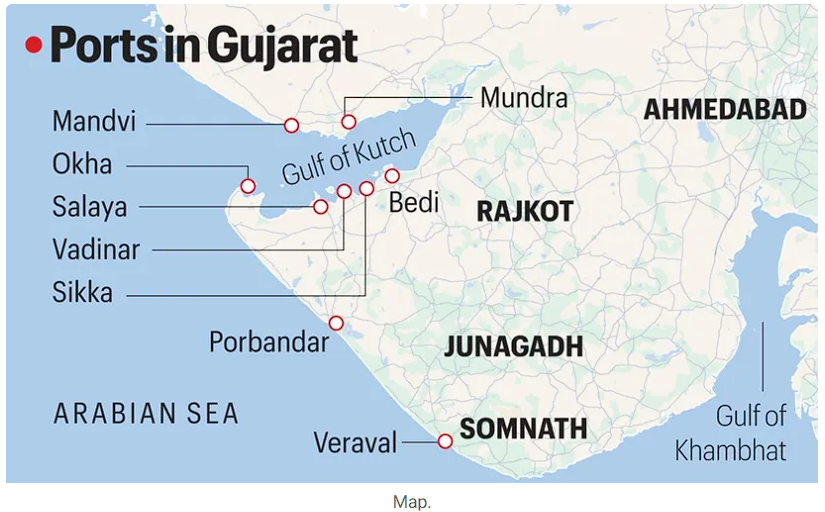
Port is Important
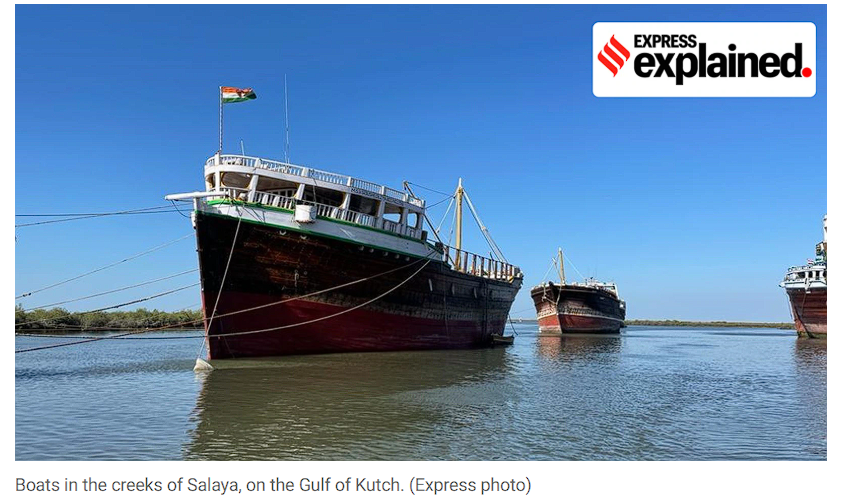
- Salaya is located in the Gulf of Kutch in Gujarat.
- It is one of the most important home ports for Indian-flagged MSVs.
- Salaya is a tidal port with creeks and mangroves.
- These natural features protect vessels from rough sea conditions.
- It can accommodate and beach a large number of boats during the monsoon season.
- It is also known for:
- Boat repair
- Painting
- Cleaning
- Dry-dock work
- Seaworthiness inspection
- Repair costs are also lower at Salaya compared to many other ports.
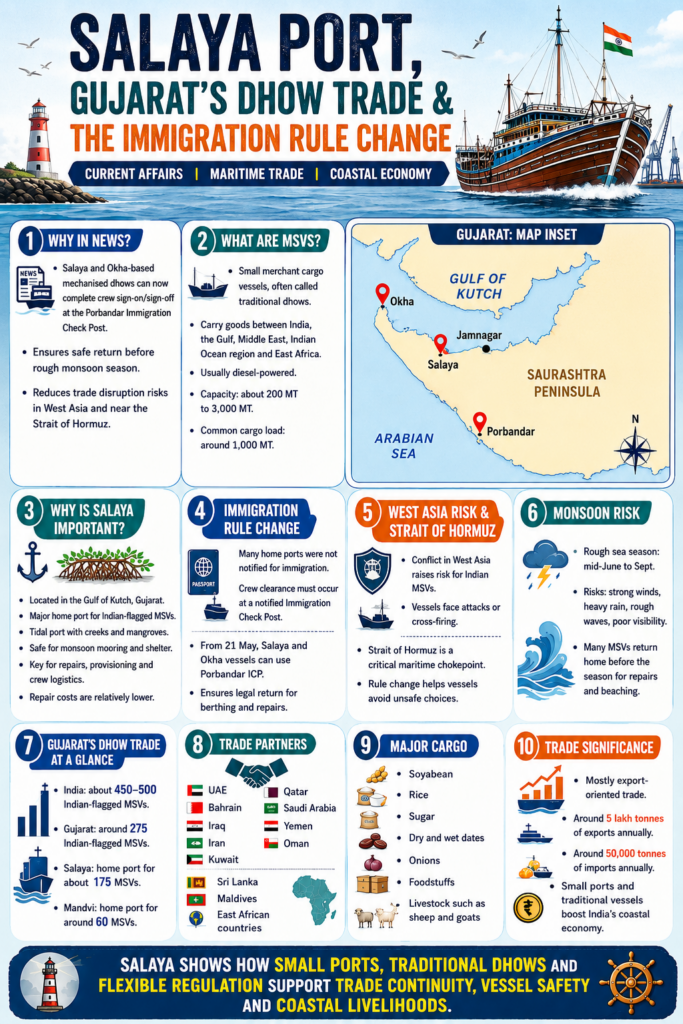
Immigration Rule Change
- Earlier, many MSVs faced problems because their home ports were not notified for immigration.
- Crew members must complete immigration formalities at a notified Immigration Check Post.
- From May 21, MSVs whose home ports are Salaya and Okha were allowed to complete crew sign-on and sign-off at Porbandar ICP.
- This helped vessels legally return to Salaya and Okha for berthing and repairs.
- Police and immigration authorities can now process the crew at Porbandar while the vessels berth at their home ports.
Link with Iran War and Strait of Hormuz
- The conflict in West Asia created safety concerns for Indian MSVs operating in Gulf waters.
- Some vessels were reportedly hit or caught in cross-firing.
- The Strait of Hormuz is a critical maritime chokepoint connecting the Gulf region with global sea routes.
- For small Indian vessels, sailing through conflict zones became risky.
- The rule change allowed vessels to avoid unsafe choices and return to Gujarat before the monsoon.
Monsoon and Rough Sea Risk
- The rough sea season generally lasts from mid-June to September.
- During this period, small vessels are at high risk due to:
- Strong winds
- Heavy rainfall
- Rough waves
- Poor visibility
- Under maritime practice, many MSVs return to home ports for beaching and repairs before the rough season.
- If they had been forced to dock at crowded or exposed ports, they could have suffered major damage.
Gujarat’s Dhow Trade
- India has around 450–500 Indian-flagged MSVs.
- Around 275 Indian-flagged MSVs are based in Gujarat.
- Salaya is the home port for around 175 MSVs.
- Mandvi is the home port for around 60 MSVs.
- MSVs trade with UAE, Bahrain, Iraq, Iran, Kuwait, Qatar, Saudi Arabia, Yemen, Oman, Sri Lanka, Maldives
- East African countries
- Major cargo includes:
- Soyabean
- Rice
- Sugar
- Dry and wet dates
- Onions
- Foodstuffs
- Livestock such as sheep and goats
- The trade is mostly export-oriented.
- Indian MSVs carry around 5 lakh tonnes of exports and about 50,000 tonnes of imports annually.
Significance
- Protects small Indian merchant vessels during the monsoon season.
- Supports Gujarat’s traditional maritime economy.
- Helps avoid damage to vessels during rough sea conditions.
- Provides regulatory flexibility during emergency conditions.
- Supports export trade with Gulf, Indian Ocean and East African regions.
- Reduces pressure on crowded ports such as Porbandar, Okha, Sikka and Mundra.
- Shows the importance of smaller ports in India’s maritime trade.
- Strengthens coastal livelihood security for vessel owners, crews and repair workers.
Challenges
- Many traditional home ports do not have notified immigration facilities.
- Sudden legal changes can disrupt maritime trade.
- Small vessels are vulnerable to geopolitical risks in Gulf waters.
- Monsoon conditions create serious safety risks.
- Crowded and exposed ports may not provide enough protection.
- Docking at foreign ports is costly for small vessel owners.
- Regulatory delays can create uncertainty for crew and traders.
- Port infrastructure for small vessels remains limited.
Way Forward
- Notify more traditional sailing vessel ports for immigration facilities.
- Create permanent digital immigration support for MSVs.
- Improve coordination between the Bureau of Immigration, DG Shipping, port authorities and vessel associations.
- Develop Salaya and other traditional ports with better repair and safety facilities.
- Prepare a standard emergency protocol for vessels affected by war, weather or maritime insecurity.
- Strengthen maritime safety advisories for small vessels operating near conflict zones.
- Support traditional dhow trade as part of India’s coastal and export economy.
- Improve insurance, tracking and communication systems for MSVs.
Conclusion
The temporary immigration facility at Porbandar for vessels headed to Salaya and Okha helped prevent a possible maritime crisis. It allowed several Indian MSVs to return safely before the rough monsoon season and avoid dangerous routes near conflict-affected Gulf waters.
Salaya’s creeks, mangroves and repair facilities make it critical for Gujarat’s dhow trade. The episode shows that small ports and traditional vessels remain important to India’s maritime economy. A balanced policy must combine security, immigration control, port infrastructure and protection of coastal livelihoods.
CARE MCQ
Q. With reference to Salaya port, consider the following statements:
- It is located in the Gulf of Kutch.
- It is important for mechanised sailing vessels.
- It is known for sheltering vessels during the monsoon season.
Which of the above statements are correct?
A. 1 and 2 only
B. 2 and 3 only
C. 1 and 3 only
D. 1, 2 and 3
Answer: D
Explanation:
- Statement 1 is correct: Salaya is located in the Gulf of Kutch in Gujarat.
- Statement 2 is correct: It is a major home port for mechanised sailing vessels.
- Statement 3 is correct: Its creeks and mangroves help shelter vessels during rough sea conditions.
FAQs
1. Where is Salaya port located?
Salaya port is located in the Gulf of Kutch in Gujarat.
2. Why is Salaya important?
It is important because it provides shelter, repair and beaching facilities for mechanised sailing vessels during the monsoon season.
3. What are MSVs?
MSVs are Mechanised Sailing Vessels, small merchant cargo vessels used for trade with Gulf, Indian Ocean and East African countries.
4. What regulatory change helped MSVs?
MSVs belonging to Salaya and Okha were allowed to complete crew sign-on and sign-off at the Porbandar Immigration Check Post.
5. Why was this change needed?
It was needed because many home ports did not have notified immigration facilities, and vessels had to return safely before the monsoon.
6. How did the Iran war affect these vessels?
The conflict in West Asia increased risks for vessels operating near Gulf waters and the Strait of Hormuz.
7. What goods do Indian MSVs carry?
They carry goods such as rice, sugar, soyabean, dates, onions, foodstuffs and livestock.
8. Why are mangroves important at Salaya?
Mangroves and creeks help absorb wave energy and protect vessels from rough sea conditions.
Relevance: UPSC: GS Paper III – Indian Economy, Banking, Corporate Governance, Financial Sector Reforms, Ease of Doing Business.
For Prelims:
- Insolvency and Bankruptcy Code, 2016, IBBI, NCLT, NCLAT, CIRP, Committee of Creditors, Moratorium, Resolution Professional, Liquidation, Section 53 Waterfall.
For Mains:
- Creditor-driven Resolution, Time-bound Insolvency, Financial Discipline, Corporate Debt Resolution, Ease of Doing Business, Asset Value Maximisation, Banking Sector Recovery.
Why in News?
India’s insolvency framework has undergone a major transformation through the Insolvency and Bankruptcy Code, 2016. The Code introduced a unified, creditor-driven and time-bound mechanism for resolving financial distress.
Building on nearly a decade of implementation experience, the Insolvency and Bankruptcy Code (Amendment) Act, 2026 introduces several reforms to reduce delays, strengthen creditor oversight and improve procedural clarity. The amendment seeks to make insolvency resolution and liquidation more efficient, predictable and resolution-oriented.
Background: Need for Insolvency Reform
- Before the IBC, India’s insolvency resolution system was fragmented.
- Companies facing financial distress were dealt with under different laws and forums.
- These included:
- Companies Act
- Sick Industrial Companies Act
- Debt recovery mechanisms
- SARFAESI framework
- Secured creditor laws
- Multiple laws created overlapping jurisdiction and delays.
- Resolution processes often remained pending for years.
- Delay reduced asset value and weakened creditor confidence.
- There was no unified, time-bound and predictable framework.
- To address these problems, the Government introduced the Insolvency and Bankruptcy Code, 2016.
What is Insolvency and Bankruptcy Code?
- The Insolvency and Bankruptcy Code, 2016 is India’s principal insolvency law.
- It provides a unified framework for resolving insolvency of:
- Companies, Partnership firms, Individuals
- It shifted the system from a debtor-controlled model to a creditor-driven resolution framework.
- The main focus of the Code is:
- Timely resolution, Value maximisation, Protection of viable businesses Balanced treatment of stakeholders, Improved credit discipline
Corporate Insolvency Resolution Process
- The Corporate Insolvency Resolution Process is the main mechanism for resolving corporate insolvency.
- It is supervised by the National Company Law Tribunal.
- A Resolution Professional manages the affairs of the distressed company during the process.
- The Committee of Creditors evaluates and approves resolution plans.
- The CIRP was designed to be completed within 180 days, extendable up to 330 days in specified cases.
- If resolution fails, the company may move into liquidation.
Institutional Structure under IBC
- Insolvency and Bankruptcy Board of India:
It is the regulator of the insolvency ecosystem. It frames regulations and supervises insolvency professionals and related institutions. - Insolvency Professionals:
They manage distressed companies, protect assets and conduct meetings of creditors. - National Company Law Tribunal:
It acts as the adjudicating authority for corporate insolvency cases. - National Company Law Appellate Tribunal:
It hears appeals against NCLT decisions. - Together, these institutions create a structured and legally enforceable insolvency resolution system.
Success of IBC
- The IBC has strengthened India’s credit and recovery ecosystem.
- Till March 2026, 8,987 CIRPs had been admitted.
- 1,419 corporate debtors were resolved through approved resolution plans.
- Creditors realised nearly ₹4.32 lakh crore through approved resolution plans.
- Recoveries exceeded 116.85% of liquidation value and more than 94.56% of fair value.
- The RBI’s Report on Trends and Progress of Banking in India for 2024–25 highlighted that IBC contributed significantly to recoveries by scheduled commercial banks.
- Studies also show that resolved firms witnessed improvement in:
- Sales growth, Employment expenses, Asset growth, Market valuation Profitability, Liquidity
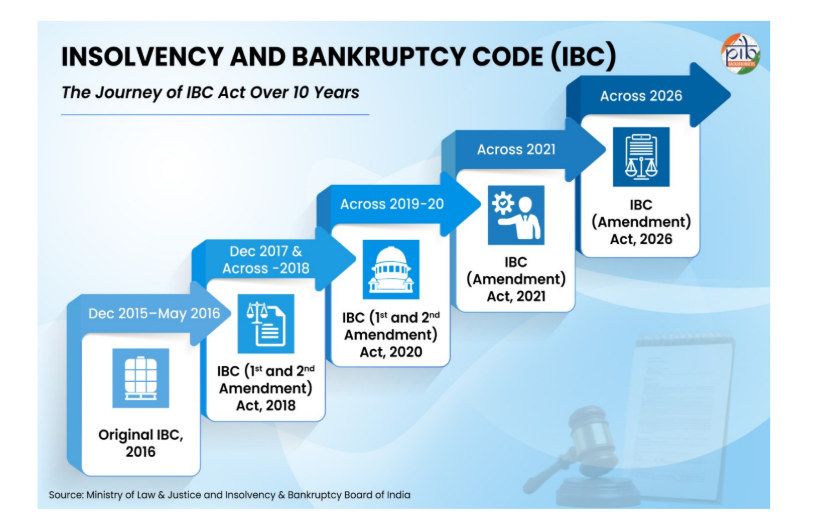
Legislative Progression of IBC
The IBC has evolved through several amendments.
- IBC, 2016:
Introduced a unified insolvency framework. - 2018 Amendment:
Strengthened creditor participation, changed voting thresholds and modified eligibility criteria under Section 29A. - 2019 Amendment:
Introduced an overall time limit of 330 days for completion of the process. - 2020 Amendment:
Added safeguards such as immunity for corporate debtors after resolution and suspension of proceedings for specified defaults during COVID-19. - 2021 Amendment:
Introduced pre-packaged insolvency resolution process for MSMEs. - 2026 Amendment:
Introduces reforms to improve timelines, creditor oversight, liquidation process and procedural clarity.
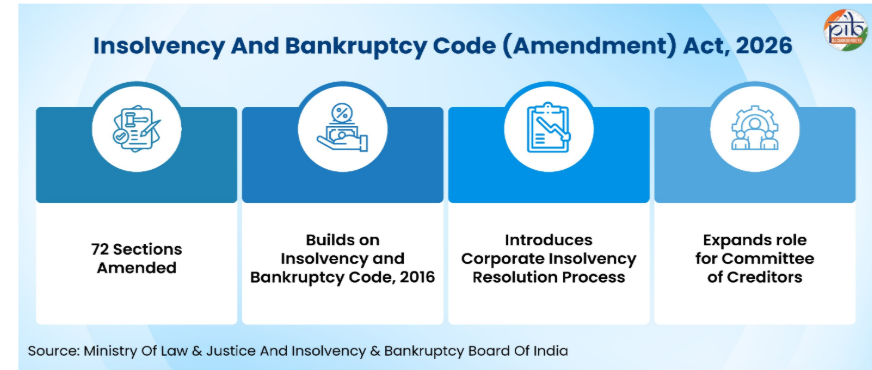
Insolvency and Bankruptcy Code Amendment Act, 2026
The IBC Amendment Act, 2026 builds on the experience of the 2016 Code. It seeks to address delays, legal ambiguities and operational challenges in insolvency resolution and liquidation.
It introduces reforms across different stages of the insolvency process. The amendment strengthens timelines for admission and approval of cases, expands the role of the Committee of Creditors during liquidation and clarifies provisions relating to security interests, avoidance transactions and resolution plans.
Benefits of IBC Amendment Act, 2026
- Eases burden on judicial system:
Clearer rules, better timelines and structured procedures can reduce unnecessary litigation and repeated delays. - Establishes a time-bound framework:
The amendment strengthens timelines for admission, resolution, liquidation and approval of cases. - Protects interests of stakeholders:
It balances the interests of creditors, debtors, guarantors, dissenting creditors and other stakeholders. - Ensures efficient resolution process:
Faster appointment of resolution professionals, improved cooperation and better information access can improve resolution quality. - Promotes ease of doing business:
A predictable insolvency system improves investor confidence and strengthens India’s business environment. - Strengthens credibility and speed:
Clear definitions, creditor oversight and procedural safeguards make the process faster and more credible. - Improves chances of recovery:
Inclusion of guarantor assets, continuation of avoidance transaction proceedings and stronger creditor supervision can improve recovery for lenders. - Balances interests of creditors:
The amendment protects dissenting creditors and strengthens the role of the Committee of Creditors across resolution and liquidation stages.
Major Changes in the Amendment Act
1. Clearer Definitions
- The amendment defines important terms such as:
- Service provider
- Avoidance transaction
- Fraudulent trading
- Wrongful trading
- A service provider includes insolvency professionals, insolvency professional agencies, information utilities and other notified persons registered with IBBI.
- The amendment also clarifies the meaning of security interest.
- Security interest will exist only where it arises through an agreement or arrangement between parties.
2. Faster Entry into Insolvency Process
- The Adjudicating Authority must decide insolvency applications within 14 days.
- If the timeline is not followed, reasons must be recorded.
- This creates greater accountability and protects the time-bound nature of the Code.
3. Discipline in Withdrawal of Cases
- Earlier, cases could be withdrawn even at advanced stages.
- The amendment restricts withdrawal:
- It cannot happen before the Committee of Creditors is constituted.
- It is barred after resolution plans are invited.
- This prevents disruption and protects stakeholder interests.
4. Stronger Moratorium Protection
- The amendment clarifies that moratorium protection will apply in situations involving guarantees.
- This prevents creditors from bypassing the insolvency process through parallel actions.
- It gives the company under resolution a stable environment.
5. Better Access to Information
- The amendment simplifies the appointment of resolution professionals.
- It expands the obligation of cooperation.
- Employees, promoters and associated persons must assist the resolution professional.
- This can reduce delays and improve information flow.
6. Larger Role for Creditors
- The role of the Committee of Creditors is extended into the liquidation stage.
- Creditors can supervise liquidation and replace the liquidator where required.
- This ensures continuity of creditor oversight throughout the insolvency lifecycle.
7. Accountability for Past Transactions
- Proceedings relating to avoidance transactions and fraudulent or wrongful trading can continue even after resolution or liquidation.
- Creditors, members or partners may approach the Adjudicating Authority if such transactions are not reported.
- This strengthens accountability for past misconduct.
8. Expansion of Asset Base
- The amendment allows assets of guarantors to be included in the resolution process in specified cases.
- This can improve recovery in complex financial structures involving guarantees.
9. Fair Treatment of Creditors
- The amendment protects dissenting creditors.
- Dissenting creditors must receive at least the lower of:
- Liquidation value
- Amount receivable under the resolution plan as per Section 53 waterfall
- This reduces disputes and improves confidence in resolution plans.
10. Practical and Enforceable Resolution Plans
- The amendment allows phased approval of resolution plans.
- It protects licences, permits and regulatory approvals in specified cases.
- It clarifies treatment of past claims.
- This makes resolution plans more practical and business-friendly.
11. Flexibility Before Liquidation
- The amendment allows one-time restoration of the resolution process within defined timelines before liquidation is finalised.
- This gives viable businesses another chance for revival.
12. Structured Liquidation
- The amendment introduces clearer timelines and better supervision for liquidation.
- Even when resolution fails, the exit process becomes more orderly and time-bound.
13. New Creditor-led Insolvency Process
- A new mechanism allows creditors to initiate insolvency directly.
- It is subject to defined approval thresholds and procedural safeguards.
- It reduces dependency on formal admission stages and makes the system more responsive.
Challenges
- Delays in adjudication may still continue if tribunal capacity is weak.
- NCLT and NCLAT require adequate judges, staff and digital infrastructure.
- Complex corporate structures may create difficulty in including guarantor assets.
- Creditor-led processes need safeguards against misuse.
- Protection of small operational creditors remains important.
- Resolution professionals need stronger capacity and accountability.
- Excessive litigation can still delay realisation of value.
- Coordination with sectoral regulators may be difficult where licences and permissions are involved.
Way Forward
- Strengthen NCLT and NCLAT capacity.
- Improve digital case management in insolvency proceedings.
- Train insolvency professionals and improve regulatory supervision.
- Ensure fair treatment of operational and dissenting creditors.
- Reduce unnecessary litigation through clearer procedural rules.
- Improve coordination between IBBI, courts and sectoral regulators.
- Promote early warning systems for financial distress.
- Ensure that the creditor-led process is transparent and not misused.
- Maintain the balance between recovery, revival and stakeholder protection.
Conclusion
The IBC, 2016 transformed India’s insolvency system by creating a unified, creditor-driven and time-bound framework. The IBC Amendment Act, 2026 strengthens this system by improving timelines, creditor oversight, legal clarity and practical resolution. Its success will depend on tribunal efficiency, institutional capacity, fair treatment of stakeholders and reduced litigation.
UPSC PYQ
Q. The Insolvency and Bankruptcy Board of India (IBBI) was established in the year
A. 2014
B. 2015
C. 2016
D. 2017
Answer: C
Explanation
Option C is correct: The Insolvency and Bankruptcy Board of India (IBBI) was established on 1 October 2016.
It is a statutory body established under the Insolvency and Bankruptcy Code, 2016.
The IBBI acts as the regulator of India’s insolvency ecosystem. It regulates:
- Insolvency Professionals
- Insolvency Professional Agencies
- Information Utilities
- Insolvency resolution process for companies, partnership firms and individuals
Additional Information
The Insolvency and Bankruptcy Code, 2016 was enacted to create a single, time-bound and creditor-driven insolvency resolution framework in India.
It replaced the earlier fragmented system involving multiple laws and forums.
CARE MCQ
Q. With reference to the Insolvency and Bankruptcy Code, 2016, consider the following statements:
- It created a unified insolvency framework in India.
- It shifted the process towards a creditor-driven resolution model.
- It completely removed the role of adjudicating authorities.
Which of the above statements are correct?
A. 1 and 2 only
B. 2 and 3 only
C. 1 and 3 only
D. 1, 2 and 3
Answer: A
Explanation:
- Statement 1 is correct: IBC consolidated multiple insolvency laws into a unified framework.
- Statement 2 is correct: It made creditors central to the resolution process.
- Statement 3 is incorrect: NCLT continues to act as the adjudicating authority.
Mains Practice Question
Question
The Insolvency and Bankruptcy Code has transformed India’s financial distress resolution framework. Discuss the significance of the IBC Amendment Act, 2026 in strengthening this framework.
FAQs
1. What is the Insolvency and Bankruptcy Code?
The Insolvency and Bankruptcy Code, 2016 is India’s main law for resolving insolvency of companies, partnership firms and individuals in a structured and time-bound manner.
2. Why was the IBC introduced?
IBC was introduced to replace multiple fragmented laws with a single insolvency framework. It aimed to reduce delays, improve recovery for creditors and revive viable businesses.
3. What is CIRP?
CIRP stands for Corporate Insolvency Resolution Process. It is the process through which a financially distressed company is resolved under the IBC.
4. What is the role of the Committee of Creditors?
The Committee of Creditors evaluates resolution plans and takes major commercial decisions regarding the future of the distressed company.
5. What is the role of IBBI?
The Insolvency and Bankruptcy Board of India regulates the insolvency ecosystem, including insolvency professionals and related institutions.
6. What is the role of NCLT under IBC?
The National Company Law Tribunal acts as the adjudicating authority for corporate insolvency cases.