Table of Contents
Relevance: UPSC: GS Paper III – Indian Economy, Banking, Corporate Governance, Financial Sector Reforms, Ease of Doing Business.
For Prelims:
- Insolvency and Bankruptcy Code, 2016, IBBI, NCLT, NCLAT, CIRP, Committee of Creditors, Moratorium, Resolution Professional, Liquidation, Section 53 Waterfall.
For Mains:
- Creditor-driven Resolution, Time-bound Insolvency, Financial Discipline, Corporate Debt Resolution, Ease of Doing Business, Asset Value Maximisation, Banking Sector Recovery.
Why in News?
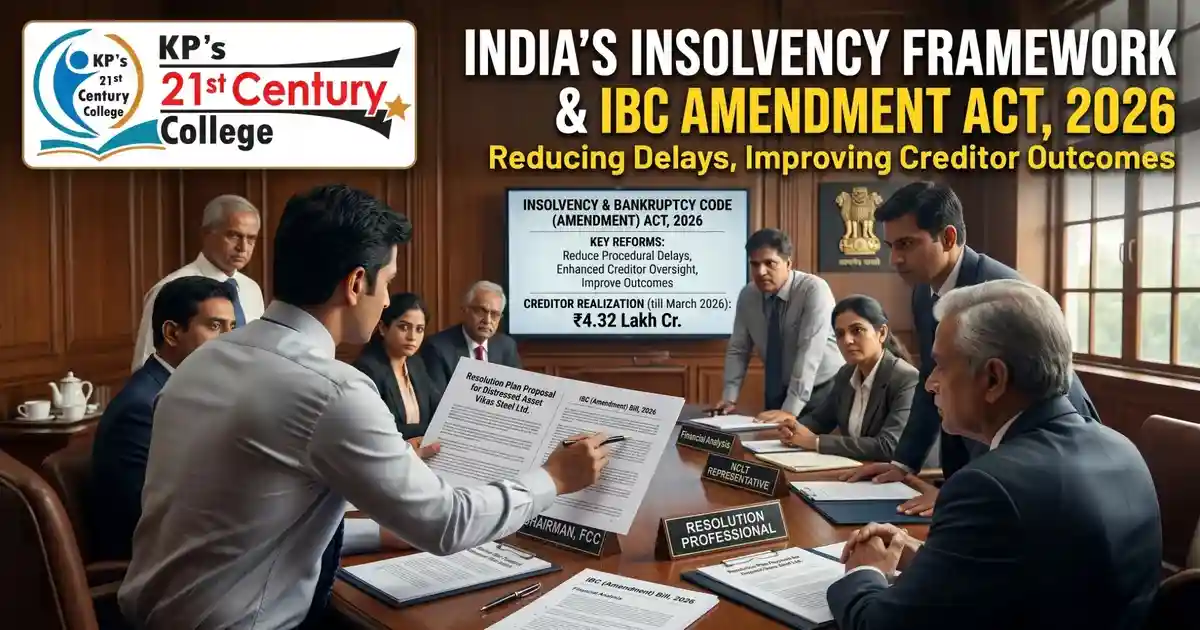
India’s insolvency framework has undergone a major transformation through the Insolvency and Bankruptcy Code, 2016. The Code introduced a unified, creditor-driven and time-bound mechanism for resolving financial distress.
Building on nearly a decade of implementation experience, the Insolvency and Bankruptcy Code (Amendment) Act, 2026 introduces several reforms to reduce delays, strengthen creditor oversight and improve procedural clarity. The amendment seeks to make insolvency resolution and liquidation more efficient, predictable and resolution-oriented.
Background: Need for Insolvency Reform
- Before the IBC, India’s insolvency resolution system was fragmented.
- Companies facing financial distress were dealt with under different laws and forums.
- These included:
- Companies Act
- Sick Industrial Companies Act
- Debt recovery mechanisms
- SARFAESI framework
- Secured creditor laws
- Multiple laws created overlapping jurisdiction and delays.
- Resolution processes often remained pending for years.
- Delay reduced asset value and weakened creditor confidence.
- There was no unified, time-bound and predictable framework.
- To address these problems, the Government introduced the Insolvency and Bankruptcy Code, 2016.
What is Insolvency and Bankruptcy Code?
- The Insolvency and Bankruptcy Code, 2016 is India’s principal insolvency law.
- It provides a unified framework for resolving insolvency of:
- Companies, Partnership firms, Individuals
- It shifted the system from a debtor-controlled model to a creditor-driven resolution framework.
- The main focus of the Code is:
- Timely resolution, Value maximisation, Protection of viable businesses Balanced treatment of stakeholders, Improved credit discipline
Corporate Insolvency Resolution Process
- The Corporate Insolvency Resolution Process is the main mechanism for resolving corporate insolvency.
- It is supervised by the National Company Law Tribunal.
- A Resolution Professional manages the affairs of the distressed company during the process.
- The Committee of Creditors evaluates and approves resolution plans.
- The CIRP was designed to be completed within 180 days, extendable up to 330 days in specified cases.
- If resolution fails, the company may move into liquidation.
Institutional Structure under IBC
- Insolvency and Bankruptcy Board of India:
It is the regulator of the insolvency ecosystem. It frames regulations and supervises insolvency professionals and related institutions. - Insolvency Professionals:
They manage distressed companies, protect assets and conduct meetings of creditors. - National Company Law Tribunal:
It acts as the adjudicating authority for corporate insolvency cases. - National Company Law Appellate Tribunal:
It hears appeals against NCLT decisions. - Together, these institutions create a structured and legally enforceable insolvency resolution system.
Success of IBC
- The IBC has strengthened India’s credit and recovery ecosystem.
- Till March 2026, 8,987 CIRPs had been admitted.
- 1,419 corporate debtors were resolved through approved resolution plans.
- Creditors realised nearly ₹4.32 lakh crore through approved resolution plans.
- Recoveries exceeded 116.85% of liquidation value and more than 94.56% of fair value.
- The RBI’s Report on Trends and Progress of Banking in India for 2024–25 highlighted that IBC contributed significantly to recoveries by scheduled commercial banks.
- Studies also show that resolved firms witnessed improvement in:
- Sales growth, Employment expenses, Asset growth, Market valuation Profitability, Liquidity
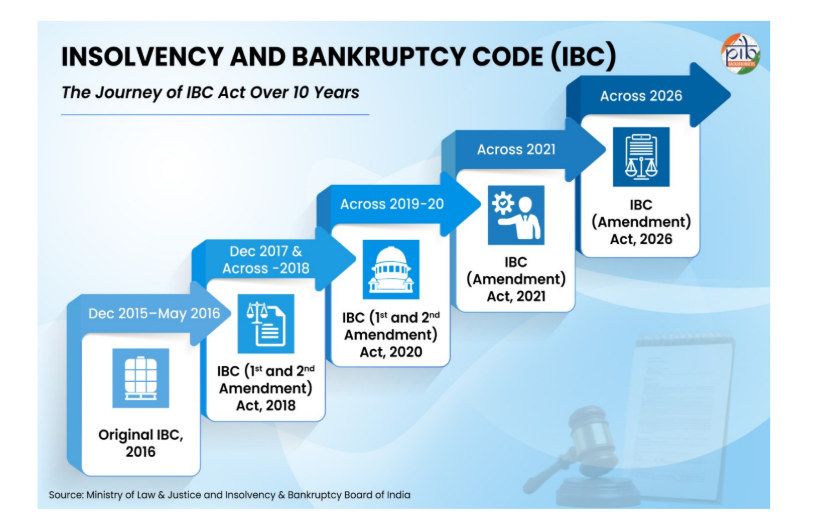
Legislative Progression of IBC
The IBC has evolved through several amendments.
- IBC, 2016:
Introduced a unified insolvency framework. - 2018 Amendment:
Strengthened creditor participation, changed voting thresholds and modified eligibility criteria under Section 29A. - 2019 Amendment:
Introduced an overall time limit of 330 days for completion of the process. - 2020 Amendment:
Added safeguards such as immunity for corporate debtors after resolution and suspension of proceedings for specified defaults during COVID-19. - 2021 Amendment:
Introduced pre-packaged insolvency resolution process for MSMEs. - 2026 Amendment:
Introduces reforms to improve timelines, creditor oversight, liquidation process and procedural clarity.
Insolvency and Bankruptcy Code Amendment Act, 2026
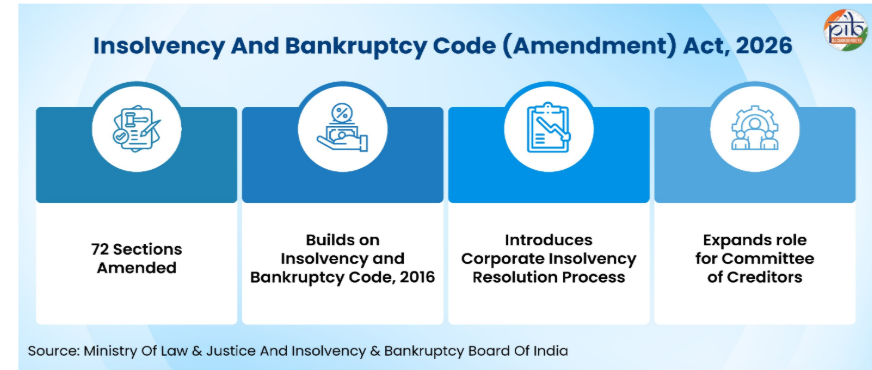
The IBC Amendment Act, 2026 builds on the experience of the 2016 Code. It seeks to address delays, legal ambiguities and operational challenges in insolvency resolution and liquidation.
It introduces reforms across different stages of the insolvency process. The amendment strengthens timelines for admission and approval of cases, expands the role of the Committee of Creditors during liquidation and clarifies provisions relating to security interests, avoidance transactions and resolution plans.
Benefits of IBC Amendment Act, 2026
- Eases burden on judicial system:
Clearer rules, better timelines and structured procedures can reduce unnecessary litigation and repeated delays. - Establishes a time-bound framework:
The amendment strengthens timelines for admission, resolution, liquidation and approval of cases. - Protects interests of stakeholders:
It balances the interests of creditors, debtors, guarantors, dissenting creditors and other stakeholders. - Ensures efficient resolution process:
Faster appointment of resolution professionals, improved cooperation and better information access can improve resolution quality. - Promotes ease of doing business:
A predictable insolvency system improves investor confidence and strengthens India’s business environment. - Strengthens credibility and speed:
Clear definitions, creditor oversight and procedural safeguards make the process faster and more credible. - Improves chances of recovery:
Inclusion of guarantor assets, continuation of avoidance transaction proceedings and stronger creditor supervision can improve recovery for lenders. - Balances interests of creditors:
The amendment protects dissenting creditors and strengthens the role of the Committee of Creditors across resolution and liquidation stages.
Major Changes in the Amendment Act
1. Clearer Definitions
- The amendment defines important terms such as:
- Service provider
- Avoidance transaction
- Fraudulent trading
- Wrongful trading
- A service provider includes insolvency professionals, insolvency professional agencies, information utilities and other notified persons registered with IBBI.
- The amendment also clarifies the meaning of security interest.
- Security interest will exist only where it arises through an agreement or arrangement between parties.
2. Faster Entry into Insolvency Process
- The Adjudicating Authority must decide insolvency applications within 14 days.
- If the timeline is not followed, reasons must be recorded.
- This creates greater accountability and protects the time-bound nature of the Code.
3. Discipline in Withdrawal of Cases
- Earlier, cases could be withdrawn even at advanced stages.
- The amendment restricts withdrawal:
- It cannot happen before the Committee of Creditors is constituted.
- It is barred after resolution plans are invited.
- This prevents disruption and protects stakeholder interests.
4. Stronger Moratorium Protection
- The amendment clarifies that moratorium protection will apply in situations involving guarantees.
- This prevents creditors from bypassing the insolvency process through parallel actions.
- It gives the company under resolution a stable environment.
5. Better Access to Information
- The amendment simplifies the appointment of resolution professionals.
- It expands the obligation of cooperation.
- Employees, promoters and associated persons must assist the resolution professional.
- This can reduce delays and improve information flow.
6. Larger Role for Creditors
- The role of the Committee of Creditors is extended into the liquidation stage.
- Creditors can supervise liquidation and replace the liquidator where required.
- This ensures continuity of creditor oversight throughout the insolvency lifecycle.
7. Accountability for Past Transactions
- Proceedings relating to avoidance transactions and fraudulent or wrongful trading can continue even after resolution or liquidation.
- Creditors, members or partners may approach the Adjudicating Authority if such transactions are not reported.
- This strengthens accountability for past misconduct.
8. Expansion of Asset Base
- The amendment allows assets of guarantors to be included in the resolution process in specified cases.
- This can improve recovery in complex financial structures involving guarantees.
9. Fair Treatment of Creditors
- The amendment protects dissenting creditors.
- Dissenting creditors must receive at least the lower of:
- Liquidation value
- Amount receivable under the resolution plan as per Section 53 waterfall
- This reduces disputes and improves confidence in resolution plans.
10. Practical and Enforceable Resolution Plans
- The amendment allows phased approval of resolution plans.
- It protects licences, permits and regulatory approvals in specified cases.
- It clarifies treatment of past claims.
- This makes resolution plans more practical and business-friendly.
11. Flexibility Before Liquidation
- The amendment allows one-time restoration of the resolution process within defined timelines before liquidation is finalised.
- This gives viable businesses another chance for revival.
12. Structured Liquidation
- The amendment introduces clearer timelines and better supervision for liquidation.
- Even when resolution fails, the exit process becomes more orderly and time-bound.
13. New Creditor-led Insolvency Process
- A new mechanism allows creditors to initiate insolvency directly.
- It is subject to defined approval thresholds and procedural safeguards.
- It reduces dependency on formal admission stages and makes the system more responsive.
Challenges
- Delays in adjudication may still continue if tribunal capacity is weak.
- NCLT and NCLAT require adequate judges, staff and digital infrastructure.
- Complex corporate structures may create difficulty in including guarantor assets.
- Creditor-led processes need safeguards against misuse.
- Protection of small operational creditors remains important.
- Resolution professionals need stronger capacity and accountability.
- Excessive litigation can still delay realisation of value.
- Coordination with sectoral regulators may be difficult where licences and permissions are involved.
Way Forward
- Strengthen NCLT and NCLAT capacity.
- Improve digital case management in insolvency proceedings.
- Train insolvency professionals and improve regulatory supervision.
- Ensure fair treatment of operational and dissenting creditors.
- Reduce unnecessary litigation through clearer procedural rules.
- Improve coordination between IBBI, courts and sectoral regulators.
- Promote early warning systems for financial distress.
- Ensure that the creditor-led process is transparent and not misused.
- Maintain the balance between recovery, revival and stakeholder protection.
Conclusion
The IBC, 2016 transformed India’s insolvency system by creating a unified, creditor-driven and time-bound framework. The IBC Amendment Act, 2026 strengthens this system by improving timelines, creditor oversight, legal clarity and practical resolution. Its success will depend on tribunal efficiency, institutional capacity, fair treatment of stakeholders and reduced litigation.
UPSC PYQ
Q. The Insolvency and Bankruptcy Board of India (IBBI) was established in the year
A. 2014
B. 2015
C. 2016
D. 2017
Answer: C
Explanation
Option C is correct: The Insolvency and Bankruptcy Board of India (IBBI) was established on 1 October 2016.
It is a statutory body established under the Insolvency and Bankruptcy Code, 2016.
The IBBI acts as the regulator of India’s insolvency ecosystem. It regulates:
- Insolvency Professionals
- Insolvency Professional Agencies
- Information Utilities
- Insolvency resolution process for companies, partnership firms and individuals
Additional Information
The Insolvency and Bankruptcy Code, 2016 was enacted to create a single, time-bound and creditor-driven insolvency resolution framework in India.
It replaced the earlier fragmented system involving multiple laws and forums.
CARE MCQ
Q. With reference to the Insolvency and Bankruptcy Code, 2016, consider the following statements:
- It created a unified insolvency framework in India.
- It shifted the process towards a creditor-driven resolution model.
- It completely removed the role of adjudicating authorities.
Which of the above statements are correct?
A. 1 and 2 only
B. 2 and 3 only
C. 1 and 3 only
D. 1, 2 and 3
Answer: A
Explanation:
- Statement 1 is correct: IBC consolidated multiple insolvency laws into a unified framework.
- Statement 2 is correct: It made creditors central to the resolution process.
- Statement 3 is incorrect: NCLT continues to act as the adjudicating authority.
Mains Practice Question
Question
The Insolvency and Bankruptcy Code has transformed India’s financial distress resolution framework. Discuss the significance of the IBC Amendment Act, 2026 in strengthening this framework.
FAQs
1. What is the Insolvency and Bankruptcy Code?
The Insolvency and Bankruptcy Code, 2016 is India’s main law for resolving insolvency of companies, partnership firms and individuals in a structured and time-bound manner.
2. Why was the IBC introduced?
IBC was introduced to replace multiple fragmented laws with a single insolvency framework. It aimed to reduce delays, improve recovery for creditors and revive viable businesses.
3. What is CIRP?
CIRP stands for Corporate Insolvency Resolution Process. It is the process through which a financially distressed company is resolved under the IBC.
4. What is the role of the Committee of Creditors?
The Committee of Creditors evaluates resolution plans and takes major commercial decisions regarding the future of the distressed company.
5. What is the role of IBBI?
The Insolvency and Bankruptcy Board of India regulates the insolvency ecosystem, including insolvency professionals and related institutions.
6. What is the role of NCLT under IBC?
The National Company Law Tribunal acts as the adjudicating authority for corporate insolvency cases.