Mains Practice Questions for the Day
- Q. Small ports and traditional maritime vessels continue to play an important role in India’s coastal economy. Discuss with reference to Salaya port and Gujarat’s dhow trade.
- Q. The Insolvency and Bankruptcy Code, 2016 has transformed India’s insolvency framework from a fragmented recovery system to a creditor-driven resolution mechanism. Discuss the achievements of the IBC and examine how the Insolvency and Bankruptcy Code (Amendment) Act, 2026 seeks to address its operational challenges.
Q. Small ports and traditional maritime vessels continue to play an important role in India’s coastal economy. Discuss with reference to Salaya port and Gujarat’s dhow trade.
(GS Paper III – Indian Economy, Infrastructure, Ports and Maritime Trade)
Introduction:
India’s maritime economy is not limited to major ports such as Mumbai, Kandla or Chennai. Small ports and traditional maritime vessels also support coastal commerce, export trade, employment and regional connectivity. The case of Salaya port in the Gulf of Kutch and Gujarat’s dhow trade shows the continued importance of traditional maritime systems in India’s economy.
Body
Importance of Salaya Port
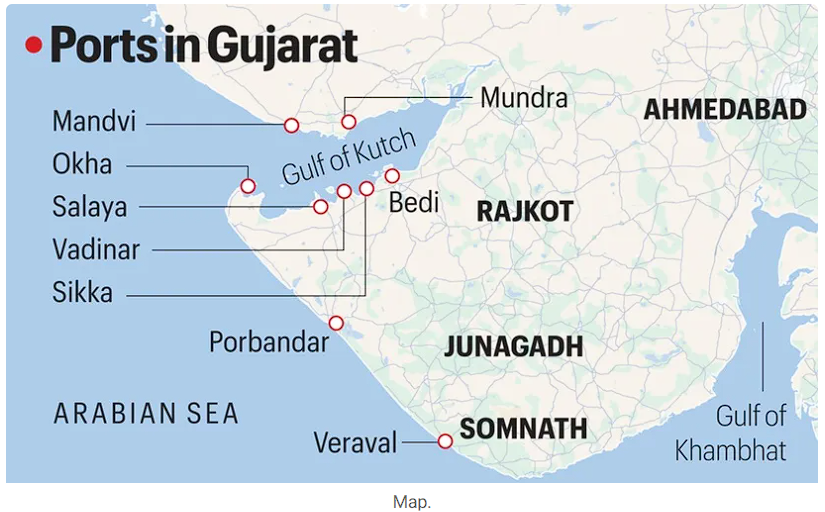
- Strategic location: Salaya is located in the Gulf of Kutch, an important maritime zone of Gujarat.
- Home port for MSVs: It is a major home port for Mechanised Sailing Vessels (MSVs), also called traditional dhows.
- Natural protection: Salaya has creeks and mangroves, which protect vessels from rough sea conditions by reducing wave impact.
- Monsoon shelter: During the rough sea season from mid-June to September, MSVs return to Salaya for beaching, repair and maintenance.
- Repair facilities: Salaya is known for affordable painting, cleaning, dry-dock repair and seaworthiness inspection of traditional vessels.
Role of Gujarat’s Dhow Trade
- Gujarat has a large number of Indian-flagged MSVs.
- These vessels trade with countries in the Gulf, Middle East, Indian Ocean and East Africa.
- They carry goods such as:
- Rice
- Sugar
- Soyabean
- Dates
- Onions
- Foodstuffs
- Livestock
- The trade is largely export-oriented, helping small merchants and coastal communities.
- MSVs provide livelihood to vessel owners, sailors, repair workers, traders and port-based workers.
Recent Regulatory Significance
- Many MSVs faced difficulty because ports such as Salaya and Okha were not notified Immigration Check Posts.
- A temporary rule allowed crew sign-on and sign-off at Porbandar Immigration Check Post for vessels headed to Salaya and Okha.
- This helped vessels return safely before the monsoon and avoid risky routes near conflict-affected Gulf waters.
Challenges
- Many traditional ports lack notified immigration and digital processing facilities.
- Small vessels are vulnerable to rough seas, war zones and crowded ports.
- Docking abroad during the monsoon is costly for small owners.
- Port infrastructure for traditional vessels remains limited.
Way Forward
- Notify more traditional ports for immigration and customs services.
- Improve repair, berthing and safety facilities at small ports.
- Provide digital immigration support for MSVs.
- Strengthen maritime safety advisories for vessels operating in conflict-prone areas.
- Recognise dhow trade as part of India’s coastal and export economy.
Conclusion:
Salaya port shows that small ports and traditional vessels remain vital to India’s maritime economy. They support exports, livelihoods and regional trade. India’s maritime policy should not focus only on major ports but also strengthen small ports, traditional vessels and coastal communities for inclusive maritime development.
Q. The Insolvency and Bankruptcy Code, 2016 has transformed India’s insolvency framework from a fragmented recovery system to a creditor-driven resolution mechanism. Discuss the achievements of the IBC and examine how the Insolvency and Bankruptcy Code (Amendment) Act, 2026 seeks to address its operational challenges.
(GS Paper III – Indian Economy: Banking, Financial Sector Reforms, Mobilisation of Resources)
Introduction:
The Insolvency and Bankruptcy Code, 2016 (IBC) is one of India’s major structural reforms in the financial sector. Before the IBC, insolvency resolution was governed by multiple laws such as the Companies Act, SICA, SARFAESI Act and debt recovery mechanisms. This created delays, overlapping jurisdiction and loss of asset value. The IBC introduced a unified, creditor-driven and time-bound insolvency framework for resolving financial distress.
Body
Major Achievements of the IBC
- Unified legal framework: The IBC consolidated multiple insolvency laws into a single system, making the process more coordinated and predictable.
- Creditor-driven process: It shifted control from the debtor to the Committee of Creditors (CoC), allowing financial creditors to decide the future of stressed companies.
- Time-bound resolution: The Corporate Insolvency Resolution Process (CIRP) was designed to be completed within 180 days, extendable up to 330 days in specified cases.
- Improved recoveries: Till March 2026, around 8,987 CIRPs were admitted and 1,419 corporate debtors were resolved through approved resolution plans. Creditors realised nearly ₹4.32 lakh crore through approved resolution plans.
- Better value realisation: Recoveries under the IBC exceeded liquidation value and helped preserve enterprise value in many cases.
- Strengthening credit discipline: The IBC improved repayment behaviour among borrowers. It created fear of loss of control over the company, encouraging timely repayment and settlement.
- Positive impact on resolved firms: Studies by IIM Ahmedabad and IIM Bangalore showed improvements in sales, employment, capital expenditure, governance and cost of debt after resolution.
Operational Challenges
Despite its success, the IBC faced several challenges:
- Delays in admission and adjudication weakened the time-bound nature of the Code.
- Prolonged litigation reduced the value of distressed assets.
- Average resolution timelines in several cases exceeded the statutory limit.
- Withdrawal of cases at advanced stages sometimes wasted institutional effort.
- Liquidation proceedings often lacked clear timelines and creditor oversight.
- Legal ambiguities regarding security interests, avoidance transactions and guarantees created disputes.
Reforms under the IBC Amendment Act, 2026
The IBC Amendment Act, 2026 seeks to make insolvency resolution more efficient, predictable and resolution-oriented.
- It mandates that the Adjudicating Authority decide applications within 14 days, with reasons recorded for delay.
- It defines important terms such as service provider, avoidance transaction and fraudulent or wrongful trading.
- It restricts withdrawal of cases at critical stages to prevent misuse.
- It strengthens moratorium protection, including cases involving guarantees.
- It expands the role of creditors during liquidation, allowing better supervision and replacement of liquidators where necessary.
- It permits continuation of proceedings related to avoidance transactions and fraudulent trading even after resolution or liquidation.
- It allows, subject to conditions, inclusion of guarantor assets in the resolution process.
- It improves fairness for dissenting creditors.
- It provides for phased approval of resolution plans and continuity of licences and regulatory permissions.
- It introduces a new creditor-led insolvency process for specified corporate debtors.
Conclusion:
The IBC has improved India’s insolvency ecosystem by promoting creditor discipline, faster resolution and better recovery outcomes. However, delays and litigation continue to affect its efficiency. The IBC Amendment Act, 2026 is a timely reform that strengthens institutional accountability, creditor oversight and procedural clarity. If implemented effectively, it can further improve India’s credit culture, ease of doing business and financial stability.