Table of Contents
Relevance: APPSC: Polity & Governance, Judiciary, Governance, Digital Administration, E-Courts, Legal Reforms.
For Prelims:
- Andhra Pradesh Electronic Processes Rules 2025, Electronic Summons, Digital Warrants, WhatsApp Summons, Email Service, Digital Signature, Encryption, e-Courts, NSTEP.
For Mains:
- Judicial Efficiency, Speedy Trial, Digital Justice, Procedural Reform, Access to Justice, Due Process, Data Security, Court Modernisation.
Why in News?
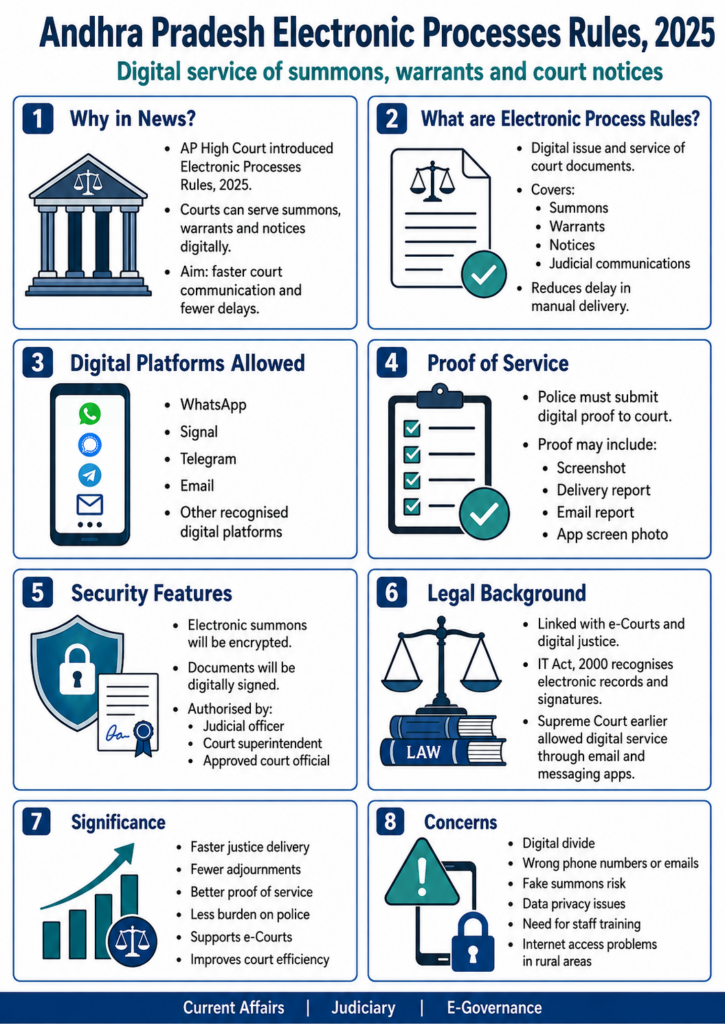
The Andhra Pradesh High Court has introduced the Andhra Pradesh Electronic Processes (Issuance, Service and Execution) Rules, 2025 to modernise the service of court summons, warrants and other notices through electronic platforms. The rules were published in the Andhra Pradesh Gazette through G.O.Ms.No.107, Home (Courts-B), dated 22 May 2026.
The reform allows courts to use digital modes such as email and messaging applications for faster communication with accused persons, witnesses, victims and other parties involved in legal proceedings.

What are Electronic Process Rules?
- Electronic process refers to the digital issue, service and execution of court processes.
- Court processes include:
- Summons
- Warrants
- Notices
- Other judicial communications
- The new rules allow courts and police to use electronic platforms for delivering these documents.
- The aim is to reduce delays caused by manual delivery of court notices.
Major Features
- Courts can issue summons, warrants and notices through electronic platforms.
- The rules apply to the issue, service and execution of court processes.
- The system is expected to reduce delays in criminal and other legal proceedings.
- Existing physical methods of service will continue where electronic service is not possible.
- Police officers must record and submit proof of service before the court.
Digital Platforms Allowed
The new process allows delivery through:
- Signal
- Telegram
- Other recognised electronic communication platforms
Electronic communication can help courts deal with excuses such as non-receipt of summons or absence from station, which often delay proceedings.
Proof of Service
- Police officials must submit digital proof of successful delivery to the court.
- Proof may include:
- Screenshot of the message
- Photo of the application screen
- Delivery report
- Email service provider report
- If electronic service fails or bounces back, the officer must prepare a report with relevant details and proceed through other legally accepted methods. The official rules provide for reporting failed electronic delivery with details such as mobile number, messaging application and screenshot or photo.
Security and Authenticity
- Electronic summons and warrants will be encrypted.
- They will be digitally signed by authorised officials.
- The authorised official may be:
- Judicial officer
- Court superintendent
- Other authorised court official
- This is important to ensure that the electronic process is genuine and secure.
Legal Background
- Digital service of legal documents is part of the larger movement towards e-Courts and modern justice delivery.
- The Information Technology Act, 2000 gives legal recognition to electronic records and electronic signatures. It also supports the use of electronic documents in legal processes.
- During the COVID-19 period, the Supreme Court allowed service of notices, summons and pleadings through email, fax and instant messaging services such as WhatsApp, Telegram and Signal, along with email service.
Significance
- Reduces delay in service of summons and warrants.
- Supports speedy trial and timely court proceedings.
- Helps courts avoid repeated adjournments due to non-service of notices.
- Saves time and administrative cost for police and courts.
- Promotes digital transformation of the judiciary.
- Improves tracking and accountability in the service of court processes.
- Helps victims, witnesses and accused persons receive court communication quickly.
- Strengthens the larger e-Courts ecosystem.
Challenges
- Digital divide may affect persons without smartphones or internet access.
- Wrong phone numbers or email IDs may lead to failed delivery.
- Screenshot-based proof may need strong verification standards.
- Privacy and data protection concerns may arise.
- Cyber fraud or fake summons may increase if public awareness is weak.
- Rural areas may face connectivity issues.
- Police and court staff need training in digital process handling.
Way Forward
- Build a verified database of phone numbers and email IDs of parties.
- Use electronic service along with physical service where necessary.
- Train police and court staff in digital evidence, screenshots and delivery reports.
- Ensure strong encryption and secure digital signatures.
- Create public awareness on how to verify genuine court summons.
- Provide alternative service methods for digitally excluded citizens.
- Integrate the system with e-Courts and National Service and Tracking of Electronic Processes.
Conclusion
The Andhra Pradesh Electronic Processes Rules, 2025 mark an important step in modernising justice delivery. By allowing courts to serve summons and warrants through digital platforms, the rules can reduce delays, improve accountability and support speedy trial.
However, digital justice must also protect due process. Secure authentication, proper proof of delivery, data privacy, staff training and safeguards for digitally excluded citizens are essential for the success of this reform.
CARE MCQ
Q. With reference to the Andhra Pradesh Electronic Processes Rules, 2025, consider the following statements:
- They allow electronic service of summons and warrants.
- They permit use of platforms such as WhatsApp, Telegram and email.
- They completely abolish physical service of court processes.
Which of the above statements are correct?
A. 1 and 2 only
B. 2 and 3 only
C. 1 and 3 only
D. 1, 2 and 3
Answer: A
Explanation:
- Statement 1 is correct: The rules allow electronic issue, service and execution of court processes.
- Statement 2 is correct: Messaging platforms and email may be used.
- Statement 3 is incorrect: Physical service can still be used where electronic service is not possible.
FAQs
1. What are the Andhra Pradesh Electronic Processes Rules, 2025?
They are rules introduced to allow courts to issue, serve and execute summons, warrants and notices through electronic platforms.
2. Which platforms can be used?
Platforms such as WhatsApp, Signal, Telegram, email and other electronic communication modes can be used.
3. Why are these rules important?
They can reduce delays in court proceedings and improve the speed of justice delivery.
4. How will courts verify delivery?
Police officials may submit screenshots, delivery reports or other digital proof before the court.
5. Are electronic summons legally valid?
Yes, if issued and served according to the rules and supported by valid proof of delivery.
6. Will physical summons stop completely?
No. Physical service can still be used where electronic service is not possible.
7. Why are digital signatures important?
Digital signatures help prove that the electronic summons or warrant is genuine.
8. What are the main concerns?
The main concerns are digital exclusion, fake summons, privacy risks, wrong contact details and protection of due process.