
Roadways
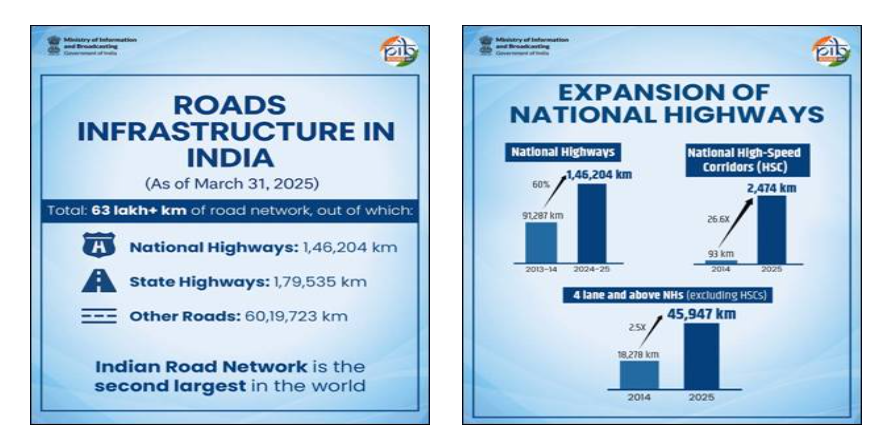
India possesses the second-largest road network in the world, and its National Highways span a total length of 146,195 kilometers, forming the primary arterial backbone of the country’s surface transport system. Despite comprising just about 2% of the total road length, these highways carry nearly 40% of the total road traffic, highlighting their strategic importance in connectivity, trade, and mobility.
1. Significance of Road Transport
- Road transport serves as the backbone of India’s mobility and logistics network, carrying nearly 85% of passenger traffic and about 70% of freight. The road network in India is the second largest in the world, and National Highways (NHs) form the primary arterial network, stretching over 146,195 kilometers. Despite comprising only about 2% of the total road length, these highways bear nearly 40% of the total traffic load, indicating their strategic importance. Roads are classified into various categories—National Highways, State Highways, District Roads, and Rural Roads—each playing a distinct role in connecting people, markets, production centers, and services across the country.
2. Existing Challenges in Road Infrastructure
- For decades, India’s road development suffered due to limited investments and poor-quality roads. While rural areas benefited from schemes like the Pradhan Mantri Gram Sadak Yojana (PMGSY), National and State Highways remained congested, underdeveloped, and structurally inadequate. Problems such as pothole-ridden surfaces, railway crossings without overpasses, slow toll collection, and delays at state borders added to high logistics costs and travel inefficiencies. This hampered the competitiveness of Indian businesses and contributed to regional disparities in infrastructure development.
3. Policy Reforms and Institutional Framework Post-1991
- Following liberalization, the Indian government initiated key policy reforms to improve road infrastructure. The National Highways Act was amended in 1995, enabling private sector involvement in road development through Public-Private Partnerships (PPP). The National Highways Authority of India (NHAI) became the implementing agency for mega road projects. Several funding mechanisms were introduced, such as cess on fuel and the facilitation of Foreign Direct Investment (FDI) in the infrastructure sector. Institutional coordination among various ministries and states was improved through centralized planning and monitoring mechanisms.
4. Major Flagship Programmes and Road Expansion
- The most ambitious infrastructure programme, the Bharatmala Pariyojana, was launched to optimize freight movement and economic connectivity. It aims to develop 34,800 kilometers of highways with a projected investment of ₹5.35 lakh crore. The project integrates several pre-existing schemes, including the National Highways Development Project (NHDP), which has now been subsumed into Bharatmala. It also incorporates region-specific projects such as the Special Accelerated Road Development Programme for the North-East (SARDP-NE), which seeks to address connectivity issues in the remote hilly states of Northeast India.
- Another important component is the Special Programme for Left Wing Extremism-affected Areas (LWE), which includes the development of critical roads like the Vijayawada–Ranchi corridor. These are aimed at improving connectivity in tribal and conflict-affected regions. In addition, the government has launched several Externally Aided Projects (EAP), with funding and technical support from multilateral agencies such as the World Bank, ADB, and JICA to support the construction and upgradation of highways in difficult terrain and strategic locations.
5. Synergistic Infrastructure Planning: PM GatiShakti and PRAGATI
- Launched in October 2021, the PM GatiShakti National Master Plan aims to coordinate infrastructure planning across 44 central ministries and all states and UTs. It leverages Geographic Information Systems (GIS) and real-time data for synchronized project execution across sectors such as roadways, railways, ports, and industrial corridors. By April 2025, the Network Planning Group (NPG) under GatiShakti had reviewed 131 road-related projects, identifying 65 as critical for filling infrastructure gaps.
- Meanwhile, the PRAGATI platform (Pro-Active Governance and Timely Implementation) launched in 2015, allows the Prime Minister to review progress on major road and highway projects. By April 2025, 46 PRAGATI meetings had been held, reviewing 363 projects amounting to over ₹90,000 crore, ensuring real-time monitoring and resolution of inter-agency bottlenecks.
6. Impressive Expansion in National Highway Construction
- Between 2014 and 2025, India witnessed unprecedented expansion in road construction. The total National Highway length grew from 91,287 kilometers in 2013–14 to 146,204 kilometers, a 60% increase in just over a decade. The pace of construction rose dramatically, from 11.6 kilometers per day to 34 kilometers per day, thanks to improved processes, fast-tracked land acquisition, and digitized clearances. High-Speed Corridors saw a 26-fold increase—from just 93 kilometers in 2013–14 to over 2,474 kilometers in 2025. Simultaneously, 4-lane and above highways grew from 18,278 kilometers to 45,947 kilometers.

7. Completion of Strategic and Landmark Projects
- Several nationally important road projects were completed in this period. The Atal Tunnel in Himachal Pradesh became the world’s longest highway tunnel above 10,000 feet, dramatically improving access to Lahaul-Spiti and Leh. The Eastern and Western Peripheral Expressways around Delhi reduced urban congestion and enabled faster freight movement. In the Northeast, the Dhola–Sadiya Bridge, India’s longest river bridge, was inaugurated in Assam to enhance connectivity to Arunachal Pradesh. The Chenani–Nashri Tunnel in Jammu & Kashmir and the Maitri Setu in Tripura linking India to Bangladesh are other critical infrastructure additions.
8. Ongoing Expressways and Strategic Road Projects
- The Delhi–Mumbai Expressway, covering 1,386 kilometers, is over 80% complete and will reduce travel time by 50% between major cities such as Jaipur, Vadodara, and Indore. The Char Dham Mahamarg Vikas Pariyojana, aiming to connect the Himalayan shrines, has completed 76% of its 825-kilometer target. Other major expressways under construction include the Ahmedabad–Dholera, Bengaluru–Chennai, and Delhi–Amritsar–Katra corridors, each slated for completion by FY 2025–26.
- A strategically vital initiative is the construction of the Frontier Highway (NH-913) in Arunachal Pradesh. At 1,824 kilometers, this highway runs along the sensitive India-China-Myanmar border and is being developed by the BRO, NHIDCL, and State PWD to bolster both civilian access and military logistics.
9. Role of FASTag and Digital Tolling
- India has revolutionized toll collection through the adoption of FASTag, a component of the National Electronic Toll Collection (NETC) system. As of December 2024, over 10.3 crore FASTags have been issued. With 98.5% of toll revenue collected electronically, the system has reduced queue times, improved fuel efficiency, and minimized leakages. Over 1,051 toll plazas are now FASTag-enabled, facilitating seamless vehicular movement across the National Highway network.

Rural Roads
Pradhan Mantri Gram Sadak Yojana (PMGSY)
Universal Rural Connectivity (PMGSY-I)
- The Pradhan Mantri Gram Sadak Yojana (PMGSY) was launched with the goal of connecting all unconnected habitations with populations of 500+ in plain areas and 250+ in special category areas such as NE states, hill states, desert regions, tribal belts, and backward areas as per Census 2001. The target of 1,63,000 habitations has been fully achieved, leading to enhanced service delivery, strengthening of the rural core road network, and significant socio-economic transformation in rural India.
Upgradation and Consolidation (PMGSY-II and PMGSY-III)
- The second phase, PMGSY-II, focused on upgrading Through Routes and Major Rural Links (MRLs) to improve connectivity to growth centres, achieving 49,053 km out of the 50,000 km target. The third phase, PMGSY-III, launched in July 2019, aimed at consolidating 1,25,000 km of rural roads to enhance connectivity to habitations via key routes. Under PMGSY-III, 6,96,620 rural facilities such as schools (1,46,784), agricultural markets (1,38,637), medical centres (82,806), and transport nodes (3,28,393) have received improved connectivity.
PMGSY-IV: The Next Leap (2024–2029)
- On September 11, 2024, the government approved PMGSY-IV to provide all-weather road connectivity to 25,000 unconnected habitations, with a target of constructing 62,500 km of roads. The scheme, to be implemented during 2024–25 to 2028–29, has an outlay of ₹70,125 crore. As of May 24, 2025, a total of 8,37,022 km has been sanctioned across PMGSY phases, and 7,80,401 km have already been constructed or upgraded, resulting in 99% rural connectivity coverage.

Sustainable Construction and Maintenance
- To ensure quality and longevity, an expenditure of ₹4,056 crore has been made on road maintenance via eMARG by March 2025. For sustainable development, green technologies such as waste plastic, cold mix, full depth reclamation (FDR), nanotechnology, geotextiles, etc., are being used. In 2024 alone, 15,783 km of roads were constructed using these eco-friendly technologies, reflecting a shift towards resource-efficient infrastructure.
Targeted Connectivity for PVTGs – PM-JANMAN Vertical
- A separate vertical under PMGSY, the Pradhan Mantri Janjati Adivasi Nyaya Maha Abhiyan (PM-JANMAN), was launched to provide road connectivity to Particularly Vulnerable Tribal Groups (PVTGs) with population sizes as small as 100. With a target of 8,000 km over five years (2023–24 to 2027–28), the initiative aims at inclusive tribal development. So far, 5,718.229 km has been sanctioned under PM-JANMAN, involving an expenditure of ₹4,366.03 crore.
Associated Organisations in Road Sector Development
National Highways Authority of India (NHAI)
- The National Highways Authority of India (NHAI) was established under the NHAI Act, 1988, passed by the Parliament of India, and became operational in February 1995. It functions as the nodal agency for the development, maintenance, and management of the National Highways entrusted to it, along with all associated and incidental responsibilities.
National Highways & Infrastructure Development Corporation Ltd. (NHIDCL)
- The NHIDCL was created as a corporate entity under the Ministry of Road Transport and Highways following Cabinet approval on 13 March 2014. It is tasked with the construction, upgradation, and widening of National Highways in strategic and difficult regions, particularly in border areas that share international boundaries, with the broader aim of promoting regional connectivity on a sustainable basis.
Indian Roads Congress (IRC)
- The Indian Roads Congress (IRC), formally registered as a society on 24 September 1937 under the Societies Registration Act of 1860, functions as a professional body to advance road development in India. It serves as a platform for engineers and stakeholders from across sectors—central and state governments, PSUs, research and academic institutions, local bodies, private sector entities, contractors, consultants, and international organizations such as World Bank, ADB, JICA, and IRF. With over 19,612 registered members, the IRC’s primary objective is to formulate and standardize road construction practices by issuing Codes, Standards, Specifications, Guidelines, and Manuals for adoption by road agencies. The IRC also conducts annual sessions, mid-term council meetings, international seminars, and regional workshops to disseminate technical knowledge and promote adoption of cutting-edge, environment-friendly road technologies.
