
Railway Sector
Indian Railways
- Indian Railways is the fourth largest railway network in the world in terms of route length. It carries the largest number of passengers globally and also stands as the fourth largest freight transporting system. However, the share of railways in surface freight transport has steadily declined, dropping from 86.2 per cent in 1950–51 to only 33 per cent in 2015.
Historical Development
1. Western Region
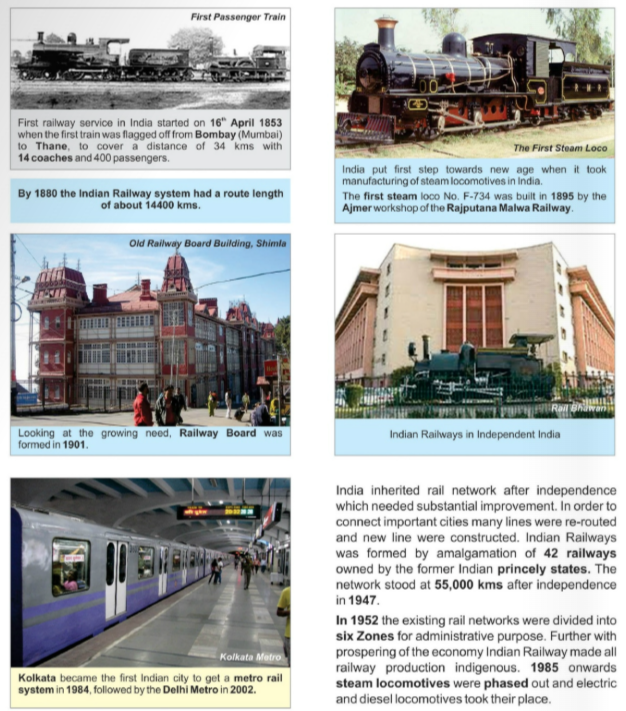
- The first railway line in India was laid between Bombay and Thane, covering a distance of 21 miles. The idea was first suggested in 1843 by George Clark, the Chief Engineer of the Bombay Government. The line was formally inaugurated on 16 April 1853, when fourteen carriages carrying about 400 guests left Bori Bunder station at 3:30 pm amidst great public applause and a salute of 21 guns.
2. Eastern Region
- On the eastern side of the subcontinent, the first passenger train ran from Howrah to Hooghly on 15 August 1854, covering 24 miles. This marked the opening of the first section of the East Indian Railway for public use.
3. Southern Region
- In the south, the first railway line was opened on 1 July 1856 by the Madras Railway Company. It connected Vyasarpadi Jeeva Nilayam (then Veyasarpandy) with Walajah Road (Arcot), covering a distance of 63 miles.
4. Northern Region
- In northern India, a railway line between Allahabad and Kanpur, measuring 119 miles, was inaugurated on 3 March 1859. Later, another section from Hathras Road to Mathura Cantonment was opened to traffic on 19 October 1875.
5. Central Public Sector Enterprises (CPSEs) under Indian Railways
- There are 12 Central Public Sector Enterprises (CPSEs) functioning under the administrative control of the Ministry of Railways, each catering to different domains such as finance, infrastructure development, connectivity, catering, and telecom. These are: (i) RITES Ltd., (ii) IRCON International Ltd., (iii) Indian Railway Finance Corporation (IRFC), (iv) Container Corporation of India Ltd. (CONCOR), (v) Konkan Railway Corporation Ltd. (KRCL), (vi) Mumbai Railway Vikas Corporation (MRVC), (vii) Indian Railway Catering & Tourism Corporation (IRCTC), (viii) RailTel Corporation of India Ltd. (RCIL), (ix) Rail Vikas Nigam Ltd. (RVNL), (x) Dedicated Freight Corridor Corporation of India Ltd. (DFCCIL), (xi) Kolkata Metro Rail Corporation Ltd. (KMRCL), and (xii) Braithwaite and Company Ltd. (BCL).
6. Research and Development (R&D)
- The Research Design and Standards Organisation (RDSO), based in Lucknow, is the R&D wing of Indian Railways. It provides technical consultancy to Indian Railways and other associated organisations. Recent innovations include speed and controllability trials of Vande Bharat Express and the development of the SigDATE automation tool (in collaboration with IIT Kharagpur) for route control chart generation in Electronic Interlocking systems.
7. Railway Finance and Budget Merger
- Historically, Indian Railways had a separate budget presentation owing to the Separation Convention of 1924, meant to protect civil estimates. However, since 2017-18, the Railway Budget has been merged with the Union Budget to promote multi-modal transport planning. Railways retains its functional autonomy and financial powers and now operates with a single demand for grants under the Ministry of Finance.
8. Mission 100% Electrification
- The Railway Electrification Mission is central to India’s energy and environmental goals. Electrification reduces crude oil imports, improves energy efficiency, and enhances average train speeds and load capacity. As of March 2023, 58,812 Route Kilometers (RKMs) have been electrified, including the Konkan Railway—covering nearly 90% of the Broad Gauge (BG) Network. Electrification is key to providing green, clean, and cost-effective transport.
9. Rail-Based Tourism and Bharat Gaurav Trains
- Indian Railways plays a significant role in domestic tourism. The Bharat Gaurav Trains Policy enables theme-based tourist circuit trains to showcase India’s cultural and historical heritage. State Governments, Tourism Development Corporations, and private players may run such trains, providing comprehensive packages including rail, accommodation, food, and local transport. Concessions of up to 33% are offered to promote tourism.
10. Zonal Railway Headquarters
Indian Railways is divided into 17 zones and 1 Metro Railway zone, each with a zonal headquarters:
- Central – Mumbai
- Eastern – Kolkata
- East Coast – Bhubaneswar
- East Central – Hajipur
- Northern – New Delhi
- North Central – Prayagraj (Allahabad)
- North Eastern – Gorakhpur
- Northeast Frontier – Maligaon (Guwahati)
- North Western – Jaipur
- Southern – Chennai
- South Central – Secunderabad
- South Eastern – Kolkata
- South East Central – Bilaspur
- South Western – Hubballi
- Western – Mumbai
- West Central – Jabalpur
- South Coast – Visakhapatnam
- Metro Railway – Kolkata
Railways (Amendment) Bill, 2024:The Railways (Amendment) Bill, 2024, was recently passed in the Lok Sabha. Alongside this, the Parliamentary Standing Committee on Railways presented a detailed report on Railway Modernization and Financial Sustainability, highlighting structural gaps and suggesting reforms. Snapshot of Indian Railways
Railways (Amendment) Bill, 2024Simplification of Legal Framework
Centralization of Powers
Limitations
Key Highlights of the Standing Committee ReportFinancial Performance Railways continue to depend heavily on freight earnings. In 2023–24, revenue from freight services stood at ₹1,68,293 crore, while passenger services contributed only around ₹70,000 crore. Low passenger revenue translates into thin net returns.
Operational Efficiency The average freight train speed has stagnated at 25 km/hr for over a decade.
Infrastructure and Modernisation
Research and Development Budgetary allocation for railway research remains very low, with just ₹72 crore earmarked in 2024–25.
Safety The indigenous train collision avoidance system, Kavach, has been implemented only on 1,465 route km in South Central Railway and 80 km in North Central Railway, reflecting a very slow rollout.
Towards Green Railways Indian Railways has set the ambitious goal of becoming a Net Zero Carbon Emitter by 2030. Initiatives include 100% electrification of railway lines, sourcing power from renewable energy, water conservation, and waste management.
|
