
Non-Performing Assets (NPAs) – Recovery Mechanism
The issue of Non-Performing Assets (NPAs) has emerged as one of the most critical challenges for the Indian banking sector. Both the Reserve Bank of India (RBI) and the Government of India have emphasized that reduction of NPAs is essential for financial stability and credit growth. To deal with this, a structured recovery mechanism has been established, broadly classified into preventive management and curative management.
Preventive Management
- Preventive management refers to the steps taken by banks to ensure that assets do not slip into the category of NPAs. The focus is on improving credit discipline, enhancing monitoring, and providing timely relief to borrowers facing temporary stress.
Restructuring Loan Installments
- Banks may redesign repayment schedules by reducing installment amounts and extending repayment periods. This makes repayment easier for borrowers, thereby increasing the likelihood of recovery.
Know Your Client (KYC) and Active Monitoring
- Maintaining detailed KYC profiles and credit reports of borrowers allows banks to keep track of their financial health. Regular site visits and effective follow-up help prevent accounts from turning into NPAs.
Credit Assessment and Risk Management
- Sound pre-sanction appraisal, documented credit policies, and immediate credit audits after sanction are critical for ensuring loan quality. Effective risk management is considered a lasting solution to the problem of NPAs.
Recovery Camps
- Banks organize recovery camps for agricultural loans and seasonal businesses, usually during harvest or peak business seasons. Involving local authorities such as panchayats ensures higher participation and successful settlements.
Watch-List and Special Mention Accounts (SMA)
- Banks prepare watch-lists of accounts showing early stress. Categorization under SMA provides early warning signals and allows timely corrective action before the account becomes an NPA.
Tackling Willful Defaulters
- RBI defines willful defaulters as borrowers who intentionally avoid repayment or divert funds. Banks must report their names to RBI and SEBI to prevent them from accessing capital markets.
Early Warning Signals (EWS)
- Banks monitor financial, operational, banking, management, and external indicators to identify accounts with potential stress. Timely detection of these signals enables corrective measures.
Rehabilitation Packages
- RBI guidelines recommend rehabilitation for sick but viable units. Such packages involve restructuring debt and extending repayment timelines, ensuring that temporary stress does not push borrowers into default.
Role of DICGC
- The Deposit Insurance and Credit Guarantee Corporation (DICGC) allows banks to settle eligible claims, thereby reducing their burden of NPAs.
Corporate Debt Restructuring (CDR)
- Introduced in 2001, CDR provides a transparent framework for restructuring the debt of corporates. It allows re-phasing of obligations and concessions in interest rates, thereby preventing defaults.
Asset Reconstruction Companies (ARCs)
- ARCs purchase NPAs from banks and specialize in their recovery or restructuring. This helps clean up bank balance sheets and allows professional management of stressed assets.
Legal Action as Deterrence
- In cases where compromise proposals are rejected, banks may initiate civil suits promptly. Legal action, although time-consuming, acts as a strong deterrent against willful default.
Curative Management
- Curative management is designed to recover and recycle funds already locked in NPAs. The emphasis is on maximizing recovery through legal and institutional frameworks.
Compromise Settlement Schemes
- These schemes cover sub-standard, doubtful, and loss assets. They are applicable even in cases pending under SARFAESI, DRT, or BIFR, provided consent decrees are obtained. However, cases involving fraud, willful default, or malfeasance are excluded.
Lok Adalats
- Lok Adalats are voluntary bodies that facilitate compromise settlements of small loans. They provide speedy recovery through settlement certificates without lengthy litigation. The ceiling for loans referred to Lok Adalats has been raised from ₹5 lakh to ₹20 lakh, making them effective for small-ticket NPAs.
Debt Recovery Tribunals (DRTs)
- Established under the Act of 1993, DRTs are statutory bodies for speedy adjudication and recovery of debts due to banks and financial institutions. They also act as appellate authorities for cases under SARFAESI. However, inadequate staffing, infrastructure shortages, and frequent adjournments limit their effectiveness. Strengthening DRTs is therefore essential.
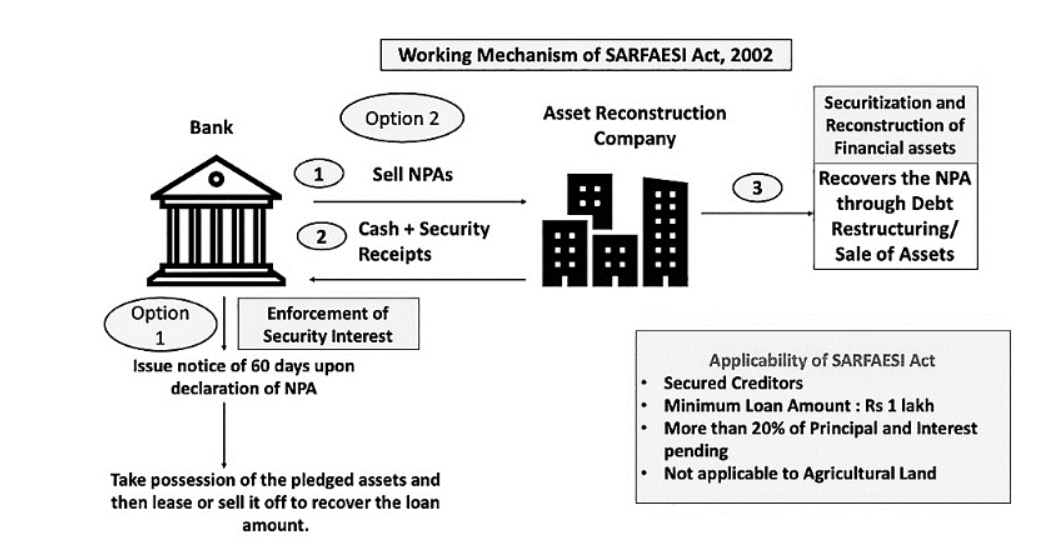
Securitization and Reconstruction of Financial Assets and Enforcement of Security Interest (SARFAESI) Act, 2002
- The Government passed the SARFAESI Act on 21st June 2002 to vest more powers in banks to proceed against the “willful defaulter” and affect recoveries without the intervention of courts and tribunals.
- Securitization is considered an effective tool for improvement of capital adequacy. The primary objective of the Act is reduction of NPA levels of banks or financial institutions and unlocking value from distressed assets in the banking and financial system. It is also seen as a tool for transferring the reinvestment risk, apart from credit risk, helping banks to maintain a proper match between assets and liabilities.
- Securitization can also help in reducing the risks arising out of credit exposure norms and the imbalances of credit exposure, which in turn help in the maintenance of healthy assets.
- The SARFAESI Act, 2002 is seen initially as a booster for banks in tackling the menace of NPAs without having to approach the courts. Therefore, SARFAESI is the preferred route for finding solutions to NPAs.
Insolvency and Bankruptcy Code (IBC) and the Bad Bank
Insolvency and Bankruptcy Code (IBC), 2016
- The Insolvency and Bankruptcy Code (IBC), enacted in 2016, is regarded as a landmark reform in India’s financial and legal architecture. Before its enactment, insolvency was governed by several fragmented legislations such as the SARFAESI Act, the Companies Act, and the Sick Industrial Companies Act. These laws were slow, overlapping, and often ineffective, leading to prolonged disputes and massive losses for creditors. The IBC unified this fragmented regime into a single comprehensive law. Its aim was to provide a time-bound, transparent, and creditor-driven mechanism for resolving insolvency and bankruptcy across companies, limited liability partnerships, partnerships, and individuals.
Process and Institutional Mechanism
- The IBC prescribes a systematic process. When a corporate debtor defaults, creditors or the debtor itself can file an application before the National Company Law Tribunal (NCLT). Once admitted, a moratorium comes into effect, preventing any parallel proceedings against the debtor. Control of the company shifts from the existing management to an Insolvency Professional, who runs the company during the process. The Committee of Creditors (CoC) evaluates resolution plans submitted by potential buyers or investors. If the CoC approves a plan with a 66 percent majority, it is implemented. If no plan is approved within the stipulated time, liquidation proceedings commence.
- The Code imposes strict timelines. Initially, the process had to be completed in 180 days, with a one-time extension of 90 days. In 2019, an upper limit of 330 days, including litigation, was added. Though some delays persist due to overburdened tribunals, the time-bound nature of the framework has instilled urgency in resolution proceedings.
Institutional Architecture
- The IBC created a robust institutional framework. Corporate insolvency cases fall under the jurisdiction of the NCLT, while individual and partnership cases are handled by Debt Recovery Tribunals (DRTs). The Insolvency and Bankruptcy Board of India (IBBI) regulates insolvency professionals and information utilities. Insolvency Professionals act as neutral managers during the resolution process, ensuring transparency and accountability.
Achievements
- The IBC has been instrumental in reshaping India’s insolvency landscape. Several high-value corporate cases, including Essar Steel and Bhushan Steel, were resolved under its framework. The law has contributed to a decline in non-performing assets (NPAs) and improved India’s global Ease of Doing Business ranking. According to government and RBI data, recoveries worth over three lakh crore rupees were achieved in the initial years, demonstrating its impact in cleaning up bank balance sheets.
Challenges
- Despite its successes, the IBC faces challenges. A large number of cases overshoot the 330-day timeline due to capacity constraints in NCLTs. Recovery rates, averaging around 30 to 40 percent, remain lower than anticipated. Moreover, many cases end in liquidation rather than revival, defeating the Code’s objective of preserving viable businesses. Strengthening institutional capacity and ensuring faster judicial processes remain pressing needs.
The Bad Bank (NARCL and IDRCL), 2021
Even after the enactment of the IBC, Indian banks, particularly public sector banks, continued to be weighed down by massive NPAs. By 2018, stressed assets in the system had crossed ten lakh crore rupees. Banks needed a mechanism to quickly remove these bad loans from their balance sheets so they could focus on fresh lending. To address this, the government in 2021 announced the creation of a “Bad Bank,” formally known as the National Asset Reconstruction Company Ltd. (NARCL), supported by the India Debt Resolution Company Ltd. (IDRCL).
Structure and Mechanism
- NARCL is a government-backed Asset Reconstruction Company with majority ownership by public sector banks. Its role is to acquire large NPAs, typically above ₹500 crore, from commercial banks. Once the loans are transferred, NARCL pays 15 percent of the value upfront in cash and issues Security Receipts for the remaining 85 percent. These receipts are backed by a sovereign guarantee of ₹30,600 crore for five years, approved by the Union Cabinet in September 2021.
- IDRCL, composed of private sector professionals, works alongside NARCL to manage and recover these stressed assets. IDRCL brings in expertise in resolution strategies, asset sales, and negotiations, while NARCL provides the institutional platform.
Progress and Outcomes
- By late 2024, NARCL had acquired twenty-two stressed accounts worth nearly ₹95,700 crore. Several other accounts were resolved directly by banks after NARCL made acquisition offers, highlighting its indirect impact. The initiative has begun to ease the pressure on banks, helping them refocus on new credit growth. However, the long-term success of NARCL depends on whether it can recover significant value from these NPAs and avoid becoming a mere parking lot for bad loans.
Challenges
- The Bad Bank faces challenges similar to earlier asset reconstruction efforts in India. Effective recovery requires market buyers, efficient resolution, and coordination with judicial mechanisms such as the IBC. If recoveries remain slow, the fiscal burden of the government guarantee may rise. Ensuring professional independence of IDRCL and avoiding political interference in loan resolutions are also key challenges.
