Economic Reforms in India
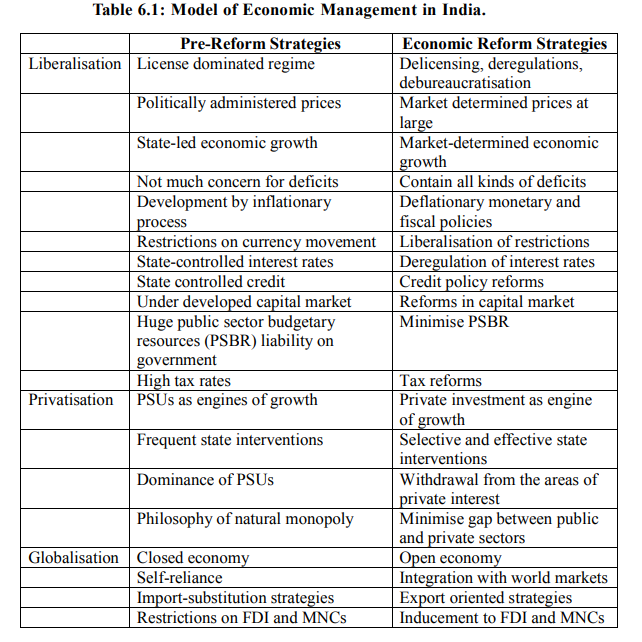
After attainment of independence, India adopted the regime of economic planning with a glorious vision of a resurgent India. It aimed to marching firmly on the path of progress while ensuring an equitable distribution of the nation’s wealth. Policies relating to licensing focussed on public sector, putting infant industry argument for imposing trade barriers, import-substitution policies, etc. This gamut of policies led to over-protection, inefficient resource utilisation, high revenue deficits, mismanagement of firms and economy, poor technological development and shortage of foreign exchange.
- The resultant stress and pressures compelled the government to revisit the policy framework. The outcome came to be a set of changes in economic policies, which in a broad sense came to be identified as economic reforms. The principal aim of economic reforms was to enter an era of globalisation which meant a) free flow of goods and services, b) free flow of technology, c) free flow of capital, and d) free movement of human beings, especially labour from one country to another. Economic reforms, therefore, required integrating the Indian economy with world economy and the emphasis in economic reforms shifted to export-led growth strategy from import substitution strategy.
India’s 1991 Crisis and ReformsBy the end of the 1980s, India looked as if it was moving ahead—but beneath the surface, the economy was shaky. The government was spending far more than it earned, borrowing heavily both at home and abroad. Inflation was rising, foreign loans were piling up, and the balance of payments was slipping deeper into the red.
Thus, out of the severe crisis of 1991 was born a new India—one that began to integrate with the world economy and set itself on the path of rapid growth. |
Rationale of Economic Reforms
- Indian economy was highly regulated during the first four decades of economic planning (1950-1990). The five-year plan objectives were focussed on development of public sector for setting up heavy and basic industries, self-reliance, import-substitution strategies, nationalisation and state-interventionist regime. While on one hand it helped in setting up some key industries like SAIL, ONGC, IOC, BHEL, etc., on the other hand it restricted the growth of private sector, private business plans and brought about bureaucracy-led corruption, sick public sector enterprises, deteriorating trade balance, economic and financial crisis in early 1990s.
- India had to borrow foreign exchange from IMF and comply with the conditionality imposed by it such as stabilisation and structural stability programme, reduction of trade barriers, revision of fiscal and monetary policies, active role of market and integration of the Indian economy with the world economy. In a nutshell, the three basic elements of economic reforms were liberalisation, privatisation and globalisation (also known as LPG strategy) of the Indian economy.
Key Features of Economic Reforms
The New Economic Policy (NEP) during the economic reforms process reflected neo-liberalism. The rationale of economic reforms was provided by the Industrial Policy announced by the Government in 1991. Its basic philosophy was summed up as ‘continuity with change’. The key objectives can be summarised as:
a) to set free the Indian industrial economy from the hassles of unnecessary bureaucratic controls;
b) to introduce liberalisation with a view to integrate the Indian economy with the world economy;
c) to remove restrictions on foreign direct investment (FDI) and also to lessen the restrictions of Monopolies and Restrictive Trade Practices (MRTP) Act for the domestic entrepreneur;
d) to dilute the monopoly of public sector enterprises and encourage competition from new private enterprises.
Liberalisation
A liberal policy adopted on both domestic and external fronts aimed to counter the financial crisis during early 1990’s included the following measures:
a) All industrial licensing was abolished except for 18 industries relating to security and strategic concerns, social sectors, hazardous chemicals, environmental reasons and items of elitist consumption industries. (Presently, only five industries are subject to licensing)
b) To promote domestic and global competition, reservation of Small-scale industry (SSI) items is being reduced gradually since 1990s. Currently, the number of items facing reservation stands only 21, a marked decline from 836 in 1996.
c) MRTP Act was amended to account for removal of pre-entry restrictions, concentration of economic power, threshold limits of assets in respect of dominant undertakings and MRTP companies. (Subsequently, the MRTP Act has been withdrawn and the MRTP commission stands disbanded)
Privatisation
Privatisation refers to any process that reduces the involvement of the state/public sector in economic activities of a nation. Contrary to the post-independence thrust on enlargement of public sector, the economic reforms of 1991 recognised private sector as the engine of growth. Policies were framed to increase the role of private sector in the process of development. Privatisation in a mixed economy like India can take several forms such as:
a) Total denationalisation, implying complete transfer of state ownership of productive assets into private hands. Some prominent examples in India were of Allwyn Nissan, Mangalore Chemical and Fertilisers, Maharashtra Scooters – transferred to private hands.
b) Joint venture, implying partial induction of private ownership from 25 to 50 per cent or even more in a public sector enterprise, depending upon the nature of the enterprise and state policy in this regard. The basic aim is to improve efficiency, productivity and profitability of the firms.
Three kinds of proposals are put forward in it:
- 26 per cent ownership by the private sector (banks, mutual funds, corporations, individuals). Workers also to be included and equity to the extent of 5 per cent to be transferred to them.
- 51 per cent equity to be retained by the Government and 49 per cent to be sold to private sector.
- 74 per cent of the equity transferred to the private sector and Government retains 26 per cent.
c) Worker’s co-operative is another form of privatisation where a loss-making public sector firm is transferred to the workers. A classic example of the Indian case is the Indian Coffee Houses run by a chain of worker cooperative societies, retained from the British rule post-independence. However, it did not assume a significant role in economic reforms due to requirement of investments for expansion of businesses.
d) Token Privatisation, also known as deficit privatisation or disinvestment, implying sale of 5-10 per cent shares of a profit-making public sector enterprise in the market with the objective of obtaining revenue to reduce budget deficits. During the period 1991-92 to 2011-12, the government could raise a sum of Rs. 60,000 crore by way of disinvestment. On an average, disinvestment receipts have managed to cover 7 per cent of the revenue deficit and 4 per cent of the fiscal deficit over the period 1992-2012.
Government announced a new policy on November 5, 2009 which has two components: One dealing with listed profit-making units and another extending to all other government-owned companies. While the former will have to off load minimum 10 per cent equity stake, unlisted ones (meeting 3 criteria – a positive net worth, no accumulated reserves and a net profit for three consecutive years) will have to opt for listing on the stock exchanges by divesting similar amounts.
Globalisation
Globalisation is the process of integrating the various economies of the world without creating any barriers in the flow of goods and services, technology, capital and labour/human capital. It involves four components:
a) Reduction of trade barriers in the form of custom duties/quotas/quantitative restrictions so as to permit free flow of goods and services in different economies.
b) Creation of an environment in which free flow of capital (or investment) can take place between nation states.
c) Creation of an enabling environment for the free flow of technology; and
d) From the viewpoint of developing countries, creation of an environment in which free flow of labour or human resources can take place among different countries of the world.
Essentially, globalisation is an extension of the process of liberalisation in the international domain. It therefore signifies internationalisation plus liberalisation. In India, the process of globalisation began with the adoption of LPG model during economic reforms since 1990s.
Some of the key features in this context are:
a) Its key impact was seen in India’s service sector particularly in fast-paced growth of industries like information technology (IT), information technology-enabled services (ITES), outsourcing, telecommunications, tourism, real estate, transport, banking, insurance, entertainment, etc.
b) Inducement to foreign investment flows (FDIs and FIIs) has brought about efficiency, competition, profitability and global standards in productivity and quality of economic goods. Mergers, joint-ventures, PPPs, and contracting to foreign players have accelerated the development process in the Indian economy.
c) The two decades of economic-reforms have seen an increase in the rate of exports, migration (domestic and international), etc.
Public Private Partnership (PPP)
India is setting out a successful example of PPP projects and encouraging private participation in key development projects. The main advantages of public-private partnerships are efficient and speedy delivery of projects, alleviation of capacity constraints and bottlenecks in the economy, innovation and diversity in provision of world-class facilities, value for money of the tax-payer through optimal risk transfer and risk management, etc.
There are various models of PPP and the ones primarily followed in India are:
- Build-Operate-Transfer (BOT), example – Mumbai Metro rail undertaken by Anil Ambani group
- Build-Own-Operate-Transfer
- Build-Own-Operate (BOOT), example – Rajiv Gandhi International airport, Hyderabad.
- Concession
- Design-Build-Finance-Operate
- Management contract
- Asset sale
These models are being developed as per the needs of the projects for highways (expressways, flyovers, sub-ways and foot-over-bridges), railways (IRCTC), metro rails as well as airports. As of now 450 PPP projects are under implementation.