Relevance: APPSC G1 &G2– Science and Technology, Space Technology, Defence Technology, Disaster Management
For Prelims:
- Super Pressure Balloon, Mission SANA, VISTA Platform, Red Balloon Aerospace, Vijayawada, Stratosphere, Near-Space Technology, Hydrogen Balloon, GNSS, Polymer Nanocomposite, Earth Observation, Disaster Management, Telecommunications, Non-Terrestrial Network, Payload, Andhra Pradesh Innovation Society.
For Mains:
- Near-space technology, indigenous aerospace innovation, space economy, rural connectivity, disaster monitoring, atmospheric research, strategic surveillance, deep-tech ecosystem, public-private innovation, communication infrastructure, cost-effective satellite alternatives, India’s space sector reforms.
Why in News?
India’s first indigenous Super Pressure Balloon mission was launched from Vijayawada, Andhra Pradesh.
The mission was flagged off by Union Civil Aviation Minister Kinjarapu Ram Mohan Naidu. The system was developed by Red Balloon Aerospace under Mission SANA.
The mission carried commercial and scientific payloads. It marks an important step in India’s emerging near-space technology and deep-tech aerospace ecosystem.
What is a Super Pressure Balloon?
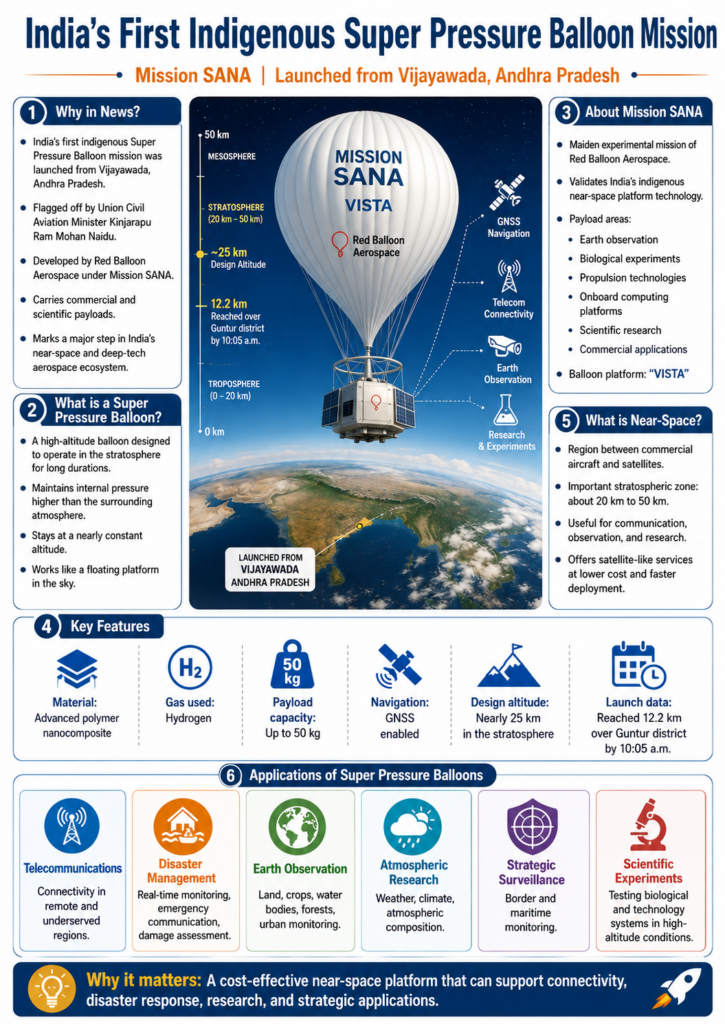
- A Super Pressure Balloon is a high-altitude balloon designed to operate in the stratosphere for a long duration.
- It maintains internal pressure higher than the surrounding atmospheric pressure. This allows it to remain stable at high altitudes for extended periods.
- Unlike ordinary balloons, super pressure balloons can stay at a nearly constant altitude and carry scientific or commercial payloads.
- In simple terms, it acts like a floating platform in the sky.
About Mission SANA
Mission SANA is the maiden experimental mission of Red Balloon Aerospace.
It aims to validate India’s indigenous near-space platform technology. The mission carried payloads related to:
- Earth observation
- Biological experiments
- Propulsion technologies
- Onboard computing platforms
- Scientific research
- Commercial applications
The balloon platform is also referred to as VISTA.
Key Features of the Balloon
- The Super Pressure Balloon has several important technological features.
- It is made of advanced polymer nanocomposite material. It is filled with hydrogen gas and is designed for long-duration operations in the stratosphere.
- The balloon can carry payloads of up to 50 kg. It is equipped with a Global Navigation Satellite System, or GNSS, for tracking and navigation.
- The balloon is designed to operate at altitudes of nearly 25 km in the stratosphere.
- During the launch, data showed that the balloon reached an altitude of 12.2 km over Guntur district by 10:05 a.m.
What is Near-Space?
- Near-space refers to the region between the altitude used by commercial aircraft and the region used by satellites.
- Commercial aircraft generally fly below the stratospheric region, while satellites operate much higher in space.
- The stratospheric region, especially between about 20 km and 50 km, is useful because it can support high-altitude platforms for communication, observation and research.
- This region is important because it can provide services similar to satellites at lower cost and with faster deployment.
Applications of Super Pressure Balloons
1. Telecommunications
- Super Pressure Balloons can help provide communication services in remote and underserved regions.
- They can act as high-altitude communication platforms and support rural connectivity.
2. Disaster Management
- These balloons can be deployed during floods, cyclones, earthquakes and other disasters.
- They can support real-time monitoring, emergency communication and damage assessment.
3. Earth Observation
- The platform can carry sensors for observing land, water bodies, crops, forests and urban areas.
- This is useful for agriculture, environmental monitoring and planning.
4. Atmospheric Research
- Super Pressure Balloons can collect data from the stratosphere.
- This can help scientists study weather patterns, climate processes and atmospheric composition.
5. Strategic Surveillance
- Near-space platforms can support surveillance and monitoring.
- They may be useful for border monitoring, maritime awareness and security-related applications.
6. Scientific Experiments
- The platform can carry biological, technological and computing experiments in high-altitude conditions.
- This helps test systems before they are used in satellites or other space missions.
Significance for India
1. Indigenous Technology Development
- The launch shows India’s ability to develop advanced near-space platforms using domestic technology.
- This supports the goal of Atmanirbhar Bharat in aerospace and space technology.
2. Boost to Space Economy
- India’s space economy is growing rapidly. Technologies like Super Pressure Balloons can support new commercial opportunities in telecommunications, earth observation and research.
3. Cost-Effective Alternative to Satellites
- Super Pressure Balloons can provide some services at lower cost compared to satellites.
- They do not require expensive rocket launches and can be deployed more quickly.
4. Support for Remote Connectivity
- India has many remote, hilly, tribal and border regions where communication services are limited.
- Near-space platforms can help improve connectivity in such areas.
5. Disaster Resilience
- These balloons can provide quick communication support during disasters when ground infrastructure is damaged.
6. Strategic Advantage
- Near-space technology has strategic value for surveillance, communication and national security.
- It can help India strengthen its technological capabilities between aircraft-based systems and satellite-based systems.
7. Public-Private Innovation
- The mission highlights the growing role of Indian startups in the aerospace and space technology sectors.
- It shows how private innovation can contribute to national technological capacity.
Significance for Andhra Pradesh
- The launch from Vijayawada is important for Andhra Pradesh.
- It shows the State’s growing role in aerospace, artificial intelligence, data centres, quantum technologies and deep-tech innovation.
- The mission also strengthens Andhra Pradesh’s image as an emerging innovation hub.
- It can encourage investment, research, startup activity and skilled employment in the State.
Challenges
1. Technical Complexity
- Super Pressure Balloons require advanced materials, pressure control, navigation systems and payload safety mechanisms.
2. Weather Dependence
- High-altitude balloon launches are affected by wind, temperature and atmospheric conditions.
3. Regulatory Framework
- Near-space platforms need clear rules for airspace management, safety, communication frequencies and data use.
4. Payload Safety
- Scientific and commercial payloads must be protected from extreme temperature, pressure and radiation conditions.
5. Long-Duration Reliability
- For commercial use, the platform must remain stable and operational for long periods.
6. Security Concerns
- Near-space platforms may raise concerns related to surveillance, data security and cross-border movement.
7. Scaling Up
- A successful experimental launch is only the first step. India must scale the technology for regular commercial and strategic use.
Way Forward
1. Develop Clear Near-Space Policy
- India should prepare a clear regulatory framework for near-space platforms, including safety, airspace use and data governance.
2. Encourage Startup Innovation
- Startups working in aerospace, communication and earth observation should receive financial, technical and regulatory support.
3. Strengthen Public-Private Partnership
- Government agencies, research institutions and private companies should collaborate in near-space technology.
4. Promote Disaster Management Use
- Super Pressure Balloons should be integrated into disaster communication and early warning systems.
5. Support Rural Connectivity
- Near-space platforms can be used to improve internet and communication services in remote villages, border areas and tribal regions.
6. Invest in Materials Research
- India should strengthen research in advanced polymers, lightweight materials, hydrogen systems and high-altitude navigation.
7. Link with National Space Policy
- Near-space technology should be connected with India’s larger space reforms, satellite ecosystem and commercial space economy.
Conclusion
The launch of India’s first indigenous Super Pressure Balloon from Vijayawada is a major achievement in India’s near-space technology journey.
It shows the potential of Indian startups, indigenous innovation and public-private collaboration in the aerospace sector.
This technology can support telecommunications, disaster management, atmospheric research, earth observation and strategic surveillance.
For India, Super Pressure Balloons can become an important bridge between aircraft and satellites. With proper policy support, safety regulation and investment, near-space platforms can play a significant role in India’s future space economy and national development.
CARE MCQ
Q. With reference to India’s first indigenous Super Pressure Balloon mission, consider the following statements:
- It was launched from Vijayawada.
- It was developed by Red Balloon Aerospace.
- It is designed to operate in the deep ocean region.
How many of the above statements are correct?
A. Only one
B. Only two
C. All the three
D. None
Answer: B
Explanation:
- Statement 1 is correct: India’s first indigenous Super Pressure Balloon mission was launched from Vijayawada.
- Statement 2 is correct: It was developed by Red Balloon Aerospace.
- Statement 3 is incorrect: It is designed to operate in the stratosphere, not in the deep ocean region.
Additional Information:
Super Pressure Balloons are high-altitude platforms useful for communication, observation and scientific research.
FAQs
1. What is a Super Pressure Balloon?
A Super Pressure Balloon is a high-altitude balloon that maintains internal pressure and operates in the stratosphere for a long duration.
2. Where was India’s first indigenous Super Pressure Balloon launched?
It was launched from Vijayawada in Andhra Pradesh.
3. Which company developed the mission?
The mission was developed by Red Balloon Aerospace under Mission SANA.
4. What is the use of Super Pressure Balloons?
They can be used for telecommunications, disaster management, earth observation, atmospheric research and strategic surveillance.
5. Why is this topic important for UPSC?
It is important for GS Paper III under Science and Technology, Space Technology, Disaster Management and Internal Security.
6. Why is it important for Andhra Pradesh?
The launch highlights Andhra Pradesh’s growing role in aerospace, deep-tech innovation and emerging space technologies.
Relevance: UPSC GS Paper I – Indian Society: Population and Associated Issues and demographic changes.
For Prelims:
- High-Level Committee on Demographic Change, Illegal Immigration, Population Stabilisation, Census 2027, Total Fertility Rate, Sample Registration System, Article 355, Foreigners Act, Citizenship Act, Sixth Schedule, Siliguri Corridor.
For Mains:
- Internal Security, Demographic Imbalance, Illegal Migration, Border Management, Tribal Identity, Electoral Integrity, Population Stabilisation, Centre-State Coordination, Migration Governance.
Why in News?
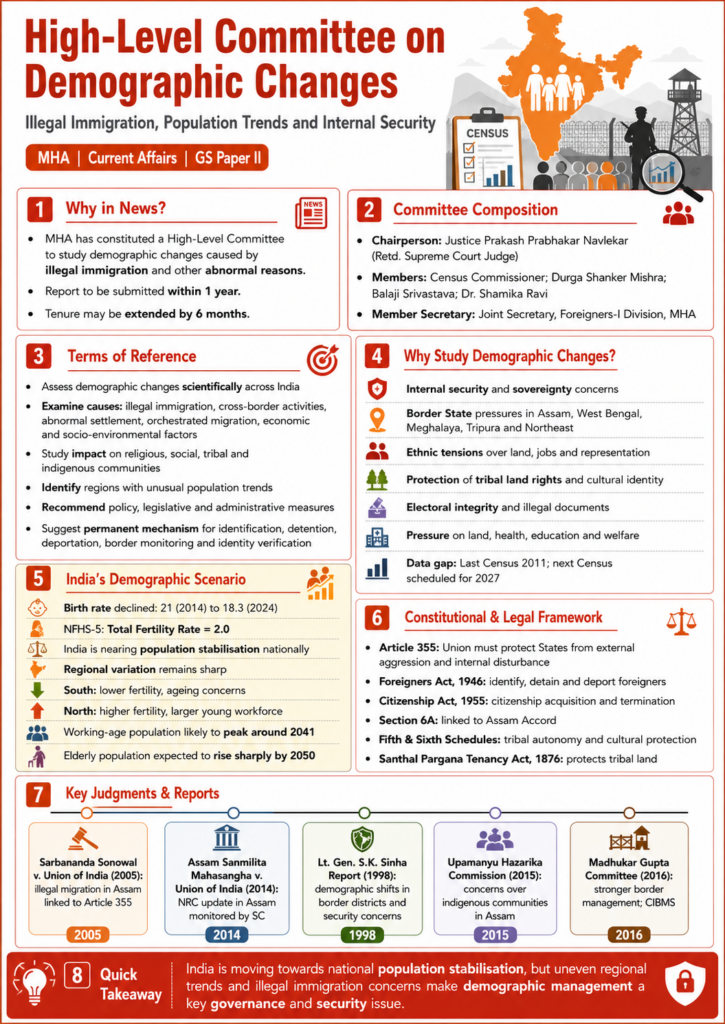
The Union Ministry of Home Affairs has constituted a High-Level Committee to study demographic changes arising from illegal immigration and other abnormal reasons.
The committee has been asked to submit its report within one year. Its tenure may be extended by up to six months, if required.
The committee will study abnormal demographic changes, identify their causes and recommend policy, legislative and administrative measures. It will also suggest an institutional mechanism for population stabilisation, border management and identification of illegal immigrants.
Composition and Timeline of the Committee
- The committee will be headed by Justice Prakash Prabhakar Navlekar, retired Supreme Court Judge and former Lokayukta of Madhya Pradesh.
- Other members include:
- Census Commissioner
- Durga Shanker Mishra, retired IAS officer
- Balaji Srivastava, retired IPS officer
- Dr. Shamika Ravi, member of the Prime Minister’s Economic Advisory Council
- The Joint Secretary, Foreigners-I Division, Ministry of Home Affairs will serve as the Member Secretary.
- The committee must submit its report within one year.
- The tenure can be extended by six months, if needed.
Terms of Reference
- Scientifically assess demographic changes occurring in different parts of India.
- Study changes caused by:
- Illegal immigration
- Cross-border activities
- Abnormal settlement patterns
- Orchestrated migration
- Economic opportunities
- Socio-environmental factors
- Analyse population changes at the level of:
- Religious communities
- Social communities
- Tribal and indigenous groups
- Identify regions where population trends deviate from wider national patterns.
- Recommend policy, legislative and administrative measures.
- Suggest a permanent mechanism for:
- Identification of illegal immigrants
- Detention
- Deportation
- Border monitoring
- Identity verification
- Recommend a framework for better coordination between the Centre and State governments.
Need to Study Demographic Changes
- Internal security: Illegal immigration across porous borders may affect sovereignty, law and order and national security.
- Article 355 responsibility: The Union has a constitutional duty to protect States from external aggression and internal disturbance.
- Border States: West Bengal, Assam, Meghalaya, Tripura and parts of the Northeast have historically faced cross-border migration concerns.
- Ethnic conflict: Sudden demographic changes can create fears over land, jobs and political representation.
- Tribal protection: In tribal belts, abnormal settlement patterns may affect indigenous land rights and cultural identity.
- Electoral integrity: Illegal procurement of documents such as Aadhaar or voter ID can affect electoral rolls.
- Public resources: Rapid population rise in specific pockets may strain land, healthcare, education, welfare delivery and local employment.
- Data gap: The last Census was conducted in 2011, and the next Census is scheduled for 2027. Updated local demographic data is needed.
India’s Demographic Scenario
- India’s birth rate declined from 21 in 2014 to 18.3 in 2024.
- According to NFHS-5, India’s Total Fertility Rate declined to 2.0, below the replacement level of 2.1.
- India is moving towards population stabilisation at the national level.
- However, demographic trends are not uniform across regions.
- Southern States such as Kerala and Tamil Nadu have low fertility rates and face ageing concerns.
- Northern States such as Bihar and Uttar Pradesh still have higher fertility rates and a larger young workforce.
- India’s working-age population is expected to peak around 2041.
- The elderly population is projected to rise sharply by 2050.
Constitutional and Legal Framework
- Article 355: The Union must protect every State against external aggression and internal disturbance.
- Foreigners Act, 1946: Empowers the government to identify, detain and deport foreigners. It also places the burden of proof on the individual to prove citizenship.
- Citizenship Act, 1955: Provides the legal framework for acquisition and termination of Indian citizenship.
- Section 6A of the Citizenship Act: Linked to the Assam Accord and citizenship issues in Assam.
- Fifth and Sixth Schedules: Protect tribal autonomy, land rights and cultural identity.
- Santhal Pargana Tenancy Act, 1876: Protects tribal land in the Santhal Pargana region from transfer to non-tribals.
Supreme Court Judgments and Reports
- Lt. Gen. S.K. Sinha Report, 1998:
It highlighted concerns over demographic changes in border districts and their security implications. - Sarbananda Sonowal v. Union of India, 2005:
The Supreme Court observed that large-scale illegal migration into Assam amounted to external aggression and internal disturbance. It connected the issue with Article 355. - Assam Sanmilita Mahasangha v. Union of India, 2014:
The Supreme Court directed a monitored update of the National Register of Citizens in Assam. - Upamanyu Hazarika Commission, 2015:
It raised concerns over the future of indigenous communities in Assam due to demographic changes. - Madhukar Gupta Committee, 2016:
It recommended strengthening border management through the Comprehensive Integrated Border Management System.
Significance
- Helps generate updated and scientific data on demographic changes.
- Strengthens policy response to illegal immigration.
- Supports better border management and identification systems.
- Protects tribal and indigenous communities from demographic and land-related pressures.
- Helps maintain law and order in sensitive regions.
- Supports electoral integrity by addressing fraudulent identity concerns.
- Helps the Centre and States coordinate on migration and demographic issues.
- Provides useful inputs before the 2027 Census.
Challenges
- Demographic issues are politically sensitive.
- Differentiating illegal immigration from internal migration can be difficult.
- Poor documentation may affect genuine citizens and vulnerable groups.
- Deportation requires legal clarity and cooperation with neighbouring countries.
- Over-securitisation may affect humanitarian concerns.
- Community-level analysis may create social tensions if not handled carefully.
- Border management is difficult in riverine, forested and porous areas.
- Data collection must be transparent, scientific and non-discriminatory.
Way Forward
- Conduct scientific and transparent demographic audits.
- Ensure that findings are based on reliable data, not assumptions.
- Strengthen border management using technology such as sensors, surveillance systems and smart fencing.
- Improve coordination between the Centre, States and border agencies.
- Create a fair, legal and time-bound mechanism for identification and deportation of illegal immigrants.
- Protect genuine citizens from harassment through proper documentation and appeal mechanisms.
- Strengthen tribal land protection laws and local governance institutions.
- Audit electoral rolls carefully without excluding legitimate voters.
- Promote balanced internal migration policies to support labour mobility.
- Use the 2027 Census to create a stronger demographic database for future planning.
Conclusion
The High-Level Committee on Demographic Change is important for understanding the link between illegal immigration, population shifts, internal security and social stability.
India’s national fertility rate is declining, but local demographic changes in border and tribal regions need careful study. The committee’s work must be scientific, transparent and constitutionally balanced.
A sound policy must protect national security, tribal rights and electoral integrity while also respecting due process, human dignity and genuine citizenship rights.
UPSC PYQ
Q. To obtain full benefits of demographic dividend, what should India do? (2013)
(a) Promoting skill development
(b) Introducing more social security schemes
(c) Reducing infant mortality rate
(d) Privatization of higher education
Ans: (a)
CARE MCQ
Q. With reference to the High-Level Committee on Demographic Change, consider the following statements:
- It has been constituted by the Union Ministry of Home Affairs.
- It will study demographic changes arising from illegal immigration and other abnormal reasons.
- It has been directed to submit its report within one year.
Which of the above statements are correct?
A. 1 and 2 only
B. 2 and 3 only
C. 1 and 3 only
D. 1, 2 and 3
Answer: D
Explanation:
- Statement 1 is correct: The committee has been constituted by the Union Ministry of Home Affairs.
- Statement 2 is correct: It will study demographic changes linked with illegal immigration and abnormal reasons.
- Statement 3 is correct: It has been directed to submit its report within one year.
FAQs
1. What is the High-Level Committee on Demographic Change?
It is a committee constituted by the Union Government to study demographic changes caused by illegal immigration and other abnormal reasons.
2. Which ministry constituted the committee?
The committee was constituted by the Union Ministry of Home Affairs.
3. What is the main purpose of the committee?
Its main purpose is to scientifically assess demographic changes and recommend suitable policy, legal and administrative measures.
4. Who is heading the committee?
The committee is headed by Justice Prakash Prabhakar Navlekar, a retired judge of the Supreme Court.
5. When will the committee submit its report?
The committee has been asked to submit its report within one year. Its tenure may be extended by six months, if required.
Relevance: UPSC: GS Paper III – Rural Economy, Employment, Inclusive Growth and Public Finance.
For Prelims:
- VB-G RAM G, MGNREGA, Rural Employment, Job Card, DBT, Unemployment Allowance, Normative Allocation, Sixteenth Finance Commission, Social Audit.
For Mains:
- Rural Livelihood Security, Fiscal Federalism, Wage Employment, State Finances, Demand-driven Welfare, Social Audit, Direct Benefit Transfer, Rural Distress.
Why in News?
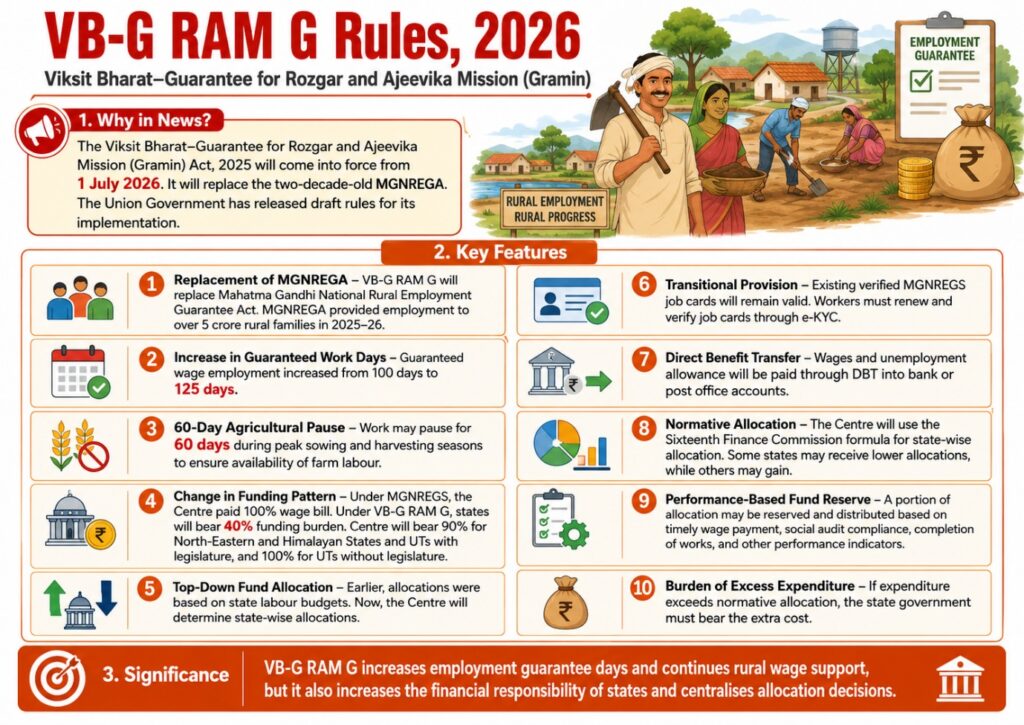
The Viksit Bharat-Guarantee for Rozgar and Ajeevika Mission (Gramin) Act, 2025, also called VB-G RAM G, is set to replace the two-decade-old Mahatma Gandhi National Rural Employment Guarantee Act (MGNREGA).
Ahead of its rollout, the Union government has released draft rules covering wage payment, unemployment allowance, State allocations and monitoring of implementation.
What is VB-G RAM G?
- VB-G RAM G is a new rural employment guarantee scheme.
- It seeks to provide guaranteed wage employment to rural households.
- It replaces MGNREGA, which had provided employment support to crores of rural families.
- It increases the guaranteed workdays from 100 days to 125 days.
- It also introduces a 60-day pause during peak agricultural sowing and harvesting seasons.
- The aim is to ensure rural employment while also protecting availability of labour for agriculture.
How it Differs from MGNREGA
| Feature | MGNREGA | VB-G RAM G |
| Guaranteed workdays | 100 days | 125 days |
| Funding of wages | Centre paid 100% wage bill | States to share part of cost |
| Allocation model | Based on State labour budgets | Centre determines normative allocation |
| Agricultural season pause | Not a major feature | 60-day pause during peak farm seasons |
| Payment mode | Bank/post office-based payments | DBT into bank/post office accounts |
| Transition | Existing MGNREGS job cards | Valid after renewal and e-KYC |
Draft Rules Released
The Ministry of Rural Development released draft rules related to:
- National Level Steering Committee
- Grievance Redressal
- Administrative Expenses
- Transitional Provisions
- Objective Parameters for Normative Allocation
- Central Gramin Rozgar Guarantee Council
- Wage and Unemployment Allowance Payment
- Expenditure beyond Normative Allocation
The public can submit objections and suggestions before final notification.
Impact on Existing MGNREGS Workers
- Existing MGNREGS job cards will remain valid under the new scheme.
- These cards must be:
- Renewed
- Verified through e-KYC
- This arrangement will continue until States issue new Gramin Rozgar Guarantee Cards.
- Wages and unemployment allowance will be paid through Direct Benefit Transfer into bank or post office accounts.
- The Union government is yet to declare the wage rate under the new scheme.
Fund Sharing Pattern
- Under MGNREGS, the Centre paid 100% of the wage bill.
- Under VB-G RAM G, States will bear 40% of the funding burden.
- For Northeastern and Himalayan States and Union Territories with legislature, the Centre will bear 90% of the funding.
- For Union Territories without legislature, the Centre will bear the full funding burden.
Normative Allocation to States
- The Centre will determine the normative allocation of funds to every State each financial year.
- The allocation will be based on objective parameters.
- The draft rules propose the use of the Sixteenth Finance Commission’s horizontal devolution formula.
- This may change the distribution of funds among States.
- Some States may receive lower allocations than under MGNREGS, while others may receive higher shares.
Performance-linked Allocation
- The Union government may keep aside a portion of the normative allocation.
- This amount may be distributed among States based on:
- Timely wage payment
- Compliance with social audit
- Completion of works
- Other performance indicators specified by the Centre
- This provision is expected to apply from the next financial year.
Significance
- Increases guaranteed rural employment from 100 to 125 days.
- Ensures continuity for existing MGNREGS workers through verified job cards.
- Promotes transparency through DBT wage payments.
- Links fund allocation with performance and monitoring.
- Attempts to balance rural employment with agricultural labour needs.
- Introduces a more structured allocation system.
- Can support rural livelihoods if implemented effectively.
Challenges
- Shifting 40% funding burden to States may stress State finances.
- Top-down allocation may weaken the demand-driven nature of rural employment guarantee.
- States with higher labour demand may face higher expenditure beyond allocation.
- The 60-day pause may affect workers who depend on wage employment during lean periods.
- e-KYC and digital verification may create exclusion risks for vulnerable workers.
- Delay in wage declaration may create uncertainty.
- Performance-linked funds may disadvantage States with weaker administrative capacity.
Way Forward
- Protect the demand-driven character of rural employment guarantee.
- Ensure that workers are not excluded due to e-KYC or documentation issues.
- Release wage rates clearly and on time.
- Provide adequate fiscal support to States with high rural employment demand.
- Strengthen social audits and grievance redressal.
- Ensure timely DBT payments.
- Avoid excessive centralisation in fund allocation.
- Provide special support to poorer and drought-prone regions.
Conclusion
VB-G RAM G marks a major shift in India’s rural employment guarantee framework. It increases guaranteed workdays and introduces DBT, new allocation rules and performance-linked funding.
However, the success of the scheme will depend on timely wage payments, protection of workers’ rights, fiscal support to States and strong social audits. Rural employment guarantee should remain a tool of livelihood security, not only a budget-controlled welfare programme.
UPSC PYQ
Q. Which one of the following is not an objective of the MGNREGA?
A. Providing up to 100 days of skilled labour in a financial year
B. Creation of productive assets
C. Enhancing livelihood security
D. Ensuring empowerment to women
Answer: A
Explanation:
The Mahatma Gandhi National Rural Employment Guarantee Act (MGNREGA), enacted in 2005, is a major rural employment and social security programme aimed at enhancing livelihood security in rural areas.
Its major objectives include:
- Enhancing livelihood security by guaranteeing wage employment to rural households.
- Creation of durable and productive assets such as ponds, roads, irrigation canals, and water conservation structures.
- Women empowerment, as the Act mandates that at least one-third of the beneficiaries should be women.
- Providing up to 100 days of guaranteed wage employment to rural households willing to do unskilled manual work.
However, MGNREGA guarantees unskilled manual labour, not skilled labour. Therefore, option A is not an objective of the scheme.
CARE MCQ
Q. With reference to VB-G RAM G, consider the following statements:
- It increases guaranteed workdays from 100 to 150 days.
- It replaces MGNREGA.
- It provides a 60-day pause during peak agricultural seasons.
Which of the above statements are correct?
A. 1 and 2 only
B. 2 and 3 only
C. 1 and 3 only
D. 1, 2 and 3
Answer: C
Explanation:
- Statement 1 is correct: VB-G RAM G increases guaranteed workdays to 125.
- Statement 2 is correct: It replaces MGNREGA.
- Statement 3 is correct: It provides for a 60-day pause during peak sowing and harvesting seasons.
FAQs
1. What is VB-G RAM G?
VB-G RAM G stands for Viksit Bharat–Guarantee for Rozgar and Ajeevika Mission (Gramin). It is a new rural employment guarantee scheme that will replace MGNREGA.
2. What does VB-G RAM G replace?
It will replace the two-decade-old Mahatma Gandhi National Rural Employment Guarantee Act (MGNREGA).
3. How many days of work will be guaranteed under VB-G RAM G?
The scheme increases guaranteed wage employment from 100 days to 125 days.
4. What is the 60-day pause under the scheme?
VB-G RAM G provides for a 60-day pause during peak sowing and harvesting seasons to ensure the availability of farm labour.
5. Will existing MGNREGS job cards remain valid?
Yes. Existing MGNREGS job cards will remain valid after renewal and e-KYC verification until new Gramin Rozgar Guarantee Cards are issued.