Relevance: APPSC: G1 MAINS Paper — IV — ECONOMY AND DEVELOPMENT OF INDIA AND ANDHRA PRADESH, Andhra Pradesh Economy, Irrigation Projects, Agriculture, Regional Development
For Prelims:
- Polavaram Project, Handri-Neeva Sujala Sravanthi, Veligonda Project, Polavaram Left Main Canal, Water Calendar, Lift Irrigation, Ayacut, Jaladhara–Jalaharathi, Groundwater Recharge, River Interlinking
For Mains:
- Irrigation governance, water security, agricultural planning, regional imbalance, drought-proofing, maintenance of irrigation systems, farmer-centric water management, climate-resilient agriculture
Why in News?
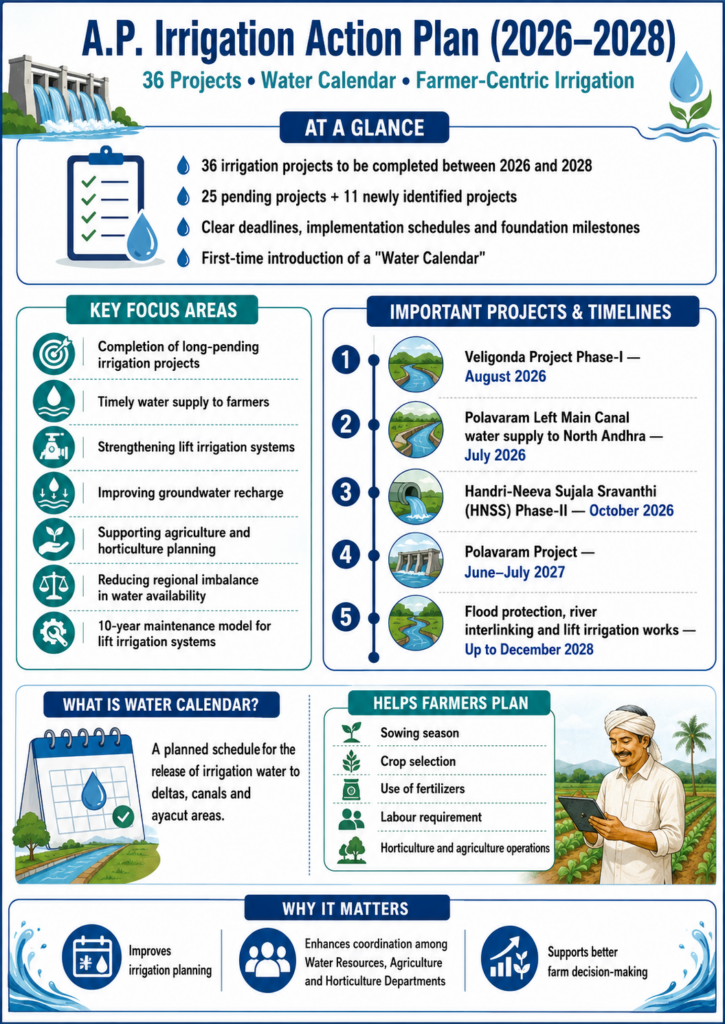
The Andhra Pradesh government has prepared a time-bound action plan to complete 36 irrigation projects between 2026 and 2028.
According to the State Water Resources Development Minister, the plan includes 25 pending projects and 11 newly identified projects. These projects have been given clear deadlines, implementation schedules and foundation milestones.
The government has also decided to introduce a Water Calendar for the first time to specify irrigation water release dates for major deltas and ayacut regions.
Key Highlights
The Andhra Pradesh government aims to give a new direction to the irrigation sector by completing key projects in a phased manner.
The major focus is on:
- Completion of long-pending irrigation projects
- Timely water supply to farmers
- Strengthening lift irrigation systems
- Improving groundwater recharge
- Supporting agriculture and horticulture planning
- Reducing regional imbalance in water availability
The government has also proposed a 10-year maintenance model for lift irrigation systems. This is expected to ensure regular operation, transparency and uninterrupted water supply.
Important Projects and Timelines
| Project / Initiative | Target Timeline |
| Veligonda Project Phase-I | August 2026 |
| Handri-Neeva Sujala Sravanthi Phase-II | October 2026 |
| Polavaram Left Main Canal water supply to North Andhra | July 2026 |
| Polavaram Project | June–July 2027 |
| Flood protection, river interlinking and lift irrigation works | Up to December 2028 |
Reports also indicate that the irrigation calendar includes works such as Polavaram Left Main Canal, Veligonda Phase-I, canal modernisation and several lift irrigation projects across Rayalaseema and North Andhra.
What is Water Calendar?
A Water Calendar is a planned schedule that clearly mentions when irrigation water will be released to different deltas, canals and ayacut areas.
It helps farmers to plan:
- Sowing season
- Crop selection
- Use of fertilizers
- Labour requirement
- Horticulture and agriculture operations
This system can improve coordination between the Water Resources Department, Agriculture Department and Horticulture Department.
Significance
1. Support to Farmers
- A clear water release schedule will help farmers plan cultivation in advance. It reduces uncertainty during the sowing season.
2. Drought-Proofing of Rayalaseema
- Projects such as Handri-Neeva Sujala Sravanthi are important for drought-prone areas of Rayalaseema. They can improve irrigation access and drinking water availability.
3. Development of North Andhra
- Water supply through the Polavaram Left Main Canal can support agriculture and drinking water needs in North Andhra.
4. Completion of Polavaram Project
- The Polavaram Project is one of Andhra Pradesh’s most important multipurpose irrigation projects on the Godavari River. It has importance for irrigation, drinking water, power generation and inter-basin water transfer.
5. Better Use of Lift Irrigation
- The proposed 10-year maintenance model can improve the efficiency of lift irrigation systems. It can reduce breakdowns and ensure regular water delivery.
6. Groundwater Recharge
- The Jaladhara–Jalaharathi programme aims to promote groundwater recharge as a mass movement. This is important because groundwater is a major source of irrigation and drinking water in many rural areas.
Challenges
1. Financial Burden
- Large irrigation projects require huge investment. Cost escalation and delayed funding may affect completion.
2. Land Acquisition and Rehabilitation
- Projects like dams, canals and reservoirs may involve land acquisition and rehabilitation of affected families.
3. Environmental Concerns
- Major irrigation and river interlinking projects may affect forests, river ecology and biodiversity.
4. Maintenance of Lift Irrigation
- Lift irrigation systems need regular power supply, repair and maintenance. Without proper management, they may become costly and inefficient.
5. Inter-State Water Issues
- Rivers such as Godavari and Krishna involve multiple states. Water sharing disputes may affect project execution and operation.
6. Climate Variability
- Erratic rainfall, floods and droughts can disturb irrigation planning. Therefore, irrigation management must become climate-resilient.
Way Forward
- Complete projects within the announced timelines through strict monitoring.
- Use digital dashboards and real-time project tracking.
- Ensure transparent tendering and expenditure monitoring.
- Strengthen coordination between irrigation, agriculture and horticulture departments.
- Give priority to tail-end farmers and drought-prone areas.
- Improve canal maintenance and reduce water losses.
- Promote micro-irrigation along with major irrigation projects.
- Ensure proper rehabilitation and environmental safeguards.
- Link the Water Calendar with crop advisory services for farmers.
Conclusion
Andhra Pradesh’s plan to complete 36 irrigation projects by 2028 is significant for agriculture, water security and regional development. The proposed Water Calendar can make irrigation governance more predictable and farmer-friendly. However, success will depend on timely execution, financial discipline, environmental care and proper maintenance of irrigation systems.
CARE MCQ
Q. With reference to the recent irrigation action plan of Andhra Pradesh, consider the following statements:
- The State government has planned to complete 36 irrigation projects between 2026 and 2028.
- The plan includes both pending projects and newly identified projects.
- The Water Calendar will specify irrigation water release dates for farmers.
Which of the above statements are correct?
A. 1 and 2 only
B. 2 and 3 only
C. 1 and 3 only
D. 1, 2 and 3
Answer: D
Explanation:
- Statement 1 is correct: Andhra Pradesh has prepared a plan to complete 36 irrigation projects between 2026 and 2028.
- Statement 2 is correct: The plan includes 25 pending projects and 11 newly identified projects.
- Statement 3 is correct: The Water Calendar will mention water release dates for major deltas and ayacut regions.
Additional Information:
A Water Calendar helps farmers plan sowing, crop choice and other agricultural activities in advance.
FAQs
Q. What is the main aim of Andhra Pradesh’s irrigation plan?
To complete 36 irrigation projects between 2026 and 2028 and improve water supply to farmers.
Q. What is a Water Calendar?
It is a schedule that specifies irrigation water release dates for different regions.
Q. Why is Polavaram important?
It is a major multipurpose project on the Godavari River, useful for irrigation, drinking water and power generation.
Q. What is Jaladhara–Jalaharathi?
It is a programme aimed at promoting groundwater recharge as a mass movement.
Relevance: UPSC GS Paper III – Science and Technology, Space Technology, SMILE Mission, Magnetosphere
For Prelims:
- SMILE Mission, Magnetosphere, Solar Wind, Solar Flares, Coronal Mass Ejections, Auroras, Space Weather, Vega-C Rocket, Soft X-ray Imager, Ultraviolet Aurora Imager
For Mains:
- Space weather forecasting, protection of satellites, solar-terrestrial interaction, critical infrastructure security, international space cooperation, early warning systems
Why in News?
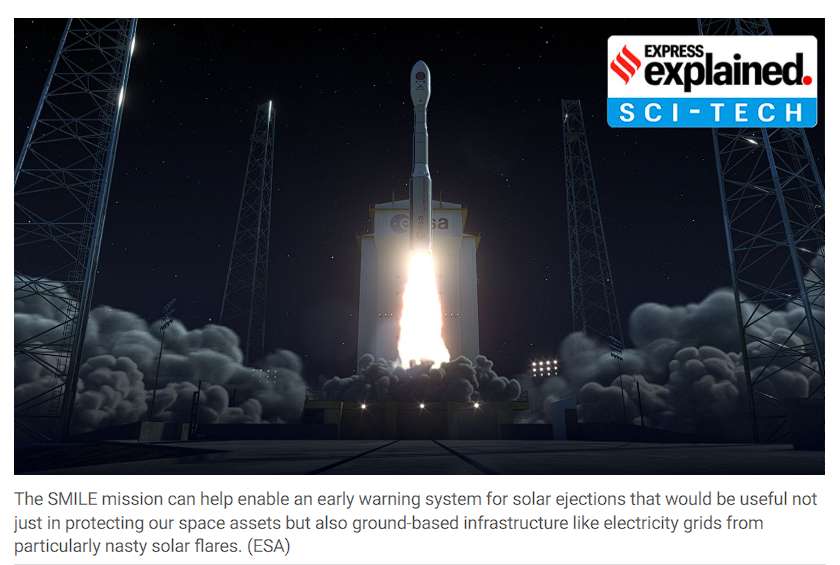
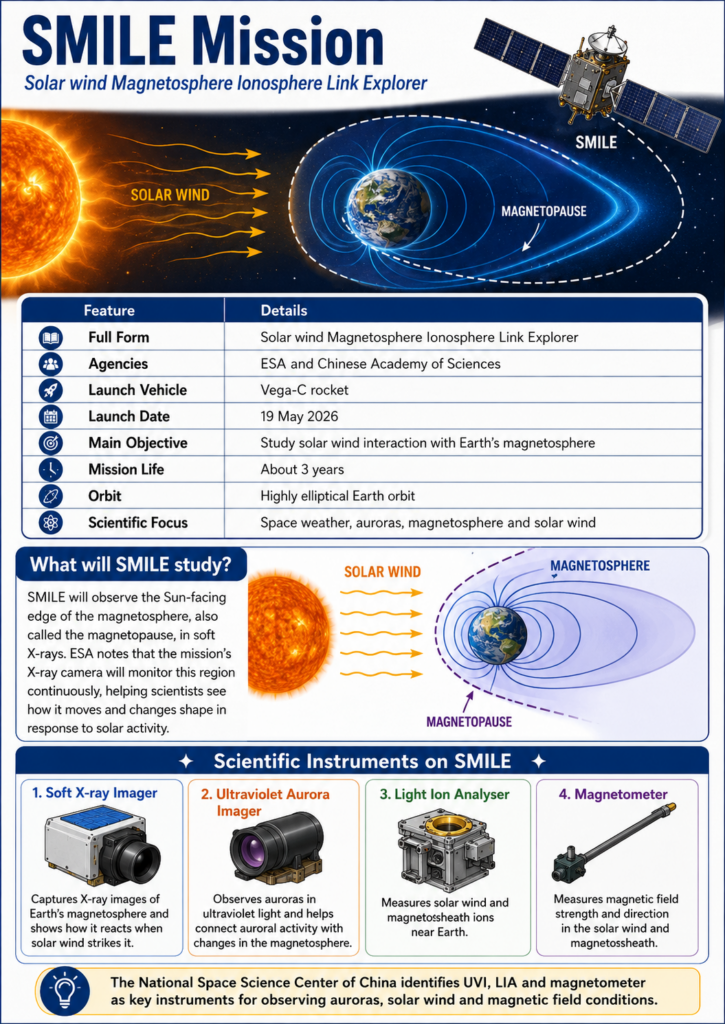
The Solar wind Magnetosphere Ionosphere Link Explorer (SMILE) mission is scheduled to be launched on 19 May 2026 on a European Vega-C rocket from Europe’s Spaceport in French Guiana. It is a joint mission of the European Space Agency (ESA) and the Chinese Academy of Sciences (CAS).
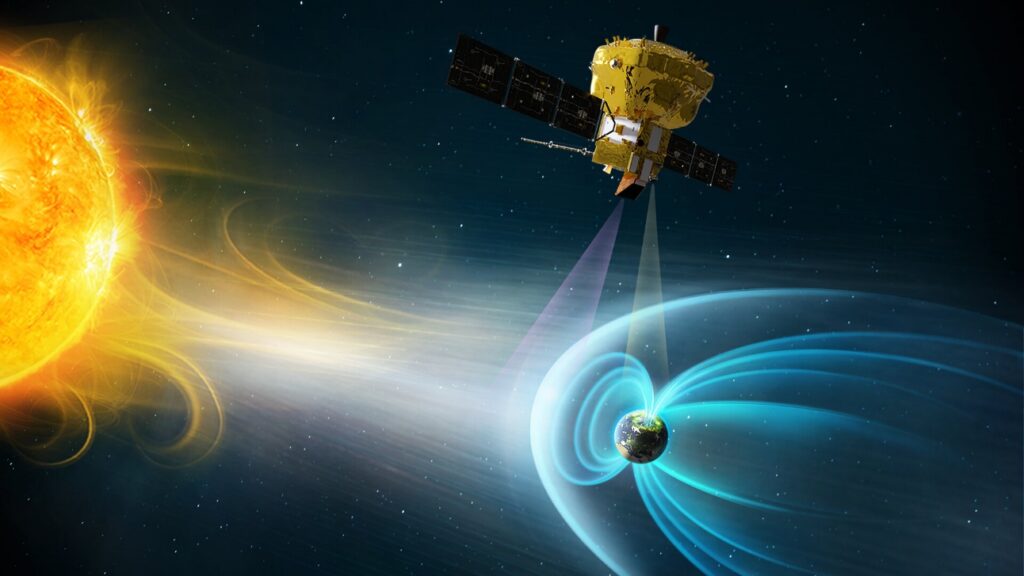
The mission will study how the solar wind interacts with Earth’s magnetosphere, which acts as a protective shield against harmful particles and radiation from the Sun.
What is SMILE Mission?
SMILE stands for Solar wind Magnetosphere Ionosphere Link Explorer.
It is a joint Chinese-European space science mission designed to study the interaction between the Sun and Earth’s magnetic environment. ESA describes SMILE as the first mission to observe Earth’s magnetosphere in X-ray light, helping scientists understand when, where and how solar wind interacts with Earth’s magnetic shield.
The mission will observe the magnetosphere, auroras and solar wind using X-ray, ultraviolet and in-situ instru ments.
Earth’s Magnetic Shield: Magnetosphere
The magnetosphere is the region around Earth controlled by Earth’s magnetic field. It forms a vast protective bubble around the planet.
It protects Earth by:
- Deflecting harmful charged particles from the Sun.
- Reducing the direct impact of solar wind.
- Preventing gradual erosion of Earth’s atmosphere.
- Supporting conditions necessary for life.
- Protecting satellites and communication systems from space weather effects.
Earth’s magnetosphere is not fixed. It changes shape and size depending on the strength of solar wind and solar storms.
How the Sun Affects Earth
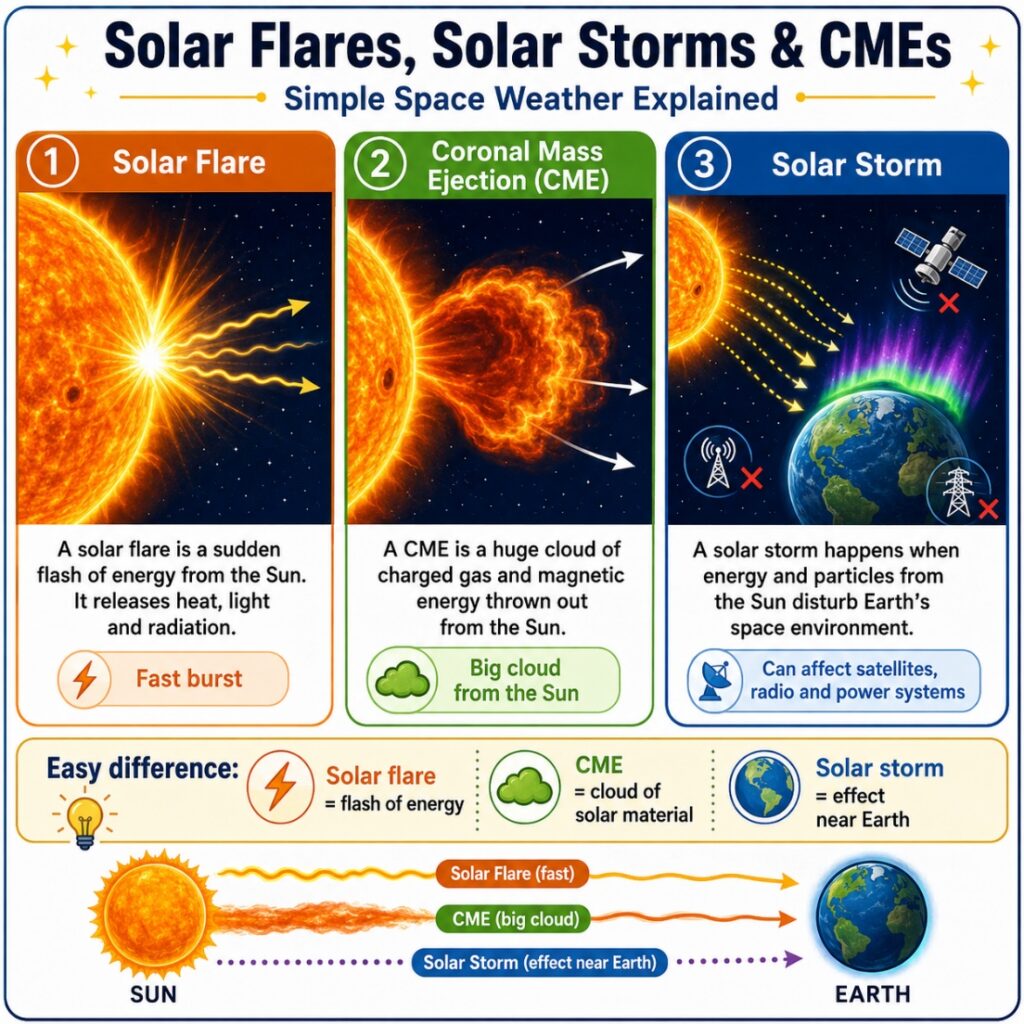
The Sun constantly releases solar wind, which is a stream of charged particles. It also produces powerful events such as:
- Solar flares
- Solar storms
- Coronal Mass Ejections (CMEs)
These events can disturb space weather. Space weather disturbances may affect satellites, GPS, communication networks, power grids, airlines and astronaut safety.
When charged particles from the Sun interact with Earth’s upper atmosphere near the poles, they produce bright lights called auroras.
Scientific Instruments on SMILE
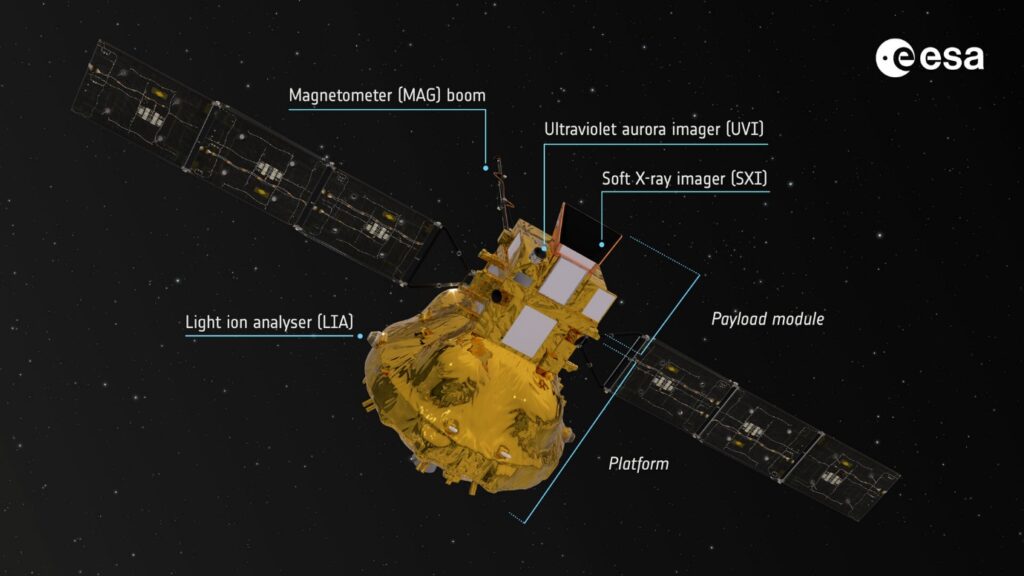
The mission carries four major instruments:
1.Soft X-ray Imager
- It will capture X-ray images of Earth’s magnetosphere. This is important because it will show how the magnetosphere reacts when solar wind strikes it.
2.Ultraviolet Aurora Imager
- It will observe auroras in ultraviolet light and help connect auroral activity with changes in the magnetosphere.
3.Light Ion Analyser
- It will measure solar wind and magnetosheath ions near Earth.
4.Magnetometer
- It will measure magnetic field strength and direction in the solar wind and magnetosheath.
- The National Space Science Center of China identifies UVI, LIA and magnetometer as key instruments for observing auroras, solar wind and magnetic field conditions.
Significance of the SMILE Mission
- Better Understanding of Earth’s Protection System
- SMILE will help scientists understand how Earth naturally protects itself from harmful solar particles and radiation. This is important for studying the relationship between the Sun and Earth.
- Improvement in Space Weather Forecasting
- Space weather can disturb satellites, GPS, communication systems and electricity grids. SMILE can provide better data for forecasting such disturbances.
- Protection of Space Assets
- Modern economies depend on satellites for communication, navigation, weather forecasting, banking and defence. Accurate forecasting of solar storms can help protect these assets.
- Support for Astronaut Safety
- Solar radiation can be dangerous for astronauts. Better space weather warning systems are important for future space missions and space stations.
- International Space Cooperation
- SMILE is an important example of cooperation between Europe and China in space science. Such missions show how scientific collaboration can address global challenges.
- First Global X-ray View of the Magnetosphere
- Past missions studied Earth’s magnetosphere, but SMILE will provide a wider and more direct view using X-ray imaging. This makes it scientifically unique.
Challenges and Concerns
- Complex Space Environment
- The magnetosphere is highly dynamic. It changes quickly during solar storms, making observations and forecasting difficult.
- Dependence on Advanced Instruments
- The mission depends on sensitive X-ray and ultraviolet instruments. Any technical failure may affect the quality of data.
- Limited Mission Life
- The mission life is about three years. Long-term space weather research needs continuous monitoring.
- Space Weather Prediction is Still Developing
- Even with better data, predicting the exact timing and intensity of solar storms remains challenging.
- Geopolitical Sensitivities
- International space cooperation may face challenges due to changing geopolitical relations.
Way Forward
- Strengthen global cooperation in space weather monitoring.
- Develop better early warning systems for solar storms.
- Improve protection of satellites, power grids and communication networks.
- Use SMILE data for scientific research and disaster preparedness.
- Encourage India to expand its own space weather research through ISRO, IIST and academic institutions.
- Integrate space weather forecasting with national security and infrastructure planning.
Conclusion
The SMILE mission is an important step in understanding how Earth protects itself from the Sun. By capturing X-ray and ultraviolet images of the magnetosphere and auroras, it will improve scientific knowledge of space weather. The mission is also important for protecting satellites, communication systems, GPS networks, power grids and astronauts. In an age of growing dependence on space-based infrastructure, missions like SMILE are essential for both science and security.
UPSC PYQ
Q. With reference to India’s satellite launch vehicles, consider the following statements: (2018)
- PSLVs launch the satellites useful for Earth resources monitoring whereas GSLVs are designed mainly to launch communication satellites.
- Satellites launched by PSLV appear to remain permanently fixed in the same position in the sky, as viewed from a particular location on Earth.
- GSLV Mk III is a four-staged launch vehicle with the first and third stages using solid rocket motors; and the second and fourth stages using liquid rocket engines.
Which of the statements given above is/are correct?
A. 1 only
B. 2 and 3
C. 1 and 2
D. 3 only
Answer: A
Explanation
Statement 1: Correct
- Indian Space Research Organisation’s PSLV (Polar Satellite Launch Vehicle) is mainly used to launch:
- Earth observation satellites,
- remote sensing satellites,
- resource monitoring satellites.
- GSLV (Geosynchronous Satellite Launch Vehicle) is mainly designed to launch:
- communication satellites,
- heavier satellites into Geostationary Transfer Orbit (GTO).
So, Statement 1 is correct.
Statement 2: Incorrect
Satellites that remain fixed at one position in the sky are geostationary satellites.
- PSLV mainly launches satellites into:
- Polar Orbit,
- Sun-synchronous Orbit (SSO).
These satellites move relative to Earth and do not appear fixed in the sky.
So, Statement 2 is wrong.
Statement 3: Incorrect
GSLV Mk III (LVM3) is actually a three-stage launch vehicle, not four-stage.
Structure:
- Two solid strap-on boosters
- Liquid core stage
- Cryogenic upper stage
Hence, Statement 3 is incorrect.
CARE MCQ
Q. SMILE Mission, recently seen in the context of space science, is a joint mission of:
A. NASA and ISRO
B. ESA and Chinese Academy of Sciences
C. JAXA and Roscosmos
D. ISRO and CNES
Answer: B
Explanation:
- SMILE stands for Solar wind Magnetosphere Ionosphere Link Explorer.
- It is a joint space science mission of the European Space Agency (ESA) and the Chinese Academy of Sciences (CAS).
- The mission will study how the solar wind interacts with Earth’s magnetosphere.
Why other options are incorrect:
- A → NASA and ISRO are associated with missions like NISAR.
- C → JAXA and Roscosmos are not partners in SMILE.
- D → ISRO and CNES are not associated with this mission.
Additional Information:
- Launch Vehicle: Vega-C rocket
- Launch Site: Europe’s Spaceport, French Guiana
- Mission Life: About 3 years
FAQs
Q. What is SMILE Mission?
SMILE is a joint European-Chinese mission to study how solar wind interacts with Earth’s magnetosphere.
Q. What is the magnetosphere?
It is the magnetic shield around Earth that protects the planet from harmful charged particles from the Sun.
Q. Why is SMILE important?
It will improve understanding of space weather and help protect satellites, GPS, power grids and astronauts.
Q. What causes auroras?
Auroras are caused when charged particles from the Sun interact with Earth’s upper atmosphere near the polar regions.
Relevance: GS Paper II – Health, Governance, Global Health Institutions, International Health Regulations
For Prelims:
Ebola, PHEIC, WHO, International Health Regulations, Democratic Republic of the Congo, Uganda, Bundibugyo Virus, Zoonotic Disease, Ring Vaccination, Monoclonal Antibodies, Contact Tracing, Safe Burial.
For Mains:
- Global Health Security, Disease Surveillance, Zoonotic Spillover, Public Health Emergency, Outbreak Preparedness, One Health, Infection Control, International Cooperation, Vaccine Equity.
Why in News?
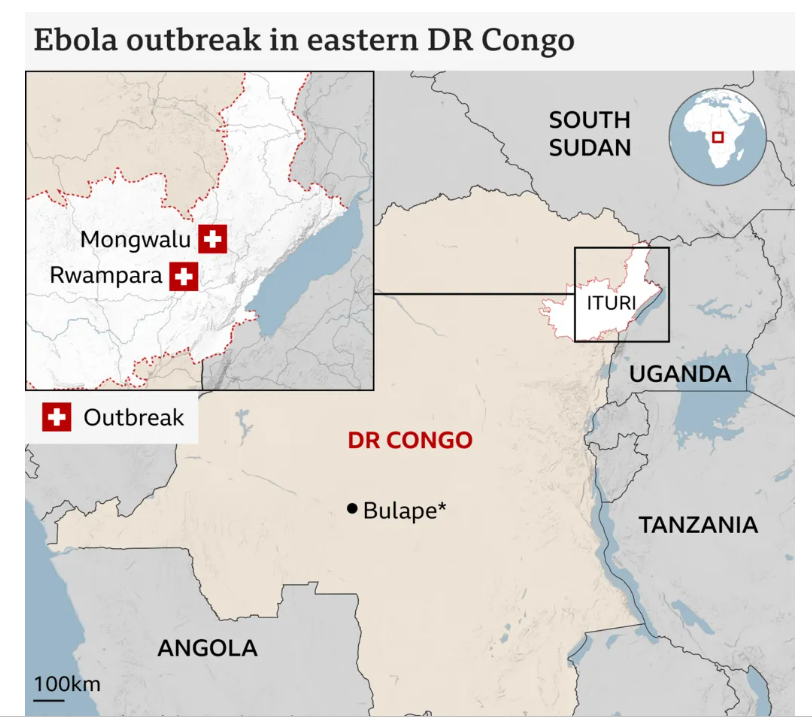
- The World Health Organization declared the Ebola outbreak in the Democratic Republic of the Congo and Uganda as a Public Health Emergency of International Concern. The outbreak was reported in eastern DRC and Uganda. The current outbreak is linked to the Bundibugyo ebolavirus strain. WHO stated that the outbreak requires coordinated international response, but it does not yet meet the criteria of a pandemic emergency like COVID-19.
What is PHEIC?
- PHEIC stands for Public Health Emergency of International Concern.
- It is the highest level of global health alert issued by the WHO under the International Health Regulations.
- It is declared when a health event is:
- Serious
- Sudden
- Unexpected or unusual
- Capable of spreading across countries
- Requiring international coordination
- A PHEIC declaration helps mobilise global action for surveillance, containment, treatment and response.
Current Ebola Outbreak
- 8 laboratory-confirmed cases in Ituri Province of DRC
- 246 suspected cases
- 80 suspected deaths
- 2 laboratory-confirmed cases in Kampala, Uganda, including one death
- The Uganda cases were reported among individuals travelling from the DRC.
- WHO noted uncertainty regarding the true number of infected persons and the actual geographic spread.
- High positivity among initial samples indicates that the outbreak may be larger than currently detected.
What is Ebola?
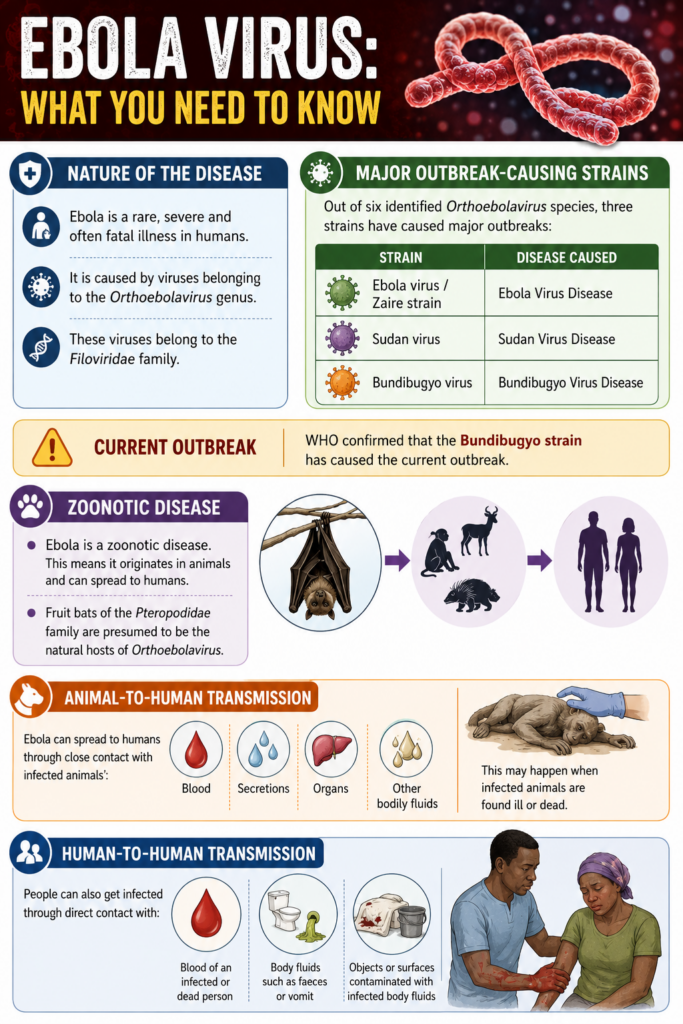
- Ebola virus disease is a severe zoonotic disease.
- It spreads from animals to humans and can also spread from human to human.
- It is often fatal if not detected and treated early.
- Ebola is caused by viruses belonging to the Ebola group.
- Three viruses are known to cause large Ebola outbreaks:
- Ebola virus
- Sudan virus
- Bundibugyo virus
- The current outbreak is linked to Bundibugyo virus.
Historical Background
- Ebola has been known since 1976.
- Early outbreaks mostly occurred in remote villages of Central Africa.
- The largest Ebola outbreak occurred in West Africa from 2014 to 2016.
- It affected Guinea, Liberia and Sierra Leone.
- That outbreak caused more than 28,600 reported cases and 11,325 deaths.
- It also accelerated global research into Ebola vaccines and treatments.
Transmission of Ebola
- Ebola is a zoonotic disease, meaning it can spread from animals to humans.
- It can spill over from wild animals such as:
- Fruit bats, non-human primates, Chimpanzees, Gorillas, Monkeys, Forest antelope, Porcupines
- Human-to-human spread occurs through direct contact with:
- Blood, Secretions, Bodily fluids, Organs of infected persons, Contaminated surfaces, Bedding or clothing used by infected persons
- Infection may also occur through contact with vomit, semen or other infected body fluids.
Symptoms and Diagnosis
- The incubation period may range from 2 to 21 days.
- Common early symptoms include:
- Fever, Fatigue, Muscle pain, Headache, Sore throat, Malaise
- Later symptoms may include:
- Vomiting, Diarrhoea, Abdominal pain, Rash, Kidney and liver dysfunction
- Bleeding is possible but is not always present.
- Confirmatory tests include:
- RT-PCR
- Antibody-capture ELISA
- Antigen-capture detection tests
- Virus isolation by cell culture
Treatment and Vaccines
- Ebola patients need rapid isolation and intensive supportive care.
- Supportive care includes:
- Rehydration
- Symptom management
- Emergency care
- Treatment of complications
- Monoclonal antibody treatments can improve survival if given early.
- WHO has recommended monoclonal antibody treatments such as:
- mAb114 / Ansuvimab
- REGN-EB3 / Inmazeb
- Approved Ebola vaccines include:
- Ervebo
- Zabdeno and Mvabea
- Vaccines are used for targeted ring vaccination of contacts and frontline workers where relevant.
Containment Measures
- Rapid identification and isolation of patients.
- Immediate supportive care to reduce mortality.
- Contact tracing and monitoring for 21 days.
- Safe and dignified burials.
- Strict infection prevention and control in health facilities.
- Laboratory testing and disease surveillance.
- Vaccination of at-risk groups where feasible.
- Use of monoclonal antibodies where available.
- Social mobilisation to reduce stigma and encourage early care-seeking.
Challenges
- The true number of infected persons may be higher than reported.
- Epidemiological links between cases may not be clear.
- Cross-border movement can increase spread.
- Symptoms overlap with other diseases, making diagnosis difficult.
- Health systems in affected areas may face capacity constraints.
- Fear, stigma and misinformation can delay treatment.
- Safe burial practices may be difficult in communities with strong traditional customs.
- The Bundibugyo strain has limited vaccine and treatment options compared with some other Ebola variants.
Way Forward
- Strengthen surveillance in affected and neighbouring regions.
- Improve laboratory testing and early diagnosis.
- Ensure rapid isolation and clinical care for confirmed cases.
- Scale up contact tracing and 21-day monitoring.
- Protect frontline health workers with infection-control measures.
- Use vaccines and monoclonal antibodies where available and relevant.
- Strengthen community engagement to reduce stigma.
- Avoid unnecessary border closures, but improve screening and cross-border coordination.
- Build long-term One Health systems to track zoonotic spillovers.
Conclusion
The Ebola outbreak in DRC and Uganda is a reminder that infectious diseases can quickly become international health concerns. A PHEIC declaration helps mobilise global coordination, surveillance and response.
Ebola control depends not only on medical care but also on contact tracing, safe burials, vaccination, infection control and community trust. Long-term preparedness requires stronger public health systems, cross-border cooperation and a One Health approach to reduce zoonotic risks.
UPSC PYQ
Q. Among the following, which were frequently mentioned in the news for the outbreak of Ebola virus recently? (2015)
A. Syria and Jordan
B. Guinea, Sierra Leone and Liberia
C. Philippines and Papua New Guinea
D. Jamaica, Haiti and Surinam
Answer: B
Explanation
- Guinea, Sierra Leone and Liberia were frequently mentioned in the news due to the major Ebola virus disease outbreak in West Africa.
- The outbreak began in Guinea in December 2013 and later spread to neighbouring Liberia and Sierra Leone.
- This became the largest Ebola outbreak recorded at that time and caused serious health, social and economic impacts in the West African region.
- Ebola is a zoonotic viral disease, meaning it can spread from animals to humans. The uploaded source also notes that Ebola outbreaks have been reported in several West African countries and are linked with human–animal interaction and later human-to-human transmission.
Therefore, option B is the correct answer.
CARE MCQ
Q. The recent Ebola outbreak in Uganda and the Democratic Republic of Congo is associated with which one of the following strains?
A. Zaire strain
B. Sudan strain
C. Bundibugyo strain
D. Reston strain
Answer: C
Explanation:
- The recent Ebola outbreak in Uganda and the Democratic Republic of Congo is linked to the Bundibugyo strain of Ebola virus.
- This strain is considered dangerous because there is no specific approved vaccine available for it at present.
Additional Information:
- Ebola is caused by viruses of the Orthoebolavirus group.
- The disease spreads through direct contact with bodily fluids of infected persons.
- Common control measures include isolation, contact tracing, rapid testing and safe burials.
FAQs
Q. What is PHEIC?
PHEIC means Public Health Emergency of International Concern. It is WHO’s highest global health alert.
Q. Why did WHO declare a PHEIC?
WHO declared a PHEIC because the Ebola outbreak in DRC and Uganda posed a risk of international spread.
Q. What is Ebola?
Ebola is a severe zoonotic disease that can spread from animals to humans and then from human to human.
Q. Which virus is linked to the current outbreak?
The current outbreak is linked to the Bundibugyo ebolavirus strain.
Q. How does Ebola spread?
It spreads through direct contact with blood, bodily fluids, secretions, organs or contaminated materials of infected persons or animals.
Q. What are common symptoms of Ebola?
Common symptoms include fever, fatigue, muscle pain, headache, sore throat, vomiting, diarrhoea and abdominal pain.
Q. What are the main containment measures?
Main measures include isolation, supportive care, contact tracing, safe burials, infection control, vaccination where relevant and social mobilisation.
Q. Is Ebola the same as a pandemic?
No. WHO stated that the outbreak is a PHEIC but does not yet meet pandemic emergency criteria.