
Relevance: APPSC Group 1 Paper -V, SCIENCE AND TECHNOLOGY –Cyber Security, Indigenous Technology Development, Digital Infrastructure
For Prelims:
- Quantum Communication, Quantum-Secure Communications Test Bed, C-DOT, Department of Telecommunications, SRM University-A.P., Amaravati Quantum Valley, Cyber Resilience, Photonic Systems, Optical Systems, Encryption Technologies, Make in India
For Mains:
- Trusted Digital Infrastructure, Cyber Security Capabilities, Deep-Tech Innovation, Indigenous Technology Development, Secure Network Infrastructure, Research and Startup Ecosystem, Frontier Technologies
Why in News?
Andhra Pradesh Chief Minister N. Chandrababu Naidu announced that SRM University-A.P., in collaboration with C-DOT, the Department of Telecommunications, Government of India, and Amaravati Quantum Valley, will establish a first-of-its-kind Quantum-Secure Communications Test Bed.
The announcement was made on the occasion of World Telecommunication and Information Society Day.
This initiative aims to strengthen Amaravati’s quantum technology ecosystem and promote secure communications, cyber resilience and trusted digital infrastructure.

Background and Context
Digital communication has become an essential part of governance, banking, defence, education, health services and business. However, the rise of cyber threats has created the need for more secure communication systems.
Traditional encryption systems may face challenges in the future because powerful quantum computers can break many present-day security methods. Therefore, countries are investing in quantum-safe and quantum-secure communication technologies.
Andhra Pradesh is trying to position Amaravati as an emerging centre for frontier technologies, especially through the Amaravati Quantum Valley initiative.
Earlier, Quantum Computing Reference Facilities were launched on April 14, 2026. The new Quantum-Secure Communications Test Bed is another step in this direction.
Key Highlights
The proposed facility will act as a research and testing platform for advanced technologies related to secure communication and cyber defence.
It will focus on:
- Quantum communication hardware
- Photonic and optical systems
- Encryption technologies
- Secure network infrastructure
- Next-generation cyber defence solutions
The project is expected to support students, researchers, startups, innovators and young technology professionals from Andhra Pradesh.
It also reflects the state’s focus on Make in India technologies, indigenous innovation and secure digital infrastructure.

What is Quantum-Secure Communication?
Quantum-secure communication refers to communication systems that use principles of quantum science or quantum-safe encryption methods to protect information from cyber-attacks.
In simple terms, it aims to make digital communication more secure, especially against future threats from advanced computing technologies.
One important area is Quantum Key Distribution (QKD). It allows two users to share encryption keys in a highly secure manner. Any attempt to disturb or intercept the communication can be detected.
Significance of the Initiative
- Strengthens Cyber Security
The test bed can help develop technologies for protecting sensitive communication networks. This is important for sectors like defence, banking, governance, telecom and critical infrastructure.
- Promotes Make in India
The initiative supports the development of indigenous technology in advanced communication and cyber security. It reduces dependence on imported systems.
- Builds Amaravati as a Deep-Tech Hub
The project can help position Amaravati Quantum Valley as a centre for quantum technologies, advanced manufacturing and innovation.
- Supports Students and Researchers
Universities and research institutions will get access to a practical testing platform. This can improve research quality and skill development in emerging technologies.
- Encourages Startups and Innovation
Startups working in cyber security, optical systems, encryption and communication technologies can use such platforms for testing and product development.
- Helps India’s Technological Advancement
Quantum communication is an important area for national security and digital sovereignty. Such initiatives can strengthen India’s long-term cyber and technological capabilities.
Challenges
- High Cost of Quantum Technologies
Quantum communication systems require advanced equipment, laboratories and skilled professionals. This may involve high investment.
- Shortage of Skilled Human Resources
India needs more trained experts in quantum science, photonics, cryptography and cyber security.
- Need for Industry-Academia Linkages
The success of such a test bed depends on strong cooperation between universities, government agencies, startups and industry.
- Technology Standardisation
Quantum-secure communication technologies require proper technical standards, testing norms and security protocols.
- Scaling from Lab to Market
Research outcomes must be converted into usable products and services. This requires funding, incubation and industry support.
Way Forward
- Strengthen collaboration between government, academia, startups and telecom industry.
- Create specialised training programmes in quantum communication, cyber security and photonics.
- Support startups through funding, incubation and testing access.
- Develop national standards for quantum-safe communication systems.
- Link the project with India’s broader goals under Digital India, Make in India and the National Quantum Mission.
- Encourage public sector and private sector use cases in defence, governance, banking and critical infrastructure.
Conclusion
The Quantum-Secure Communications Test Bed in Amaravati is an important step towards building a secure and future-ready digital infrastructure. It can strengthen Andhra Pradesh’s position in advanced technologies and support India’s broader goal of technological self-reliance.
By combining research, innovation, cybersecurity and indigenous technology development, the initiative can make Amaravati an important centre for India’s emerging quantum ecosystem.
CARE MCQ
Q. Consider the following items in the context of the Amaravati Quantum Valley initiative:
- Quantum communication hardware
- Photonic and optical systems
- Encryption technologies
- Next-generation cyber defence solutions
Which of the above are associated with the proposed Quantum-Secure Communications Test Bed?
A. 1, 2 and 3 only
B. 2 and 4 only
C. 1, 3 and 4 only
D. 1, 2, 3 and 4
Answer: D
Explanation:
All the four areas are associated with the proposed test bed.
- Quantum communication hardware will help develop secure communication systems.
- Photonic and optical systems are important for advanced communication technologies.
- Encryption technologies are central to secure data transfer.
- Cyber defence solutions are needed to protect digital infrastructure from threats.
Additional Information:
Such test beds help convert scientific research into practical technologies for real-world use.
FAQs
Q. What is the Quantum-Secure Communications Test Bed?
It is a research and testing platform for secure communication technologies, quantum communication hardware, encryption and cyber defence systems.
Q. Which institutions are involved in this initiative?
SRM University-A.P., C-DOT, the Department of Telecommunications and Amaravati Quantum Valley are associated with the initiative.
Q. Why is quantum-secure communication important?
It helps protect digital communication from advanced cyber threats and future risks linked to quantum computing.
Q. How will this help Andhra Pradesh?
It can support students, startups, researchers and innovators while positioning Amaravati as a hub for frontier and deep-tech technologies.
Relevance: UPSC GS Paper II – Governance, Government Policies, Security-related Institutions; GS Paper III – Science & Technology, Defence, Internal Security, Indigenisation of Technology
For Prelims:
- Make in India, Defence Manufacturing, Defence Public Sector Undertakings, Strategic Partnership Model, Foreign Direct Investment, DRDO, Transfer of Technology, UAVs, Akashteer, BrahMos, Akash Missile System, Defence Industrial Corridor.
For Mains:
- Defence indigenisation, import dependence, private sector participation, technology transfer, modern warfare, defence procurement reforms, research and development, strategic autonomy, public-private partnership.
Why in News?
Defence Minister Rajnath Singh recently said that Operation Sindoor proved India’s ability to understand the changing nature of warfare and confidently use modern defence technologies.
He stated that India used indigenous defence systems such as Akashteer, Akash missile system and BrahMos during the operation. He also stressed that future wars will be shaped by research, technological innovation and the ability to surprise the enemy.
The issue is important because India is trying to reduce its dependence on defence imports and strengthen domestic defence manufacturing under Make in India.


Background and Context
India has historically depended heavily on foreign countries for defence equipment. After Independence, India initially imported defence equipment from the United Kingdom and later from the Soviet Union. Over time, the United States and Israel also became important defence suppliers.
India has developed the capacity to procure and assemble several defence platforms. However, it still faces difficulties in producing highly advanced systems such as jet engines, sophisticated drones, advanced sensors and next-generation warfare technologies.
The changing nature of war has made defence self-reliance more important. Current global conflicts show that wars are no longer fought only with tanks, aircraft and missiles. Drones, sensors, artificial intelligence, cyber tools, precision weapons and counter-drone systems are becoming equally important.
Present Status of India’s Defence Manufacturing
India has taken several steps to promote defence manufacturing. These include encouraging private sector participation, liberalising FDI, promoting defence corridors and transferring DRDO technologies to industries.
However, India continues to remain among the major arms importers in the world. This shows that domestic defence production has improved, but it has not yet fully replaced import dependence.
Defence manufacturing in India is still dominated by Defence Public Sector Undertakings (DPSUs). According to the article, DPSUs account for more than 70% of total defence manufacturing. This limits wider private sector participation.
Challenges and Bottlenecks
1. Heavy Dependence on Imports
India depends on imports due to domestic technological limitations and budgetary constraints. This dependence is most visible in high-end platforms and advanced technologies such as:
- Jet engines
- Sophisticated drones
- Advanced sensors
- High-end electronic warfare systems
- Modern air defence technologies
This creates strategic vulnerability during wars or global crises.
2. Over-Centralised Defence Acquisition Process
India’s defence acquisition system is highly centralised and layered. The armed forces first identify their needs through Quantitative Requirements (QRs), which specify the technical and operational features of equipment.
However, these QRs are often ambiguous or too rigid. This leads to delays in procurement and manufacturing.
3. Delay in Defence Projects
The Parliamentary Standing Committee of the Ministry of Defence observed that many defence projects have faced serious delays. Out of 178 projects, original timelines were not followed in 119 cases. In some cases, delays ranged from 16% to 500% beyond the agreed timeline.
Such delays weaken military preparedness and increase costs.
4. Multiple Layers of Approval
Defence procurement passes through many official layers. Overlapping approvals, file movement and prolonged decision-making slow down the process.
This makes defence production less efficient and discourages private companies from entering the sector.
5. Limited Technical Talent in Public Institutions
Government-owned defence institutions often face difficulty in attracting and retaining top engineering and scientific talent. One major reason is the relatively low compensation structure compared to private industry and developed countries.
For advanced defence production, India needs highly skilled scientists, engineers and technicians.
6. Weak Technology Transfer
Foreign defence companies may form joint ventures with Indian companies, but meaningful transfer of high-end technology remains limited. Often, India receives assembly or production rights, but not the core technology.
This prevents India from becoming truly self-reliant.
7. Unequal Playing Field for Private Sector
Private defence firms face several challenges such as:
- Preferential treatment to DPSUs
- Complex documentation requirements
- Delayed payments
- Limited role in procurement decision-making
- Lower trust compared to public sector units
This reduces private sector enthusiasm and investment in defence manufacturing.
Lessons from Current Global Conflicts
Recent conflicts in Ukraine, Gaza, Lebanon and Iran-related regional tensions show that modern warfare is changing rapidly.
1. Drones Have Become Game-Changers
In Ukraine and West Asia, low-cost drones have damaged military assets and critical infrastructure. This shows that even relatively inexpensive technologies can create major battlefield impact.
For India, investment in UAVs, counter-UAV systems and autonomous platforms is essential.
2. Wars Are Becoming Technology-Driven
Modern wars are not only about large armies. They depend on:
- Sensors
- Artificial intelligence
- Precision weapons
- Missile defence
- Cyber systems
- Space-based surveillance
- Electronic warfare
India must invest in these areas to remain prepared.
3. Supply Chains Can Be Disrupted
In times of war, global supply chains may be disturbed. Countries may delay or deny defence supplies due to diplomatic pressure, sanctions or strategic interests.
Therefore, India must reduce dependence on foreign military suppliers.
4. Element of Surprise Remains Important
Defence Minister Rajnath Singh highlighted that the side which has the element of surprise often gains a decisive advantage in war.
This requires strong research, innovation and rapid deployment of new technologies.
5. Civilian Technologies Can Become Weapons
Recent pager attacks in West Asia show that ordinary technologies can be weaponised. This means India must prepare for hybrid threats, cyber risks and unconventional warfare.
Role of Private Sector in Defence Manufacturing
The private sector can play a major role in making India self-reliant in defence production.
1. Innovation and Advanced Manufacturing
Private companies can bring innovation, speed and efficiency. They can contribute to drones, robotics, artificial intelligence, sensors, cyber systems and electronic warfare.
2. Collaboration with Foreign OEMs
Under the Strategic Partnership Model, Indian private firms can work with foreign Original Equipment Manufacturers. This can help in producing submarines, helicopters, fighter aircraft and other major platforms in India.
3. Support to Start-ups and MSMEs
Start-ups and MSMEs can contribute to niche technologies such as:
- Drone components
- AI-based battlefield tools
- Communication systems
- Robotics
- Surveillance devices
- Counter-drone systems
They can make the defence ecosystem more flexible and innovative.
4. Competition with DPSUs
A fair competition between DPSUs and private companies can improve quality, reduce costs and speed up production.
India should not choose only public or only private manufacturing. It needs a hybrid model where both public and private sectors work together.
Government Initiatives
1. Make in India in Defence
The government has promoted domestic manufacturing of defence equipment to reduce imports and improve self-reliance.
2. Strategic Partnership Model
This model allows Indian private firms to partner with foreign OEMs for manufacturing major defence platforms in India.
3. Liberalisation of FDI
FDI in defence was increased from 24% to 49% in 2016 and further to 74% under the automatic route in 2020. This aims to attract foreign investment and technology partnerships.
4. DRDO Technology Transfer
The government has waived the earlier 20% Transfer of Technology fee for development-cum-production partners, development partners and production agencies.
According to the article, DRDO has transferred over 2,200 technologies to industries.
5. Access to DRDO Patents and Testing Facilities
Indian industries are being given free access to DRDO patents. DRDO testing facilities have also been opened to industries on a payment basis.
6. Defence Industrial Corridors
Defence Industrial Corridors, especially in Uttar Pradesh and Tamil Nadu, aim to build a strong defence manufacturing base by attracting investment and creating industrial clusters.
Significance of Defence Indigenisation
- Defence indigenisation is important for India’s security and development.
- It strengthens strategic autonomy by reducing dependence on foreign suppliers. It also improves India’s preparedness during wars and emergencies.
- Domestic defence manufacturing can create employment, promote research and development, support MSMEs and improve India’s technological base.
- It can also make India a defence exporter in the long run. A strong defence industrial base will support India’s ambition to become a major global power.
Challenges Ahead
- India’s defence indigenisation journey still faces many obstacles. The most important challenge is the lack of high-end technological capability in critical areas.
- Another concern is the slow pace of procurement reforms. If decision-making remains delayed, private firms may hesitate to invest heavily in defence production.
- India also needs better coordination between armed forces, DRDO, DPSUs, private industries, start-ups and academic institutions.
- The real test of Make in India in defence will be whether India can move from assembling equipment to designing and manufacturing advanced systems independently.
Way Forward
1. Reform Defence Procurement
- The procurement process should be simplified. Quantitative Requirements must be clear, realistic and flexible enough to allow innovation.
2. Create a Level Playing Field
- Private firms and DPSUs should compete on fair terms. The government should act as a strategic buyer rather than favouring one category of producer.
3. Strengthen Research and Development
India must invest more in defence research in areas such as:
- Directed energy weapons
- Hypersonic weapons
- Artificial intelligence
- Quantum technologies
- Space situational awareness
- Underwater domain awareness
- Advanced drones and counter-drone systems
4. Improve Talent Retention
- Top scientists and engineers in public defence institutions should receive better pay, research freedom and modern laboratory facilities.
- This will help India retain skilled human resources.
5. Promote Public-Private-Academia Collaboration
- Armed forces, DRDO, DPSUs, private companies, start-ups and universities must work together. This will create a strong innovation ecosystem.
6. Focus on Emerging Warfare Technologies
- India must not focus only on traditional platforms like tanks, aircraft and ships. It must also invest in low-cost and scalable technologies such as drones, sensors, cyber systems and AI-enabled decision-making tools.
7. Ensure Real Technology Transfer
- India should focus on gaining core technologies, not just assembly rights. Joint ventures should include design, development and intellectual property sharing.
Conclusion
Make in India in the defence sector is essential for India’s national security, strategic autonomy and technological strength. Operation Sindoor and recent global conflicts show that future wars will be shaped by speed, innovation, drones, sensors, artificial intelligence and precision systems.
India has made progress through FDI reforms, DRDO technology transfer, defence corridors and private sector participation. However, import dependence, procurement delays, limited high-end technology and unequal treatment of private firms remain major challenges.
India needs a balanced defence ecosystem where the public sector, private industry, start-ups and research institutions work together. A self-reliant defence sector will not only strengthen India’s security but also support economic growth and national power.
UPSC PYQ
Q. Operations undertaken by the Army towards upliftment of the local population in remote areas to include addressing of their basic needs is called: (2024)
- Operation Sankalp
- Operation Maitri
- Operation Sadbhavana
- Operation Madad
Ans: C
CARE MCQ
Q. Consider the following technologies in the context of modern warfare:
- Unmanned Aerial Vehicles
- Artificial Intelligence-enabled decision-making tools
- Counter-UAV systems
- Quantum technologies
Which of the above are important for future warfare preparedness?
A. 1 and 2 only
B. 1, 2 and 3 only
C. 2, 3 and 4 only
D. 1, 2, 3 and 4
Answer: D
Explanation:
- 1 is correct: UAVs have become important in recent conflicts.
- 2 is correct: AI-enabled tools improve decision-making and battlefield awareness.
- 3 is correct: Counter-UAV systems are needed to protect military assets from drone attacks.
- 4 is correct: Quantum technologies are emerging as important areas in defence research.
Additional Information:
Future wars will depend on both traditional military power and advanced technologies.
Q. With reference to Foreign Direct Investment in India’s defence sector, consider the following statements:
- The FDI cap in defence was increased to 74% under the automatic route in 2020.
- FDI reforms are expected to promote joint ventures and technology partnerships.
- FDI reforms alone can ensure complete defence self-reliance.
Which of the above statements are correct?
A. 1 and 2 only
B. 2 and 3 only
C. 1 and 3 only
D. 1, 2 and 3
Answer: A. 1 and 2 only
Explanation:
- Statement 1 is correct: The FDI cap was increased to 74% under the automatic route in 2020.
- Statement 2 is correct: FDI reforms can encourage joint ventures between Indian and foreign companies.
- Statement 3 is incorrect: FDI alone cannot ensure self-reliance. India also needs R&D, skilled talent, procurement reforms and real technology transfer.
Additional Information:
Foreign investment is useful only when it supports domestic capacity-building and technological learning.
FAQs
Q. Why is defence indigenisation important for India?
It reduces import dependence and strengthens India’s strategic autonomy.
Q. What is the Strategic Partnership Model?
It allows Indian private firms to partner with foreign defence companies for manufacturing major platforms in India.
Q. What lesson do recent wars give India?
Recent wars show that drones, sensors, AI, cyber tools and precision weapons are becoming central to modern warfare.
Q. How can the private sector help in defence manufacturing?
The private sector can bring innovation, faster production, advanced technology and competition into the defence ecosystem.
Relevance: UPSC: GS Paper III – Economy, Agriculture, Food Processing, Rural Economy, Inclusive Growth, Exports and Value Addition.
For Prelims:
Jaggery, Gur, Sugarcane, Natural Sweetener, PM Kisan SAMPADA Yojana, PMFME, ODOP, AGMARK, GI Tag, Kolhapur Jaggery, Muzaffarnagar Gur, Marayoor Jaggery, Central Travancore Jaggery.
For Mains:
- Agro-processing, Rural Livelihoods, Value Addition, Cottage Industry, Food Processing Exports, Nutrition Security, Women Cooperatives, Farmer Income, Traditional Knowledge, Rural Entrepreneurship.
Why in News?
India accounts for over 70% of global jaggery production, making it the world leader in natural sweeteners.Nearly 20–30% of India’s sugarcane output is used for jaggery production. The sector supports around 2.5 million rural livelihoods.India’s jaggery exports have also grown strongly, increasing by 106.5% in value between 2015–16 and 2024–25.
What is Jaggery?
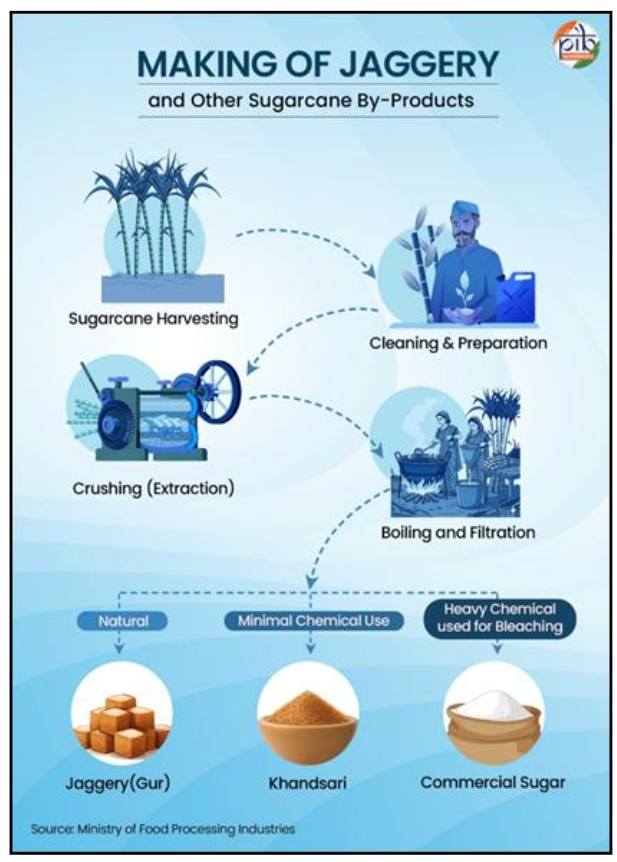
- Jaggery, commonly known as gur, is a traditional, unrefined and natural sweetener.
- It is produced by concentrating sugarcane juice without chemical refining.
- It is often called “medicinal sugar” because it contains minerals and micronutrients.
- Jaggery is consumed in Asia, Africa, Latin America and the Caribbean under different local names.
- It is valued for its natural origin, traditional processing and rising demand for chemical-free sweeteners.
Historical and Cultural Importance
- Jaggery is considered an indigenous Indian product.
- Its history is linked to sugarcane cultivation from the Vedic period.
- Early references to sugarcane cultivation are found around 1400–1000 BCE.
- The word “sugar” is derived from the Sanskrit term sarkara.
- In 647 AD, a Chinese mission reportedly travelled to Magadha to learn sugarcane processing techniques.
- This shows India’s long tradition of sweetener production and knowledge transfer.
India’s Position in Jaggery Production
- India produces over 70% of the world’s jaggery.
- It is the world’s largest producer of jaggery.
- Nearly 20–30% of India’s sugarcane production is diverted to jaggery production.
- Jaggery production is an important rural agro-processing activity.
- It is marked by:
- Decentralised processing
- Low transport cost
- Small-scale entrepreneurship
- Cottage industries
- Rural employment generation
Sugarcane Production Base
- India’s sugarcane production in 2024–25 was estimated at 444.9 million tonnes.
- Major producing States include:
- Uttar Pradesh – 48.5%
- Maharashtra – 24.1%
- Karnataka – 10.5%
- Other producing States include Gujarat, Tamil Nadu, Bihar, Uttarakhand, Punjab, Madhya Pradesh and Haryana.
Growth of Jaggery Exports
- India is a leading exporter of jaggery and confectionery products.
- In 2015–16, exports stood at USD 197 million with a volume of 292.8 MT.
- In 2024–25, exports increased to USD 406.8 million with a volume of 471.9 MT.
- This shows a rise of:
- 106.5% in value
- 61.2% in volume
- Major export destinations in 2024–25 included:
- Indonesia
- USA
- UAE
- Nigeria
- Nepal
Rising Domestic Demand
- Domestic demand for natural sweeteners has increased.
- In the sweetener segment, jaggery and honey recorded a 15–20% CAGR during 2021–24.
- Jaggery sales in domestic markets reached around 5,000 metric tonnes annually by August 2024.
- This reflects growing consumer preference for traditional and natural sweeteners.
Nutritional Value of Jaggery
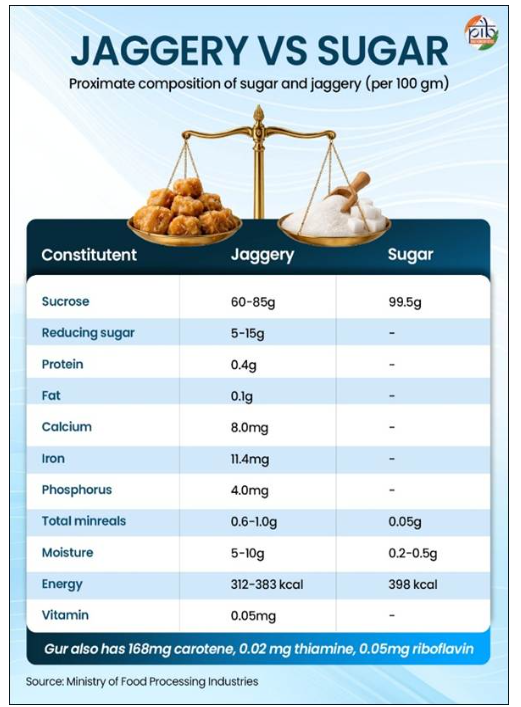
- Jaggery retains many nutrients present in sugarcane juice.
- It contains minerals such as:
- Calcium, Magnesium, Potassium, Phosphorus, Sodium, Iron, Zinc Copper Manganese
- Good-quality jaggery usually contains more than 70% sucrose and about 5% minerals.
- Iron content is around 10–13 mg per 100 grams.
- It also contains trace vitamins such as folic acid, B-complex vitamins and vitamins A, C, D and E.
Health Benefits of Jaggery
- Jaggery provides sustained energy because it is digested slowly.
- It may help improve haemoglobin levels due to its iron content.
- Potassium and magnesium support cardiovascular and muscle function.
- In traditional systems like Ayurveda, jaggery is used for digestion and respiratory comfort.
- It is also considered useful for people exposed to dust and pollution due to its cleansing properties.
- However, jaggery is still a sweetener and should be consumed in moderation.

Jaggery in Nutrition Interventions
- Tamil Nadu has included jaggery in nutrition interventions.
- It is used in complementary weaning food under the nutritious meal programme and ICDS framework.
- The supplementary food is popularly known as Sathumavu.
- Jaggery forms around 27% of the complementary food mix.
- It is distributed as Take-Home Rations for eligible beneficiaries for 300 days a year.
- The programme benefits nearly 32.75 lakh beneficiaries in Tamil Nadu.
Link with Women’s Livelihoods
- Sathumavu is procured from 25 women-run weaning food manufacturing cooperative societies and two private manufacturers.
- These cooperatives include around 1,450 members.
- Many members are widows, deserted women or economically vulnerable women.
- Thus, jaggery-based nutrition support also promotes women’s livelihood generation.
Role in Rural Livelihoods
- Jaggery production is part of India’s unorganised agro-processing sector.
- It supports farmers, workers, processors and rural entrepreneurs.
- Jaggery processing generates local employment and supports migrant labour.
- Value addition through jaggery provides higher returns than selling raw sugarcane to mills.
- It strengthens rural economies through cottage industries and small enterprises.
Value Addition and Entrepreneurship
- Organic jaggery powder has emerged as a profitable value-added product.
- A farmer from Tirunelveli district in Tamil Nadu produces organic jaggery powder using local sugarcane varieties.
- Organic jaggery powder sells at about ₹75 per kg, compared to ₹50 per kg for conventional jaggery.
- Production cost for both is about ₹30 per kg.
- Diversified products such as jaggery-flavoured chocolate and coconut products are expanding market reach.
Government Support and Policy Push
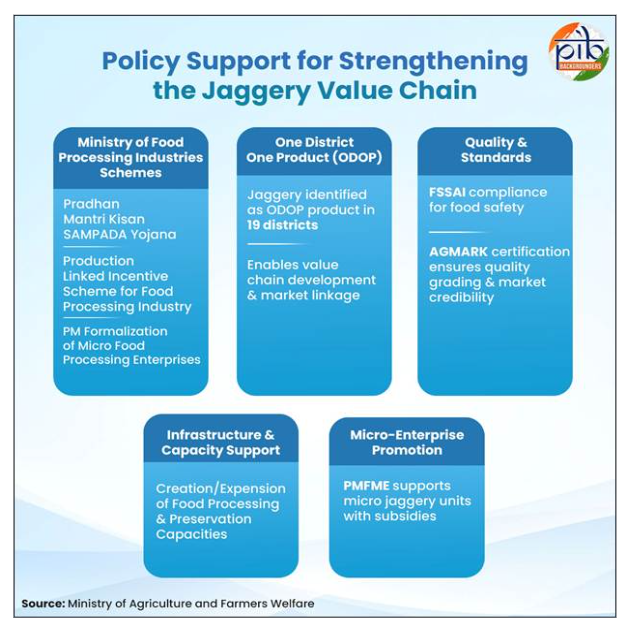
The Ministry of Food Processing Industries supports the jaggery sector through several schemes.
Major initiatives include:
- Pradhan Mantri Kisan SAMPADA Yojana
- Production Linked Incentive Scheme for Food Processing Industry
- PM Formalization of Micro Food Processing Enterprises Scheme
- One District One Product
- AGMARK certification
- GI tagging
Under the CEFPPC component of PMKSY, five jaggery processing units have been approved with grants-in-aid of ₹17.07 crore.
The PMFME Scheme has supported 3,528 jaggery-based micro food processing units with subsidies of ₹102.31 crore.
ODOP and Quality Certification
- Under One District One Product, jaggery and allied products have been identified in 19 districts.
- ODOP helps in value chain development, shared services, input procurement and market access.
- AGMARK certification supports quality assurance and standardisation.
- Jaggery is a notified commodity under AGMARK.
- Quality certification improves consumer trust, farmer prices and export readiness.
GI-Tagged Jaggery Varieties
- Geographical Indication helps protect region-specific products.
- GI recognition improves branding, market access and traditional processing value.
Important GI-tagged jaggery varieties include:
- Kolhapur Jaggery – Maharashtra
- Muzaffarnagar Gur – Uttar Pradesh
- Marayoor Jaggery – Kerala
- Central Travancore Jaggery – Kerala
These varieties are known for regional quality, purity, traditional methods and market value.
Challenges
- Jaggery processing is largely part of the unorganised sector.
- Many units may lack modern processing technology.
- Quality standardisation remains a challenge.
- Small producers often face limited market access.
- Export competitiveness requires food safety compliance.
- Seasonal production may affect steady supply.
- Farmers need better access to branding, packaging and value-added markets.
- Consumer awareness must distinguish quality jaggery from adulterated products.
Way Forward
- Modernise jaggery processing units with clean and efficient technology.
- Expand PMFME and PMKSY support for micro and small jaggery enterprises.
- Strengthen FPOs, SHGs and cooperatives in jaggery value chains.
- Promote quality certification through AGMARK and FSSAI standards.
- Expand GI-based branding for regional jaggery varieties.
- Encourage value-added products such as jaggery powder, liquid jaggery and jaggery-based confectionery.
- Improve packaging, storage and marketing facilities.
- Link jaggery with nutrition programmes where suitable.
- Support exports through quality control and international standards.
Conclusion
Jaggery is not only a traditional sweetener but also an important part of India’s rural economy. India’s leadership in global jaggery production, rising exports and growing domestic demand show the sector’s strong potential.
The jaggery sector connects agriculture, nutrition, rural livelihoods, women’s empowerment and export promotion. With better processing, certification, branding, GI protection and value addition, it can become a major driver of inclusive and sustainable rural growth.
UPSC PYQ
Q. Sugarcane is one of the important cash crops in India. It is grown to obtain (NDA PYQ 2017)
A. Starch
B. Glucose
C. Fructose
D. Sucrose
Answer: D
Explanation:
Sugarcane is an important cash crop in India. It is mainly grown for the production of sugar.
The chief sugar obtained from sugarcane is sucrose. Sucrose is a type of sugar formed from glucose and fructose units.
Sugarcane is also used for producing:
- Jaggery
- Khandsari
- Molasses
- Ethanol
Thus, sugarcane is commercially grown mainly to obtain sucrose.
Therefore, the correct answer is D. Sucrose.
CARE MCQ
Q. The word “sugar” is derived from which of the following Sanskrit terms?
A. Sakkara
B. Sarkara
C. Ikshu
D. Guda
Answer: B
Explanation:
The word “sugar” is derived from the Sanskrit term sarkara.
This shows the deep cultural and historical roots of sugarcane cultivation and sweetener production in India. Sugarcane cultivation was known in India from ancient times, and jaggery is widely regarded as an indigenous Indian product.
Additional Information:
- Early references to sugarcane cultivation are found in Indian texts from around 1400–1000 BCE.
- Sugarcane cultivation was closely linked with the Vedic period.
- In 647 AD, a Chinese mission travelled to Magadha to learn sugarcane processing techniques.
- Jaggery is traditionally produced by concentrating sugarcane juice without chemical refining.
FAQs
Q. What is jaggery?
Jaggery, also called gur, is a traditional unrefined sweetener made by concentrating sugarcane juice.
Q. Why is India important in global jaggery production?
India accounts for over 70% of global jaggery production, making it the world’s largest producer.
Q. How much sugarcane is used for jaggery production in India?
Nearly 20–30% of India’s sugarcane output is used for jaggery production.
Q. Why is jaggery considered nutritious?
Jaggery contains minerals such as iron, calcium, magnesium, potassium, zinc and trace vitamins.
Q. Which government schemes support jaggery processing?
PMKSY, PMFME, ODOP, AGMARK certification and GI tagging support jaggery processing and marketing.
Q. What are some GI-tagged jaggery varieties?
Kolhapur Jaggery, Muzaffarnagar Gur, Marayoor Jaggery and Central Travancore Jaggery are important GI-tagged varieties.
Q. Why is jaggery important for rural livelihoods?
It supports farmers, workers, cottage industries, women cooperatives and small food processing enterprises.
Q. What is the export significance of jaggery?
India’s jaggery exports have grown strongly, showing rising global demand for natural sweeteners.