Table of Contents
Relevance: UPSC GS Paper III – Science and Technology, Space Technology, SMILE Mission, Magnetosphere
For Prelims:
- SMILE Mission, Magnetosphere, Solar Wind, Solar Flares, Coronal Mass Ejections, Auroras, Space Weather, Vega-C Rocket, Soft X-ray Imager, Ultraviolet Aurora Imager
For Mains:
- Space weather forecasting, protection of satellites, solar-terrestrial interaction, critical infrastructure security, international space cooperation, early warning systems
Why in News?
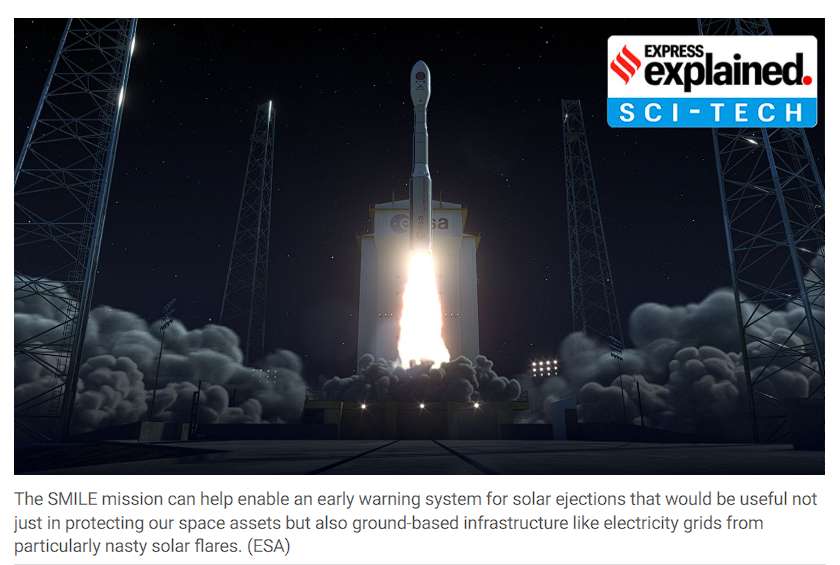
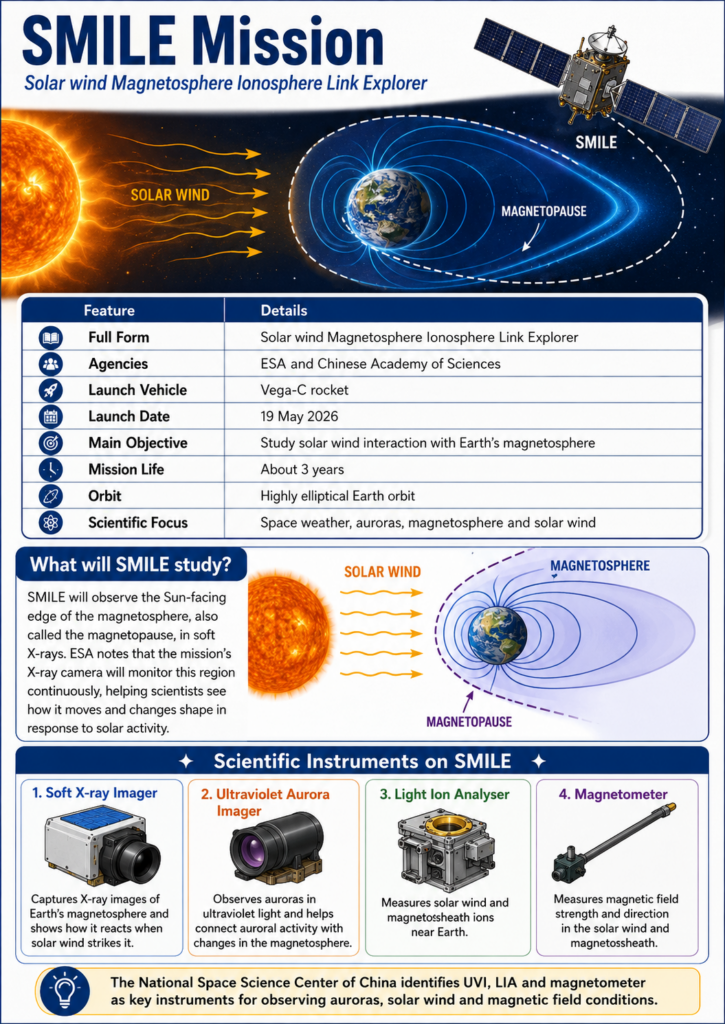
The Solar wind Magnetosphere Ionosphere Link Explorer (SMILE) mission is scheduled to be launched on 19 May 2026 on a European Vega-C rocket from Europe’s Spaceport in French Guiana. It is a joint mission of the European Space Agency (ESA) and the Chinese Academy of Sciences (CAS).
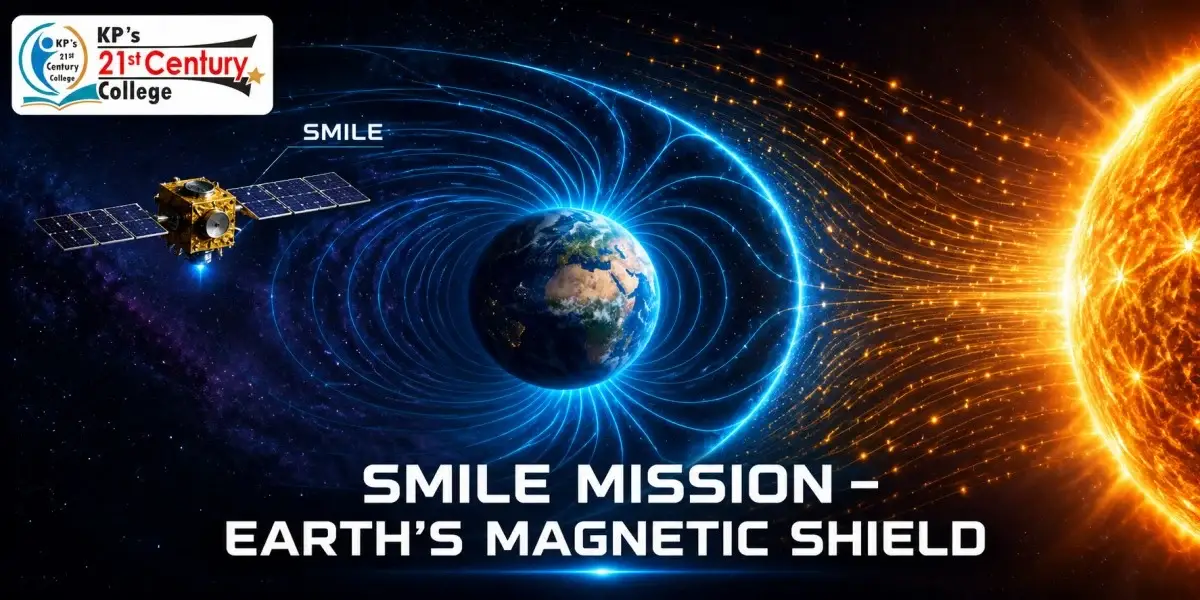
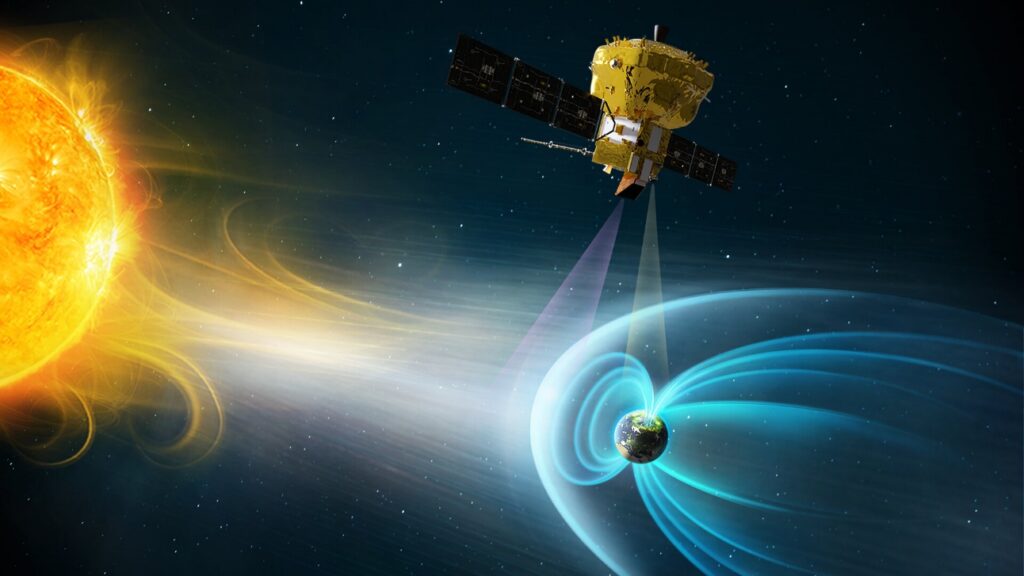
The mission will study how the solar wind interacts with Earth’s magnetosphere, which acts as a protective shield against harmful particles and radiation from the Sun.
What is SMILE Mission?
SMILE stands for Solar wind Magnetosphere Ionosphere Link Explorer.
It is a joint Chinese-European space science mission designed to study the interaction between the Sun and Earth’s magnetic environment. ESA describes SMILE as the first mission to observe Earth’s magnetosphere in X-ray light, helping scientists understand when, where and how solar wind interacts with Earth’s magnetic shield.
The mission will observe the magnetosphere, auroras and solar wind using X-ray, ultraviolet and in-situ instru ments.
Earth’s Magnetic Shield: Magnetosphere
The magnetosphere is the region around Earth controlled by Earth’s magnetic field. It forms a vast protective bubble around the planet.
It protects Earth by:
- Deflecting harmful charged particles from the Sun.
- Reducing the direct impact of solar wind.
- Preventing gradual erosion of Earth’s atmosphere.
- Supporting conditions necessary for life.
- Protecting satellites and communication systems from space weather effects.
Earth’s magnetosphere is not fixed. It changes shape and size depending on the strength of solar wind and solar storms.
How the Sun Affects Earth
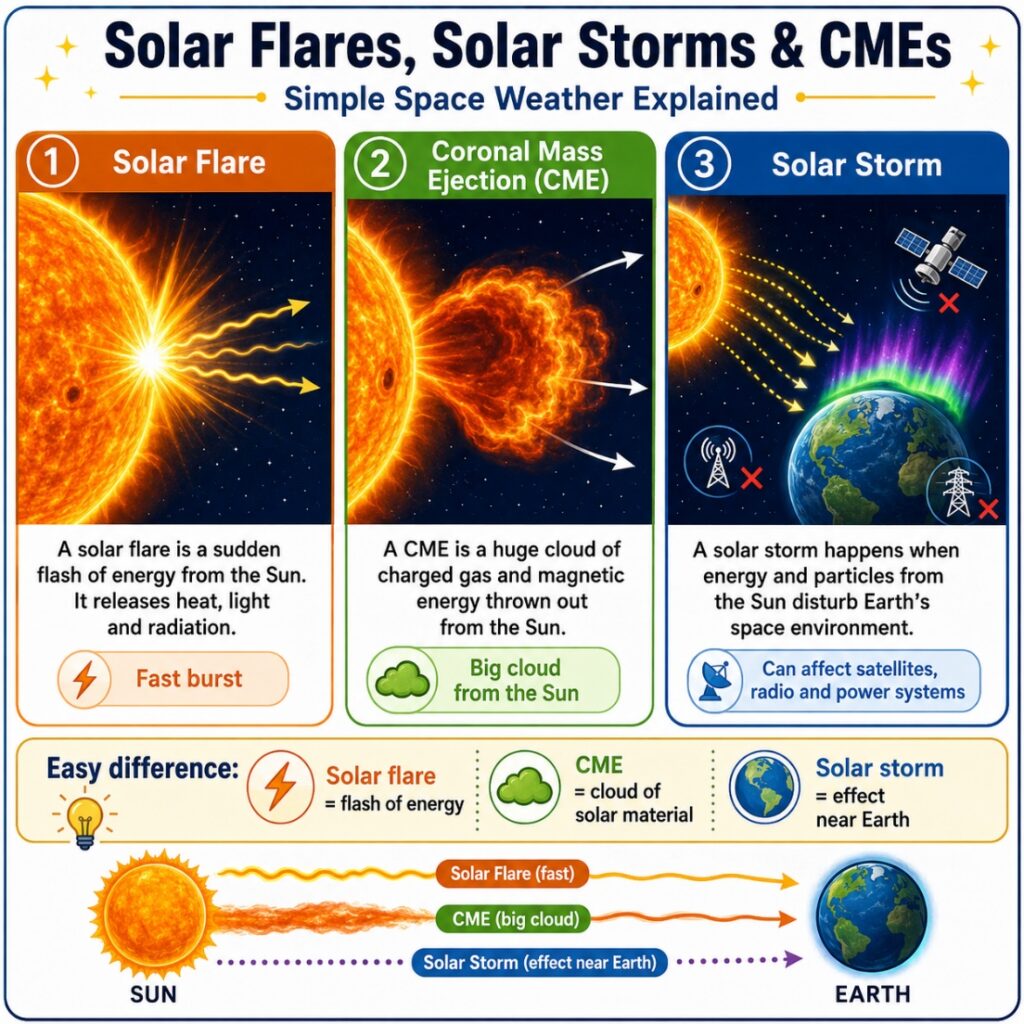
The Sun constantly releases solar wind, which is a stream of charged particles. It also produces powerful events such as:
- Solar flares
- Solar storms
- Coronal Mass Ejections (CMEs)
These events can disturb space weather. Space weather disturbances may affect satellites, GPS, communication networks, power grids, airlines and astronaut safety.
When charged particles from the Sun interact with Earth’s upper atmosphere near the poles, they produce bright lights called auroras.
Scientific Instruments on SMILE
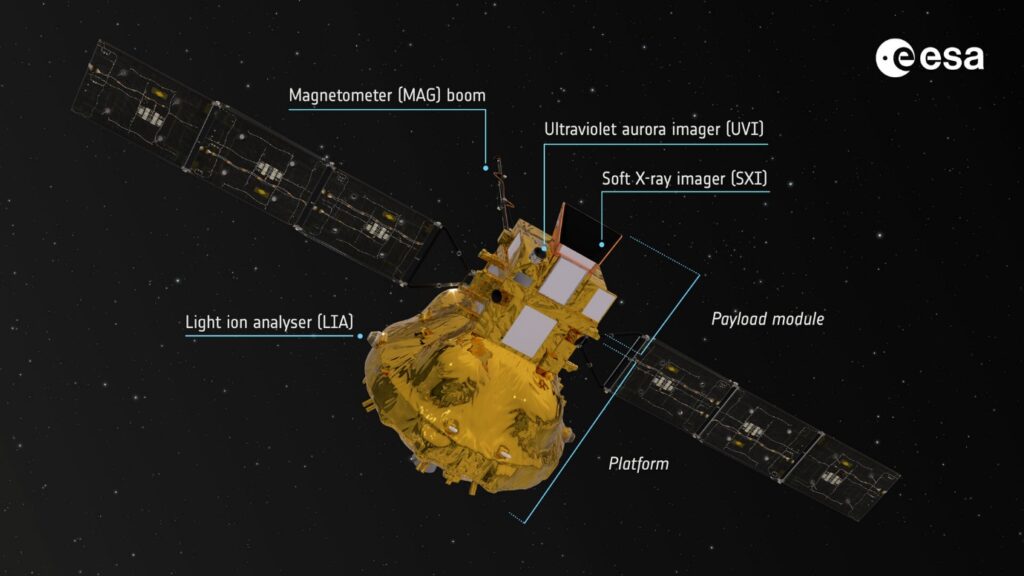
The mission carries four major instruments:
1.Soft X-ray Imager
- It will capture X-ray images of Earth’s magnetosphere. This is important because it will show how the magnetosphere reacts when solar wind strikes it.
2.Ultraviolet Aurora Imager
- It will observe auroras in ultraviolet light and help connect auroral activity with changes in the magnetosphere.
3.Light Ion Analyser
- It will measure solar wind and magnetosheath ions near Earth.
4.Magnetometer
- It will measure magnetic field strength and direction in the solar wind and magnetosheath.
- The National Space Science Center of China identifies UVI, LIA and magnetometer as key instruments for observing auroras, solar wind and magnetic field conditions.
Significance of the SMILE Mission
- Better Understanding of Earth’s Protection System
- SMILE will help scientists understand how Earth naturally protects itself from harmful solar particles and radiation. This is important for studying the relationship between the Sun and Earth.
- Improvement in Space Weather Forecasting
- Space weather can disturb satellites, GPS, communication systems and electricity grids. SMILE can provide better data for forecasting such disturbances.
- Protection of Space Assets
- Modern economies depend on satellites for communication, navigation, weather forecasting, banking and defence. Accurate forecasting of solar storms can help protect these assets.
- Support for Astronaut Safety
- Solar radiation can be dangerous for astronauts. Better space weather warning systems are important for future space missions and space stations.
- International Space Cooperation
- SMILE is an important example of cooperation between Europe and China in space science. Such missions show how scientific collaboration can address global challenges.
- First Global X-ray View of the Magnetosphere
- Past missions studied Earth’s magnetosphere, but SMILE will provide a wider and more direct view using X-ray imaging. This makes it scientifically unique.
Challenges and Concerns
- Complex Space Environment
- The magnetosphere is highly dynamic. It changes quickly during solar storms, making observations and forecasting difficult.
- Dependence on Advanced Instruments
- The mission depends on sensitive X-ray and ultraviolet instruments. Any technical failure may affect the quality of data.
- Limited Mission Life
- The mission life is about three years. Long-term space weather research needs continuous monitoring.
- Space Weather Prediction is Still Developing
- Even with better data, predicting the exact timing and intensity of solar storms remains challenging.
- Geopolitical Sensitivities
- International space cooperation may face challenges due to changing geopolitical relations.
Way Forward
- Strengthen global cooperation in space weather monitoring.
- Develop better early warning systems for solar storms.
- Improve protection of satellites, power grids and communication networks.
- Use SMILE data for scientific research and disaster preparedness.
- Encourage India to expand its own space weather research through ISRO, IIST and academic institutions.
- Integrate space weather forecasting with national security and infrastructure planning.
Conclusion
The SMILE mission is an important step in understanding how Earth protects itself from the Sun. By capturing X-ray and ultraviolet images of the magnetosphere and auroras, it will improve scientific knowledge of space weather. The mission is also important for protecting satellites, communication systems, GPS networks, power grids and astronauts. In an age of growing dependence on space-based infrastructure, missions like SMILE are essential for both science and security.
UPSC PYQ
Q. With reference to India’s satellite launch vehicles, consider the following statements: (2018)
- PSLVs launch the satellites useful for Earth resources monitoring whereas GSLVs are designed mainly to launch communication satellites.
- Satellites launched by PSLV appear to remain permanently fixed in the same position in the sky, as viewed from a particular location on Earth.
- GSLV Mk III is a four-staged launch vehicle with the first and third stages using solid rocket motors; and the second and fourth stages using liquid rocket engines.
Which of the statements given above is/are correct?
A. 1 only
B. 2 and 3
C. 1 and 2
D. 3 only
Answer: A
Explanation
Statement 1: Correct
- Indian Space Research Organisation’s PSLV (Polar Satellite Launch Vehicle) is mainly used to launch:
- Earth observation satellites,
- remote sensing satellites,
- resource monitoring satellites.
- GSLV (Geosynchronous Satellite Launch Vehicle) is mainly designed to launch:
- communication satellites,
- heavier satellites into Geostationary Transfer Orbit (GTO).
So, Statement 1 is correct.
Statement 2: Incorrect
Satellites that remain fixed at one position in the sky are geostationary satellites.
- PSLV mainly launches satellites into:
- Polar Orbit,
- Sun-synchronous Orbit (SSO).
These satellites move relative to Earth and do not appear fixed in the sky.
So, Statement 2 is wrong.
Statement 3: Incorrect
GSLV Mk III (LVM3) is actually a three-stage launch vehicle, not four-stage.
Structure:
- Two solid strap-on boosters
- Liquid core stage
- Cryogenic upper stage
Hence, Statement 3 is incorrect.
CARE MCQ
Q. SMILE Mission, recently seen in the context of space science, is a joint mission of:
A. NASA and ISRO
B. ESA and Chinese Academy of Sciences
C. JAXA and Roscosmos
D. ISRO and CNES
Answer: B
Explanation:
- SMILE stands for Solar wind Magnetosphere Ionosphere Link Explorer.
- It is a joint space science mission of the European Space Agency (ESA) and the Chinese Academy of Sciences (CAS).
- The mission will study how the solar wind interacts with Earth’s magnetosphere.
Why other options are incorrect:
- A → NASA and ISRO are associated with missions like NISAR.
- C → JAXA and Roscosmos are not partners in SMILE.
- D → ISRO and CNES are not associated with this mission.
Additional Information:
- Launch Vehicle: Vega-C rocket
- Launch Site: Europe’s Spaceport, French Guiana
- Mission Life: About 3 years
FAQs
Q. What is SMILE Mission?
SMILE is a joint European-Chinese mission to study how solar wind interacts with Earth’s magnetosphere.
Q. What is the magnetosphere?
It is the magnetic shield around Earth that protects the planet from harmful charged particles from the Sun.
Q. Why is SMILE important?
It will improve understanding of space weather and help protect satellites, GPS, power grids and astronauts.
Q. What causes auroras?
Auroras are caused when charged particles from the Sun interact with Earth’s upper atmosphere near the polar regions.