Table of Contents
Relevance: GS Paper II – Health, Governance, Global Health Institutions, International Health Regulations
For Prelims:
Ebola, PHEIC, WHO, International Health Regulations, Democratic Republic of the Congo, Uganda, Bundibugyo Virus, Zoonotic Disease, Ring Vaccination, Monoclonal Antibodies, Contact Tracing, Safe Burial.
For Mains:
- Global Health Security, Disease Surveillance, Zoonotic Spillover, Public Health Emergency, Outbreak Preparedness, One Health, Infection Control, International Cooperation, Vaccine Equity.
Why in News?
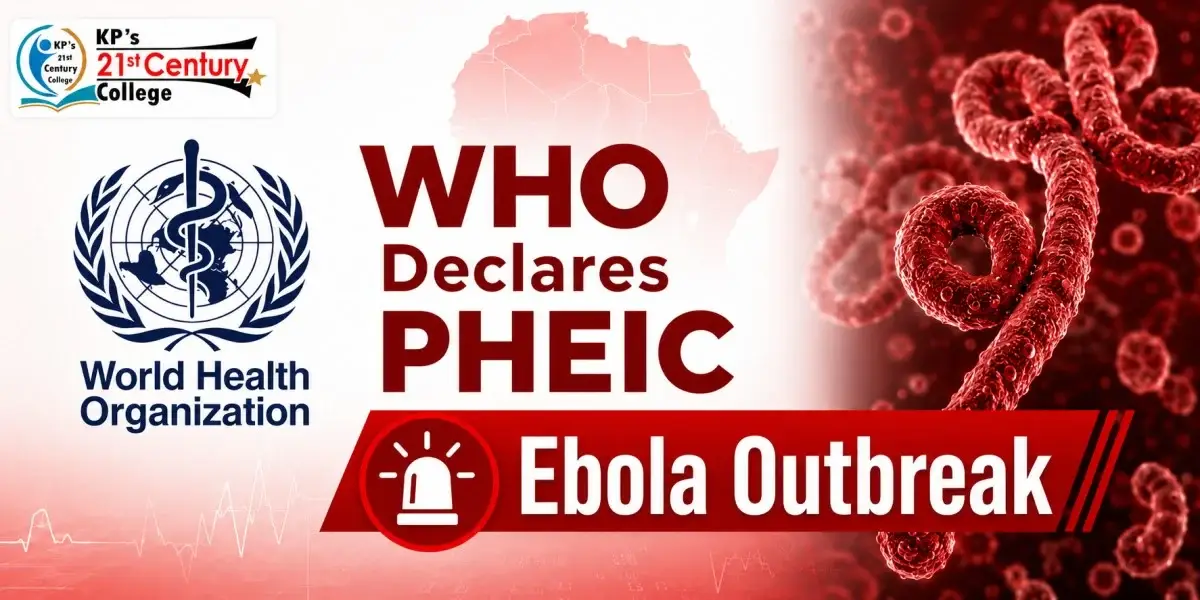
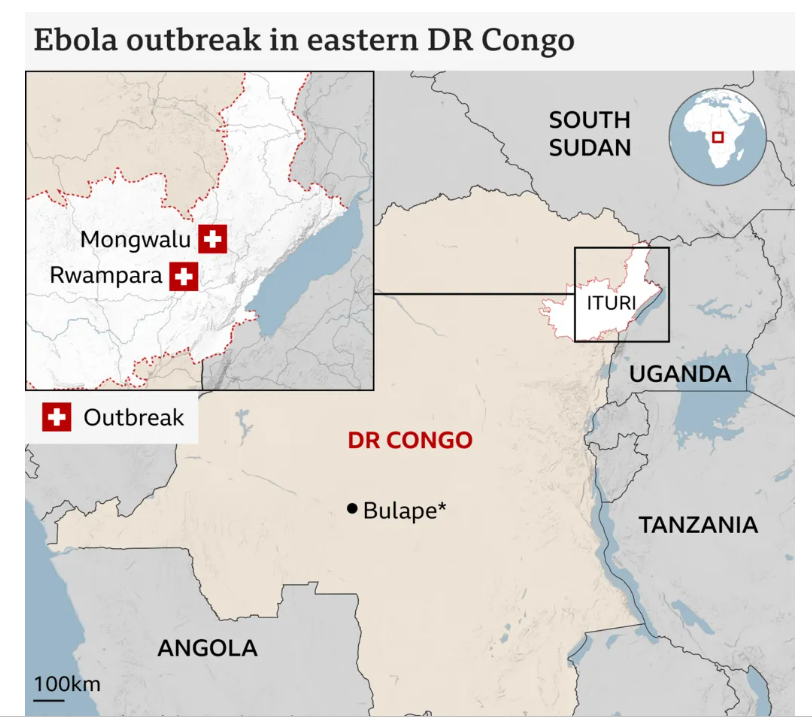
- The World Health Organization declared the Ebola outbreak in the Democratic Republic of the Congo and Uganda as a Public Health Emergency of International Concern. The outbreak was reported in eastern DRC and Uganda. The current outbreak is linked to the Bundibugyo ebolavirus strain. WHO stated that the outbreak requires coordinated international response, but it does not yet meet the criteria of a pandemic emergency like COVID-19.
What is PHEIC?
- PHEIC stands for Public Health Emergency of International Concern.
- It is the highest level of global health alert issued by the WHO under the International Health Regulations.
- It is declared when a health event is:
- Serious
- Sudden
- Unexpected or unusual
- Capable of spreading across countries
- Requiring international coordination
- A PHEIC declaration helps mobilise global action for surveillance, containment, treatment and response.
Current Ebola Outbreak
- 8 laboratory-confirmed cases in Ituri Province of DRC
- 246 suspected cases
- 80 suspected deaths
- 2 laboratory-confirmed cases in Kampala, Uganda, including one death
- The Uganda cases were reported among individuals travelling from the DRC.
- WHO noted uncertainty regarding the true number of infected persons and the actual geographic spread.
- High positivity among initial samples indicates that the outbreak may be larger than currently detected.
What is Ebola?
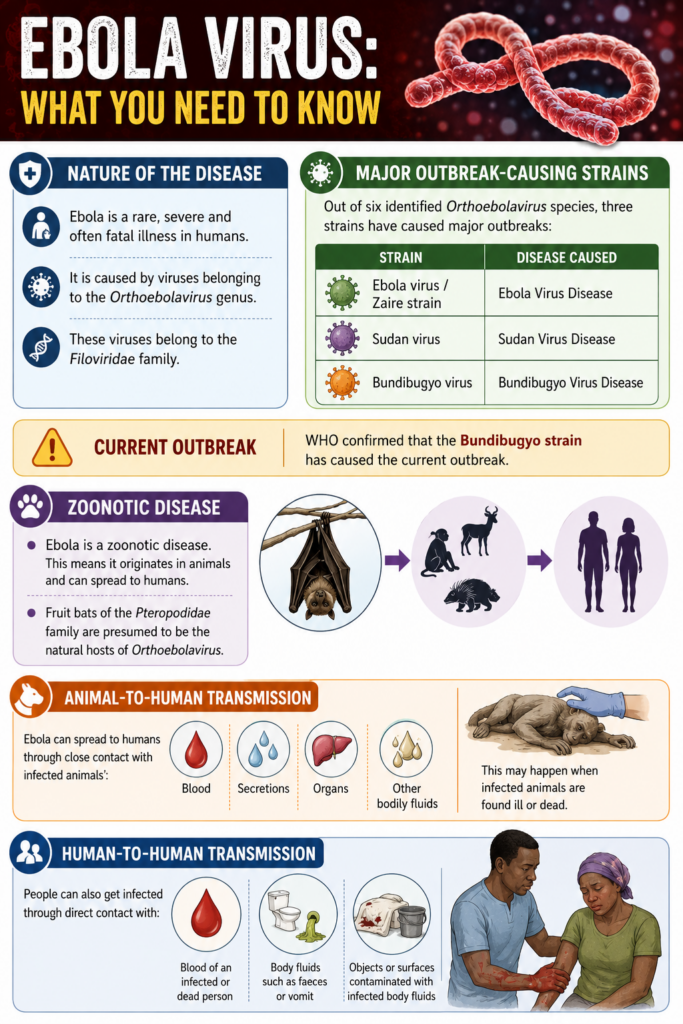
- Ebola virus disease is a severe zoonotic disease.
- It spreads from animals to humans and can also spread from human to human.
- It is often fatal if not detected and treated early.
- Ebola is caused by viruses belonging to the Ebola group.
- Three viruses are known to cause large Ebola outbreaks:
- Ebola virus
- Sudan virus
- Bundibugyo virus
- The current outbreak is linked to Bundibugyo virus.
Historical Background
- Ebola has been known since 1976.
- Early outbreaks mostly occurred in remote villages of Central Africa.
- The largest Ebola outbreak occurred in West Africa from 2014 to 2016.
- It affected Guinea, Liberia and Sierra Leone.
- That outbreak caused more than 28,600 reported cases and 11,325 deaths.
- It also accelerated global research into Ebola vaccines and treatments.
Transmission of Ebola
- Ebola is a zoonotic disease, meaning it can spread from animals to humans.
- It can spill over from wild animals such as:
- Fruit bats, non-human primates, Chimpanzees, Gorillas, Monkeys, Forest antelope, Porcupines
- Human-to-human spread occurs through direct contact with:
- Blood, Secretions, Bodily fluids, Organs of infected persons, Contaminated surfaces, Bedding or clothing used by infected persons
- Infection may also occur through contact with vomit, semen or other infected body fluids.
Symptoms and Diagnosis
- The incubation period may range from 2 to 21 days.
- Common early symptoms include:
- Fever, Fatigue, Muscle pain, Headache, Sore throat, Malaise
- Later symptoms may include:
- Vomiting, Diarrhoea, Abdominal pain, Rash, Kidney and liver dysfunction
- Bleeding is possible but is not always present.
- Confirmatory tests include:
- RT-PCR
- Antibody-capture ELISA
- Antigen-capture detection tests
- Virus isolation by cell culture
Treatment and Vaccines
- Ebola patients need rapid isolation and intensive supportive care.
- Supportive care includes:
- Rehydration
- Symptom management
- Emergency care
- Treatment of complications
- Monoclonal antibody treatments can improve survival if given early.
- WHO has recommended monoclonal antibody treatments such as:
- mAb114 / Ansuvimab
- REGN-EB3 / Inmazeb
- Approved Ebola vaccines include:
- Ervebo
- Zabdeno and Mvabea
- Vaccines are used for targeted ring vaccination of contacts and frontline workers where relevant.
Containment Measures
- Rapid identification and isolation of patients.
- Immediate supportive care to reduce mortality.
- Contact tracing and monitoring for 21 days.
- Safe and dignified burials.
- Strict infection prevention and control in health facilities.
- Laboratory testing and disease surveillance.
- Vaccination of at-risk groups where feasible.
- Use of monoclonal antibodies where available.
- Social mobilisation to reduce stigma and encourage early care-seeking.
Challenges
- The true number of infected persons may be higher than reported.
- Epidemiological links between cases may not be clear.
- Cross-border movement can increase spread.
- Symptoms overlap with other diseases, making diagnosis difficult.
- Health systems in affected areas may face capacity constraints.
- Fear, stigma and misinformation can delay treatment.
- Safe burial practices may be difficult in communities with strong traditional customs.
- The Bundibugyo strain has limited vaccine and treatment options compared with some other Ebola variants.
Way Forward
- Strengthen surveillance in affected and neighbouring regions.
- Improve laboratory testing and early diagnosis.
- Ensure rapid isolation and clinical care for confirmed cases.
- Scale up contact tracing and 21-day monitoring.
- Protect frontline health workers with infection-control measures.
- Use vaccines and monoclonal antibodies where available and relevant.
- Strengthen community engagement to reduce stigma.
- Avoid unnecessary border closures, but improve screening and cross-border coordination.
- Build long-term One Health systems to track zoonotic spillovers.
Conclusion
The Ebola outbreak in DRC and Uganda is a reminder that infectious diseases can quickly become international health concerns. A PHEIC declaration helps mobilise global coordination, surveillance and response.
Ebola control depends not only on medical care but also on contact tracing, safe burials, vaccination, infection control and community trust. Long-term preparedness requires stronger public health systems, cross-border cooperation and a One Health approach to reduce zoonotic risks.
UPSC PYQ
Q. Among the following, which were frequently mentioned in the news for the outbreak of Ebola virus recently? (2015)
A. Syria and Jordan
B. Guinea, Sierra Leone and Liberia
C. Philippines and Papua New Guinea
D. Jamaica, Haiti and Surinam
Answer: B
Explanation
- Guinea, Sierra Leone and Liberia were frequently mentioned in the news due to the major Ebola virus disease outbreak in West Africa.
- The outbreak began in Guinea in December 2013 and later spread to neighbouring Liberia and Sierra Leone.
- This became the largest Ebola outbreak recorded at that time and caused serious health, social and economic impacts in the West African region.
- Ebola is a zoonotic viral disease, meaning it can spread from animals to humans. The uploaded source also notes that Ebola outbreaks have been reported in several West African countries and are linked with human–animal interaction and later human-to-human transmission.
Therefore, option B is the correct answer.
CARE MCQ
Q. The recent Ebola outbreak in Uganda and the Democratic Republic of Congo is associated with which one of the following strains?
A. Zaire strain
B. Sudan strain
C. Bundibugyo strain
D. Reston strain
Answer: C
Explanation:
- The recent Ebola outbreak in Uganda and the Democratic Republic of Congo is linked to the Bundibugyo strain of Ebola virus.
- This strain is considered dangerous because there is no specific approved vaccine available for it at present.
Additional Information:
- Ebola is caused by viruses of the Orthoebolavirus group.
- The disease spreads through direct contact with bodily fluids of infected persons.
- Common control measures include isolation, contact tracing, rapid testing and safe burials.
FAQs
Q. What is PHEIC?
PHEIC means Public Health Emergency of International Concern. It is WHO’s highest global health alert.
Q. Why did WHO declare a PHEIC?
WHO declared a PHEIC because the Ebola outbreak in DRC and Uganda posed a risk of international spread.
Q. What is Ebola?
Ebola is a severe zoonotic disease that can spread from animals to humans and then from human to human.
Q. Which virus is linked to the current outbreak?
The current outbreak is linked to the Bundibugyo ebolavirus strain.
Q. How does Ebola spread?
It spreads through direct contact with blood, bodily fluids, secretions, organs or contaminated materials of infected persons or animals.
Q. What are common symptoms of Ebola?
Common symptoms include fever, fatigue, muscle pain, headache, sore throat, vomiting, diarrhoea and abdominal pain.
Q. What are the main containment measures?
Main measures include isolation, supportive care, contact tracing, safe burials, infection control, vaccination where relevant and social mobilisation.
Q. Is Ebola the same as a pandemic?
No. WHO stated that the outbreak is a PHEIC but does not yet meet pandemic emergency criteria.