Relevance : APPSC Group 1: Paper II – Polity and Governance – Government policies and interventions, welfare schemes, women and child development, public health and population-related issues.
For Prelims:
- Fertility Rate, Total Fertility Rate, Working-age Population, Demographic Dividend, Anganwadi Centres, NTR Baby Kit, Thalli Ki Vandanam, Gram Sabha, IVF Treatment, Public-Private Partnership, Millets, Family Welfare Department.
For Mains:
- Declining Fertility Rate, Ageing Population, Demographic Transition, Human Capital, Women’s Health, Reproductive Rights, Maternal Nutrition, Child Welfare, Economic Productivity, Population Policy, Social Security, Responsible Parenthood.
Why in News?
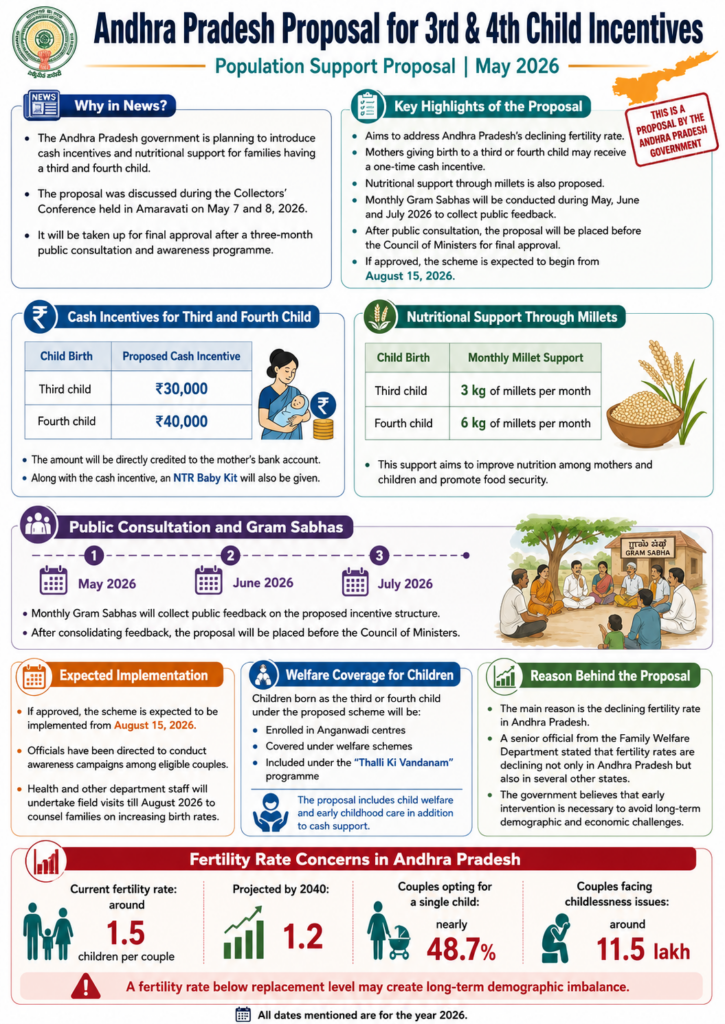
The Andhra Pradesh government is planning to introduce cash incentives and nutritional support for families having a third and fourth child.
The proposal was discussed during the Collectors’ Conference held in Amaravati on May 7 and 8, 2026.
The proposal will be taken up for final approval after a three-month public consultation and awareness programme.
Key Highlights of the Proposal
- The proposal aims to address Andhra Pradesh’s declining fertility rate.
- Under the proposal, mothers giving birth to a third or fourth child may receive a one-time cash incentive.
- Nutritional support through millets is also proposed.
- Monthly Gram Sabhas will be conducted during May, June and July 2026 to collect public feedback.
- After public consultation, the proposal will be placed before the Council of Ministers for final approval.
- If approved, the scheme is expected to begin from August 15, 2026.
Cash Incentives for Third and Fourth Child
Under the proposal, mothers will receive financial support at the time of childbirth.
| Child Birth | Proposed Cash Incentive |
| Third child | ₹30,000 |
| Fourth child | ₹40,000 |
The amount will be directly credited to the mother’s bank account.
Along with the cash incentive, an NTR Baby Kit will also be given.
Nutritional Support Through Millets
The proposal also includes monthly nutritional support.
| Child Birth | Monthly Millet Support |
| Third child | 3 kg of millets per month |
| Fourth child | 6 kg of millets per month |
This support aims to improve nutrition among mothers and children.
Millets are also important because they are nutritious and suitable for promoting food security.
Public Consultation and Gram Sabhas
Monthly Gram Sabhas will be conducted during:
- May 2026
- June 2026
- July 2026
The purpose is to collect public feedback on the proposed incentive structure.
After consolidating the feedback, the proposal will be placed before the Council of Ministers.
Expected Implementation
- If approved, the scheme is expected to be implemented from August 15, 2026.
- Officials have been directed to conduct awareness campaigns among eligible couples.
- Health and other department staff will undertake field visits till August 2026 to counsel families on increasing birth rates.
Welfare Coverage for Children
Children born as the third or fourth child under the proposed scheme will be:
- Enrolled in Anganwadi centres
- Covered under welfare schemes
- Included under the “Thalli Ki Vandanam” programme
This shows that the proposal is not limited to cash support. It also includes child welfare and early childhood care.
Reason Behind the Proposal
- The main reason behind the proposal is the declining fertility rate in Andhra Pradesh.
- A senior official from the Family Welfare Department stated that fertility rates are declining not only in Andhra Pradesh but also in several other states.
- The government believes that early intervention is necessary to avoid long-term demographic and economic challenges.
Fertility Rate Concerns in Andhra Pradesh
According to official data mentioned in the article:
- Andhra Pradesh’s fertility rate has dropped to around 1.5 children per couple.
- It is projected to decline further to 1.2 by 2040.
- Nearly 48.7% of couples in the state are opting for a single child.
- Around 11.5 lakh couples are facing issues related to childlessness.
A fertility rate below replacement level may create long-term demographic imbalance.
Working-age Population Challenge
The state is also concerned about a fall in the working-age population.
According to the article:
- The working-age population is expected to fall from 62.9% to 57%.
This may affect:
- Labour availability
- Economic productivity
- Tax base
- Social security burden
- Care of the elderly population
IVF Support for Childless Couples
The government is also exploring public-private partnership models to provide IVF treatment to couples facing childlessness.
This may help couples who want children but are unable to have them due to medical reasons.
Public Concerns
Some sections of the public have expressed concerns over the proposal.
For example, G. Gangabhavani from Nandalur in Kadapa district said that rising education costs and financial pressures make it difficult even to raise one child.
This shows that cash incentives alone may not be enough unless families feel secure about:
- Education costs
- Healthcare expenses
- Employment opportunities
- Cost of living
- Childcare support
Other Government Directions
The Chief Minister has also directed officials to:
- Scale down family planning operations
- Reduce the number of caesarean deliveries in private hospitals
- Curb teenage pregnancies
- Intensify awareness campaigns at the grassroots level
These directions show that the government is trying to address both fertility concerns and reproductive health issues.
Significance
1. Addresses Declining Fertility Rate
The proposal aims to respond to Andhra Pradesh’s falling fertility rate and prevent future ageing-related challenges.
2. Maintains Demographic Balance
A balanced population structure is important for social stability and economic growth.
3. Supports Mothers Directly
Cash incentives will be credited to the mother’s bank account, strengthening direct benefit delivery.
4. Promotes Nutrition
Monthly millet support can improve maternal and child nutrition.
5. Strengthens Anganwadi Linkage
Enrolment in Anganwadi centres can support nutrition monitoring, immunisation, pre-school education and early childhood care.
6. Supports Childless Couples
Proposed IVF support through PPP models may help couples facing infertility issues.
7. Supports Future Economy
A stable working-age population is important for labour supply, productivity and long-term economic planning.
Challenges
1. Rising Cost of Raising Children
Education, healthcare and living costs may discourage families from having more children.
2. Women’s Health Concerns
The policy must protect maternal health, safe childbirth and reproductive rights.
3. Reproductive Choice
Couples should not feel pressured. The policy should promote informed choice.
4. Implementation Issues
Cash transfers, millet distribution and welfare coverage require strong monitoring.
5. Unequal Impact
Poor families may respond more to incentives, so child welfare safeguards are necessary.
6. Public Acceptance
Changing family preferences and financial pressures may create public hesitation.
7. Teenage Pregnancies
Promotion of birth rates must be accompanied by efforts to prevent teenage pregnancies.
8. Caesarean Deliveries
Reduction of C-sections should be based on medical need, not administrative targets.
Way Forward
1. Conduct Public Consultation
Gram Sabhas should collect genuine feedback from families, women and health workers.
2. Protect Women’s Health
The policy must ensure safe pregnancy, institutional delivery and post-natal care.
3. Link Incentives with Health Services
Benefits should be linked with check-ups, immunisation and child nutrition.
4. Strengthen Anganwadi Centres
Anganwadi centres should be improved for nutrition, monitoring and early childhood care.
5. Reduce Family Burden
The state should support education, healthcare and childcare costs.
6. Promote Responsible Parenthood
Awareness should focus on maternal health, child welfare and informed family decisions.
7. Regulate IVF Support
IVF support through PPP models should be affordable, transparent and medically regulated.
8. Ensure Monitoring
Strong monitoring is needed to prevent leakages and ensure benefits reach eligible mothers and children.
Conclusion
Andhra Pradesh’s proposal reflects a shift from population control to demographic balance.
It aims to address declining fertility, future workforce concerns and economic productivity.
However, its success will depend on protecting women’s health, supporting child nutrition, reducing family expenses and respecting reproductive choice.
A balanced population policy should promote family welfare, women’s dignity and long-term demographic stability.
CARE MCQ
Q. With reference to Andhra Pradesh’s proposed incentive scheme for third and fourth child, consider the following statements:
- Mothers giving birth to a third child may receive ₹30,000.
- Mothers giving birth to a fourth child may receive ₹40,000.
- The scheme has already received final approval from the Council of Ministers.
Which of the above statements are correct?
A. 1 and 2 only
B. 2 and 3 only
C. 1 and 3 only
D. 1, 2 and 3
Answer: A
Explanation:
- Statement 1 is correct: The proposal provides ₹30,000 for the birth of a third child.
- Statement 2 is correct: The proposal provides ₹40,000 for the birth of a fourth child.
- Statement 3 is incorrect: The proposal has not yet received final approval. It will be taken up after public consultation.
Additional Information:
If approved, the scheme is expected to be implemented from August 15, 2026.
FAQs
1. Why is Andhra Pradesh planning incentives for a third and fourth child?
Andhra Pradesh is concerned about its declining fertility rate. The state’s fertility rate has fallen to around 1.5 children per couple and is projected to decline further to 1.2 by 2040.
2. What cash incentives are proposed?
The proposal provides a one-time incentive of ₹30,000 for the third child and ₹40,000 for the fourth child.
3. Who will receive the cash incentive?
The cash incentive will be directly credited to the mother’s bank account at the time of childbirth.
4. What nutritional support is proposed?
Families may receive 3 kg of millets per month after the birth of a third child and 6 kg of millets per month after the birth of a fourth child.
5. Has the scheme been approved?
No. The proposal has not yet received final approval. It will be taken up after a three-month public consultation and awareness programme.
6. When may the scheme be implemented?
If approved, the scheme is expected to begin from August 15, 2026.
7. What is the role of Gram Sabhas?
Gram Sabhas will be conducted during May, June and July 2026 to collect public feedback on the proposed incentive structure.
Source: Deccan Chronicle
Relevance: UPSC GS Paper II: Indian Polity – Constitution, Parliament, Judiciary, Election Commission of India, Constitutional Bodies, Separation of Powers, Judicial Review, Electoral Reforms
For Prelims:
- Article 324(2), Election Commission of India, Chief Election Commissioner, Election Commissioners, Anoop Baranwal vs Union of India, 2023, Chief Election Commissioner and Other Election Commissioners Act, 2023, Association for Democratic Reforms
For Mains:
- Independence of Election Commission, Executive dominance, Free and fair elections, Judicial intervention, Parliamentary delay, Institutional autonomy, Democratic accountability
Why in News?
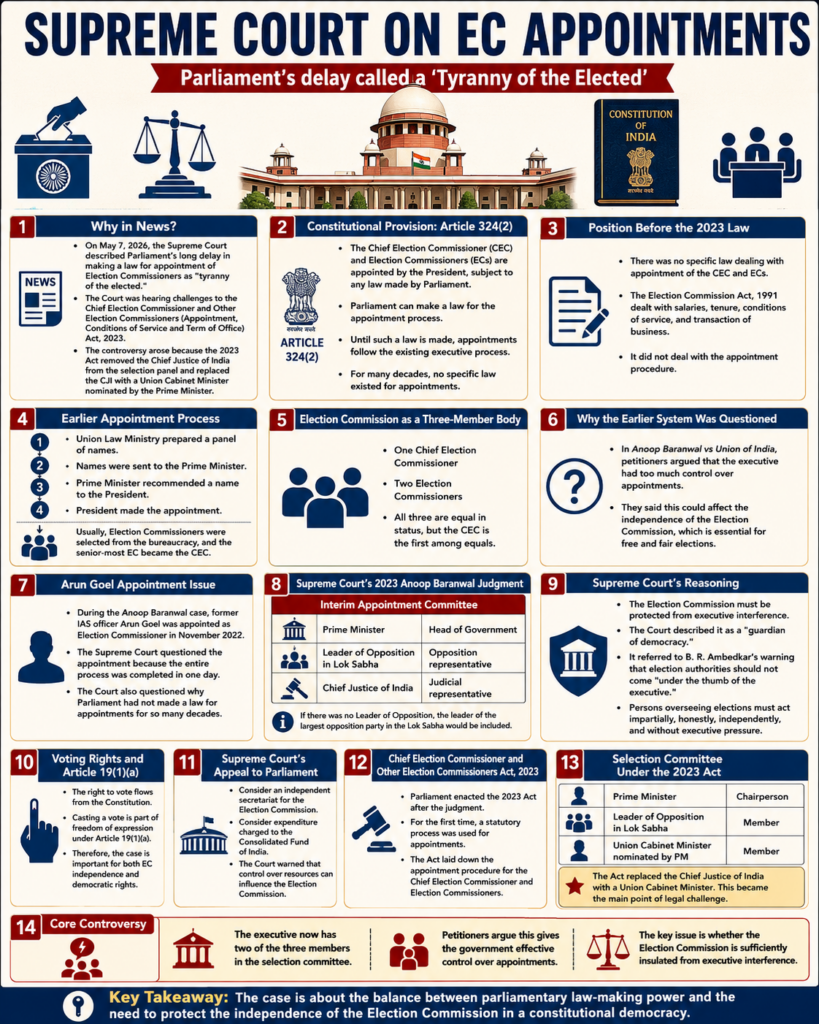
The Supreme Court, on May 7, 2026, described Parliament’s long delay in making a law for appointment of Election Commissioners as “tyranny of the elected.”
The Court was hearing challenges to the Chief Election Commissioner and Other Election Commissioners (Appointment, Conditions of Service and Term of Office) Act, 2023.
The controversy arose because the 2023 Act removed the Chief Justice of India from the selection panel and replaced the CJI with a Union Cabinet Minister nominated by the Prime Minister.
Constitutional Provision: Article 324(2)
Article 324(2) provides that the Chief Election Commissioner and Election Commissioners shall be appointed by the President, subject to any law made by Parliament.
This means:
- Parliament can make a law for the appointment process.
- Until such a law is made, appointments follow the existing executive process.
- For many decades, no specific law existed for appointments.
Position Before the 2023 Law
Before the 2023 Act, there was no law specifically dealing with appointment of the CEC and ECs.
The Election Commission Act, 1991 dealt with:
- Salaries
- Tenure
- Conditions of service
- Transaction of business
But it did not deal with the appointment procedure.
Earlier Appointment Process
Earlier, the process was largely controlled by the executive:
- The Union Law Ministry prepared a panel of names.
- The names were sent to the Prime Minister.
- The Prime Minister recommended a name to the President.
- The President made the appointment.
Usually, Election Commissioners were selected from the bureaucracy, and the senior-most Election Commissioner became the Chief Election Commissioner.
Election Commission as a Three-Member Body
The Election Commission consists of:
- One Chief Election Commissioner
- Two Election Commissioners
All three are equal in status, but the CEC is considered first among equals.
Why the Earlier System Was Questioned
In Anoop Baranwal vs Union of India, petitioners argued that the executive had too much control over Election Commission appointments.
They said this could affect the independence of the Election Commission, which is essential for free and fair elections.
Arun Goel Appointment Issue
- During the Anoop Baranwal case, former IAS officer Arun Goel was appointed as Election Commissioner in November 2022.
- The Supreme Court questioned the appointment because the entire process was completed in one day.
- The Court also questioned why Parliament had not made a law for appointments for so many decades.
Supreme Court’s 2023 Anoop Baranwal Judgment
In March 2023, the Supreme Court laid down an interim appointment process until Parliament made a law.
The Court said appointments should be made on the advice of a committee consisting of:
| Member | Role |
| Prime Minister | Head of Government |
| Leader of Opposition in Lok Sabha | Opposition representative |
| Chief Justice of India | Judicial representative |
If there was no Leader of Opposition, the leader of the largest opposition party in the Lok Sabha would be included.
Supreme Court’s Reasoning
The Court said that the Election Commission must be protected from executive interference.
It described the Election Commission as a “guardian of democracy.”
The Court also referred to B. R. Ambedkar’s warning that election authorities should not come “under the thumb of the executive.”
Persons overseeing elections must act:
- Impartially
- Honestly
- Independently
- Without executive pressure
Voting Rights and Article 19(1)(a)
The Court also held that:
- The right to vote flows from the Constitution.
- Casting a vote is part of freedom of expression under Article 19(1)(a).
Thus, the case was important for both Election Commission independence and democratic rights.
Supreme Court’s Appeal to Parliament
The Court asked Parliament to strengthen the Election Commission by considering:
- An independent secretariat
- Expenditure charged to the Consolidated Fund of India
The Court warned that the executive could influence the Election Commission by controlling its resources.
Chief Election Commissioner and Other Election Commissioners Act, 2023
After the judgment, Parliament enacted the Chief Election Commissioner and Other Election Commissioners Act, 2023.
The Act laid down the appointment procedure for:
- Chief Election Commissioner
- Election Commissioners
For the first time, a statutory process was used for appointments.
Selection Committee Under the 2023 Act
The Selection Committee consists of:
| Member | Position |
| Prime Minister | Chairperson |
| Leader of Opposition in Lok Sabha | Member |
| Union Cabinet Minister nominated by PM | Member |
The Act replaced the Chief Justice of India with a Union Cabinet Minister.
This became the main point of legal challenge.
Why the 2023 Act Became Controversial
The Act gives the executive a strong position in the committee.
Out of three members:
- Prime Minister belongs to the executive.
- Cabinet Minister also belongs to the executive.
- Leader of Opposition is the only non-government member.
Petitioners argue that this gives the government effective control over appointments.
Search Committee Under the 2023 Act
The Act also creates a Search Committee.
It is headed by the Law Minister and includes two senior bureaucrats.
Its function is to prepare a shortlist of five candidates for the Selection Committee.
Power to Go Beyond Shortlist
Under Section 8, the Selection Committee can consider names beyond the shortlisted candidates.
This gives the Selection Committee wide discretion.
Eligibility Conditions
The CEC and ECs must be persons who:
- Hold or have held a post equivalent to Secretary to the Government of India
- Are persons of integrity
- Have knowledge and experience in management and conduct of elections
Tenure and Reappointment
The Act provides that:
- CEC and ECs are not eligible for reappointment.
- If an EC becomes CEC, the total term as EC and CEC cannot exceed six years.
Section 7(2)
Section 7(2) says an appointment shall not become invalid merely due to:
- Vacancy in the Selection Committee
- Defect in constitution of the Selection Committee
Legal Challenge
In 2024, petitioners including Association for Democratic Reforms challenged the 2023 Act.
Their main argument is that the law restores executive dominance and goes against the principle of insulating the Election Commission from executive interference.
Key Constitutional Question
The main question is:
Can Parliament override or modify a Constitution Bench judgment through legislation or ordinance?
This question arose because the Supreme Court had included the CJI in the interim panel, but the 2023 law replaced the CJI with a Cabinet Minister.
Appointment of Gyanesh Kumar as CEC
In February 2025, the Selection Committee met to appoint the new CEC.
The committee consisted of:
| Member | Position |
| Narendra Modi | Prime Minister |
| Rahul Gandhi | Leader of Opposition |
| Amit Shah | Home Minister and nominated Cabinet Minister |
Former IAS officer Gyanesh Kumar was appointed as the Chief Election Commissioner.
He succeeded Rajiv Kumar, who retired on February 18, 2025.
Gyanesh Kumar’s appointment took effect from February 19, 2025.
Appointment of Vivek Joshi
Along with Gyanesh Kumar’s appointment as CEC, Vivek Joshi, an IAS officer of the 1989 batch, was appointed as an Election Commissioner.
Seniority Issue
- Under the earlier convention, the senior-most EC usually became CEC.
- Gyanesh Kumar and Sukhbir Singh Sandhu were appointed as ECs on the same day, March 14, 2024.
- Gyanesh Kumar was treated as senior because his name appeared first in the appointment notification.
- Thus, under the old convention also, he would likely have become CEC.
Why the Appointment Did Not Settle the Issue
The legal challenge to the 2023 Act is still pending.
The Supreme Court had said that the consequences of its final decision would apply even if appointments were made in the meantime.
Supreme Court’s Recent Observations
Justice Dipankar Datta observed that the Anoop Baranwal judgment was only meant to “fill the vacuum till the law is made.”
He also said that the judgment did not say Parliament must make the law in a particular manner.
However, the Court questioned why Parliament had not made such a law earlier.
Meaning of “Tyranny of the Elected”
Prashant Bhushan argued that governments avoided creating an independent appointment process because they wanted to retain control once in power.
Justice Datta responded that this could be called “tyranny of the elected.”
It means elected governments may misuse or neglect their power when they fail to protect constitutional institutions.
Parliamentary Debate Issue
The Supreme Court also asked whether Parliament properly debated the spirit of the Anoop Baranwal judgment.
Senior Advocate Shadan Farasat said there was no proper debate.
Prashant Bhushan said there was virtually no debate because many MPs were suspended.
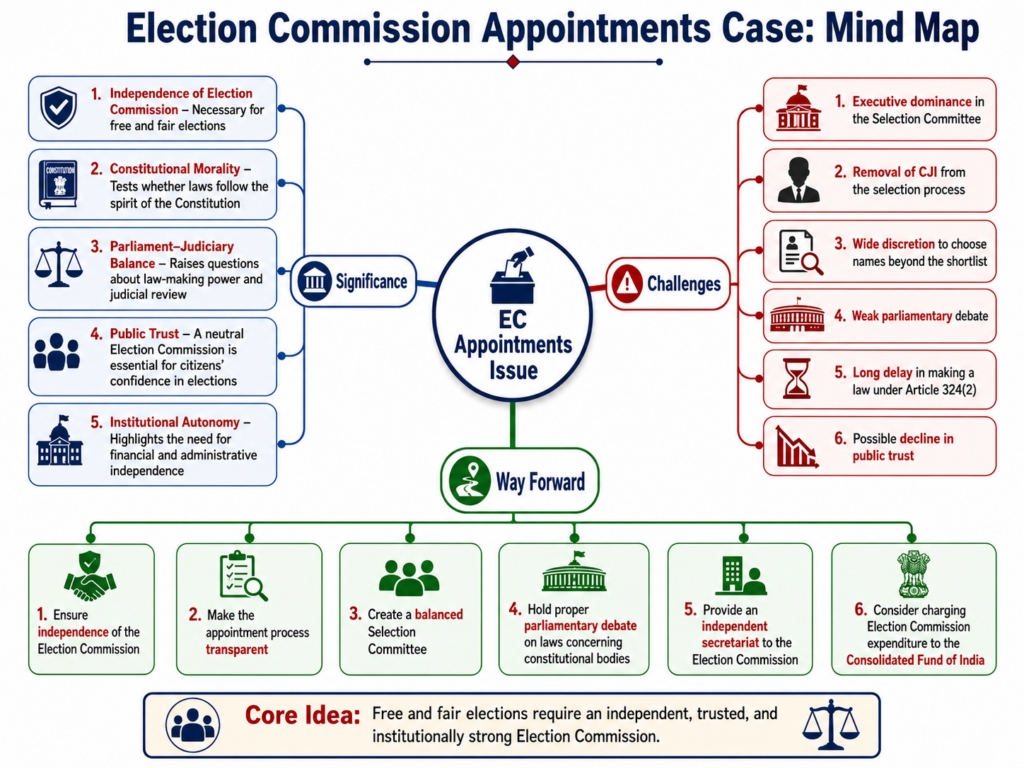
Significance
1. Independence of Election Commission
The Election Commission must be independent to conduct free and fair elections.
2. Constitutional Morality
The issue tests whether laws follow the spirit of the Constitution.
3. Parliament-Judiciary Balance
The case raises questions about Parliament’s law-making power and judicial review.
4. Public Trust
A neutral Election Commission is necessary to maintain citizens’ confidence in elections.
5. Institutional Autonomy
The issue highlights the need for financial and administrative independence of the Election Commission.
Challenges
- Executive dominance in the Selection Committee
- Removal of CJI from the selection process
- Wide discretion to choose names beyond the shortlist
- Weak parliamentary debate
- Long delay in making a law under Article 324(2)
- Possible decline in public trust
Way Forward
- Ensure independence of the Election Commission
- Make the appointment process transparent
- Create a balanced Selection Committee
- Hold proper parliamentary debate on laws concerning constitutional bodies
- Provide an independent secretariat to the Election Commission
- Consider charging Election Commission expenditure to the Consolidated Fund of India
Conclusion
The controversy over Election Commission appointments is about the independence of a key constitutional body.
The Supreme Court’s phrase “tyranny of the elected” shows that elected governments must respect constitutional values.
The Election Commission is the guardian of electoral democracy. Its appointment process must be transparent, balanced and independent to protect free and fair elections.
UPSC PYQ
Q. As per Article 324 of the Constitution of India, the Chief Election Commissioner shall not be removed from his office except in like manner and on the like grounds as: NDA-I/2026
A. a Judge of the Supreme Court
B. a Judge of a High Court
C. the Speaker of the Lok Sabha
D. the Governor of a State
Answer: A
Explanation:
Article 324(5) of the Constitution gives security of tenure to the Chief Election Commissioner (CEC).
It states that the Chief Election Commissioner cannot be removed from office except in the same manner and on the same grounds as a Judge of the Supreme Court.
This means:
- The CEC can be removed only by the President of India.
- Such removal must be based on a resolution passed by both Houses of Parliament.
- The resolution must be passed by a special majority.
- The grounds of removal are proved misbehaviour or incapacity.
Therefore, the correct answer is A. a Judge of the Supreme Court.
Additional Information:
Other Election Commissioners do not have the same direct removal protection as the CEC. They can be removed only on the recommendation of the Chief Election Commissioner. This provision helps protect the independence of the Election Commission of India.
CARE MCQ
Q. With reference to the Supreme Court’s judgment in Anoop Baranwal vs Union of India, consider the following statements:
- The Court included the Chief Justice of India in the interim selection committee.
- The Court described the Election Commission as a guardian of democracy.
- The Court held that the right to vote has no connection with freedom of expression.
Which of the above statements are correct?
A. 1 and 2 only
B. 2 and 3 only
C. 1 and 3 only
D. 1, 2 and 3
Answer: A
Explanation:
- Statement 1 is correct: The interim committee included the Prime Minister, Leader of Opposition and Chief Justice of India.
- Statement 2 is correct: The Court described the Election Commission as a guardian of democracy.
- Statement 3 is incorrect: The Court held that casting a vote is part of freedom of expression under Article 19(1)(a).
Q. With reference to the Chief Election Commissioner and Other Election Commissioners Act, 2023, consider the following statements:
- The Selection Committee includes the Prime Minister, Leader of Opposition and a Union Cabinet Minister nominated by the Prime Minister.
- The Search Committee is headed by the Chief Justice of India.
- The Selection Committee can consider names beyond the shortlist prepared by the Search Committee.
Which of the above statements are correct?
A. 1 and 2 only
B. 1 and 3 only
C. 2 and 3 only
D. 1, 2 and 3
Answer: B
Explanation:
- Statement 1 is correct: The 2023 Act provides for a Selection Committee with the Prime Minister, Leader of Opposition and a Union Cabinet Minister nominated by the PM.
- Statement 2 is incorrect: The Search Committee is headed by the Law Minister, not the Chief Justice of India.
- Statement 3 is correct: The Selection Committee can consider persons outside the shortlist.
Additional Information:
This provision gives wide discretion to the Selection Committee.
FAQs
1. What is the main issue in the Election Commission appointment case?
The main issue is whether the 2023 law gives excessive control to the executive in appointing the Chief Election Commissioner and Election Commissioners.
2. What did the Supreme Court decide in Anoop Baranwal case?
The Supreme Court laid down an interim process where the Prime Minister, Leader of Opposition and Chief Justice of India would advise the President on appointments until Parliament made a law.
3. Why is the 2023 Act challenged?
It is challenged because it removed the Chief Justice of India from the Selection Committee and replaced the CJI with a Union Cabinet Minister nominated by the Prime Minister.
4. What does “tyranny of the elected” mean in this context?
It refers to the failure or misuse of power by elected representatives when they delay or frame laws in a way that may weaken constitutional institutions.
5. Who is the current Chief Election Commissioner mentioned in the article?
The article mentions Gyanesh Kumar, who was appointed Chief Election Commissioner with effect from February 19, 2025.
Relevance: UPSC: GS Paper I – Indian Culture, Heritage, History and Architecture
For Prelims:
- Somnath Temple, Jyotirlinga, Prabhas Patan, Shiva Purana, Dwadasha Jyotirlinga Stotram, Sardar Vallabhbhai Patel, Dr. Rajendra Prasad, Somnath Swabhiman Parv, Veer Hamirji Gohil, Shree Somnath Trust
For Mains:
- Civilisational Continuity, Cultural Resilience, Heritage Preservation, Vikas Bhi Virasat Bhi, National Resurgence, Sustainable Pilgrimage, Women Empowerment, Community Welfare
Why in News?
The Somnath Swabhiman Parv is being observed to mark two important milestones: 1000 years since the first recorded attack on Somnath Temple in 1026 and 75 years since its reopening in May 1951. Prime Minister Narendra Modi is visiting Somnath Temple on May 11 to commemorate this occasion.
Sacred and Cultural Importance of Somnath
- Somnath Temple is located at Prabhas Patan on the Saurashtra coast of Gujarat.
- It is one of India’s most sacred pilgrimage centres.
- It is regarded as the first among the twelve Jyotirlingas of Lord Shiva.
- The temple is associated with the worship of:
- Lord Shiva
- Lord Krishna
- Shakti
- The Dwadasha Jyotirlinga Stotram places Somnath first among the twelve Jyotirlingas.
- This gives Somnath a special place in India’s spiritual and civilisational heritage.
Historical Journey of Somnath
The origins of Somnath are closely linked with ancient Indian tradition, Lord Shiva and the worship of Chandra, the Moon God. Over centuries, Somnath witnessed several phases of construction, symbolising renewal and continuity.
In January 1026, Somnath faced its first recorded attack. Between the 11th and 18th centuries, the temple was repeatedly destroyed. However, every time it was destroyed, devotees and rulers came forward to rebuild it.
Important contributors to Somnath’s restoration include:
- King Kumarapala, who restored the temple in the 12th century
- The King of Junagarh, who rebuilt it in the 13th century
- Lokmata Ahilyabai Holkar, who consecrated a new temple in the 18th century
- Sardar Vallabhbhai Patel, who visited the ruins in 1947 and resolved to rebuild the temple after Independence
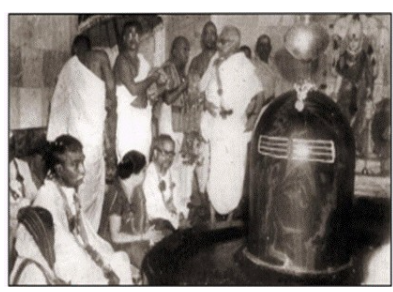
- Dr. Rajendra Prasad, who ceremonially consecrated the present temple on 11 May 1951
The present temple was constructed in the Kailash Mahameru Prasad architectural style. Its reconstruction after Independence became a symbol of India’s cultural confidence and national pride.
Somnath Swabhiman Parv
- Somnath Swabhiman Parv honours the enduring legacy of Somnath Temple.
- It connects two historic milestones:
- First recorded attack on Somnath in 1026
- Reopening of the temple in 1951
- He highlighted “Vikas Bhi, Virasat Bhi” — development along with heritage preservation.
- Special pujas have been announced at Somnath for the next 1,000 days.
January 2026 celebrations included:
- 72-hour Omkar Mantra chanting
- Sacred rituals and prayers for national welfare
- Shaurya Yatra at Prabhas Patan
- Procession of 108 horses honouring Somnath’s defenders.
Architecture and Living Heritage
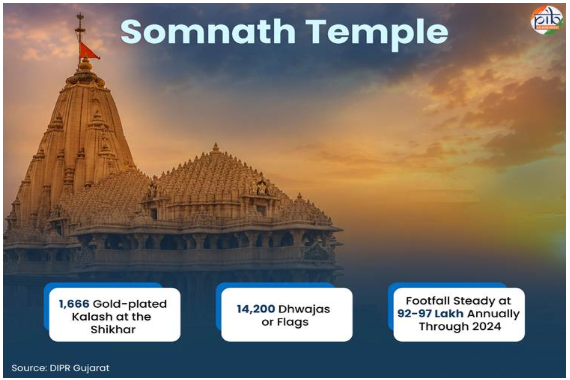
Somnath is the first among the twelve Aadi Jyotirlingas of Lord Shiva. The temple complex includes the Garbhagriha, Sabha Mandap and Nritya Mandap. It rises along the Arabian Sea shoreline.
Important architectural features include:
- 150-foot Shikhar
- 10-tonne Kalash
- 27-foot Dhwajdand
- 1,666 gold-plated Kalash
- 14,200 Dhwajas
Social and Welfare Activities of Shree Somnath Trust
The Shree Somnath Trust undertakes activities in education, skill development, food donation, healthcare, disability support, environmental protection and disaster relief.
Education and Skill Training
The Trust promotes vocational and employment-focused training for youth and women. Courses include:
- Computer education
- Tailoring
- Beauty services
- Digital literacy training
- Scholarship assistance after Class 10 and Class 12
The “School on Wheels” initiative provides mobile digital learning in villages.
Food Donation and Community Welfare
The Trust provides free meals to devotees and needy people through community-supported food assistance programmes. During emergencies, it also supports affected communities through food, medical help and essential supplies.
Health and Disability Support
The Trust supports economically weaker families near Somnath-Prabhas Patan through:
- Medical assistance
- Physiotherapy facilities
- Free dental camps
- Free eye treatment camps
- Wheelchairs, hearing aids and crutches for Persons with Disabilities
COVID-19 Relief Support
- During the COVID-19 pandemic, the Shree Somnath Trust provided relief support of ₹8.73 crore in the first wave and ₹2.21 crore in the second wave.
- It also donated ₹1 crore to the Chief Minister’s Relief Fund and supported oxygen plants and concentrators.
Women Empowerment and Sustainability
- Somnath was declared a “Swachh Iconic Place” in 2018.
- Key sustainability practices include:
- Temple flowers converted into vermicompost
- Plastic waste recycled into paver blocks under Mission LiFE
- Nearly 30 lakh litres of sewage water treated per month through rainwater harvesting systems
- A Miyawaki forest has been developed with:
- Spread over 72,000 sq. ft.
- Absorbs about 93,000 kg of CO₂ annually
- Purified Abhishek water is bottled as Somganga jal, benefiting over 1.13 lakh families as of December 2024.
- Somnath is also a centre of women’s employment:
- Total employees: 906
- Women employees: 262
- Bilva Van is managed entirely by women
- Overall, 363 women receive direct employment
- Women earn about ₹9 crore annually.
Significance
1. Cultural Continuity
Somnath represents India’s civilisational continuity because it survived repeated destruction and was rebuilt again and again.
2. Spiritual Heritage
As the first among the twelve Jyotirlingas, Somnath holds deep importance in India’s religious and cultural life.
3. National Resurgence
The reopening of the temple in 1951 reflected India’s cultural confidence after Independence.
4. Heritage and Development
The idea of “Vikas Bhi, Virasat Bhi” links heritage preservation with modern development.
5. Social Welfare
The activities of Shree Somnath Trust show how religious institutions can support education, health, food assistance and community welfare.
6. Sustainable Pilgrimage
Waste recycling, sewage treatment, plantation drives and Mission LiFE-related practices make Somnath an example of environmentally responsible pilgrimage management.
7. Women Empowerment
Women’s direct employment in trust activities shows the role of heritage institutions in promoting dignity and economic self-reliance.
Challenges
- Managing high pilgrim footfall while preserving the sanctity of the temple
- Maintaining cleanliness and sustainable waste management
- Balancing heritage conservation with tourism growth
- Protecting cultural memory for future generations
- Expanding welfare activities without weakening heritage focus
- Ensuring that women and local communities continue to benefit from temple-linked development
Way Forward
- Strengthen heritage conservation with public participation
- Promote responsible and sustainable pilgrimage tourism
- Expand skill training for youth and women
- Continue environmental initiatives such as composting, plantation and water recycling
- Improve visitor facilities while protecting the sacred character of the temple
- Use cultural programmes to connect younger generations with heritage
- Strengthen education, health and disaster-relief activities of the Trust
Conclusion
Somnath is not only a temple; it is a living symbol of India’s faith, resilience and civilisational continuity. Its repeated destruction and reconstruction reflect the strength of collective memory and cultural confidence.
The 75th anniversary of its reopening is a reminder that heritage survives not only through preservation but also through renewal, welfare, sustainability and people’s participation.
UPSC PYQ
Q. The Prime Minister recently inaugurated the new Circuit House near Somnath Temple at Veraval. Which of the following statements are correct regarding Somnath Temple? (UPSC PYQ – IAS/2022)
- Somnath Temple is one of the Jyotirlinga shrines.
- A description of Somnath Temple was given by Al-Biruni.
- Pran Pratishtha of Somnath Temple, that is, installation of the present-day temple, was done by President S. Radhakrishnan.
Select the correct answer using the code given below:
- 1 and 2 only
- 2 and 3 only
- 1 and 3 only
- 1, 2 and 3
Answer: A
Explanation:
Statement 1 is correct:
Somnath Temple is one of the twelve Jyotirlinga shrines of Lord Shiva. It is located at Prabhas Patan near Veraval in Gujarat.
Statement 2 is correct:
A description of Somnath Temple was given by Al-Biruni, the famous Persian scholar. He mentioned the temple in his work Kitab-ul-Hind.
Statement 3 is incorrect:
The Pran Pratishtha of the reconstructed Somnath Temple was performed on May 11, 1951 by Dr. Rajendra Prasad, the first President of India, not by S. Radhakrishnan.
Final Answer: A. 1 and 2 only
CARE MCQ
Veer Hamirji Gohil is associated with the defence of which one of the following temples?
- Kedarnath Temple
- Jagannath Temple
- Somnath Temple
- Brihadeeswara Temple
Answer: C
Explanation:
- Veer Hamirji Gohil is remembered in regional tradition for defending the Somnath Temple during the invasion of Zafar Khan in 1299 AD.
Additional Information:
- Somnath Temple is located in Gujarat
- It is regarded as the first Jyotirlinga of Lord Shiva
- Veer Hamirji Gohil is associated with the idea of Rajadharma
FAQs
Why is Somnath Temple in news?
Somnath Temple is in news because Somnath Swabhiman Parv is being observed to mark 1,000 years since the first recorded attack in 1026 and 75 years since the reopening of the temple in 1951.
2. Where is Somnath Temple located?
Somnath Temple is located at Prabhas Patan on the Saurashtra coast of Gujarat.
3. Why is Somnath Temple spiritually important?
Somnath is regarded as the first among the twelve Jyotirlingas of Lord Shiva. It is also associated with the worship of Lord Shiva, Lord Krishna and Shakti.
4. What is Somnath Swabhiman Parv?
Somnath Swabhiman Parv is a commemorative event that honours the legacy of Somnath Temple. It connects two historic moments: the first recorded attack in 1026 and the reopening of the temple in 1951.
5. Who rebuilt Somnath Temple after Independence?
After Independence, Sardar Vallabhbhai Patel resolved to rebuild Somnath Temple in 1947. The present temple was ceremonially consecrated by Dr. Rajendra Prasad on 11 May 1951.
6. What does Somnath represent in Indian civilisation?
Somnath represents faith, resilience and civilisational continuity. Its repeated destruction and reconstruction show India’s cultural strength and collective memory.
7. What is the meaning of “Vikas Bhi, Virasat Bhi” in this context?
It means development along with heritage preservation. In Somnath’s case, it refers to improving pilgrimage facilities, social welfare, sustainability and cultural preservation together.