Table of Contents
Relevance : APPSC Group 1: Paper II – Polity and Governance – Government policies and interventions, welfare schemes, women and child development, public health and population-related issues.
For Prelims:
- Fertility Rate, Total Fertility Rate, Working-age Population, Demographic Dividend, Anganwadi Centres, NTR Baby Kit, Thalli Ki Vandanam, Gram Sabha, IVF Treatment, Public-Private Partnership, Millets, Family Welfare Department.
For Mains:
- Declining Fertility Rate, Ageing Population, Demographic Transition, Human Capital, Women’s Health, Reproductive Rights, Maternal Nutrition, Child Welfare, Economic Productivity, Population Policy, Social Security, Responsible Parenthood.
Why in News?
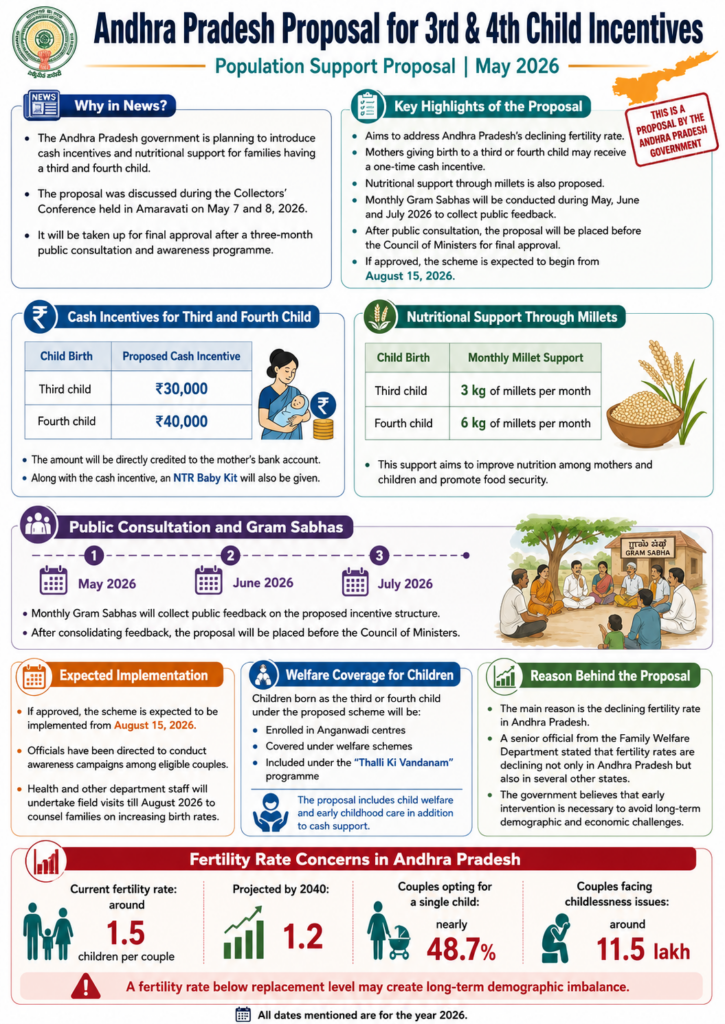
The Andhra Pradesh government is planning to introduce cash incentives and nutritional support for families having a third and fourth child.
The proposal was discussed during the Collectors’ Conference held in Amaravati on May 7 and 8, 2026.
The proposal will be taken up for final approval after a three-month public consultation and awareness programme.
Key Highlights of the Proposal
- The proposal aims to address Andhra Pradesh’s declining fertility rate.
- Under the proposal, mothers giving birth to a third or fourth child may receive a one-time cash incentive.
- Nutritional support through millets is also proposed.
- Monthly Gram Sabhas will be conducted during May, June and July 2026 to collect public feedback.
- After public consultation, the proposal will be placed before the Council of Ministers for final approval.
- If approved, the scheme is expected to begin from August 15, 2026.
Cash Incentives for Third and Fourth Child
Under the proposal, mothers will receive financial support at the time of childbirth.
| Child Birth | Proposed Cash Incentive |
| Third child | ₹30,000 |
| Fourth child | ₹40,000 |
The amount will be directly credited to the mother’s bank account.
Along with the cash incentive, an NTR Baby Kit will also be given.
Nutritional Support Through Millets
The proposal also includes monthly nutritional support.
| Child Birth | Monthly Millet Support |
| Third child | 3 kg of millets per month |
| Fourth child | 6 kg of millets per month |
This support aims to improve nutrition among mothers and children.
Millets are also important because they are nutritious and suitable for promoting food security.
Public Consultation and Gram Sabhas
Monthly Gram Sabhas will be conducted during:
- May 2026
- June 2026
- July 2026
The purpose is to collect public feedback on the proposed incentive structure.
After consolidating the feedback, the proposal will be placed before the Council of Ministers.
Expected Implementation
- If approved, the scheme is expected to be implemented from August 15, 2026.
- Officials have been directed to conduct awareness campaigns among eligible couples.
- Health and other department staff will undertake field visits till August 2026 to counsel families on increasing birth rates.
Welfare Coverage for Children
Children born as the third or fourth child under the proposed scheme will be:
- Enrolled in Anganwadi centres
- Covered under welfare schemes
- Included under the “Thalli Ki Vandanam” programme
This shows that the proposal is not limited to cash support. It also includes child welfare and early childhood care.
Reason Behind the Proposal
- The main reason behind the proposal is the declining fertility rate in Andhra Pradesh.
- A senior official from the Family Welfare Department stated that fertility rates are declining not only in Andhra Pradesh but also in several other states.
- The government believes that early intervention is necessary to avoid long-term demographic and economic challenges.
Fertility Rate Concerns in Andhra Pradesh
According to official data mentioned in the article:
- Andhra Pradesh’s fertility rate has dropped to around 1.5 children per couple.
- It is projected to decline further to 1.2 by 2040.
- Nearly 48.7% of couples in the state are opting for a single child.
- Around 11.5 lakh couples are facing issues related to childlessness.
A fertility rate below replacement level may create long-term demographic imbalance.
Working-age Population Challenge
The state is also concerned about a fall in the working-age population.
According to the article:
- The working-age population is expected to fall from 62.9% to 57%.
This may affect:
- Labour availability
- Economic productivity
- Tax base
- Social security burden
- Care of the elderly population
IVF Support for Childless Couples
The government is also exploring public-private partnership models to provide IVF treatment to couples facing childlessness.
This may help couples who want children but are unable to have them due to medical reasons.
Public Concerns
Some sections of the public have expressed concerns over the proposal.
For example, G. Gangabhavani from Nandalur in Kadapa district said that rising education costs and financial pressures make it difficult even to raise one child.
This shows that cash incentives alone may not be enough unless families feel secure about:
- Education costs
- Healthcare expenses
- Employment opportunities
- Cost of living
- Childcare support
Other Government Directions
The Chief Minister has also directed officials to:
- Scale down family planning operations
- Reduce the number of caesarean deliveries in private hospitals
- Curb teenage pregnancies
- Intensify awareness campaigns at the grassroots level
These directions show that the government is trying to address both fertility concerns and reproductive health issues.
Significance
1. Addresses Declining Fertility Rate
The proposal aims to respond to Andhra Pradesh’s falling fertility rate and prevent future ageing-related challenges.
2. Maintains Demographic Balance
A balanced population structure is important for social stability and economic growth.
3. Supports Mothers Directly
Cash incentives will be credited to the mother’s bank account, strengthening direct benefit delivery.
4. Promotes Nutrition
Monthly millet support can improve maternal and child nutrition.
5. Strengthens Anganwadi Linkage
Enrolment in Anganwadi centres can support nutrition monitoring, immunisation, pre-school education and early childhood care.
6. Supports Childless Couples
Proposed IVF support through PPP models may help couples facing infertility issues.
7. Supports Future Economy
A stable working-age population is important for labour supply, productivity and long-term economic planning.
Challenges
1. Rising Cost of Raising Children
Education, healthcare and living costs may discourage families from having more children.
2. Women’s Health Concerns
The policy must protect maternal health, safe childbirth and reproductive rights.
3. Reproductive Choice
Couples should not feel pressured. The policy should promote informed choice.
4. Implementation Issues
Cash transfers, millet distribution and welfare coverage require strong monitoring.
5. Unequal Impact
Poor families may respond more to incentives, so child welfare safeguards are necessary.
6. Public Acceptance
Changing family preferences and financial pressures may create public hesitation.
7. Teenage Pregnancies
Promotion of birth rates must be accompanied by efforts to prevent teenage pregnancies.
8. Caesarean Deliveries
Reduction of C-sections should be based on medical need, not administrative targets.
Way Forward
1. Conduct Public Consultation
Gram Sabhas should collect genuine feedback from families, women and health workers.
2. Protect Women’s Health
The policy must ensure safe pregnancy, institutional delivery and post-natal care.
3. Link Incentives with Health Services
Benefits should be linked with check-ups, immunisation and child nutrition.
4. Strengthen Anganwadi Centres
Anganwadi centres should be improved for nutrition, monitoring and early childhood care.
5. Reduce Family Burden
The state should support education, healthcare and childcare costs.
6. Promote Responsible Parenthood
Awareness should focus on maternal health, child welfare and informed family decisions.
7. Regulate IVF Support
IVF support through PPP models should be affordable, transparent and medically regulated.
8. Ensure Monitoring
Strong monitoring is needed to prevent leakages and ensure benefits reach eligible mothers and children.
Conclusion
Andhra Pradesh’s proposal reflects a shift from population control to demographic balance.
It aims to address declining fertility, future workforce concerns and economic productivity.
However, its success will depend on protecting women’s health, supporting child nutrition, reducing family expenses and respecting reproductive choice.
A balanced population policy should promote family welfare, women’s dignity and long-term demographic stability.
CARE MCQ
Q. With reference to Andhra Pradesh’s proposed incentive scheme for third and fourth child, consider the following statements:
- Mothers giving birth to a third child may receive ₹30,000.
- Mothers giving birth to a fourth child may receive ₹40,000.
- The scheme has already received final approval from the Council of Ministers.
Which of the above statements are correct?
A. 1 and 2 only
B. 2 and 3 only
C. 1 and 3 only
D. 1, 2 and 3
Answer: A
Explanation:
- Statement 1 is correct: The proposal provides ₹30,000 for the birth of a third child.
- Statement 2 is correct: The proposal provides ₹40,000 for the birth of a fourth child.
- Statement 3 is incorrect: The proposal has not yet received final approval. It will be taken up after public consultation.
Additional Information:
If approved, the scheme is expected to be implemented from August 15, 2026.
FAQs
1. Why is Andhra Pradesh planning incentives for a third and fourth child?
Andhra Pradesh is concerned about its declining fertility rate. The state’s fertility rate has fallen to around 1.5 children per couple and is projected to decline further to 1.2 by 2040.
2. What cash incentives are proposed?
The proposal provides a one-time incentive of ₹30,000 for the third child and ₹40,000 for the fourth child.
3. Who will receive the cash incentive?
The cash incentive will be directly credited to the mother’s bank account at the time of childbirth.
4. What nutritional support is proposed?
Families may receive 3 kg of millets per month after the birth of a third child and 6 kg of millets per month after the birth of a fourth child.
5. Has the scheme been approved?
No. The proposal has not yet received final approval. It will be taken up after a three-month public consultation and awareness programme.
6. When may the scheme be implemented?
If approved, the scheme is expected to begin from August 15, 2026.
7. What is the role of Gram Sabhas?
Gram Sabhas will be conducted during May, June and July 2026 to collect public feedback on the proposed incentive structure.
Source: Deccan Chronicle