Table of Contents
Relevance: UPSC: GS Paper I – Indian Culture, Heritage, History and Architecture
For Prelims:
- Somnath Temple, Jyotirlinga, Prabhas Patan, Shiva Purana, Dwadasha Jyotirlinga Stotram, Sardar Vallabhbhai Patel, Dr. Rajendra Prasad, Somnath Swabhiman Parv, Veer Hamirji Gohil, Shree Somnath Trust
For Mains:
- Civilisational Continuity, Cultural Resilience, Heritage Preservation, Vikas Bhi Virasat Bhi, National Resurgence, Sustainable Pilgrimage, Women Empowerment, Community Welfare
Why in News?
The Somnath Swabhiman Parv is being observed to mark two important milestones: 1000 years since the first recorded attack on Somnath Temple in 1026 and 75 years since its reopening in May 1951. Prime Minister Narendra Modi is visiting Somnath Temple on May 11 to commemorate this occasion.
Sacred and Cultural Importance of Somnath
- Somnath Temple is located at Prabhas Patan on the Saurashtra coast of Gujarat.
- It is one of India’s most sacred pilgrimage centres.
- It is regarded as the first among the twelve Jyotirlingas of Lord Shiva.
- The temple is associated with the worship of:
- Lord Shiva
- Lord Krishna
- Shakti
- The Dwadasha Jyotirlinga Stotram places Somnath first among the twelve Jyotirlingas.
- This gives Somnath a special place in India’s spiritual and civilisational heritage.
Historical Journey of Somnath
The origins of Somnath are closely linked with ancient Indian tradition, Lord Shiva and the worship of Chandra, the Moon God. Over centuries, Somnath witnessed several phases of construction, symbolising renewal and continuity.
In January 1026, Somnath faced its first recorded attack. Between the 11th and 18th centuries, the temple was repeatedly destroyed. However, every time it was destroyed, devotees and rulers came forward to rebuild it.
Important contributors to Somnath’s restoration include:
- King Kumarapala, who restored the temple in the 12th century
- The King of Junagarh, who rebuilt it in the 13th century
- Lokmata Ahilyabai Holkar, who consecrated a new temple in the 18th century
- Sardar Vallabhbhai Patel, who visited the ruins in 1947 and resolved to rebuild the temple after Independence
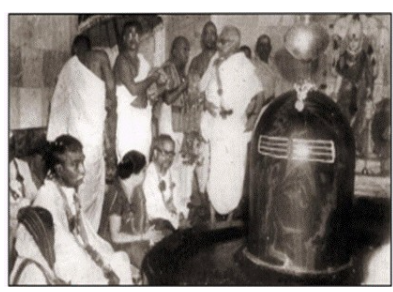
- Dr. Rajendra Prasad, who ceremonially consecrated the present temple on 11 May 1951
The present temple was constructed in the Kailash Mahameru Prasad architectural style. Its reconstruction after Independence became a symbol of India’s cultural confidence and national pride.
Somnath Swabhiman Parv
- Somnath Swabhiman Parv honours the enduring legacy of Somnath Temple.
- It connects two historic milestones:
- First recorded attack on Somnath in 1026
- Reopening of the temple in 1951
- He highlighted “Vikas Bhi, Virasat Bhi” — development along with heritage preservation.
- Special pujas have been announced at Somnath for the next 1,000 days.
January 2026 celebrations included:
- 72-hour Omkar Mantra chanting
- Sacred rituals and prayers for national welfare
- Shaurya Yatra at Prabhas Patan
- Procession of 108 horses honouring Somnath’s defenders.
Architecture and Living Heritage
Somnath is the first among the twelve Aadi Jyotirlingas of Lord Shiva. The temple complex includes the Garbhagriha, Sabha Mandap and Nritya Mandap. It rises along the Arabian Sea shoreline.
Important architectural features include:
- 150-foot Shikhar
- 10-tonne Kalash
- 27-foot Dhwajdand
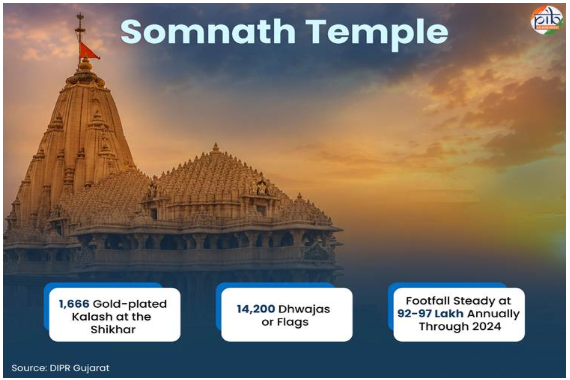
- 1,666 gold-plated Kalash
- 14,200 Dhwajas
Social and Welfare Activities of Shree Somnath Trust
The Shree Somnath Trust undertakes activities in education, skill development, food donation, healthcare, disability support, environmental protection and disaster relief.
Education and Skill Training
The Trust promotes vocational and employment-focused training for youth and women. Courses include:
- Computer education
- Tailoring
- Beauty services
- Digital literacy training
- Scholarship assistance after Class 10 and Class 12
The “School on Wheels” initiative provides mobile digital learning in villages.
Food Donation and Community Welfare
The Trust provides free meals to devotees and needy people through community-supported food assistance programmes. During emergencies, it also supports affected communities through food, medical help and essential supplies.
Health and Disability Support
The Trust supports economically weaker families near Somnath-Prabhas Patan through:
- Medical assistance
- Physiotherapy facilities
- Free dental camps
- Free eye treatment camps
- Wheelchairs, hearing aids and crutches for Persons with Disabilities
COVID-19 Relief Support
- During the COVID-19 pandemic, the Shree Somnath Trust provided relief support of ₹8.73 crore in the first wave and ₹2.21 crore in the second wave.
- It also donated ₹1 crore to the Chief Minister’s Relief Fund and supported oxygen plants and concentrators.
Women Empowerment and Sustainability
- Somnath was declared a “Swachh Iconic Place” in 2018.
- Key sustainability practices include:
- Temple flowers converted into vermicompost
- Plastic waste recycled into paver blocks under Mission LiFE
- Nearly 30 lakh litres of sewage water treated per month through rainwater harvesting systems
- A Miyawaki forest has been developed with:
- Spread over 72,000 sq. ft.
- Absorbs about 93,000 kg of CO₂ annually
- Purified Abhishek water is bottled as Somganga jal, benefiting over 1.13 lakh families as of December 2024.
- Somnath is also a centre of women’s employment:
- Total employees: 906
- Women employees: 262
- Bilva Van is managed entirely by women
- Overall, 363 women receive direct employment
- Women earn about ₹9 crore annually.
Significance
1. Cultural Continuity
Somnath represents India’s civilisational continuity because it survived repeated destruction and was rebuilt again and again.
2. Spiritual Heritage
As the first among the twelve Jyotirlingas, Somnath holds deep importance in India’s religious and cultural life.
3. National Resurgence
The reopening of the temple in 1951 reflected India’s cultural confidence after Independence.
4. Heritage and Development
The idea of “Vikas Bhi, Virasat Bhi” links heritage preservation with modern development.
5. Social Welfare
The activities of Shree Somnath Trust show how religious institutions can support education, health, food assistance and community welfare.
6. Sustainable Pilgrimage
Waste recycling, sewage treatment, plantation drives and Mission LiFE-related practices make Somnath an example of environmentally responsible pilgrimage management.
7. Women Empowerment
Women’s direct employment in trust activities shows the role of heritage institutions in promoting dignity and economic self-reliance.
Challenges
- Managing high pilgrim footfall while preserving the sanctity of the temple
- Maintaining cleanliness and sustainable waste management
- Balancing heritage conservation with tourism growth
- Protecting cultural memory for future generations
- Expanding welfare activities without weakening heritage focus
- Ensuring that women and local communities continue to benefit from temple-linked development
Way Forward
- Strengthen heritage conservation with public participation
- Promote responsible and sustainable pilgrimage tourism
- Expand skill training for youth and women
- Continue environmental initiatives such as composting, plantation and water recycling
- Improve visitor facilities while protecting the sacred character of the temple
- Use cultural programmes to connect younger generations with heritage
- Strengthen education, health and disaster-relief activities of the Trust
Conclusion
Somnath is not only a temple; it is a living symbol of India’s faith, resilience and civilisational continuity. Its repeated destruction and reconstruction reflect the strength of collective memory and cultural confidence.
The 75th anniversary of its reopening is a reminder that heritage survives not only through preservation but also through renewal, welfare, sustainability and people’s participation.
UPSC PYQ
Q. The Prime Minister recently inaugurated the new Circuit House near Somnath Temple at Veraval. Which of the following statements are correct regarding Somnath Temple? (UPSC PYQ – IAS/2022)
- Somnath Temple is one of the Jyotirlinga shrines.
- A description of Somnath Temple was given by Al-Biruni.
- Pran Pratishtha of Somnath Temple, that is, installation of the present-day temple, was done by President S. Radhakrishnan.
Select the correct answer using the code given below:
- 1 and 2 only
- 2 and 3 only
- 1 and 3 only
- 1, 2 and 3
Answer: A
Explanation:
Statement 1 is correct:
Somnath Temple is one of the twelve Jyotirlinga shrines of Lord Shiva. It is located at Prabhas Patan near Veraval in Gujarat.
Statement 2 is correct:
A description of Somnath Temple was given by Al-Biruni, the famous Persian scholar. He mentioned the temple in his work Kitab-ul-Hind.
Statement 3 is incorrect:
The Pran Pratishtha of the reconstructed Somnath Temple was performed on May 11, 1951 by Dr. Rajendra Prasad, the first President of India, not by S. Radhakrishnan.
Final Answer: A. 1 and 2 only
CARE MCQ
Veer Hamirji Gohil is associated with the defence of which one of the following temples?
- Kedarnath Temple
- Jagannath Temple
- Somnath Temple
- Brihadeeswara Temple
Answer: C
Explanation:
- Veer Hamirji Gohil is remembered in regional tradition for defending the Somnath Temple during the invasion of Zafar Khan in 1299 AD.
Additional Information:
- Somnath Temple is located in Gujarat
- It is regarded as the first Jyotirlinga of Lord Shiva
- Veer Hamirji Gohil is associated with the idea of Rajadharma
FAQs
Why is Somnath Temple in news?
Somnath Temple is in news because Somnath Swabhiman Parv is being observed to mark 1,000 years since the first recorded attack in 1026 and 75 years since the reopening of the temple in 1951.
2. Where is Somnath Temple located?
Somnath Temple is located at Prabhas Patan on the Saurashtra coast of Gujarat.
3. Why is Somnath Temple spiritually important?
Somnath is regarded as the first among the twelve Jyotirlingas of Lord Shiva. It is also associated with the worship of Lord Shiva, Lord Krishna and Shakti.
4. What is Somnath Swabhiman Parv?
Somnath Swabhiman Parv is a commemorative event that honours the legacy of Somnath Temple. It connects two historic moments: the first recorded attack in 1026 and the reopening of the temple in 1951.
5. Who rebuilt Somnath Temple after Independence?
After Independence, Sardar Vallabhbhai Patel resolved to rebuild Somnath Temple in 1947. The present temple was ceremonially consecrated by Dr. Rajendra Prasad on 11 May 1951.
6. What does Somnath represent in Indian civilisation?
Somnath represents faith, resilience and civilisational continuity. Its repeated destruction and reconstruction show India’s cultural strength and collective memory.
7. What is the meaning of “Vikas Bhi, Virasat Bhi” in this context?
It means development along with heritage preservation. In Somnath’s case, it refers to improving pilgrimage facilities, social welfare, sustainability and cultural preservation together.