Table of Contents
Relevance: TGPSC Group 1: Telangana History and Culture, Kakatiya Architecture, Heritage Conservation, Tourism and Cultural Development.
For Prelims:
Thousand Pillar Temple, Hanamkonda, Rudreshwara Temple, Kakatiya Dynasty, Rudradeva, Trikuta Aalayam, Kalyana Mandapam, Nandi, ASI, Sandbox Technology, Ulugh Khan, Raja Deen Dayal, Ramappa Temple.
For Mains:
Heritage Conservation, Kakatiya Architecture, Temple Restoration, Cultural Continuity, Conservation Ethics, Authenticity and Integrity, Living Heritage, Community Space, ASI Restoration, Telangana Heritage Tourism
Why in News?
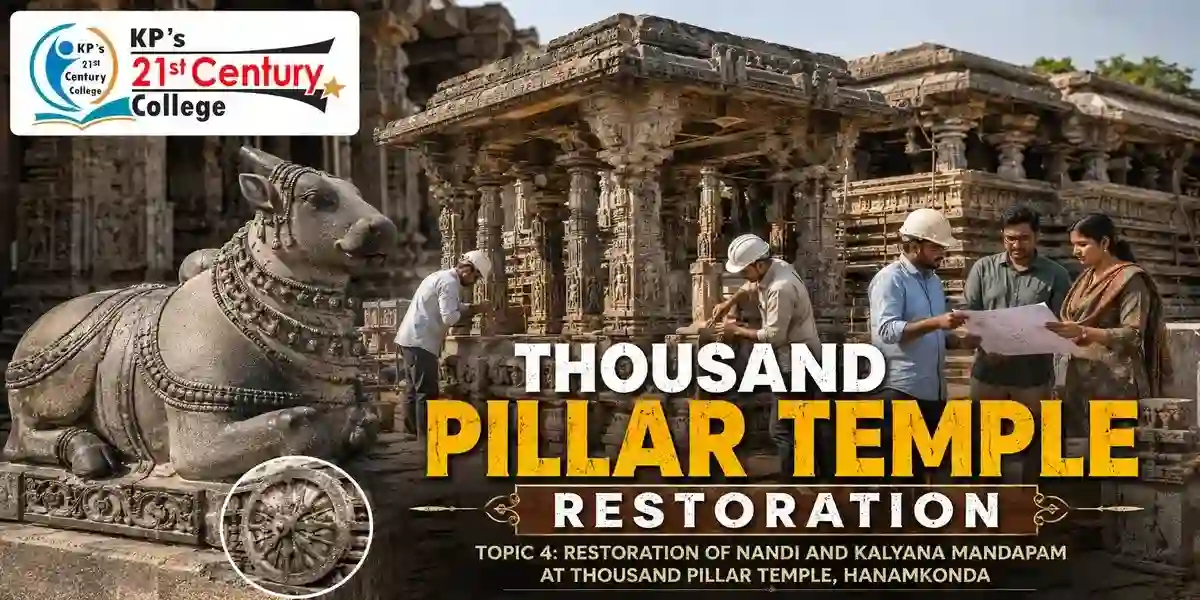
- The iconic Nandi sculpture at the entrance of the Rudreshwara Temple, popularly known as the Thousand Pillar Temple in Hanamkonda, has been reconstructed after centuries of damage.
- The Kalyana Mandapam / dance pavilion of the temple has also been rebuilt stone by stone after a long conservation effort led by the Archaeological Survey of India.
- The restoration brings renewed attention to Kakatiya-era architecture, conservation techniques and Telangana’s cultural heritage.

About Thousand Pillar Temple
- The Thousand Pillar Temple is located at Hanamkonda in Telangana.
- It is also known as the Rudreshwara Temple.
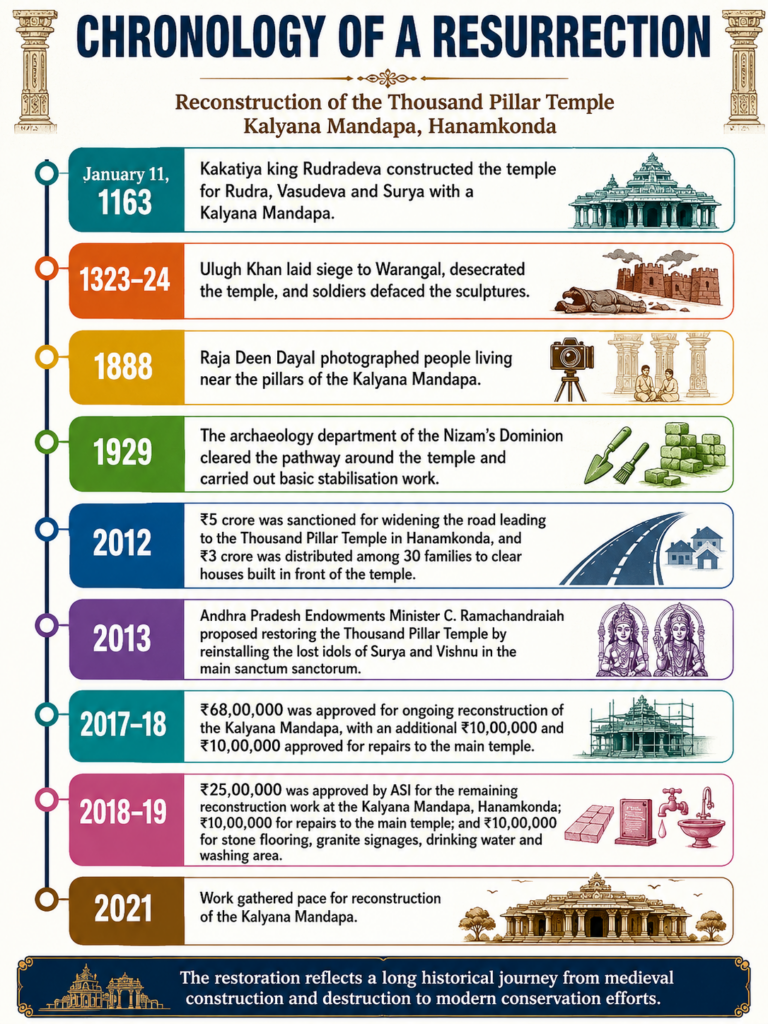
- It was built by Kakatiya ruler Rudradeva in 1163 AD.
- The temple is a Trikuta Aalayam, meaning it has three sanctum sanctorums.
- The three shrines were dedicated to:
- Rudra / Shiva
- Vasudeva / Vishnu
- Surya
- At present, regular worship is mainly offered to Shiva.
Historical Background
- The temple was damaged during the invasion of Ulugh Khan, who later became Muhammad bin Tughlaq.
- During this invasion, the Kakatiya kingdom was weakened and several temple structures were damaged.
- The sanctums of Surya and Vasudeva were left without deities.
- Several sculptures at the lower level were disfigured.
- The temple later remained in a state of neglect for a long period.
Nandi Restoration
- The massive monolithic Nandi outside the Shiva shrine had a broken leg for centuries.
- An 1888 photograph by Raja Deen Dayal also shows the Nandi with a broken leg.
- Initially, a gypsum model of the leg was created.
- The plan was to replace it with a black granite leg matching the original form.
- The leg was recreated by studying Nandi sculptures from other Kakatiya-era temples.
- The restoration required correct proportions, clean lines and careful matching with the original sculpture.
Kalyana Mandapam Reconstruction
- The temple’s Kalyana Mandapam / dance pavilion had sunk into the ground over time.
- The restoration was carried out by dismantling and rebuilding the structure piece by piece.
- More than 4,000 stone pieces were carefully removed during the dismantling process.
- The conservation effort began as a research project on Kakatiya monuments and later developed into a major ASI restoration work.
- The restored pavilion brings back an important part of the temple’s original grandeur.
Kakatiya Sandbox Technology
- The Kalyana Mandapam was not built on a conventional foundation.
- It used sandbox technology, an important Kakatiya engineering method.
- In this method, a sand pit was used to stabilise the heavy stone structure.
- During restoration, the foundation was strengthened by:
- Digging a deep sandbox
- Using granular piles of sand and gravel
- Consolidating the base with heavy vibratory rollers
- Injecting liquid lime mortar
- Replacing rusted iron dowels with stainless steel dowels
- This shows the advanced engineering knowledge of medieval Kakatiya builders.
Architectural Features
- The temple is famous for its black granite and dolerite pillars.
- It contains smooth, richly carved pillars and perforated screens.
- Sculptures include dance forms, animals and divine figures.
- The Nandi is a major artistic and spiritual centrepiece of the temple.
- The temple has both:
- Ranga Mandapam for sacred performances
- Kalyana Mandapam for ceremonial occasions
- The structure reflects the skill of Kakatiya craftsmen in stone carving, symmetry and modular architecture.
UNESCO Heritage
- In 2014, India submitted The Glorious Kakatiya Temples and Gateways as a serial nomination for UNESCO World Heritage status.
- The Thousand Pillar Temple was initially part of this wider Kakatiya heritage context.
- Later, it was not included in the final nomination due to issues related to authenticity and integrity.
- The modified dossier with Ramappa Temple alone received the UNESCO World Heritage Site tag in 2021.
- The restoration of the Thousand Pillar Temple is therefore important for strengthening the conservation value of Kakatiya heritage.
Cultural and Social Importance
- The temple is not only an architectural monument but also a living cultural space.
- In earlier times, temple mandapams acted as centres of community life.
- Cultural performances, religious events and social gatherings were held in temple spaces.
- After the formation of Telangana, the temple stepwell became a centre for Bathukamma celebrations in the district.
- The temple continues to remain a site of devotion, tourism and local memory.
Significance
- Revives an important monument of Kakatiya architecture.
- Highlights Telangana’s rich temple-building tradition.
- Shows the importance of scientific conservation by the ASI.
- Restores the damaged Nandi sculpture and Kalyana Mandapam.
- Demonstrates the engineering value of sandbox technology.
- Strengthens cultural tourism in Hanamkonda and Warangal region.
- Helps reconnect people with local history and heritage.
- Supports the idea of preserving both monuments and living cultural traditions.
Challenges
- Restoring damaged stone sculptures requires high craftsmanship.
- Matching the new stone with the old sculpture is technically difficult.
- The original structure had suffered from centuries of damage and neglect.
- Several pillars and beams were broken or missing.
- Conservation work must balance restoration with historical authenticity.
- Public expectations are high because the temple is a living place of worship.
- Past issues of encroachment and poor site management affected the monument’s integrity.
Way Forward
- Continue restoration using scientific conservation principles.
- Preserve authenticity while repairing damaged parts.
- Use trained traditional craftsmen for stone carving and reconstruction.
- Improve visitor management around the restored areas.
- Provide proper signage explaining Kakatiya architecture and sandbox technology.
- Protect the temple from encroachments and vandalism.
- Promote heritage education among students and local communities.
- Integrate the temple with Telangana’s heritage tourism circuit.
Conclusion
The restoration of the Nandi and Kalyana Mandapam at Hanamkonda’s Thousand Pillar Temple is a major step in conserving Kakatiya heritage. The temple reflects the artistic skill, engineering knowledge and cultural vision of medieval Telangana.
Its revival is not merely a repair of stone structures. It is also a recovery of historical memory, cultural pride and community identity. Scientific conservation, public participation and responsible tourism can help preserve this monument for future generations.
CARE MCQ
Q. With reference to the Thousand Pillar Temple at Hanamkonda, consider the following statements:
- The temple belongs to the Kakatiya period.
- The temple complex is dedicated to Shiva, Surya and Vishnu.
- The temple’s dance pavilion was damaged during the southern campaign of Ulugh Khan.
Which of the statements given above are correct?
A. 1 and 2 only
B. 2 and 3 only
C. 1 and 3 only
D. 1, 2 and 3
Answer: D
Explanation:
- Statement 1 is correct:
The Thousand Pillar Temple at Hanamkonda is an important monument of the Kakatiya dynasty. - Statement 2 is correct:
The temple complex is dedicated to the trinity of Shiva, Surya and Vishnu. - Statement 3 is correct:
The temple’s dance pavilion was damaged during the southern invasion of Ulugh Khan in 1323–24.
Therefore, all the statements are correct.
Additional Information:
- The temple is located in present-day Hanamkonda, Telangana.
- The Archaeological Survey of India (ASI) undertook a long-term restoration of the temple complex.
- The temple is famous for:
- intricate Kakatiya-style carvings
- monolithic Nandi sculpture
- star-shaped architecture
- finely carved dance pavilion.
FAQs
Q. Where is the Thousand Pillar Temple located?
The Thousand Pillar Temple is located at Hanamkonda in Telangana.
Q. Who built the Thousand Pillar Temple?
It was built by Kakatiya ruler Rudradeva in 1163 AD.
Q. What is Trikuta Aalayam?
Trikuta Aalayam means a temple with three sanctum sanctorums.
Q. Which deities were associated with the temple?
The temple was associated with Shiva, Vishnu and Surya.
Q. What is being restored at the temple?
The Nandi sculpture and the Kalyana Mandapam / dance pavilion have been restored.