Table of Contents
Relevance: UPSC GS Paper II: Indian Polity – Constitution, Parliament, Judiciary, Election Commission of India, Constitutional Bodies, Separation of Powers, Judicial Review, Electoral Reforms
For Prelims:
- Article 324(2), Election Commission of India, Chief Election Commissioner, Election Commissioners, Anoop Baranwal vs Union of India, 2023, Chief Election Commissioner and Other Election Commissioners Act, 2023, Association for Democratic Reforms
For Mains:
- Independence of Election Commission, Executive dominance, Free and fair elections, Judicial intervention, Parliamentary delay, Institutional autonomy, Democratic accountability
Why in News?
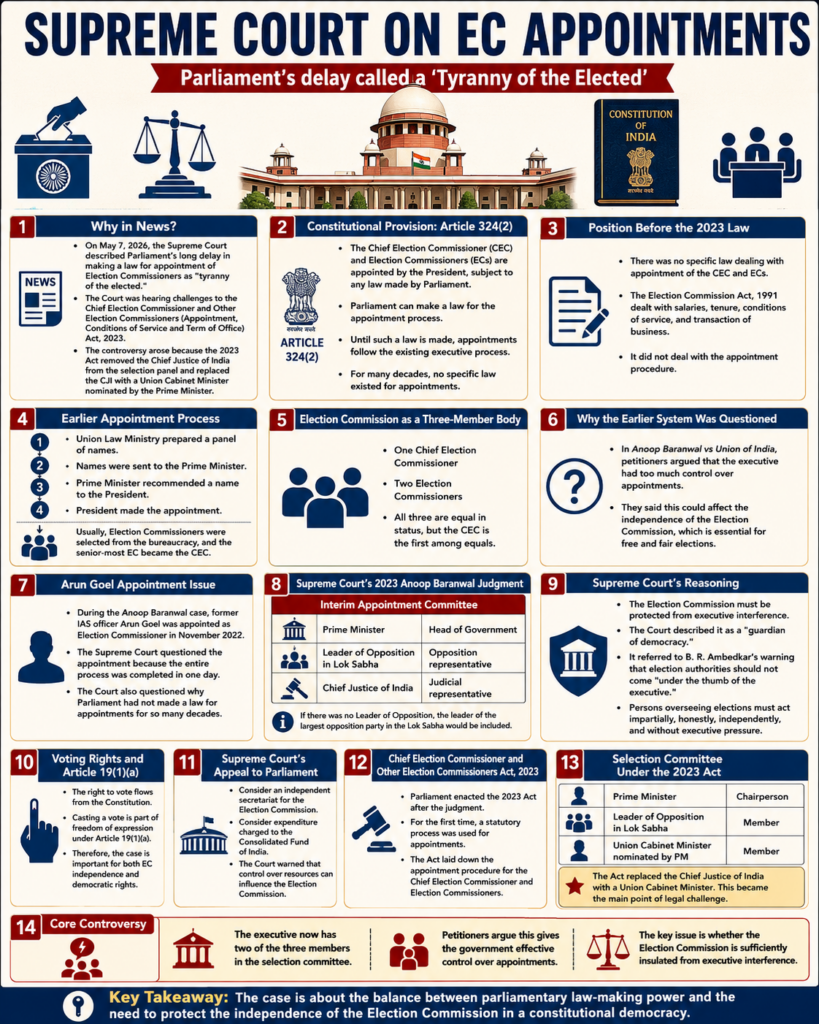
The Supreme Court, on May 7, 2026, described Parliament’s long delay in making a law for appointment of Election Commissioners as “tyranny of the elected.”
The Court was hearing challenges to the Chief Election Commissioner and Other Election Commissioners (Appointment, Conditions of Service and Term of Office) Act, 2023.
The controversy arose because the 2023 Act removed the Chief Justice of India from the selection panel and replaced the CJI with a Union Cabinet Minister nominated by the Prime Minister.
Constitutional Provision: Article 324(2)
Article 324(2) provides that the Chief Election Commissioner and Election Commissioners shall be appointed by the President, subject to any law made by Parliament.
This means:
- Parliament can make a law for the appointment process.
- Until such a law is made, appointments follow the existing executive process.
- For many decades, no specific law existed for appointments.
Position Before the 2023 Law
Before the 2023 Act, there was no law specifically dealing with appointment of the CEC and ECs.
The Election Commission Act, 1991 dealt with:
- Salaries
- Tenure
- Conditions of service
- Transaction of business
But it did not deal with the appointment procedure.
Earlier Appointment Process
Earlier, the process was largely controlled by the executive:
- The Union Law Ministry prepared a panel of names.
- The names were sent to the Prime Minister.
- The Prime Minister recommended a name to the President.
- The President made the appointment.
Usually, Election Commissioners were selected from the bureaucracy, and the senior-most Election Commissioner became the Chief Election Commissioner.
Election Commission as a Three-Member Body
The Election Commission consists of:
- One Chief Election Commissioner
- Two Election Commissioners
All three are equal in status, but the CEC is considered first among equals.
Why the Earlier System Was Questioned
In Anoop Baranwal vs Union of India, petitioners argued that the executive had too much control over Election Commission appointments.
They said this could affect the independence of the Election Commission, which is essential for free and fair elections.
Arun Goel Appointment Issue
- During the Anoop Baranwal case, former IAS officer Arun Goel was appointed as Election Commissioner in November 2022.
- The Supreme Court questioned the appointment because the entire process was completed in one day.
- The Court also questioned why Parliament had not made a law for appointments for so many decades.
Supreme Court’s 2023 Anoop Baranwal Judgment
In March 2023, the Supreme Court laid down an interim appointment process until Parliament made a law.
The Court said appointments should be made on the advice of a committee consisting of:
| Member | Role |
| Prime Minister | Head of Government |
| Leader of Opposition in Lok Sabha | Opposition representative |
| Chief Justice of India | Judicial representative |
If there was no Leader of Opposition, the leader of the largest opposition party in the Lok Sabha would be included.
Supreme Court’s Reasoning
The Court said that the Election Commission must be protected from executive interference.
It described the Election Commission as a “guardian of democracy.”
The Court also referred to B. R. Ambedkar’s warning that election authorities should not come “under the thumb of the executive.”
Persons overseeing elections must act:
- Impartially
- Honestly
- Independently
- Without executive pressure
Voting Rights and Article 19(1)(a)
The Court also held that:
- The right to vote flows from the Constitution.
- Casting a vote is part of freedom of expression under Article 19(1)(a).
Thus, the case was important for both Election Commission independence and democratic rights.
Supreme Court’s Appeal to Parliament
The Court asked Parliament to strengthen the Election Commission by considering:
- An independent secretariat
- Expenditure charged to the Consolidated Fund of India
The Court warned that the executive could influence the Election Commission by controlling its resources.
Chief Election Commissioner and Other Election Commissioners Act, 2023
After the judgment, Parliament enacted the Chief Election Commissioner and Other Election Commissioners Act, 2023.
The Act laid down the appointment procedure for:
- Chief Election Commissioner
- Election Commissioners
For the first time, a statutory process was used for appointments.
Selection Committee Under the 2023 Act
The Selection Committee consists of:
| Member | Position |
| Prime Minister | Chairperson |
| Leader of Opposition in Lok Sabha | Member |
| Union Cabinet Minister nominated by PM | Member |
The Act replaced the Chief Justice of India with a Union Cabinet Minister.
This became the main point of legal challenge.
Why the 2023 Act Became Controversial
The Act gives the executive a strong position in the committee.
Out of three members:
- Prime Minister belongs to the executive.
- Cabinet Minister also belongs to the executive.
- Leader of Opposition is the only non-government member.
Petitioners argue that this gives the government effective control over appointments.
Search Committee Under the 2023 Act
The Act also creates a Search Committee.
It is headed by the Law Minister and includes two senior bureaucrats.
Its function is to prepare a shortlist of five candidates for the Selection Committee.
Power to Go Beyond Shortlist
Under Section 8, the Selection Committee can consider names beyond the shortlisted candidates.
This gives the Selection Committee wide discretion.
Eligibility Conditions
The CEC and ECs must be persons who:
- Hold or have held a post equivalent to Secretary to the Government of India
- Are persons of integrity
- Have knowledge and experience in management and conduct of elections
Tenure and Reappointment
The Act provides that:
- CEC and ECs are not eligible for reappointment.
- If an EC becomes CEC, the total term as EC and CEC cannot exceed six years.
Section 7(2)
Section 7(2) says an appointment shall not become invalid merely due to:
- Vacancy in the Selection Committee
- Defect in constitution of the Selection Committee
Legal Challenge
In 2024, petitioners including Association for Democratic Reforms challenged the 2023 Act.
Their main argument is that the law restores executive dominance and goes against the principle of insulating the Election Commission from executive interference.
Key Constitutional Question
The main question is:
Can Parliament override or modify a Constitution Bench judgment through legislation or ordinance?
This question arose because the Supreme Court had included the CJI in the interim panel, but the 2023 law replaced the CJI with a Cabinet Minister.
Appointment of Gyanesh Kumar as CEC
In February 2025, the Selection Committee met to appoint the new CEC.
The committee consisted of:
| Member | Position |
| Narendra Modi | Prime Minister |
| Rahul Gandhi | Leader of Opposition |
| Amit Shah | Home Minister and nominated Cabinet Minister |
Former IAS officer Gyanesh Kumar was appointed as the Chief Election Commissioner.
He succeeded Rajiv Kumar, who retired on February 18, 2025.
Gyanesh Kumar’s appointment took effect from February 19, 2025.
Appointment of Vivek Joshi
Along with Gyanesh Kumar’s appointment as CEC, Vivek Joshi, an IAS officer of the 1989 batch, was appointed as an Election Commissioner.
Seniority Issue
- Under the earlier convention, the senior-most EC usually became CEC.
- Gyanesh Kumar and Sukhbir Singh Sandhu were appointed as ECs on the same day, March 14, 2024.
- Gyanesh Kumar was treated as senior because his name appeared first in the appointment notification.
- Thus, under the old convention also, he would likely have become CEC.
Why the Appointment Did Not Settle the Issue
The legal challenge to the 2023 Act is still pending.
The Supreme Court had said that the consequences of its final decision would apply even if appointments were made in the meantime.
Supreme Court’s Recent Observations
Justice Dipankar Datta observed that the Anoop Baranwal judgment was only meant to “fill the vacuum till the law is made.”
He also said that the judgment did not say Parliament must make the law in a particular manner.
However, the Court questioned why Parliament had not made such a law earlier.
Meaning of “Tyranny of the Elected”
Prashant Bhushan argued that governments avoided creating an independent appointment process because they wanted to retain control once in power.
Justice Datta responded that this could be called “tyranny of the elected.”
It means elected governments may misuse or neglect their power when they fail to protect constitutional institutions.
Parliamentary Debate Issue
The Supreme Court also asked whether Parliament properly debated the spirit of the Anoop Baranwal judgment.
Senior Advocate Shadan Farasat said there was no proper debate.
Prashant Bhushan said there was virtually no debate because many MPs were suspended.
Significance
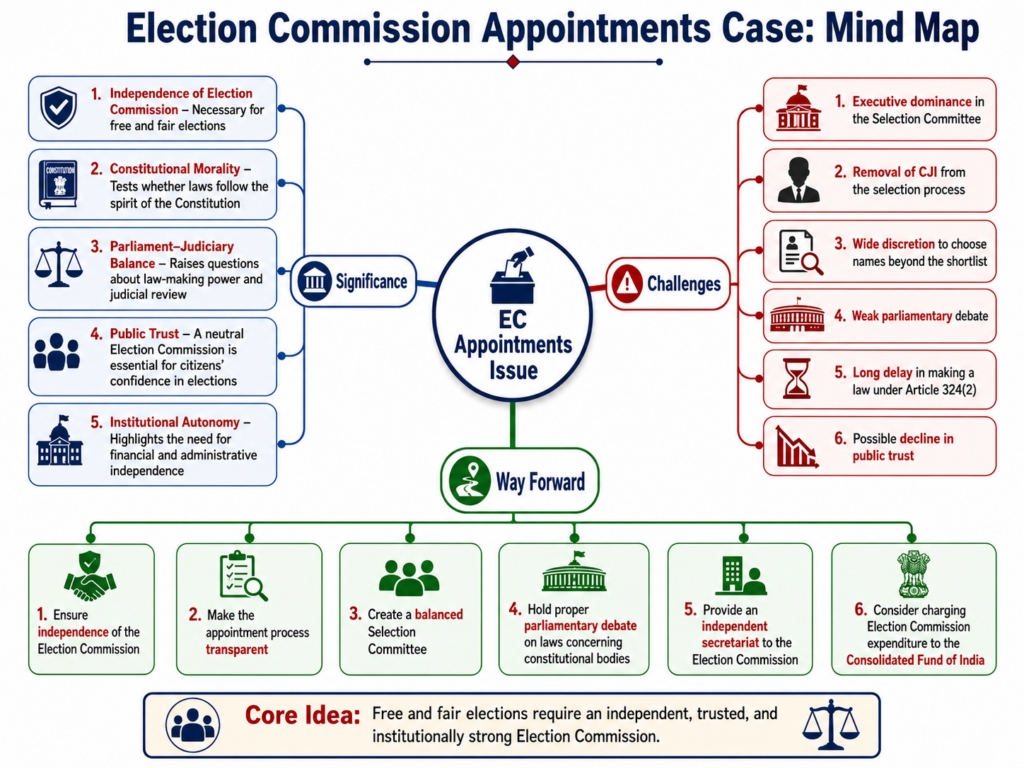
1. Independence of Election Commission
The Election Commission must be independent to conduct free and fair elections.
2. Constitutional Morality
The issue tests whether laws follow the spirit of the Constitution.
3. Parliament-Judiciary Balance
The case raises questions about Parliament’s law-making power and judicial review.
4. Public Trust
A neutral Election Commission is necessary to maintain citizens’ confidence in elections.
5. Institutional Autonomy
The issue highlights the need for financial and administrative independence of the Election Commission.
Challenges
- Executive dominance in the Selection Committee
- Removal of CJI from the selection process
- Wide discretion to choose names beyond the shortlist
- Weak parliamentary debate
- Long delay in making a law under Article 324(2)
- Possible decline in public trust
Way Forward
- Ensure independence of the Election Commission
- Make the appointment process transparent
- Create a balanced Selection Committee
- Hold proper parliamentary debate on laws concerning constitutional bodies
- Provide an independent secretariat to the Election Commission
- Consider charging Election Commission expenditure to the Consolidated Fund of India
Conclusion
The controversy over Election Commission appointments is about the independence of a key constitutional body.
The Supreme Court’s phrase “tyranny of the elected” shows that elected governments must respect constitutional values.
The Election Commission is the guardian of electoral democracy. Its appointment process must be transparent, balanced and independent to protect free and fair elections.
UPSC PYQ
Q. As per Article 324 of the Constitution of India, the Chief Election Commissioner shall not be removed from his office except in like manner and on the like grounds as: NDA-I/2026
A. a Judge of the Supreme Court
B. a Judge of a High Court
C. the Speaker of the Lok Sabha
D. the Governor of a State
Answer: A
Explanation:
Article 324(5) of the Constitution gives security of tenure to the Chief Election Commissioner (CEC).
It states that the Chief Election Commissioner cannot be removed from office except in the same manner and on the same grounds as a Judge of the Supreme Court.
This means:
- The CEC can be removed only by the President of India.
- Such removal must be based on a resolution passed by both Houses of Parliament.
- The resolution must be passed by a special majority.
- The grounds of removal are proved misbehaviour or incapacity.
Therefore, the correct answer is A. a Judge of the Supreme Court.
Additional Information:
Other Election Commissioners do not have the same direct removal protection as the CEC. They can be removed only on the recommendation of the Chief Election Commissioner. This provision helps protect the independence of the Election Commission of India.
CARE MCQ
Q. With reference to the Supreme Court’s judgment in Anoop Baranwal vs Union of India, consider the following statements:
- The Court included the Chief Justice of India in the interim selection committee.
- The Court described the Election Commission as a guardian of democracy.
- The Court held that the right to vote has no connection with freedom of expression.
Which of the above statements are correct?
A. 1 and 2 only
B. 2 and 3 only
C. 1 and 3 only
D. 1, 2 and 3
Answer: A
Explanation:
- Statement 1 is correct: The interim committee included the Prime Minister, Leader of Opposition and Chief Justice of India.
- Statement 2 is correct: The Court described the Election Commission as a guardian of democracy.
- Statement 3 is incorrect: The Court held that casting a vote is part of freedom of expression under Article 19(1)(a).
Q. With reference to the Chief Election Commissioner and Other Election Commissioners Act, 2023, consider the following statements:
- The Selection Committee includes the Prime Minister, Leader of Opposition and a Union Cabinet Minister nominated by the Prime Minister.
- The Search Committee is headed by the Chief Justice of India.
- The Selection Committee can consider names beyond the shortlist prepared by the Search Committee.
Which of the above statements are correct?
A. 1 and 2 only
B. 1 and 3 only
C. 2 and 3 only
D. 1, 2 and 3
Answer: B
Explanation:
- Statement 1 is correct: The 2023 Act provides for a Selection Committee with the Prime Minister, Leader of Opposition and a Union Cabinet Minister nominated by the PM.
- Statement 2 is incorrect: The Search Committee is headed by the Law Minister, not the Chief Justice of India.
- Statement 3 is correct: The Selection Committee can consider persons outside the shortlist.
Additional Information:
This provision gives wide discretion to the Selection Committee.
FAQs
1. What is the main issue in the Election Commission appointment case?
The main issue is whether the 2023 law gives excessive control to the executive in appointing the Chief Election Commissioner and Election Commissioners.
2. What did the Supreme Court decide in Anoop Baranwal case?
The Supreme Court laid down an interim process where the Prime Minister, Leader of Opposition and Chief Justice of India would advise the President on appointments until Parliament made a law.
3. Why is the 2023 Act challenged?
It is challenged because it removed the Chief Justice of India from the Selection Committee and replaced the CJI with a Union Cabinet Minister nominated by the Prime Minister.
4. What does “tyranny of the elected” mean in this context?
It refers to the failure or misuse of power by elected representatives when they delay or frame laws in a way that may weaken constitutional institutions.
5. Who is the current Chief Election Commissioner mentioned in the article?
The article mentions Gyanesh Kumar, who was appointed Chief Election Commissioner with effect from February 19, 2025.