Relevance: APPSC: Group 1 &2 Prelims, Group 1 Mains Paper III – Governance and Social Justice;
For Prelims:
- Mee Intiki – Mee Doctor, World Red Cross Day, World Thalassemia Day, Indian Red Cross Society, Jean Henry Dunant, Nobel Peace Prize 1901, Primary Healthcare, Doorstep Healthcare, Thalassemia Screening, Lok Bhavan
For Mains:
- Health Equity, Last-mile Delivery, Primary Healthcare Access, Vulnerable Sections, Public Health Governance, Preventive Healthcare, Humanitarian Service, Rural Healthcare Delivery
Why in News?
Andhra Pradesh Governor S. Abdul Nazeer launched the ‘Mee Intiki – Mee Doctor’ project at Lok Bhavan, Vijayawada, during the programme organised on World Red Cross Day and World Thalassemia Day.
The project aims to provide primary healthcare services at the doorstep to poor families living in inaccessible areas.
Key Highlights
- The project aims to extend medical aid to 5 lakh poor families.
- It will cover inaccessible areas in seven districts.
- The project will be implemented over a period of three years.
- Medical teams will provide healthcare services at the doorsteps of beneficiaries.
- Special focus will be given to:
- Pregnant women
- Children aged 0–6 years
- Bedridden persons who cannot visit nearby health centres
- The project was launched on World Red Cross Day and World Thalassemia Day.
- The event was held at Lok Bhavan, Vijayawada.
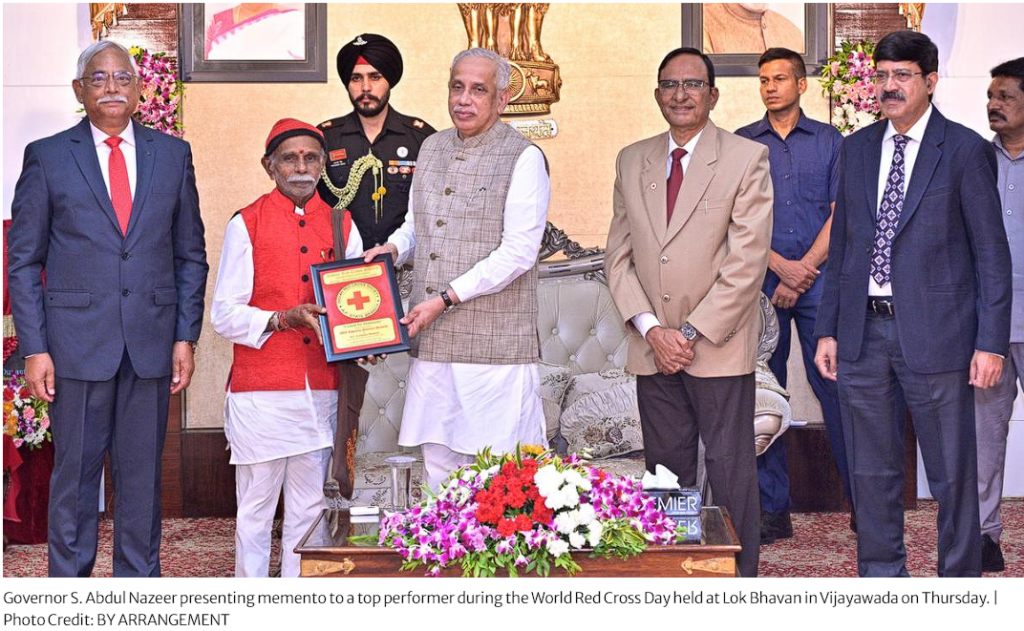
- Governor S. Abdul Nazeer also presented mementos and awards to top performers and Red Cross award winners.
About ‘Mee Intiki – Mee Doctor’ Project
‘Mee Intiki – Mee Doctor’ means “Your Doctor at Your Home.”
It is a doorstep healthcare initiative aimed at improving access to primary healthcare for poor and vulnerable families. The project is especially important for people living in remote and inaccessible areas who face difficulty in reaching nearby health centres.
The initiative follows the idea of last-mile health service delivery, where healthcare is taken directly to the people instead of expecting vulnerable groups to travel long distances.
World Red Cross Day (08 May 2026)
World Thalassemia Day (08 May 2026)World Thalassemia Day is also observed on the same day. It focuses on spreading awareness about thalassemia, a genetic blood disorder. The Governor urged the need to focus on:
|

Red Cross Awards and Event Details
Governor S. Abdul Nazeer, who is also the honourable president of the Indian Red Cross Society, Andhra Pradesh State Branch, congratulated the District Collectors and presidents of Red Cross district branches for their service.
Districts recognised with Red Cross Awards
- SPSR Nellore
- West Godavari
- Bapatla
- Krishna
- Kakinada
The awards were given in recognition of their contributions to the Red Cross movement in Andhra Pradesh during the last two years.
Officials and Participants
The programme was attended by:
- Y.D. Rama Rao – Chairman, Indian Red Cross Society, Andhra Pradesh State Branch
- Ashwini Kumar Parida – General Secretary and CEO
- G. Anantha Ramu – Special Chief Secretary to Governor
- Chairpersons of district branches
- State branch managing committee members
- Other dignitaries
Significance
1. Health Equity
- The project helps poor families in inaccessible areas receive basic healthcare services at home. It reduces the gap between rural and urban healthcare access.
2. Support to Vulnerable Groups
- Pregnant women, children aged 0–6 years, and bedridden persons need regular health support. Doorstep services directly benefit these groups.
3. Strengthening Primary Healthcare
- The project promotes early diagnosis, basic treatment and preventive healthcare. This can reduce the burden on hospitals.
4. Maternal and Child Health
- Focus on pregnant women and young children can improve maternal care, child health, nutrition monitoring and early disease detection.
5. Humanitarian Governance
- The initiative reflects the role of humanitarian institutions like the Indian Red Cross Society in supporting public welfare.
6. Disaster and Emergency Preparedness
- The Red Cross movement is important during emergencies and disasters. Such health outreach projects strengthen local humanitarian capacity.
7. Awareness on Genetic Disorders
- The link with World Thalassemia Day helps promote early screening and public awareness about inherited blood disorders.
Challenges
- Shortage of doctors and trained medical staff in remote areas
- Difficulty in regularly reaching inaccessible habitations
- Need for medicines, diagnostic tools and transport facilities
- Ensuring follow-up care for serious patients
- Maintaining proper health records of beneficiaries
- Coordination between Red Cross branches, health departments and local bodies
- Creating awareness among poor families about available services
- Ensuring long-term funding and monitoring over the three-year period
Government Initiatives / Policy Support
- Ayushman Bharat – Health and Wellness Centres for strengthening primary healthcare
- National Health Mission for rural and urban health services
- Janani Suraksha Yojana for maternal healthcare support
- Rashtriya Bal Swasthya Karyakram for child health screening
- POSHAN Abhiyaan for nutrition support to women and children
- State-level health outreach and mobile medical services
- Role of the Indian Red Cross Society in humanitarian support and health-related outreach
Way Forward
- Ensure regular medical visits to remote and inaccessible areas
- Use mobile health units for doorstep healthcare delivery
- Maintain digital health records of all beneficiaries
- Strengthen referral links with nearby PHCs and hospitals
- Train local volunteers for basic health awareness and support
- Conduct regular screening for thalassemia, anaemia and maternal health issues
- Provide special care for pregnant women, young children and bedridden persons
- Monitor the project through district-level review mechanisms
Conclusion
The ‘Mee Intiki – Mee Doctor’ project is an important step towards doorstep healthcare, health equity and last-mile service delivery. By targeting 5 lakh poor families in inaccessible areas across seven districts, the initiative can improve access to primary healthcare for vulnerable groups.
CARE MCQ
Q. With reference to the ‘Mee Intiki – Mee Doctor’ project, consider the following statements:
- It aims to provide primary healthcare services at the doorstep.
- It targets 5 lakh poor families in inaccessible areas.
- It will be implemented for a period of three years.
How many of the above statements are correct?
(a) Only one
(b) Only two
(c) All the three
(d) None
Answer: (c)
Explanation:
- Statement 1 is correct: The project aims to provide doorstep primary healthcare services.
- Statement 2 is correct: It targets 5 lakh poor families in inaccessible areas.
- Statement 3 is correct: It will be implemented over three years.
Additional Information: The project gives special focus to pregnant women, children aged 0–6 years, and bedridden persons.
FAQs
1. What is ‘Mee Intiki – Mee Doctor’?
It is a doorstep primary healthcare project in Andhra Pradesh.
2. Who launched the project?
It was launched by Governor S. Abdul Nazeer.
3. How many families will benefit?
It aims to help 5 lakh poor families.
4. What is World Red Cross Day?
It is observed to honour the humanitarian work of the Red Cross and Red Crescent Movement.
5. Whose birth anniversary is observed as World Red Cross Day?
It marks the birth anniversary of Jean Henry Dunant, founder of the Red Cross Movement.
6. What is World Thalassemia Day?
It is observed to raise awareness about thalassemia, a genetic blood disorder.
Relevance: GS Paper I – Geography – Physical Geography; GS Paper III – Environment, Climate Change, Agriculture and Disaster Management
For Prelims:
- Western Disturbance, El Niño, La Niña, ENSO, Heat Wave, Severe Heat Wave, Wet Bulb Temperature, Feels Like Temperature, Heat Index, IMD
For Mains:
- Climate Variability, Extreme Weather Events, Monsoon Uncertainty, Heat Stress, Public Health Risk, Agricultural Vulnerability, Urban Heat Island, Climate Adaptation
Why in News?
- Lebanon accused Israel of committing “ecocide” during the 2023–24 conflict by allegedly causing massive environmental destruction.
- Iran also alleged ecocide after Israeli strikes on fuel depots reportedly caused toxic “black rain” and severe pollution.
- Several countries and environmental organizations are now demanding formal recognition of ecocide as an international crime under the Rome Statute.
- The Council of Europe adopted a convention in 2025 criminalizing severe environmental destruction.
Why in News?
India is entering a summer marked by multiple climate risks such as unseasonal rainfall, heatwaves, humidity-related heat stress and possible monsoon uncertainty. The India Meteorological Department forecast a fresh Western Disturbance over North India between May 11 and May 13, while global climate agencies have indicated rising chances of El Niño conditions in 2026.
Key Climate Terms Explained
1. Western Disturbance
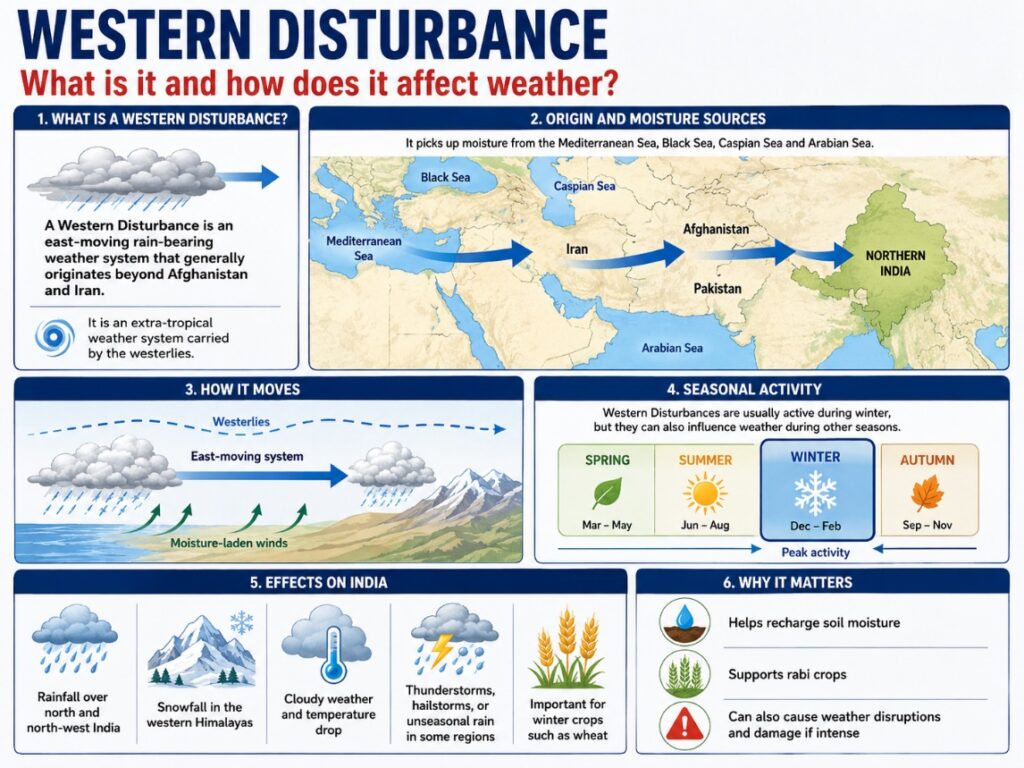
A Western Disturbance is an east-moving rain-bearing weather system that generally originates beyond Afghanistan and Iran. It picks up moisture from regions such as the Mediterranean Sea, Black Sea, Caspian Sea and Arabian Sea. These systems are usually active during winter but can also influence weather during other seasons.
Impact on India
- Brings rainfall to North and Northwest India
- Causes snowfall in the Himalayan region
- Helps winter crops such as wheat
- May also cause unseasonal rain, hailstorms and crop damage
2. ENSO
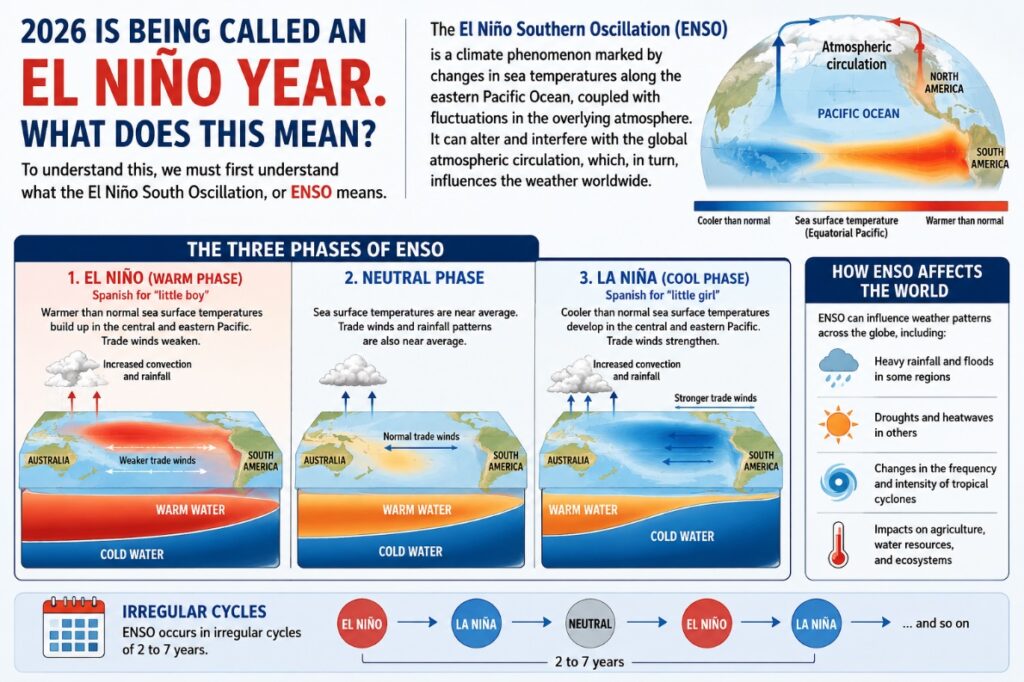
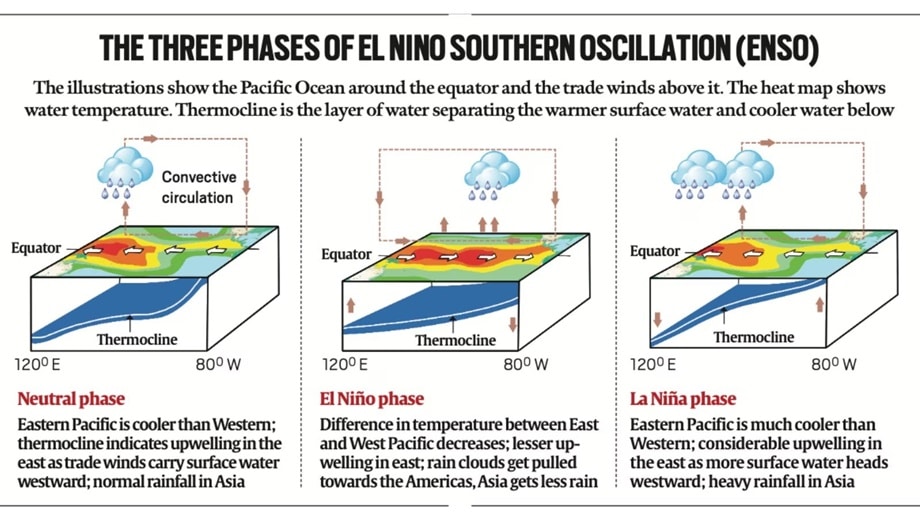
ENSO stands for El Niño Southern Oscillation. It is a climate phenomenon linked with changes in sea surface temperature and atmospheric conditions over the tropical Pacific Ocean. It has three phases: El Niño, La Niña and Neutral.
3. El Nino
El Nino is the warm phase of ENSO. It occurs when the surface waters of the central and eastern Pacific Ocean become unusually warm.
Impact on India
- May weaken the southwest monsoon
- Can increase dry spells in agricultural regions
- May intensify heatwaves
- Can affect food production and water availability
The US Climate Prediction Center stated in April 2026 that ENSO-neutral conditions were present, but El Niño was likely to emerge during May–July 2026 with a 61% chance and persist at least till the end of 2026.
4. La Nina
La Nina is the cool phase of ENSO. It occurs when the eastern Pacific Ocean becomes cooler than normal.
Impact on India
- Usually supports a stronger southwest monsoon
- Can increase rainfall in many regions
- In extreme cases, may cause floods and crop damage
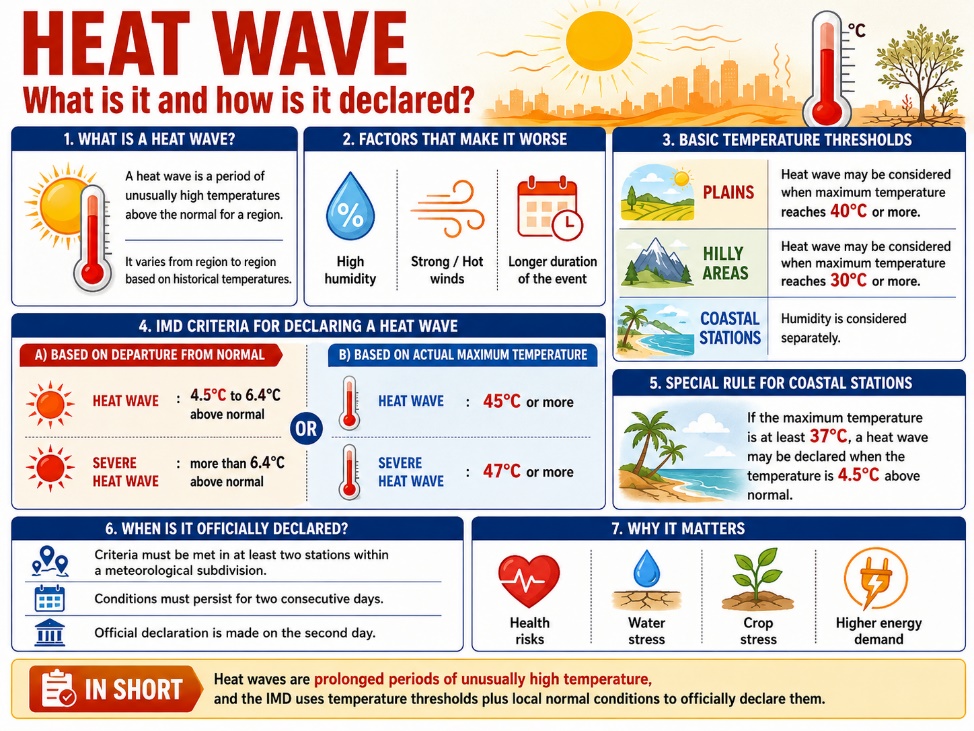
5. Heat Wave
A heat wave is a period of abnormally high temperature compared to the normal temperature of a region.
As per IMD criteria, a heat wave is considered when the maximum temperature reaches at least 40°C in plains and 30°C in hilly regions. A heat wave is declared when the departure from normal is 4.5°C to 6.4°C, while a severe heat wave is declared when the departure is more than 6.4°C. A heat wave is also declared when actual maximum temperature reaches 45°C, and a severe heat wave when it reaches 47°C.
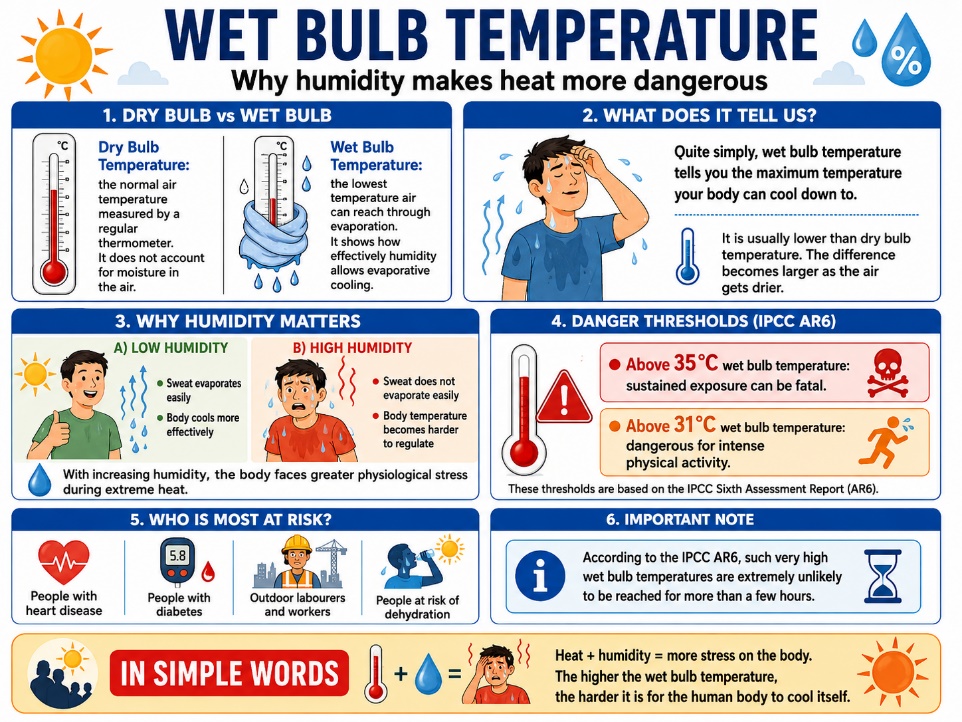
6. Wet Bulb Temperature
Wet Bulb Temperature measures the lowest temperature to which air can be cooled by evaporation. It shows how effectively the human body can cool itself through sweating.
When humidity is high, sweat does not evaporate easily. This increases heat stress on the body. Sustained exposure to wet bulb temperatures above 35°C can be fatal, while high wet bulb temperatures are dangerous for intense physical activity.
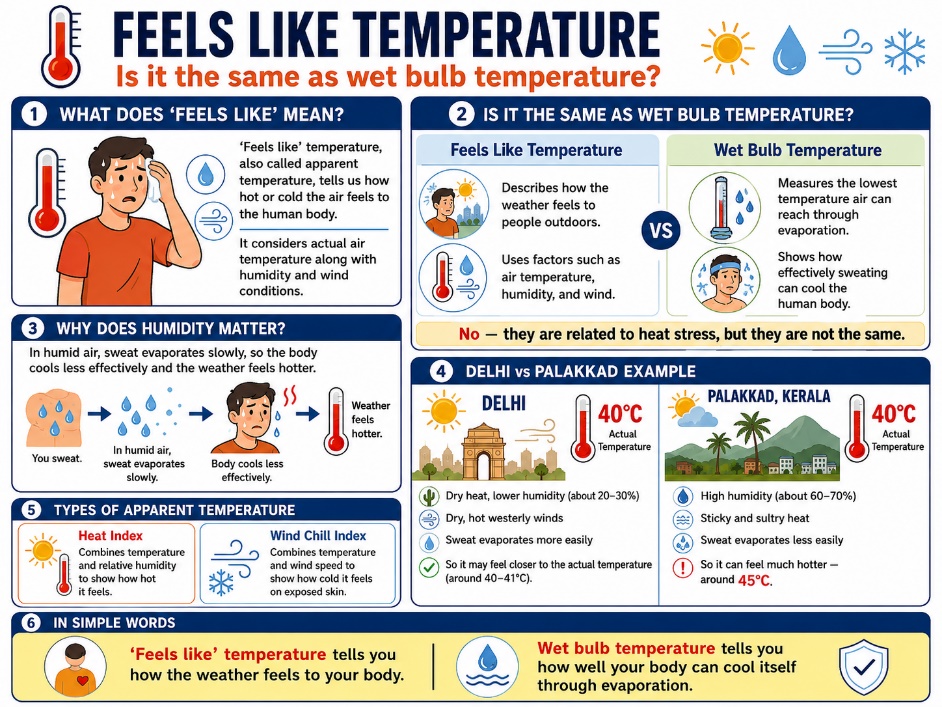
7. “Feels Like” Temperature
Feels like temperature is also called apparent temperature. It shows how hot or cold the weather feels to the human body after considering:
- Actual temperature
- Humidity
- Wind speed
For example, 40°C in Delhi and 40°C in Kerala may not feel the same. A humid place may feel hotter because sweat does not evaporate easily.
Significance

1. Agriculture
Climate phenomena like El Niño and Western Disturbances directly affect rainfall, soil moisture and crop productivity. A weak monsoon can affect crops such as paddy, pulses, cotton and oilseeds.
2. Public Health
Heatwaves and high humidity increase the risk of heat exhaustion, dehydration and heatstroke. Labourers, elderly people, children and people with existing diseases are more vulnerable.
3. Water Security
Weak monsoon or prolonged heat can reduce reservoir levels, groundwater recharge and drinking water availability.
4. Disaster Management
Extreme heat, unseasonal rainfall and floods require better forecasting, early warning systems and local-level preparedness.
5. Economy
Climate extremes affect agriculture, power demand, labour productivity, health expenditure and urban infrastructure.
Challenges
- Increasing frequency of extreme weather events
- Weak public awareness of climate terms and warnings
- Urban heat island effect in cities
- Poor heat-resilient infrastructure
- Vulnerability of outdoor workers
- Crop losses due to unseasonal rain and heatwaves
- Pressure on electricity and water supply during summer
Government Initiatives / Institutional Measures
- India Meteorological Department issues weather forecasts and heatwave warnings.
- National Disaster Management Authority provides guidelines for heatwave management.
- States prepare Heat Action Plans for vulnerable districts and cities.
- Climate-resilient agriculture is promoted through advisories, crop insurance and improved irrigation.
- Early warning systems are being strengthened for extreme weather events.
Way Forward
- Improve local-level weather forecasting and early warnings.
- Prepare heat action plans for all vulnerable districts.
- Provide drinking water, shade and rest breaks for outdoor workers.
- Promote heat-resilient crops and climate-smart agriculture.
- Increase urban green cover and cool-roof practices.
- Strengthen public awareness on heatwave safety.
- Improve coordination between IMD, disaster management authorities, health departments and local bodies.
Conclusion
Climate terms such as Western Disturbance, El Niño, heat wave, wet bulb temperature and feels like temperature are not only scientific concepts. They directly affect agriculture, health, water security, urban life and disaster preparedness.
UPSC PYQ
Q. Which one of the following is not a resultant of the El Niño effect? (CDS – I, 2022)
(a) Distortion of equatorial atmospheric circulation
(b) Flow of the South-East Trade Winds towards the Indian Ocean
(c) Irregularities in the evaporation of sea water
(d) Reduction in the amount of planktons which reduces the number of fish in the sea
Answer: (b)
Explanation
El Niño is caused by the unusual warming of surface waters in the eastern and central equatorial Pacific Ocean.
During El Niño:
- The normal equatorial atmospheric circulation gets disturbed.
- The trade winds weaken or become irregular.
- Evaporation and rainfall patterns change.
- Upwelling of cold, nutrient-rich water reduces.
- This reduces planktons, which affects fish population.
Therefore, the flow of South-East Trade Winds towards the Indian Ocean is not a resultant of El Niño effect.
CARE MCQ
How many of the above statements are correct? (a) Only one Answer: (b) Explanation:
Additional Information:
How many of the above statements are correct? (a) Only one Answer: (b) Explanation:
Additional Information: |
FAQs
1. What is a Western Disturbance?
It is an east-moving rain-bearing system that brings rain and snowfall to North India.
2. What is ENSO?
ENSO is a Pacific Ocean climate cycle with three phases: El Niño, La Niña and Neutral.
3. How does El Niño affect India?
It may weaken the monsoon and increase heatwaves and dry spells.
4. What is Wet Bulb Temperature?
It shows how difficult it is for the human body to cool itself through sweating.
Relevance: UPSC: GS Paper III – Agriculture, Cropping Patterns, Inclusive Growth, Employment, Industrial Growth
For Prelims:
- Mission for Cotton Productivity, Textile Vision 2030, 5F Vision, Bt Cotton, Bollgard-II, Extra Long Staple Cotton, Pink Bollworm, PM MITRA Scheme, Cotton Corporation of India, Kasturi Cotton Bharat
For Mains:
- Cotton Productivity, Farmer Income, Textile Value Chain, Import Dependence, Pest Resistance, Climate-Smart Agriculture, Export Competitiveness, Agricultural Biotechnology
Why in News?
The Government of India has launched the Mission for Cotton Productivity to strengthen India’s cotton sector and textile value chain. The mission is aligned with Textile Vision 2030, which aims to make India a global textile manufacturing hub.
Key Highlights
- The mission was announced in the Union Budget 2025–26.
- It is a five-year initiative to improve cotton production and productivity.
- It aims to support cotton farmers through scientific and technological interventions.
- It follows the government’s 5F Vision:
Farm → Fibre → Factory → Fashion → Foreign - The mission seeks to improve:
- Cotton productivity
- Fibre quality
- Farmer income
- Export competitiveness
- Supply of quality cotton for the textile industry
- Implemented by: Ministry of Agriculture and Farmers Welfare Ministry of Textiles
- Supported by ICAR, CSIR, AICRP centres, KVKs and SAUs.
About Mission for Cotton Productivity
Key Objectives
- production.
- Develop high-yielding, climate-resilient and pest-resistant seeds.
- Promote modern practices like HDPS, Closer Spacing and Integrated Cotton Management.
- Improve cotton quality through modern ginning and processing.
- Strengthen cotton testing and quality certification.
- Promote Kasturi Cotton Bharat for branding and traceability.
- Encourage cotton waste recycling and natural fibres.
Major Targets
- Cotton production: 498 lakh bales
- Lint productivity: From 440 kg/ha to 755 kg/ha by 2031
- Farmers benefitted: Around 32 lakh
- Initial coverage: 140 districts in 14 States
- Factories covered: 2,000 ginning/processing factories
- Trash reduction target: Less than 2%
| Note: Cotton production in India is generally expressed in lakh bales, where 1 bale equals 170 kg of cotton. (1 Bale of Cotton = 170 kg) |
Need for the Mission
1. Low Cotton Productivity
India has the largest area under cotton cultivation in the world. It has about 130.61 lakh hectares under cotton, which is around 40% of the global cotton area.
However, India ranks only 39th in cotton productivity, with an average yield of about 447 kg per hectare.
2. Rising Import Dependence
India’s cotton imports increased from USD 518.4 million in 2023–24 to USD 1.04 billion in 2024–25. At the same time, exports declined from USD 729.4 million to USD 660.5 million.
This shows the need to improve domestic cotton production and quality.
3. Pest Infestation
The spread of pink bollworm has affected cotton production. Earlier, Bt cotton helped control pests, but pink bollworm has developed resistance to Bt proteins over time.
4. Stagnation in Biotechnology
India benefited from Bt cotton and Bollgard-II, but no new genetically modified cotton variety has been approved since 2006.
This has affected India’s ability to respond to new pest and climate challenges.
Government Initiatives for Cotton Sector
- Mission for Cotton Productivity
- Cotton Corporation of India
- Minimum Support Price for Cotton
- Kasturi Cotton Bharat Programme
- Cott-Ally Mobile App
- PM MITRA Scheme
- Cotton Development Programme under National Food Security Mission
Significance
1. Farmer Income
Higher productivity and better-quality cotton can increase farmers’ income and reduce production losses.
2. Textile Industry Growth
A stable supply of quality cotton is essential for India’s textile and garment industries.
3. Export Competitiveness
Promotion of ELS cotton and branding through Kasturi Cotton India can improve India’s position in global markets.
4. Employment Generation
Cotton supports a large value chain from farming to spinning, weaving, garments and exports. This can generate rural and industrial employment.
5. Import Reduction
Improved domestic production can reduce India’s dependence on imported cotton.
6. Climate Resilience
Climate-smart cotton varieties and better farm practices can help farmers face climate and pest-related risks.
Issues and Challenges
- Low yield compared to global leaders
- Pink bollworm infestation
- Resistance to Bt cotton technology
- Slow approval of new biotechnology traits
- Dependence on cotton imports
- Poor adoption of Extra Long Staple cotton
- Water stress and climate risks
- Need for better quality testing and traceability
Way Forward
- Fast-track research and approval of next-generation cotton technologies.
- Promote Bt 3.0, RNAi technology and herbicide-tolerant traits after proper biosafety checks.
- Encourage Extra Long Staple cotton through premium MSP and contract farming.
- Scale up Integrated Pest Management using pheromone traps, crop rotation and area-wide pest control.
- Promote Kasturi Cotton India as a quality and sustainability brand.
- Set up cotton quality testing hubs.
- Use AI-based pest alerts, remote sensing and blockchain for traceability.
- Promote micro-irrigation, organic farming and precision nutrient management.
- Encourage cluster-based textile parks under PM MITRA.
UPSC PYQ
The crop is subtropical in nature. A hard frost is injurious to it. It requires at least 210 frost-free days and 50 to 100 centimeters of rainfall for its growth. A light well-drained soil capable of retaining moisture is ideally suited for the cultivation of the crop. Which one of the following is that crop? UPSC CSE Prelims – 2020
- Cotton
- Jute
- Sugarcane
- Tea
Answer: A
Explanation
- Cotton is a tropical and subtropical crop.
- It is highly sensitive to frost; therefore, it requires around 210 frost-free days.
- It grows well in areas receiving 50 to 100 cm rainfall.
- It requires well-drained soil with moisture-retaining capacity.
- Black cotton soil of the Deccan region is highly suitable for cotton cultivation.
Additional Information
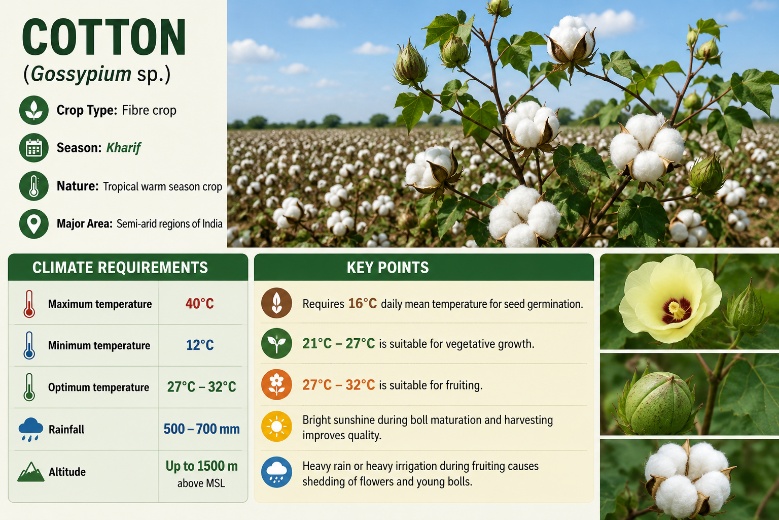
Cotton is an important fibre crop and a major raw material for the textile industry. It is generally grown as a Kharif crop in India. The Mission for Cotton Productivity is important because India has a large area under cotton cultivation but comparatively low productivity.
CARE MCQ
With reference to the Mission for Cotton Productivity, the Government of India’s 5F Vision refers to which of the following?
- Farm to Fibre to Factory to Fashion to Foreign
- Farmer to Food to Factory to Finance to Foreign
- Farm to Fertiliser to Fibre to Fashion to Finance
- Fibre to Farm to Factory to Fashion to Foreign
Answer: A
Explanation
- The Mission for Cotton Productivity aligns with the Government of India’s 5F Vision.
- The correct sequence of the 5F Vision is:
Farm → Fibre → Factory → Fashion → Foreign
- It represents the complete textile value chain:
- Farm: Cotton cultivation by farmers
- Fibre: Conversion of cotton into fibre
- Factory: Textile manufacturing
- Fashion: Garment and apparel production
- Foreign: Export to global markets
Additional Information
The Mission for Cotton Productivity has an outlay of ₹5,659.22 crore for the period 2026–27 to 2030–31. It aims to improve cotton productivity, develop disease and pest-resistant HYV seeds, reduce contamination in cotton supply, and promote high-quality cotton exports.
FAQs
1. What is Mission for Cotton Productivity?
It is a five-year initiative to improve cotton production, quality and farmer income.
2. What is the 5F Vision?
Farm to Fibre to Factory to Fashion to Foreign.
3. What is ELS cotton?
Extra Long Staple cotton has long, strong and soft fibres used for premium textiles.
4. Why is the mission needed?
India has large cotton acreage but low productivity and rising import dependence.