Table of Contents
Relevance: APPSC G1 &G2– Science and Technology, Space Technology, Defence Technology, Disaster Management
For Prelims:
- Super Pressure Balloon, Mission SANA, VISTA Platform, Red Balloon Aerospace, Vijayawada, Stratosphere, Near-Space Technology, Hydrogen Balloon, GNSS, Polymer Nanocomposite, Earth Observation, Disaster Management, Telecommunications, Non-Terrestrial Network, Payload, Andhra Pradesh Innovation Society.
For Mains:
- Near-space technology, indigenous aerospace innovation, space economy, rural connectivity, disaster monitoring, atmospheric research, strategic surveillance, deep-tech ecosystem, public-private innovation, communication infrastructure, cost-effective satellite alternatives, India’s space sector reforms.
Why in News?
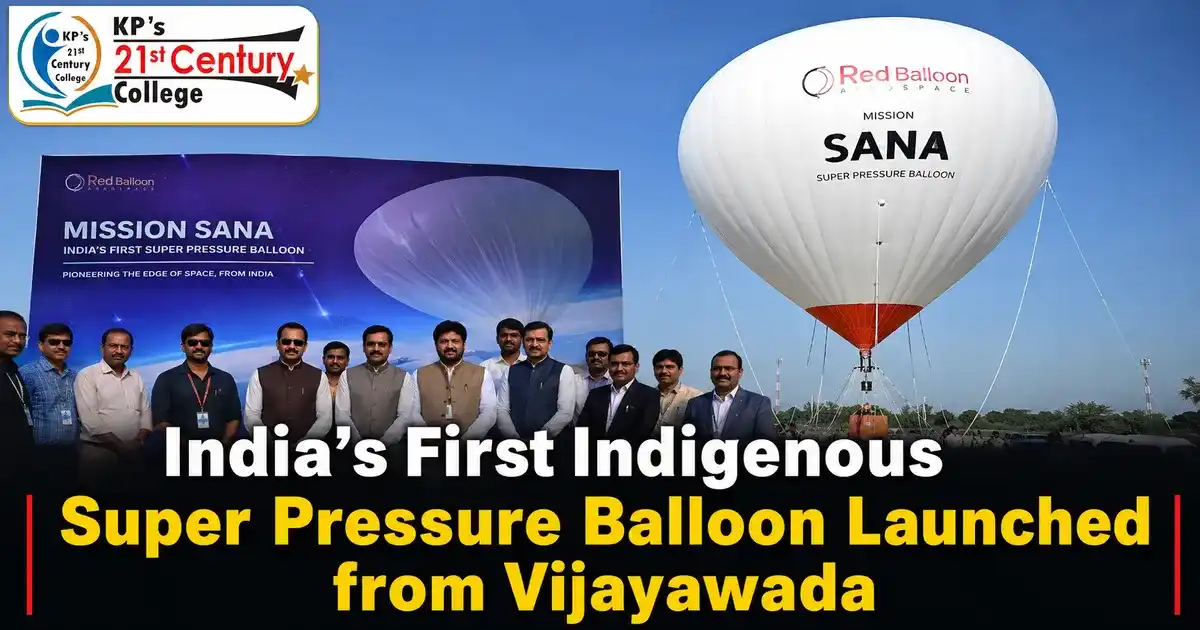
India’s first indigenous Super Pressure Balloon mission was launched from Vijayawada, Andhra Pradesh.
The mission was flagged off by Union Civil Aviation Minister Kinjarapu Ram Mohan Naidu. The system was developed by Red Balloon Aerospace under Mission SANA.
The mission carried commercial and scientific payloads. It marks an important step in India’s emerging near-space technology and deep-tech aerospace ecosystem.
What is a Super Pressure Balloon?
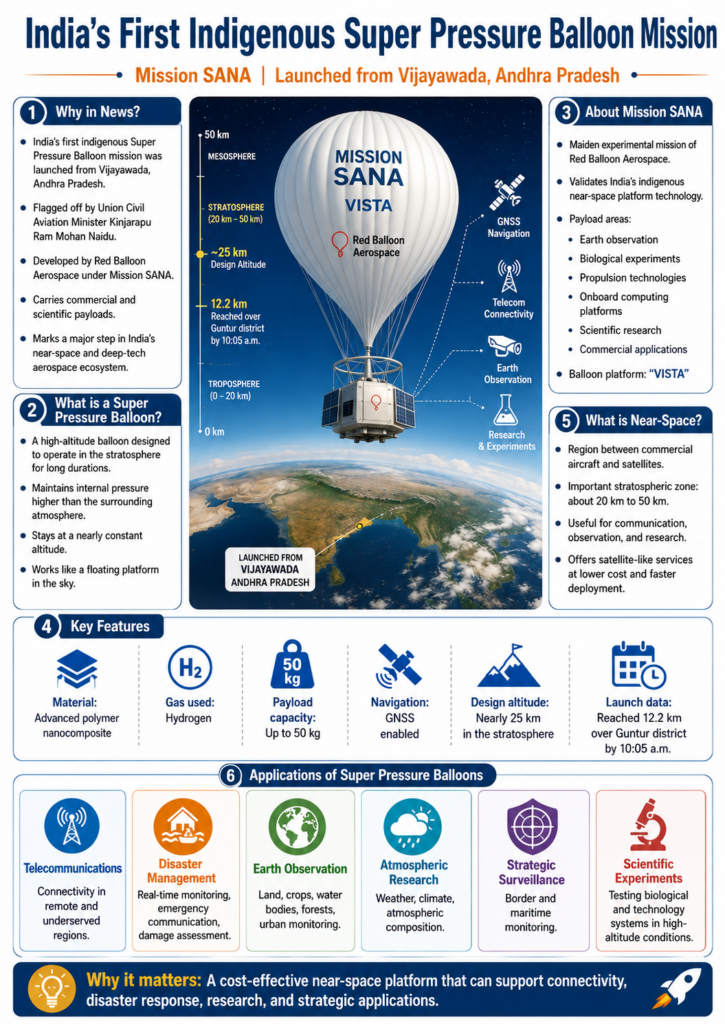
- A Super Pressure Balloon is a high-altitude balloon designed to operate in the stratosphere for a long duration.
- It maintains internal pressure higher than the surrounding atmospheric pressure. This allows it to remain stable at high altitudes for extended periods.
- Unlike ordinary balloons, super pressure balloons can stay at a nearly constant altitude and carry scientific or commercial payloads.
- In simple terms, it acts like a floating platform in the sky.
About Mission SANA
Mission SANA is the maiden experimental mission of Red Balloon Aerospace.
It aims to validate India’s indigenous near-space platform technology. The mission carried payloads related to:
- Earth observation
- Biological experiments
- Propulsion technologies
- Onboard computing platforms
- Scientific research
- Commercial applications
The balloon platform is also referred to as VISTA.
Key Features of the Balloon
- The Super Pressure Balloon has several important technological features.
- It is made of advanced polymer nanocomposite material. It is filled with hydrogen gas and is designed for long-duration operations in the stratosphere.
- The balloon can carry payloads of up to 50 kg. It is equipped with a Global Navigation Satellite System, or GNSS, for tracking and navigation.
- The balloon is designed to operate at altitudes of nearly 25 km in the stratosphere.
- During the launch, data showed that the balloon reached an altitude of 12.2 km over Guntur district by 10:05 a.m.
What is Near-Space?
- Near-space refers to the region between the altitude used by commercial aircraft and the region used by satellites.
- Commercial aircraft generally fly below the stratospheric region, while satellites operate much higher in space.
- The stratospheric region, especially between about 20 km and 50 km, is useful because it can support high-altitude platforms for communication, observation and research.
- This region is important because it can provide services similar to satellites at lower cost and with faster deployment.
Applications of Super Pressure Balloons
1. Telecommunications
- Super Pressure Balloons can help provide communication services in remote and underserved regions.
- They can act as high-altitude communication platforms and support rural connectivity.
2. Disaster Management
- These balloons can be deployed during floods, cyclones, earthquakes and other disasters.
- They can support real-time monitoring, emergency communication and damage assessment.
3. Earth Observation
- The platform can carry sensors for observing land, water bodies, crops, forests and urban areas.
- This is useful for agriculture, environmental monitoring and planning.
4. Atmospheric Research
- Super Pressure Balloons can collect data from the stratosphere.
- This can help scientists study weather patterns, climate processes and atmospheric composition.
5. Strategic Surveillance
- Near-space platforms can support surveillance and monitoring.
- They may be useful for border monitoring, maritime awareness and security-related applications.
6. Scientific Experiments
- The platform can carry biological, technological and computing experiments in high-altitude conditions.
- This helps test systems before they are used in satellites or other space missions.
Significance for India
1. Indigenous Technology Development
- The launch shows India’s ability to develop advanced near-space platforms using domestic technology.
- This supports the goal of Atmanirbhar Bharat in aerospace and space technology.
2. Boost to Space Economy
- India’s space economy is growing rapidly. Technologies like Super Pressure Balloons can support new commercial opportunities in telecommunications, earth observation and research.
3. Cost-Effective Alternative to Satellites
- Super Pressure Balloons can provide some services at lower cost compared to satellites.
- They do not require expensive rocket launches and can be deployed more quickly.
4. Support for Remote Connectivity
- India has many remote, hilly, tribal and border regions where communication services are limited.
- Near-space platforms can help improve connectivity in such areas.
5. Disaster Resilience
- These balloons can provide quick communication support during disasters when ground infrastructure is damaged.
6. Strategic Advantage
- Near-space technology has strategic value for surveillance, communication and national security.
- It can help India strengthen its technological capabilities between aircraft-based systems and satellite-based systems.
7. Public-Private Innovation
- The mission highlights the growing role of Indian startups in the aerospace and space technology sectors.
- It shows how private innovation can contribute to national technological capacity.
Significance for Andhra Pradesh
- The launch from Vijayawada is important for Andhra Pradesh.
- It shows the State’s growing role in aerospace, artificial intelligence, data centres, quantum technologies and deep-tech innovation.
- The mission also strengthens Andhra Pradesh’s image as an emerging innovation hub.
- It can encourage investment, research, startup activity and skilled employment in the State.
Challenges
1. Technical Complexity
- Super Pressure Balloons require advanced materials, pressure control, navigation systems and payload safety mechanisms.
2. Weather Dependence
- High-altitude balloon launches are affected by wind, temperature and atmospheric conditions.
3. Regulatory Framework
- Near-space platforms need clear rules for airspace management, safety, communication frequencies and data use.
4. Payload Safety
- Scientific and commercial payloads must be protected from extreme temperature, pressure and radiation conditions.
5. Long-Duration Reliability
- For commercial use, the platform must remain stable and operational for long periods.
6. Security Concerns
- Near-space platforms may raise concerns related to surveillance, data security and cross-border movement.
7. Scaling Up
- A successful experimental launch is only the first step. India must scale the technology for regular commercial and strategic use.
Way Forward
1. Develop Clear Near-Space Policy
- India should prepare a clear regulatory framework for near-space platforms, including safety, airspace use and data governance.
2. Encourage Startup Innovation
- Startups working in aerospace, communication and earth observation should receive financial, technical and regulatory support.
3. Strengthen Public-Private Partnership
- Government agencies, research institutions and private companies should collaborate in near-space technology.
4. Promote Disaster Management Use
- Super Pressure Balloons should be integrated into disaster communication and early warning systems.
5. Support Rural Connectivity
- Near-space platforms can be used to improve internet and communication services in remote villages, border areas and tribal regions.
6. Invest in Materials Research
- India should strengthen research in advanced polymers, lightweight materials, hydrogen systems and high-altitude navigation.
7. Link with National Space Policy
- Near-space technology should be connected with India’s larger space reforms, satellite ecosystem and commercial space economy.
Conclusion
The launch of India’s first indigenous Super Pressure Balloon from Vijayawada is a major achievement in India’s near-space technology journey.
It shows the potential of Indian startups, indigenous innovation and public-private collaboration in the aerospace sector.
This technology can support telecommunications, disaster management, atmospheric research, earth observation and strategic surveillance.
For India, Super Pressure Balloons can become an important bridge between aircraft and satellites. With proper policy support, safety regulation and investment, near-space platforms can play a significant role in India’s future space economy and national development.
CARE MCQ
Q. With reference to India’s first indigenous Super Pressure Balloon mission, consider the following statements:
- It was launched from Vijayawada.
- It was developed by Red Balloon Aerospace.
- It is designed to operate in the deep ocean region.
How many of the above statements are correct?
A. Only one
B. Only two
C. All the three
D. None
Answer: B
Explanation:
- Statement 1 is correct: India’s first indigenous Super Pressure Balloon mission was launched from Vijayawada.
- Statement 2 is correct: It was developed by Red Balloon Aerospace.
- Statement 3 is incorrect: It is designed to operate in the stratosphere, not in the deep ocean region.
Additional Information:
Super Pressure Balloons are high-altitude platforms useful for communication, observation and scientific research.
FAQs
1. What is a Super Pressure Balloon?
A Super Pressure Balloon is a high-altitude balloon that maintains internal pressure and operates in the stratosphere for a long duration.
2. Where was India’s first indigenous Super Pressure Balloon launched?
It was launched from Vijayawada in Andhra Pradesh.
3. Which company developed the mission?
The mission was developed by Red Balloon Aerospace under Mission SANA.
4. What is the use of Super Pressure Balloons?
They can be used for telecommunications, disaster management, earth observation, atmospheric research and strategic surveillance.
5. Why is this topic important for UPSC?
It is important for GS Paper III under Science and Technology, Space Technology, Disaster Management and Internal Security.
6. Why is it important for Andhra Pradesh?
The launch highlights Andhra Pradesh’s growing role in aerospace, deep-tech innovation and emerging space technologies.