Table of Contents
Relevance: UPSC: GS Paper III – Rural Economy, Employment, Inclusive Growth and Public Finance.
For Prelims:
- VB-G RAM G, MGNREGA, Rural Employment, Job Card, DBT, Unemployment Allowance, Normative Allocation, Sixteenth Finance Commission, Social Audit.
For Mains:
- Rural Livelihood Security, Fiscal Federalism, Wage Employment, State Finances, Demand-driven Welfare, Social Audit, Direct Benefit Transfer, Rural Distress.
Why in News?
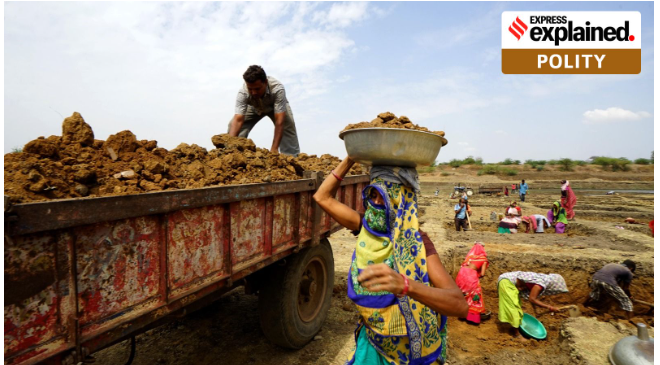
The Viksit Bharat-Guarantee for Rozgar and Ajeevika Mission (Gramin) Act, 2025, also called VB-G RAM G, is set to replace the two-decade-old Mahatma Gandhi National Rural Employment Guarantee Act (MGNREGA).
Ahead of its rollout, the Union government has released draft rules covering wage payment, unemployment allowance, State allocations and monitoring of implementation.
What is VB-G RAM G?
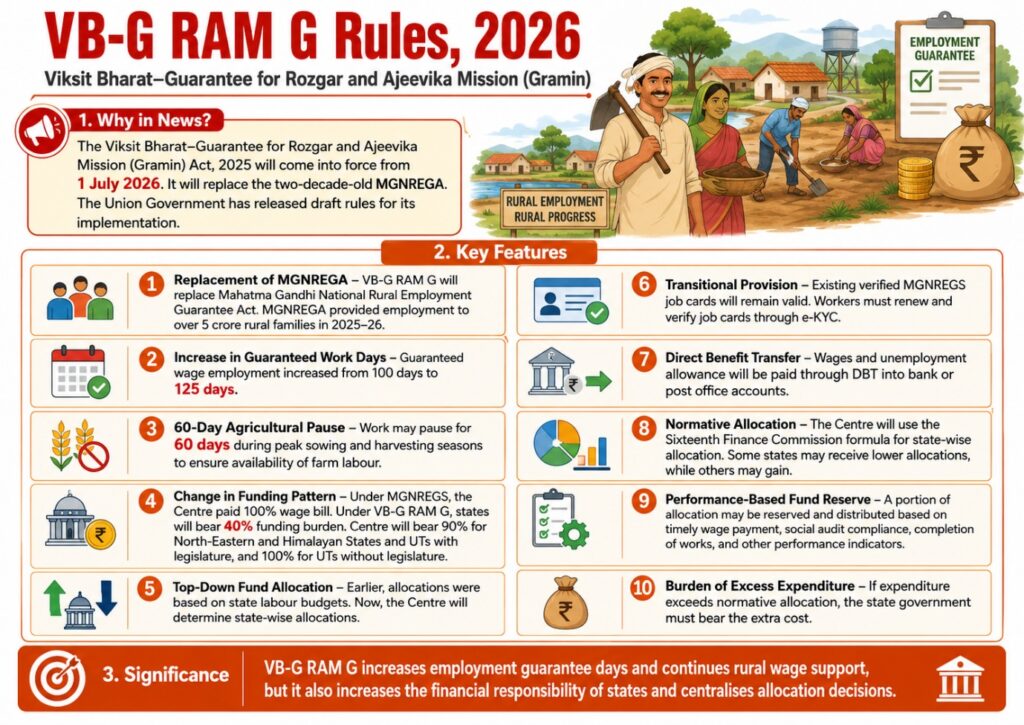
- VB-G RAM G is a new rural employment guarantee scheme.
- It seeks to provide guaranteed wage employment to rural households.
- It replaces MGNREGA, which had provided employment support to crores of rural families.
- It increases the guaranteed workdays from 100 days to 125 days.
- It also introduces a 60-day pause during peak agricultural sowing and harvesting seasons.
- The aim is to ensure rural employment while also protecting availability of labour for agriculture.
How it Differs from MGNREGA
| Feature | MGNREGA | VB-G RAM G |
| Guaranteed workdays | 100 days | 125 days |
| Funding of wages | Centre paid 100% wage bill | States to share part of cost |
| Allocation model | Based on State labour budgets | Centre determines normative allocation |
| Agricultural season pause | Not a major feature | 60-day pause during peak farm seasons |
| Payment mode | Bank/post office-based payments | DBT into bank/post office accounts |
| Transition | Existing MGNREGS job cards | Valid after renewal and e-KYC |
Draft Rules Released
The Ministry of Rural Development released draft rules related to:
- National Level Steering Committee
- Grievance Redressal
- Administrative Expenses
- Transitional Provisions
- Objective Parameters for Normative Allocation
- Central Gramin Rozgar Guarantee Council
- Wage and Unemployment Allowance Payment
- Expenditure beyond Normative Allocation
The public can submit objections and suggestions before final notification.
Impact on Existing MGNREGS Workers
- Existing MGNREGS job cards will remain valid under the new scheme.
- These cards must be:
- Renewed
- Verified through e-KYC
- This arrangement will continue until States issue new Gramin Rozgar Guarantee Cards.
- Wages and unemployment allowance will be paid through Direct Benefit Transfer into bank or post office accounts.
- The Union government is yet to declare the wage rate under the new scheme.
Fund Sharing Pattern
- Under MGNREGS, the Centre paid 100% of the wage bill.
- Under VB-G RAM G, States will bear 40% of the funding burden.
- For Northeastern and Himalayan States and Union Territories with legislature, the Centre will bear 90% of the funding.
- For Union Territories without legislature, the Centre will bear the full funding burden.
Normative Allocation to States
- The Centre will determine the normative allocation of funds to every State each financial year.
- The allocation will be based on objective parameters.
- The draft rules propose the use of the Sixteenth Finance Commission’s horizontal devolution formula.
- This may change the distribution of funds among States.
- Some States may receive lower allocations than under MGNREGS, while others may receive higher shares.
Performance-linked Allocation
- The Union government may keep aside a portion of the normative allocation.
- This amount may be distributed among States based on:
- Timely wage payment
- Compliance with social audit
- Completion of works
- Other performance indicators specified by the Centre
- This provision is expected to apply from the next financial year.
Significance
- Increases guaranteed rural employment from 100 to 125 days.
- Ensures continuity for existing MGNREGS workers through verified job cards.
- Promotes transparency through DBT wage payments.
- Links fund allocation with performance and monitoring.
- Attempts to balance rural employment with agricultural labour needs.
- Introduces a more structured allocation system.
- Can support rural livelihoods if implemented effectively.
Challenges
- Shifting 40% funding burden to States may stress State finances.
- Top-down allocation may weaken the demand-driven nature of rural employment guarantee.
- States with higher labour demand may face higher expenditure beyond allocation.
- The 60-day pause may affect workers who depend on wage employment during lean periods.
- e-KYC and digital verification may create exclusion risks for vulnerable workers.
- Delay in wage declaration may create uncertainty.
- Performance-linked funds may disadvantage States with weaker administrative capacity.
Way Forward
- Protect the demand-driven character of rural employment guarantee.
- Ensure that workers are not excluded due to e-KYC or documentation issues.
- Release wage rates clearly and on time.
- Provide adequate fiscal support to States with high rural employment demand.
- Strengthen social audits and grievance redressal.
- Ensure timely DBT payments.
- Avoid excessive centralisation in fund allocation.
- Provide special support to poorer and drought-prone regions.
Conclusion
VB-G RAM G marks a major shift in India’s rural employment guarantee framework. It increases guaranteed workdays and introduces DBT, new allocation rules and performance-linked funding.
However, the success of the scheme will depend on timely wage payments, protection of workers’ rights, fiscal support to States and strong social audits. Rural employment guarantee should remain a tool of livelihood security, not only a budget-controlled welfare programme.
UPSC PYQ
Q. Which one of the following is not an objective of the MGNREGA?
A. Providing up to 100 days of skilled labour in a financial year
B. Creation of productive assets
C. Enhancing livelihood security
D. Ensuring empowerment to women
Answer: A
Explanation:
The Mahatma Gandhi National Rural Employment Guarantee Act (MGNREGA), enacted in 2005, is a major rural employment and social security programme aimed at enhancing livelihood security in rural areas.
Its major objectives include:
- Enhancing livelihood security by guaranteeing wage employment to rural households.
- Creation of durable and productive assets such as ponds, roads, irrigation canals, and water conservation structures.
- Women empowerment, as the Act mandates that at least one-third of the beneficiaries should be women.
- Providing up to 100 days of guaranteed wage employment to rural households willing to do unskilled manual work.
However, MGNREGA guarantees unskilled manual labour, not skilled labour. Therefore, option A is not an objective of the scheme.
CARE MCQ
Q. With reference to VB-G RAM G, consider the following statements:
- It increases guaranteed workdays from 100 to 150 days.
- It replaces MGNREGA.
- It provides a 60-day pause during peak agricultural seasons.
Which of the above statements are correct?
A. 1 and 2 only
B. 2 and 3 only
C. 1 and 3 only
D. 1, 2 and 3
Answer: C
Explanation:
- Statement 1 is correct: VB-G RAM G increases guaranteed workdays to 125.
- Statement 2 is correct: It replaces MGNREGA.
- Statement 3 is correct: It provides for a 60-day pause during peak sowing and harvesting seasons.
FAQs
1. What is VB-G RAM G?
VB-G RAM G stands for Viksit Bharat–Guarantee for Rozgar and Ajeevika Mission (Gramin). It is a new rural employment guarantee scheme that will replace MGNREGA.
2. What does VB-G RAM G replace?
It will replace the two-decade-old Mahatma Gandhi National Rural Employment Guarantee Act (MGNREGA).
3. How many days of work will be guaranteed under VB-G RAM G?
The scheme increases guaranteed wage employment from 100 days to 125 days.
4. What is the 60-day pause under the scheme?
VB-G RAM G provides for a 60-day pause during peak sowing and harvesting seasons to ensure the availability of farm labour.
5. Will existing MGNREGS job cards remain valid?
Yes. Existing MGNREGS job cards will remain valid after renewal and e-KYC verification until new Gramin Rozgar Guarantee Cards are issued.