Table of Contents
Relevance: UPSC: GS Paper III – Economy, Agriculture, Food Processing, Rural Economy, Inclusive Growth, Exports and Value Addition.
For Prelims:
Jaggery, Gur, Sugarcane, Natural Sweetener, PM Kisan SAMPADA Yojana, PMFME, ODOP, AGMARK, GI Tag, Kolhapur Jaggery, Muzaffarnagar Gur, Marayoor Jaggery, Central Travancore Jaggery.
For Mains:
- Agro-processing, Rural Livelihoods, Value Addition, Cottage Industry, Food Processing Exports, Nutrition Security, Women Cooperatives, Farmer Income, Traditional Knowledge, Rural Entrepreneurship.
Why in News?
India accounts for over 70% of global jaggery production, making it the world leader in natural sweeteners.Nearly 20–30% of India’s sugarcane output is used for jaggery production. The sector supports around 2.5 million rural livelihoods.India’s jaggery exports have also grown strongly, increasing by 106.5% in value between 2015–16 and 2024–25.
What is Jaggery?
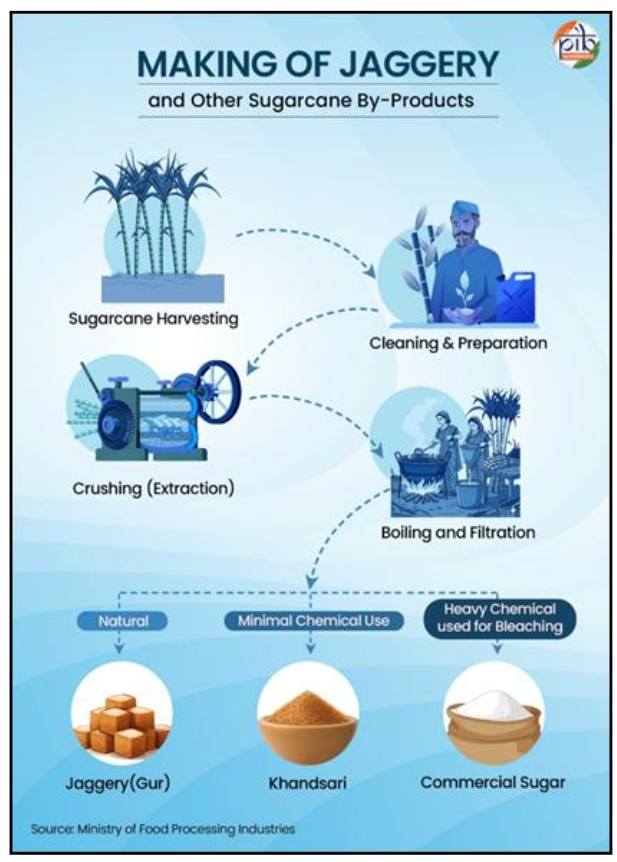
- Jaggery, commonly known as gur, is a traditional, unrefined and natural sweetener.
- It is produced by concentrating sugarcane juice without chemical refining.
- It is often called “medicinal sugar” because it contains minerals and micronutrients.
- Jaggery is consumed in Asia, Africa, Latin America and the Caribbean under different local names.
- It is valued for its natural origin, traditional processing and rising demand for chemical-free sweeteners.
Historical and Cultural Importance
- Jaggery is considered an indigenous Indian product.
- Its history is linked to sugarcane cultivation from the Vedic period.
- Early references to sugarcane cultivation are found around 1400–1000 BCE.
- The word “sugar” is derived from the Sanskrit term sarkara.
- In 647 AD, a Chinese mission reportedly travelled to Magadha to learn sugarcane processing techniques.
- This shows India’s long tradition of sweetener production and knowledge transfer.
India’s Position in Jaggery Production
- India produces over 70% of the world’s jaggery.
- It is the world’s largest producer of jaggery.
- Nearly 20–30% of India’s sugarcane production is diverted to jaggery production.
- Jaggery production is an important rural agro-processing activity.
- It is marked by:
- Decentralised processing
- Low transport cost
- Small-scale entrepreneurship
- Cottage industries
- Rural employment generation
Sugarcane Production Base
- India’s sugarcane production in 2024–25 was estimated at 444.9 million tonnes.
- Major producing States include:
- Uttar Pradesh – 48.5%
- Maharashtra – 24.1%
- Karnataka – 10.5%
- Other producing States include Gujarat, Tamil Nadu, Bihar, Uttarakhand, Punjab, Madhya Pradesh and Haryana.
Growth of Jaggery Exports
- India is a leading exporter of jaggery and confectionery products.
- In 2015–16, exports stood at USD 197 million with a volume of 292.8 MT.
- In 2024–25, exports increased to USD 406.8 million with a volume of 471.9 MT.
- This shows a rise of:
- 106.5% in value
- 61.2% in volume
- Major export destinations in 2024–25 included:
- Indonesia
- USA
- UAE
- Nigeria
- Nepal
Rising Domestic Demand
- Domestic demand for natural sweeteners has increased.
- In the sweetener segment, jaggery and honey recorded a 15–20% CAGR during 2021–24.
- Jaggery sales in domestic markets reached around 5,000 metric tonnes annually by August 2024.
- This reflects growing consumer preference for traditional and natural sweeteners.
Nutritional Value of Jaggery
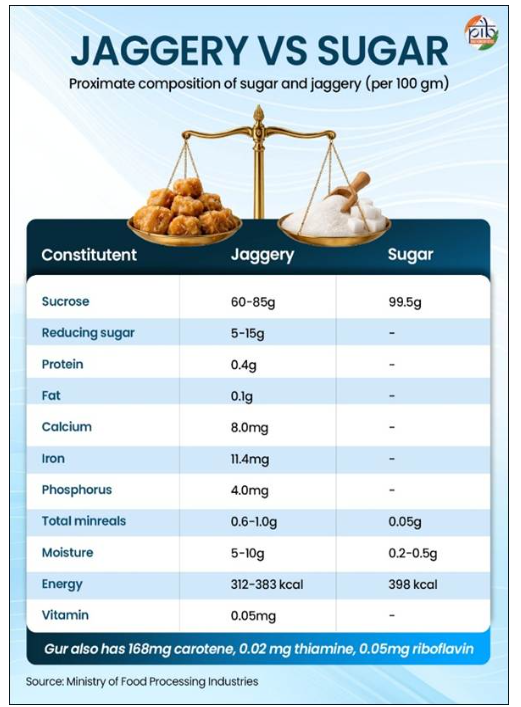
- Jaggery retains many nutrients present in sugarcane juice.
- It contains minerals such as:
- Calcium, Magnesium, Potassium, Phosphorus, Sodium, Iron, Zinc Copper Manganese
- Good-quality jaggery usually contains more than 70% sucrose and about 5% minerals.
- Iron content is around 10–13 mg per 100 grams.
- It also contains trace vitamins such as folic acid, B-complex vitamins and vitamins A, C, D and E.
Health Benefits of Jaggery
- Jaggery provides sustained energy because it is digested slowly.
- It may help improve haemoglobin levels due to its iron content.
- Potassium and magnesium support cardiovascular and muscle function.
- In traditional systems like Ayurveda, jaggery is used for digestion and respiratory comfort.
- It is also considered useful for people exposed to dust and pollution due to its cleansing properties.
- However, jaggery is still a sweetener and should be consumed in moderation.
Jaggery in Nutrition Interventions
- Tamil Nadu has included jaggery in nutrition interventions.
- It is used in complementary weaning food under the nutritious meal programme and ICDS framework.
- The supplementary food is popularly known as Sathumavu.
- Jaggery forms around 27% of the complementary food mix.
- It is distributed as Take-Home Rations for eligible beneficiaries for 300 days a year.
- The programme benefits nearly 32.75 lakh beneficiaries in Tamil Nadu.
Link with Women’s Livelihoods
- Sathumavu is procured from 25 women-run weaning food manufacturing cooperative societies and two private manufacturers.
- These cooperatives include around 1,450 members.
- Many members are widows, deserted women or economically vulnerable women.
- Thus, jaggery-based nutrition support also promotes women’s livelihood generation.
Role in Rural Livelihoods
- Jaggery production is part of India’s unorganised agro-processing sector.
- It supports farmers, workers, processors and rural entrepreneurs.
- Jaggery processing generates local employment and supports migrant labour.
- Value addition through jaggery provides higher returns than selling raw sugarcane to mills.
- It strengthens rural economies through cottage industries and small enterprises.
Value Addition and Entrepreneurship
- Organic jaggery powder has emerged as a profitable value-added product.
- A farmer from Tirunelveli district in Tamil Nadu produces organic jaggery powder using local sugarcane varieties.
- Organic jaggery powder sells at about ₹75 per kg, compared to ₹50 per kg for conventional jaggery.
- Production cost for both is about ₹30 per kg.
- Diversified products such as jaggery-flavoured chocolate and coconut products are expanding market reach.
Government Support and Policy Push
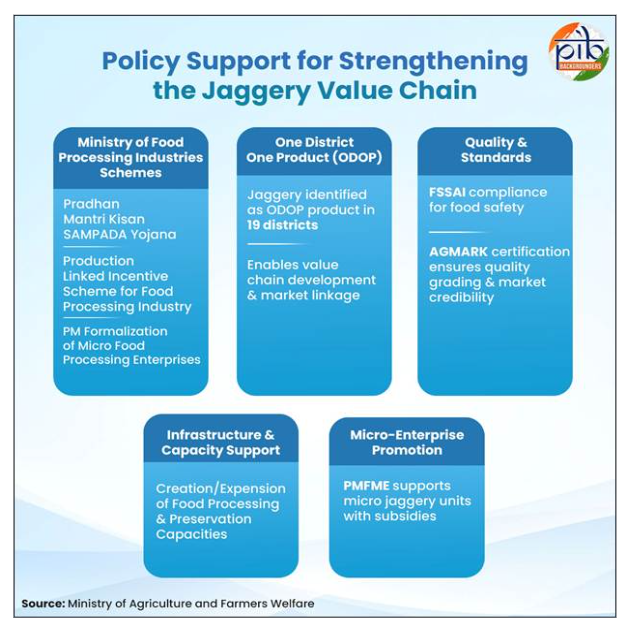
The Ministry of Food Processing Industries supports the jaggery sector through several schemes.
Major initiatives include:
- Pradhan Mantri Kisan SAMPADA Yojana
- Production Linked Incentive Scheme for Food Processing Industry
- PM Formalization of Micro Food Processing Enterprises Scheme
- One District One Product
- AGMARK certification
- GI tagging
Under the CEFPPC component of PMKSY, five jaggery processing units have been approved with grants-in-aid of ₹17.07 crore.
The PMFME Scheme has supported 3,528 jaggery-based micro food processing units with subsidies of ₹102.31 crore.
ODOP and Quality Certification
- Under One District One Product, jaggery and allied products have been identified in 19 districts.
- ODOP helps in value chain development, shared services, input procurement and market access.
- AGMARK certification supports quality assurance and standardisation.
- Jaggery is a notified commodity under AGMARK.
- Quality certification improves consumer trust, farmer prices and export readiness.
GI-Tagged Jaggery Varieties
- Geographical Indication helps protect region-specific products.
- GI recognition improves branding, market access and traditional processing value.
Important GI-tagged jaggery varieties include:
- Kolhapur Jaggery – Maharashtra
- Muzaffarnagar Gur – Uttar Pradesh
- Marayoor Jaggery – Kerala
- Central Travancore Jaggery – Kerala
These varieties are known for regional quality, purity, traditional methods and market value.
Challenges
- Jaggery processing is largely part of the unorganised sector.
- Many units may lack modern processing technology.
- Quality standardisation remains a challenge.
- Small producers often face limited market access.
- Export competitiveness requires food safety compliance.
- Seasonal production may affect steady supply.
- Farmers need better access to branding, packaging and value-added markets.
- Consumer awareness must distinguish quality jaggery from adulterated products.
Way Forward
- Modernise jaggery processing units with clean and efficient technology.
- Expand PMFME and PMKSY support for micro and small jaggery enterprises.
- Strengthen FPOs, SHGs and cooperatives in jaggery value chains.
- Promote quality certification through AGMARK and FSSAI standards.
- Expand GI-based branding for regional jaggery varieties.
- Encourage value-added products such as jaggery powder, liquid jaggery and jaggery-based confectionery.
- Improve packaging, storage and marketing facilities.
- Link jaggery with nutrition programmes where suitable.
- Support exports through quality control and international standards.
Conclusion
Jaggery is not only a traditional sweetener but also an important part of India’s rural economy. India’s leadership in global jaggery production, rising exports and growing domestic demand show the sector’s strong potential.
The jaggery sector connects agriculture, nutrition, rural livelihoods, women’s empowerment and export promotion. With better processing, certification, branding, GI protection and value addition, it can become a major driver of inclusive and sustainable rural growth.
UPSC PYQ
Q. Sugarcane is one of the important cash crops in India. It is grown to obtain (NDA PYQ 2017)
A. Starch
B. Glucose
C. Fructose
D. Sucrose
Answer: D
Explanation:
Sugarcane is an important cash crop in India. It is mainly grown for the production of sugar.
The chief sugar obtained from sugarcane is sucrose. Sucrose is a type of sugar formed from glucose and fructose units.
Sugarcane is also used for producing:
- Jaggery
- Khandsari
- Molasses
- Ethanol
Thus, sugarcane is commercially grown mainly to obtain sucrose.
Therefore, the correct answer is D. Sucrose.
CARE MCQ
Q. The word “sugar” is derived from which of the following Sanskrit terms?
A. Sakkara
B. Sarkara
C. Ikshu
D. Guda
Answer: B
Explanation:
The word “sugar” is derived from the Sanskrit term sarkara.
This shows the deep cultural and historical roots of sugarcane cultivation and sweetener production in India. Sugarcane cultivation was known in India from ancient times, and jaggery is widely regarded as an indigenous Indian product.
Additional Information:
- Early references to sugarcane cultivation are found in Indian texts from around 1400–1000 BCE.
- Sugarcane cultivation was closely linked with the Vedic period.
- In 647 AD, a Chinese mission travelled to Magadha to learn sugarcane processing techniques.
- Jaggery is traditionally produced by concentrating sugarcane juice without chemical refining.
FAQs
Q. What is jaggery?
Jaggery, also called gur, is a traditional unrefined sweetener made by concentrating sugarcane juice.
Q. Why is India important in global jaggery production?
India accounts for over 70% of global jaggery production, making it the world’s largest producer.
Q. How much sugarcane is used for jaggery production in India?
Nearly 20–30% of India’s sugarcane output is used for jaggery production.
Q. Why is jaggery considered nutritious?
Jaggery contains minerals such as iron, calcium, magnesium, potassium, zinc and trace vitamins.
Q. Which government schemes support jaggery processing?
PMKSY, PMFME, ODOP, AGMARK certification and GI tagging support jaggery processing and marketing.
Q. What are some GI-tagged jaggery varieties?
Kolhapur Jaggery, Muzaffarnagar Gur, Marayoor Jaggery and Central Travancore Jaggery are important GI-tagged varieties.
Q. Why is jaggery important for rural livelihoods?
It supports farmers, workers, cottage industries, women cooperatives and small food processing enterprises.
Q. What is the export significance of jaggery?
India’s jaggery exports have grown strongly, showing rising global demand for natural sweeteners.