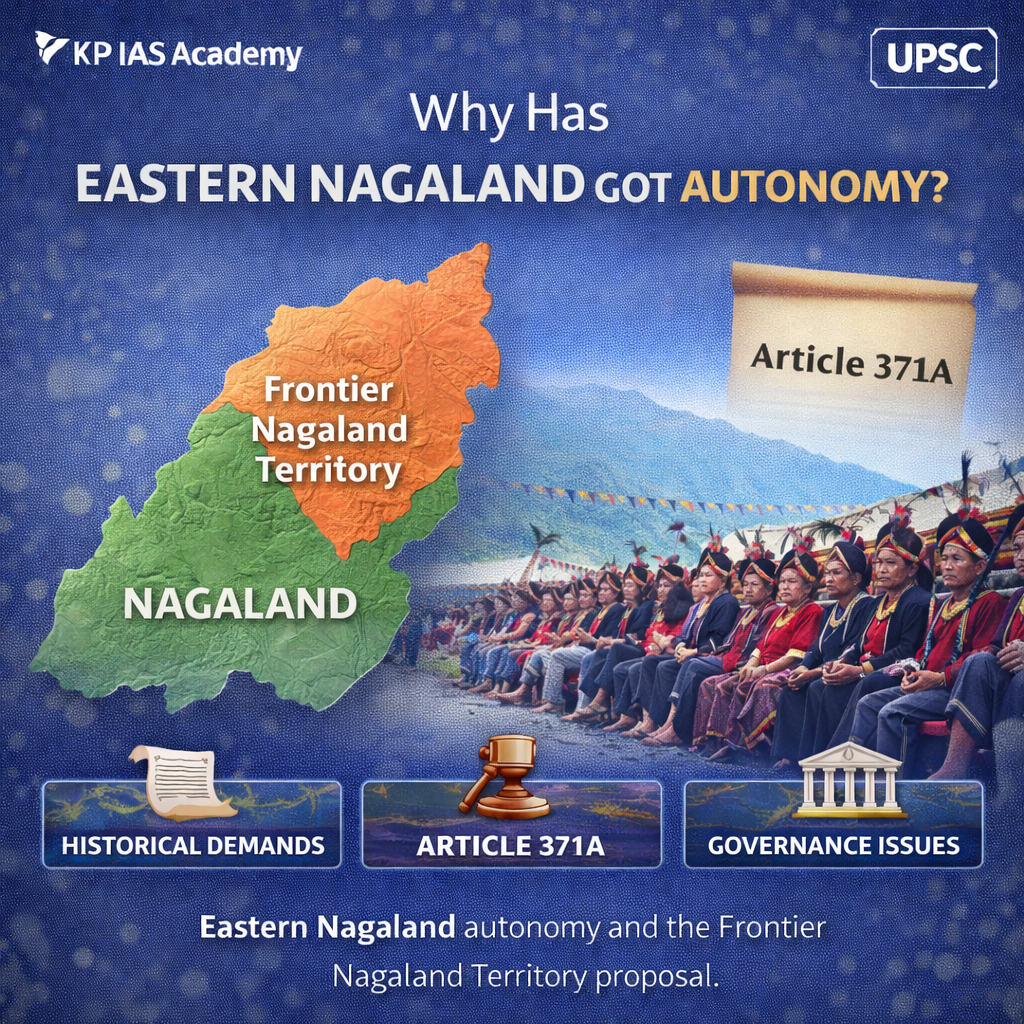
Why Has Eastern Nagaland Got Autonomy?
Table of Contents
Relevance:
GS II: Federalism, Devolution of Powers, Special Constitutional Provisions, North-East Governance
GS III: Internal Security & Border Management (Myanmar Border)
For Prelims:
- Frontier Nagaland Territorial Authority (FNTA), Eastern Nagaland Peoples’ Organisation (ENPO), Article 371(A), Article 371(C), Tripartite Agreement (Feb 5, 2026), Devolutionary Autonomy, Hill Areas Committee, Myanmar Border Buffer Zone.
For Mains:
- Asymmetric Federalism, Territorial Authority Model, Devolution of Administrative & Financial Powers, Identity Politics in North-East, Security–Development Nexus, Constitutional Innovation, Centre–State Negotiations
Why in News?
- On February 5, 2026, the Centre signed a tripartite agreement with the Nagaland Government and the Eastern Nagaland Peoples’ Organisation (ENPO) to form the Frontier Nagaland Territorial Authority (FNTA).
- The FNTA is an experiment in “devolutionary autonomy”.
- It grants a high degree of administrative and financial autonomy to six relatively “backward” eastern districts — Kiphire, Longleng, Mon, Noklak, Shamator, and Tuensang.

Background
- The demand for greater autonomy was spearheaded by the Eastern Nagaland Peoples’ Organisation (ENPO).
- ENPO formally conveyed its demand for a separate “Frontier Nagaland” State in 2010.
- The roots of the demand lie in British-era policies that left eastern hills largely unadministered.
- After Nagaland became a State in 1963, eight Naga tribes in the eastern districts felt politically and economically marginalised.
- This perceived developmental imbalance evolved into a sustained movement for statehood.
ENPO’s Core Demand
- Creation of a separate State carved out of Nagaland.
- Allegation of administrative dominance by western Naga tribes.
- Demand based on political neglect and economic backwardness.
- Movement intensified due to developmental differential between eastern and western districts.
Why Did the Centre Accept the Demand?
1. Political Pressure
- Earlier attempts such as a ₹500-crore package and standard operating procedures failed.
- In 2024, ENPO called for a Lok Sabha election boycott, showing significant leverage.
2. Strategic Compulsion
- Eastern Nagaland shares a sensitive border with Myanmar.
- Region acts as a buffer zone with presence of armed groups across porous borders.
- Prolonged unrest posed a national security risk.
3. Stabilisation Objective
- FNTA seen as a pacifying mechanism.
- Addresses aspirations without redrawing State boundaries.
Frontier Nagaland Territorial Authority (FNTA): Powers & Provisions
1. Semi-Autonomous Governance
- Establishment of a mini-Secretariat in eastern Nagaland.
- Headed by a senior officer to decentralise administration.
2. Financial & Administrative Devolution
- Development funds allocated proportionally based on population and area.
- Ministry of Home Affairs to fund initial establishment costs.
3. Legislative & Executive Authority
- FNTA to exercise powers over 46 specified subjects, including:
- Land use
- Agriculture
- Rural development
- Infrastructure
4. Constitutional Safeguards
- Article 371(A) remains intact.
- Customary laws and Naga identity preserved.
Can FNTA Model Address the Kuki-Zo Demand in Manipur?
Structural Similarity
- Similar to Hill Areas Committee under Article 371(C).
- Shows possibility of territorial authority as middle path.
Key Differences
- Nagaland negotiations were peaceful and had cooperation of State government.
- Manipur faces active ethnic tensions and trust deficit.
- Meitei-dominated government opposes administrative separation.
- Overlapping territorial claims (e.g., NSCN) complicate replication.
Significance
- Example of asymmetric federalism in India.
- Balances autonomy without creating a new State.
- Enhances border stability with Myanmar.
- Demonstrates constitutional flexibility in managing regional aspirations.
- Strengthens Centre–State negotiation framework.
Challenges
- Effective implementation of 46-subject authority.
- Avoiding administrative overlap with Nagaland Government.
- Financial sustainability of FNTA.
- Managing expectations of other autonomy movements.
- Preventing competitive identity politics.
Conclusion
The creation of the FNTA represents a constitutional middle path between full statehood and district-level administration. By granting devolutionary autonomy while preserving Article 371(A), the Centre seeks to address long-standing grievances, ensure frontier stability, and uphold federal balance. The long-term success of this model will depend on effective governance and political cooperation.
UPSC PYQ
Q. The hill range that separates the State of Manipur from the State of Nagaland is known as: (CDS-II, 2009)
- Arakan Hills
- Patkai Hills
- Barail Hills
- Manipur Hills
- It extends across Assam, Nagaland and Manipur.
- The Barail Range forms a natural geographical barrier between Manipur and Nagaland.
- It is regarded as one of the highest hill ranges in Assam.
- It separates:
- Manipur from Nagaland
- Also parts of Manipur from Assam
CARE MCQ
Q. With reference to the Frontier Nagaland Territorial Authority (FNTA), consider the following districts:
- Kiphire
- Longleng
- Mon
- Dimapur
- Tuensang
- Noklak
How many of the above districts are included in the six “backward” eastern districts granted autonomy under FNTA?
- Only three
- Only four
- Only five
- All the six
Answer: C
Explanation
The six districts under FNTA are:
- Kiphire
- Longleng
- Mon
- Noklak
- Shamator
- Tuensang
Dimapur is not included, hence five correct districts from the list.