Relevance: Paper-III – Indian Society, Constitution and Governance
For Prelims:
- Bonded Labour, Bonded Labour System (Abolition) Act 1976, Child and Adolescent Labour Act, Article 23, Human Trafficking, Brick Kilns, Migrant Workers, Release Certificate, Rehabilitation, Minimum Wages.
For Mains:
- Labour Exploitation, Forced Labour, Migrant Vulnerability, Informal Sector, Child Labour, Social Justice, Human Dignity, Labour Rights, Rehabilitation, Inter-State Migration.
Why in News?
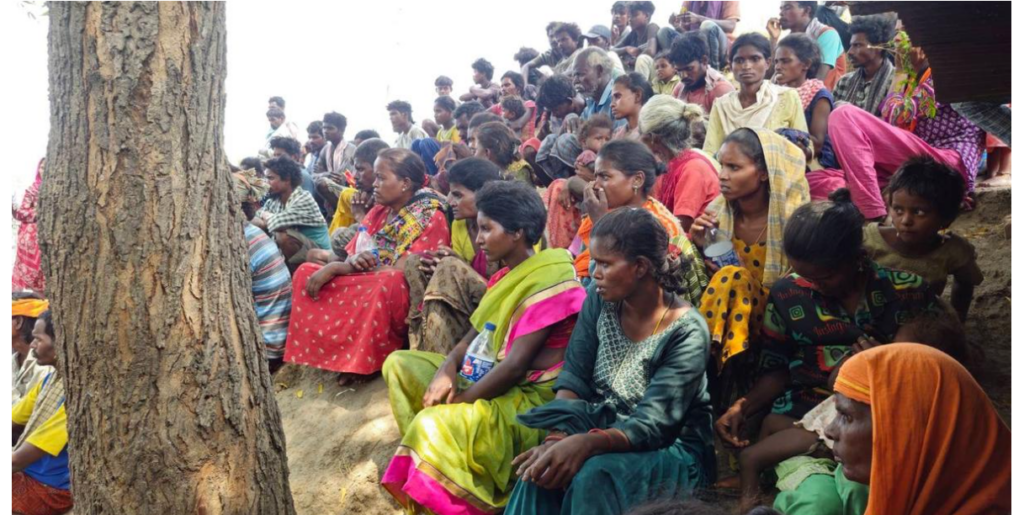
- More than 400 labourers, including nearly 100 children, were rescued from alleged bonded labour conditions at brick kilns in Armoor mandal of Nizamabad district, Telangana. The workers were reportedly from Telangana, Andhra Pradesh, Tamil Nadu and Odisha. The rescue operation was carried out after authorities received information from relatives of one of the labourers.
What Happened in Nizamabad?
- The operation was conducted at four brick kilns in Degam village, also known as Degaon.
- Three special police teams, with nearly 30 personnel from the Armoor division, were deployed.
- Around 200 persons were formally counted by evening, while identification and verification continued.
- Several rescued persons included women and children, and many showed signs of malnourishment.
Nature of Exploitation
- Workers were allegedly kept in bondage-like conditions.
- They were denied regular wages.
- Instead of direct wages, they were reportedly given vouchers that could be exchanged only for essential goods.
- One labourer from Tamil Nadu alleged that he worked for nearly four years without direct wages and survived on a grocery voucher worth ₹200 per week.
- Labourers also alleged:
- Restrictions on movement
- Denial of minimum wages
- Inability to change employment freely
- No freedom to negotiate wages
- Intimidation
- Physical violence
- Sexual abuse
Constitutional Framework Against Bonded Labour
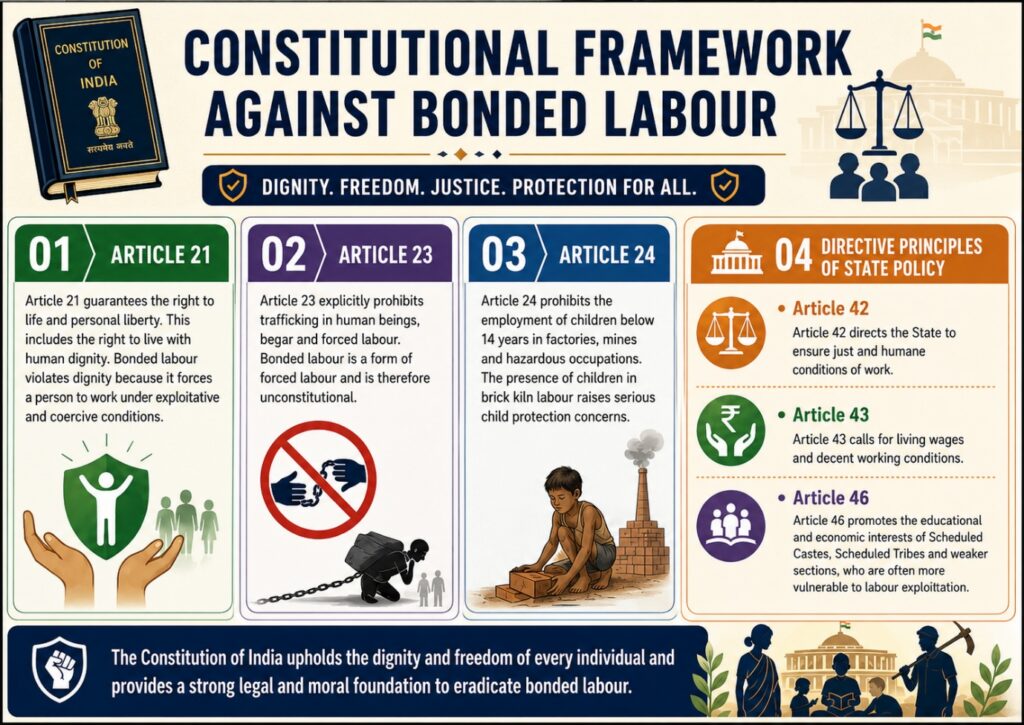
Legal Framework in India
Bonded Labour System (Abolition) Act, 1976
This Act abolishes bonded labour, frees bonded labourers from obligations and criminalises bonded labour practices.
Child and Adolescent Labour Act, 1986, amended in 2016
This law prohibits employment of children below 14 years and restricts adolescents aged 14–18 years from hazardous occupations.
Juvenile Justice Act, 2015
This Act provides for care, protection, rehabilitation and reintegration of children in need, including rescued children.
Bharatiya Nyaya Sanhita, 2023
The BNS addresses offences related to unlawful compulsory labour and provides legal provisions to punish forced labour practices.
Human Trafficking Provisions
If workers were transported, confined or exploited through coercion or deception, human trafficking-related provisions may also apply after investigation.
International Obligations
India is bound by international commitments to prevent forced labour and child exploitation.
Important instruments include:
- United Nations Convention on the Rights of the Child, 1989: Article 32 protects children from economic exploitation and hazardous work.
- ILO Convention 182: It deals with the worst forms of child labour and has been ratified by India.
These obligations strengthen India’s duty to protect children and vulnerable workers from exploitation.
Vulnerability of Migrant Labourers
- Migrant labourers are often vulnerable due to poverty, lack of local support and dependence on employers.
- Many work in informal sectors such as brick kilns, construction and agriculture.
- They may not have proper wage records, identity support, social security or access to legal help.
- Children of migrant workers are at risk of malnutrition, lack of schooling and child labour.
Rehabilitation Measures
- Authorities are expected to:
- Record testimonies
- Identify vulnerable persons
- Issue release certificates to bonded labour survivors
- Facilitate financial assistance
- Support repatriation of inter-State migrant workers
- Ensure rehabilitation under relevant schemes
- Rehabilitation is essential because rescue alone does not end economic vulnerability.
Challenges
- Bonded labour is often hidden behind informal work arrangements.
- Migrant workers may lack documents, awareness and local support.
- Wage payments through vouchers make exploitation difficult to track.
- Fear of employers may prevent victims from speaking openly.
- Children in such families may remain outside school systems.
- Verification of records and proof of bondage may take time.
- Rehabilitation becomes difficult if workers return to poverty without livelihood support.
Way Forward
- Conduct regular inspections of brick kilns and high-risk worksites.
- Maintain proper registration of migrant workers.
- Ensure direct wage payment into bank accounts.
- Strengthen enforcement of minimum wages and labour laws.
- Provide education, nutrition and protection for children of rescued families.
- Issue release certificates quickly after verification.
- Ensure financial assistance, housing support and livelihood rehabilitation.
- Improve coordination among police, labour, revenue and child welfare departments.
- Create helplines and awareness programmes for migrant workers.
- Monitor rescued workers after repatriation to prevent re-bondage.
Conclusion
The rescue of over 400 labourers from brick kilns in Nizamabad shows that bonded labour remains a serious social justice concern. Such exploitation violates human dignity, constitutional rights and labour laws.
A strong response requires more than rescue operations. It needs regular monitoring, strict prosecution of offenders, protection of children, direct wage systems and long-term rehabilitation. Protecting migrant workers from bondage is essential for inclusive development and constitutional governance
CARE MCQ
Q. International Labour Organization’s Conventions 138 and 182 are related to:
A. Child labour
B. Gender parity at the workplace
C. Regulation of food security
D. Adaptation of agriculture to climate change
Answer: A
Explanation:
- ILO Convention No. 138 deals with the minimum age for admission to employment. It aims to prevent children from entering employment before a legally permitted age.
- ILO Convention No. 182 deals with the worst forms of child labour, such as slavery, trafficking, forced labour, use of children in armed conflict, prostitution, pornography and hazardous work.
- Together, these two conventions form the core international legal framework against child labour.
Additional Information:
- The International Labour Organization (ILO) is a specialised agency of the United Nations.
- It was established in 1919.
- Its major objective is to promote social justice and decent work.
FAQs
1) What is bonded labour and which law abolishes it in India?
Bonded labour refers to a system where a person is forced to work to repay a debt or due to coercion and exploitation. It was abolished under the Bonded Labour System (Abolition) Act, 1976.
2) Why are migrant workers more vulnerable to bonded labour?
Migrant workers often face poverty, lack of local support, absence of legal awareness, irregular wage records and dependence on employers, making them vulnerable to exploitation in informal sectors like brick kilns.
3) Which constitutional provision prohibits forced labour in India?
Article 23 of the Indian Constitution prohibits human trafficking, begar and all forms of forced labour.
4) Why is rehabilitation important after rescuing bonded labourers?
Rehabilitation is important because rescue alone does not remove economic vulnerability. Financial assistance, livelihood support, housing, education and social protection help prevent workers from falling back into bondage.
Relevance: UPSC GS Paper II: International Relations, Effect of Policies of Developed Countries, India and Global Powers
For Prelims:
- U.S.–China Trade War, Trump–Xi Summit, Agricultural Trade, Soybeans, Beef Imports, Poultry Imports, Non-Tariff Barriers, Taiwan Arms Sale, One-China Principle, HIMARS, Grey-Zone Warfare, Taiwan Strait
For Mains:
- Economic Interdependence, Strategic Rivalry, Food Security, National Security, Trade Diplomacy, Market Access, Tariff War, Indo-Pacific Security, Deterrence, Supply Chain Resilience
Why in News?
China has agreed to increase imports of U.S. agricultural products after the recent Trump–Xi summit in Beijing.
According to the White House, China will buy U.S. agricultural products at an annualised rate of about $17 billion per year for 2026, 2027 and 2028. The products include beef, poultry and other farm goods, while soybean commitments are being treated separately.
At the same time, U.S.–China tensions remain high over Taiwan, as the United States approved a major arms package worth around $11.1 billion for Taiwan in December 2025. The package includes systems such as HIMARS rocket systems, howitzers, Javelin anti-tank missiles and drones.
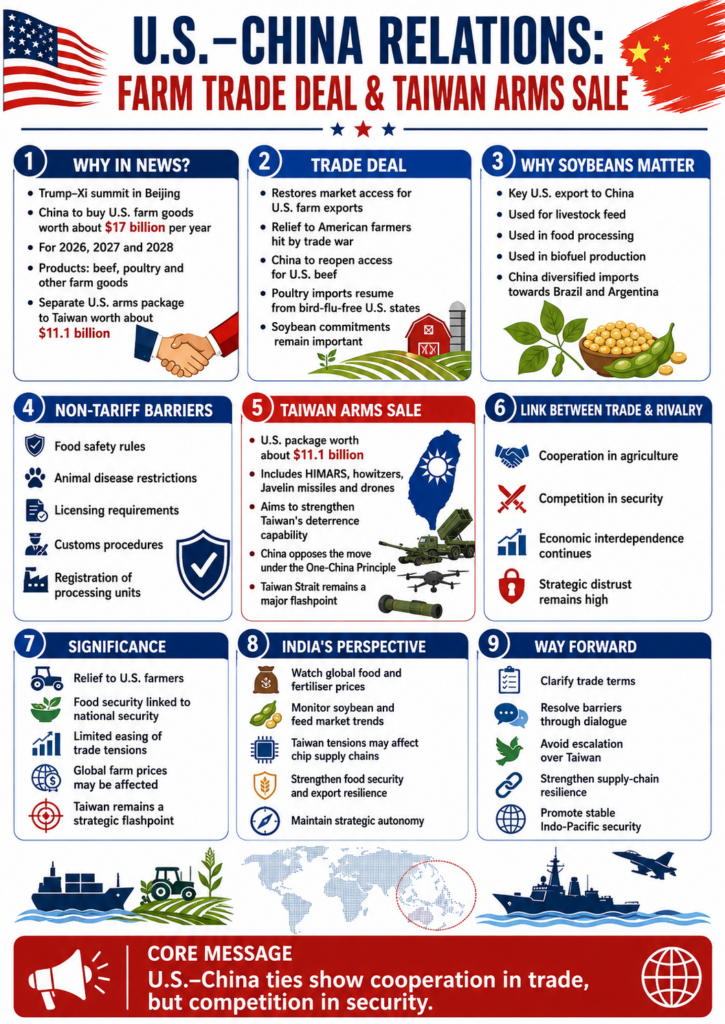
Key Highlights
- The U.S.–China agricultural agreement is aimed at restoring market access for American farm products that were badly affected during the trade war.
- China will restore access for U.S. beef and resume imports of poultry from U.S. states declared free from bird flu by the U.S. Department of Agriculture.
- The deal also focuses on resolving non-tariff barriers, including issues related to licensing, inspection rules, animal disease restrictions and registration of processing facilities.
- China had sharply reduced U.S. agricultural imports during the trade war. U.S. agricultural exports to China declined to about $8.4 billion in 2025, showing the deep impact of tariff conflicts.
- The agreement may raise total U.S. farm exports to China to nearly $28–30 billion annually, though this would still remain below the 2022 peak of about $38 billion.
- The Taiwan arms sale shows that while the U.S. and China are trying to manage trade tensions, their strategic rivalry remains serious.
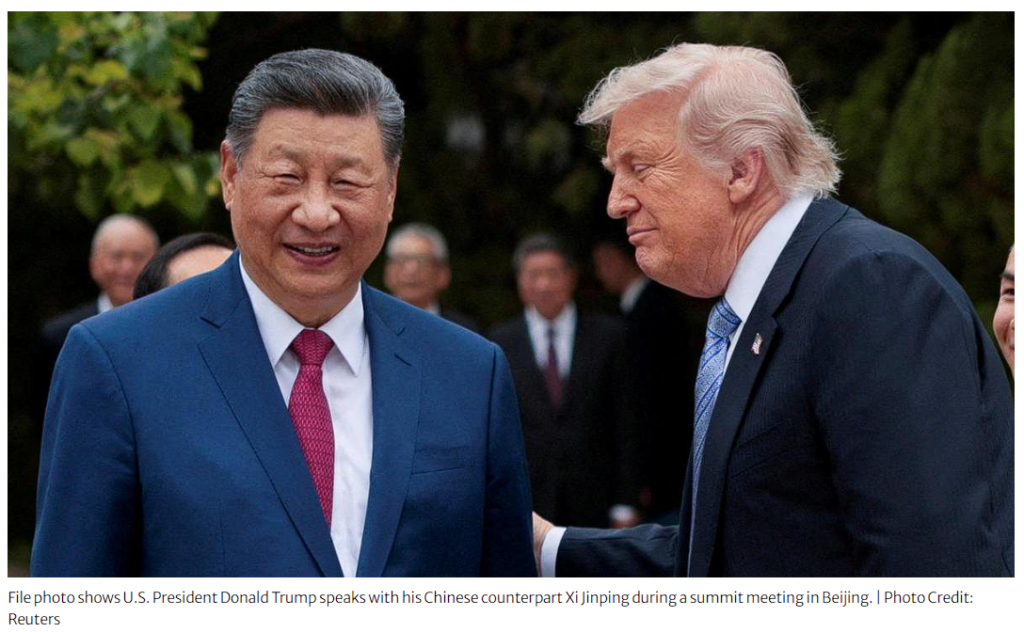
U.S.–China Agricultural Trade Deal
What Has China Agreed To?
China has agreed to increase imports of U.S. farm products for three years. The agreement covers agricultural goods such as beef and poultry.
This is important because China was once one of the biggest buyers of American farm products. However, the trade war reduced Chinese demand for U.S. agricultural goods.
The agreement is expected to provide relief to American farmers, especially those affected by the decline in soybean and meat exports.
Importance of Soybeans
Soybeans are one of the most important U.S. agricultural exports to China.
China uses soybeans mainly for:
- Livestock feed
- Food processing
- Biofuel production
During the trade war, China reduced soybean purchases from the U.S. and shifted towards countries such as Brazil and Argentina. This shows that food imports are now closely linked with national security and supply-chain strategy.
Beef and Poultry Market Access
China had allowed licences for many U.S. beef plants to expire earlier. This reduced U.S. beef exports to China.
The new agreement may allow several U.S. beef processing plants to export again to China.
China will also resume poultry imports from U.S. states that are free from bird flu. This shows the importance of health certification and disease-free status in agricultural trade.
Role of Non-Tariff Barriers
Non-tariff barriers are restrictions other than tariffs. They include:
- Food safety standards
- Animal disease restrictions
- Licensing rules
- Customs procedures
- Registration of processing units
In agricultural trade, such barriers are very important because countries use them to protect food safety, animal health and domestic markets.
Taiwan Arms Sale Issue
What Has the U.S. Approved?
The United States approved a major arms package for Taiwan worth around $11.1 billion.
The package includes:
- HIMARS rocket systems
- Howitzers
- Javelin anti-tank missiles
- Loitering munition drones
- Other defence equipment and support systems
The aim is to strengthen Taiwan’s defence and deterrence capability against possible Chinese military pressure.
Why Has China Opposed It?
China claims Taiwan as part of its territory under the One-China Principle.
Beijing strongly opposed the U.S. arms sale and warned that arming Taiwan affects China’s sovereignty and regional stability.
China has also increased military activity around Taiwan. Such actions are often described as grey-zone operations, meaning pressure tactics that remain below the level of full-scale war.
Why Taiwan Matters
Taiwan is important because of its:
- Strategic location in the Western Pacific
- Position near major sea routes
- Role in global semiconductor supply chains
- Central place in U.S.–China rivalry
- Importance for Indo-Pacific security
The Taiwan Strait is one of the most sensitive flashpoints in global politics.
Link Between Trade and Strategic Rivalry
- The two developments show the dual nature of U.S.–China relations.
- On one side, the U.S. and China are trying to cooperate in agricultural trade because both economies benefit from stable trade relations.
- On the other side, Taiwan remains a major strategic dispute. The U.S. continues to support Taiwan’s defence, while China strongly opposes any foreign military support to Taiwan.
- Therefore, U.S.–China relations are marked by both economic interdependence and strategic competition.
Significance
Relief to American Farmers
- The agricultural deal may help American farmers regain access to the Chinese market. Farmers need stable export demand for crops such as soybeans and for products such as beef and poultry.
Food Security as National Security
- China’s diversification of farm imports shows that countries increasingly treat food security as part of national security. Dependence on one supplier can become risky during trade wars or geopolitical tensions.
Limited Easing of Trade Tensions
- The agreement shows that both sides are willing to reduce tensions in selected sectors. It may create space for further dialogue on market access and tariff reductions.
Taiwan as a Continuing Flashpoint
- The Taiwan arms sale shows that deeper strategic distrust remains. Even if trade improves, security issues can quickly create fresh tensions.
Impact on Global Agricultural Markets
- China’s large-scale purchases from the U.S. can affect global prices of soybeans, wheat, corn, meat, cotton and animal feed. It may also affect exporters such as Brazil, Australia and Canada.
Challenges and Concerns
No Complete Resolution of U.S.–China Rivalry
- The agricultural agreement does not settle larger disputes related to Taiwan, technology controls, rare earths, military competition and Indo-Pacific influence.
Implementation Uncertainty
- There was no immediate full confirmation of all details from Beijing. This creates uncertainty about how much trade will actually happen.
Non-Tariff Barriers May Continue
- Even after political agreements, agricultural exports can be delayed by licensing, disease restrictions, inspection rules and safety standards.
China’s Diversified Import Strategy
- China has already increased imports from Brazil, Argentina and other countries. Therefore, it may not return fully to earlier dependence on U.S. agricultural goods.
Risk of Taiwan Strait Escalation
- Any rise in military tension around Taiwan can disturb Indo-Pacific stability and global supply chains.
India’s Perspective
- For India, these developments are important because they affect global trade, food prices and strategic balance in the Indo-Pacific.
- India must observe changes in global prices of soybeans, animal feed, meat products and fertilisers. Such changes can indirectly affect Indian farmers, consumers and agri-based industries.
- The U.S.–China trade deal also shows that agricultural exports require strong quality standards, reliable logistics and stable trade policy.
- The Taiwan issue is equally important for India because instability in the Taiwan Strait can affect semiconductor supply chains, shipping routes and Indo-Pacific security.
- India should strengthen its own food security, export competitiveness and supply-chain resilience while maintaining strategic autonomy.
Way Forward
- The U.S. and China should clearly define the terms of the agricultural trade agreement to reduce uncertainty for farmers and exporters.
- Both countries should resolve non-tariff barriers through regular institutional dialogue.
- Taiwan-related tensions should be managed through diplomacy and restraint to avoid conflict in the Indo-Pacific.
- India should diversify export markets, improve agricultural processing, strengthen food storage and build better logistics.
- India should also closely monitor Indo-Pacific security developments because trade, technology and defence issues are now deeply connected.
Conclusion
The U.S.–China agricultural trade agreement shows that economic cooperation is still possible between the world’s two largest economies. However, the Taiwan arms sale shows that strategic rivalry remains strong.
Together, these developments reflect the present nature of U.S.–China relations: cooperation in trade but competition in security.
For India, the key lesson is that food security, supply chains, defence preparedness and diplomacy are now closely linked in global politics.
CARE MCQ
Q. With reference to the recent U.S.–China agricultural trade agreement, consider the following statements:
- China agreed to increase imports of U.S. agricultural products for 2026, 2027 and 2028.
- The agreement includes products such as beef and poultry.
- The agreement completely resolved the Taiwan issue between the U.S. and China.
How many of the above statements are correct?
A. Only one
B. Only two
C. All three
D. None
Answer: B
Explanation
Statement 1 is correct:
China agreed to increase imports of U.S. agricultural products for three years: 2026, 2027 and 2028.
Statement 2 is correct:
The agreement includes products such as beef and poultry.
Statement 3 is incorrect:
The agreement is related to agricultural trade. It does not resolve the Taiwan issue.
Additional Information
U.S.–China relations include both cooperation and competition. Trade cooperation may improve, but strategic issues such as Taiwan remain sensitive.
FAQs
1. What did China agree to buy from the U.S.?
China agreed to increase imports of U.S. agricultural products such as beef, poultry and other farm goods.
2. Why are soybeans important in U.S.–China trade?
Soybeans are used in China for livestock feed, food processing and biofuels.
3. Why is Taiwan a sensitive issue?
China claims Taiwan as part of its territory, while the U.S. supports Taiwan’s defence capability.
4. Why is this issue important for India?
It affects global trade, food prices, Indo-Pacific security and supply-chain stability.
Relevance: GS Paper II – International Relations, Bilateral Agreements, Indian Diaspora, Global Governance.
For Prelims:
- India-Netherlands Strategic Partnership, Roadmap 2026–2030, Anaimangalam Copper Plates, Leiden Plates, Chola Tiger, Srivijaya Kingdom, National Maritime Heritage Complex, Lothal, Green and Digital Sea Corridor, ASML, Critical Minerals, CBAM, SPS Measures, Migration and Mobility MoU.
For Mains:
- Strategic Partnership, Indo-Pacific Cooperation, Maritime Diplomacy, Heritage Restitution, Cultural Diplomacy, Semiconductor Supply Chains, Technology Transfer, Green Hydrogen, Migration Governance, Water Diplomacy, Cooperative Globalisation
Why in News?
India and the Netherlands adopted the Roadmap for Strategic Partnership 2026–2030 at The Hague to deepen cooperation in trade, water, agriculture, health, technology, energy, defence, security, migration and culture.The partnership also gained cultural importance with the return of the Chola-era Anaimangalam Copper Plates, also known as the Leiden Plates, from the University of Leiden to India.
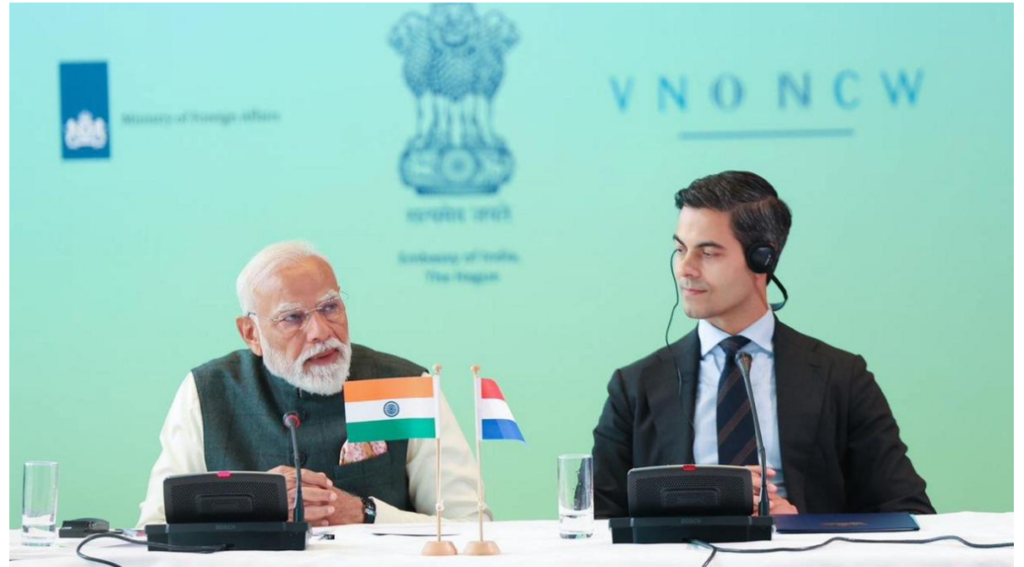
About the India-Netherlands Strategic Partnership Roadmap
The roadmap is a five-year framework to deepen cooperation between India and the Netherlands.
It moves the relationship beyond traditional trade ties and gives it a broader strategic direction. The partnership combines modern areas such as semiconductors, renewable energy, cyber security, green hydrogen and maritime cooperation with cultural areas such as heritage restitution, museum partnerships and people-to-people exchanges.
Major Areas of Cooperation
Political Dialogue
India and the Netherlands agreed to strengthen regular political engagement.
Important features include:
- Regular meetings between Heads of Government or State and Ministers.
- Annual meeting mechanism at the level of Foreign Ministers.
- Review of progress under the Strategic Partnership Roadmap.
- Greater interaction between ministries of both countries.
This will provide continuous political guidance and help both countries implement the roadmap in a time-bound manner.
Economic Cooperation and Investments
Economic cooperation is one of the main pillars of the partnership.
Focus sectors include:
- Renewable energy, Telecommunications, Maritime sector, Infrastructure and urban development, Innovation, Electronics and semiconductors, Agriculture Pharmaceuticals and medical technology, Organic chemicals, textiles, iron, steel and aluminium
Key initiatives include:
- Use of the Joint Trade and Investment Committee to increase trade and investment.
- Promotion of trade fairs and business forums.
- Review of the Fast Track Mechanism for investment facilitation.
- Cooperation in the Critical Raw Materials value chain.
- Promotion of joint ventures, industrial partnerships and technology collaboration.
This can help both countries build resilient supply chains and support innovation-led growth.
Water Cooperation
India and the Netherlands agreed to renew the Strategic Partnership on Water, originally signed in March 2022.
Focus areas include:
- Integrated water resources management
- Coastal zone management
- Urban water management
- Flood resilience
- River basin management
- Water quality and availability in the Ganga Basin
The Centre of Excellence on Water with the National Mission for Clean Ganga will support knowledge exchange, capacity building, start-ups and urban river management planning.
This is important because the Netherlands has global expertise in water management and flood control.
Agriculture Cooperation
The two countries will continue the Joint Agriculture Working Group.
Focus areas include:
- Climate-resilient agriculture, Animal husbandry, Agri-tech and biotechnology Phytosanitary and veterinary market access, Responsible value chains, Global food security, Clean Plant Centres
The Netherlands is known for advanced agriculture and water-efficient farming. Cooperation can help India improve productivity, sustainability and food safety standards.
Health Cooperation
Health cooperation will focus on public health risks and medical research.
Key areas include:
- Cross-border infectious diseases, antimicrobial resistance, non-communicable diseases, Digital health, AI and cybersecurity in health, Climate change and health One Health and disease surveillance
Important institutions include:
- RIVM – Dutch National Institute for Public Health and the Environment
- ICMR – Indian Council of Medical Research
This cooperation can strengthen disease surveillance, research and global health preparedness.
Emerging Technologies, Innovation, Science and Education
This area is important for India’s technological development.
Focus technologies include:
- Semiconductors, Artificial Intelligence, Cybersecurity, Photonics, Quantum technology, Energy materials, Biomolecular and cell technologies
India and the Netherlands will work to build trusted and resilient semiconductor supply chains.
Important linkages include:
- Dutch Semicon Competence Centre
- Indian Semiconductor Mission
A semiconductor “brain bridge” will be supported between Dutch universities and leading Indian institutions such as:
- IISc Bengaluru, IIT Bombay, IIT Delhi, IIT Gandhinagar, IIT Guwahati, IIT Madras
Industry support includes NXP, ASML, TATA and CG Semi.
Energy Transition, Sustainable Development and Maritime Development
India and the Netherlands agreed to strengthen cooperation in clean energy and sustainable development.
Key areas include:
- Renewable energy, green hydrogen, Bioenergy, Battery storage, Circular economy Waste-to-energy, Climate adaptation and mitigation, Sustainable urban development
Both countries will prepare an action plan for renewable hydrogen, including a green corridor between India and the Netherlands.
A major proposal is the Green and Digital Sea Corridor. It aims to:
- Promote green energy solutions in ports
- Develop sustainable shipping
- Support digital maritime systems
- Improve economic efficiency in maritime trade
- Promote India’s green hydrogen exports to Europe
This supports India’s maritime trade, clean shipping goals and green energy export ambitions.
Defence Cooperation
Defence cooperation will be expanded through structured engagement.
Key areas include:
- Joint tri-services interaction, Maritime cooperation, Naval exercises, Defence industry cooperation, Defence research collaboration, Defence Industrial Roadmap Possible Mutual Logistic Support Agreement
The Netherlands’ growing interest in the Indo-Pacific Region can support India’s maritime and strategic interests.
Security Cooperation
Security cooperation will cover both traditional and non-traditional security areas.
Focus areas include:
- Maritime security, Economic security, Knowledge security, Counterterrorism Cybersecurity, Critical and emerging technologies, Cybercrime prevention
Both countries will work together for the adoption of the Comprehensive Convention on International Terrorism at the United Nations.
They will also continue efforts to conclude:
- Mutual Legal Assistance Treaty
- New Extradition Treaty
Migration, Mobility and Consular Matters
The roadmap focuses on fair and legal migration.
Key points include:
- Facilitation of fair migration and mobility
- Prevention of irregular migration
- Movement of students, academics and researchers
- Mobility of skilled professionals and young professionals
- Implementation of the MoU on Mobility and Migration
- Continuation of the India-Netherlands Consular Dialogue
This is useful for Indian students, researchers and skilled workers seeking opportunities in the Netherlands.
Culture, Mobility and Heritage
- Migration and Mobility: India and the Netherlands signed an MoU to promote fair mobility of students, researchers and highly skilled professionals, while addressing irregular migration.
- Heritage Restitution: India welcomed the return of the Chola-era Anaimangalam Copper Plates from the University of Leiden, marking an important step in heritage restitution.
- Museums and Arts: Both countries expanded cultural cooperation through museum partnerships, exhibitions involving Amrita Sher-Gil and Van Gogh, and cooperation on the National Maritime Heritage Complex, Lothal.
Leiden Plates / Anaimangalam Copper Plates
- The Leiden Plates consist of 21 large copper plates, 3 small copper plates and a royal bronze ring.
- They were taken to the Netherlands in the 18th century during Dutch control of Nagapattinam.
- They record the grant of Anaimangalam village to Chulamanivarma Vihara, a Buddhist monastery built by the Srivijaya ruler Sri Mara Vijayotunga Varman.
- The grant was promised by Raja Raja Chola I and executed by Rajendra Chola I.
Historical Significance
- The plates show Chola maritime diplomacy, India–Southeast Asia links, religious syncretism and strong local administration.
- They used Sanskrit in Grantha script for royal genealogy and Tamil for land boundaries, tax exemptions and local assembly duties.
- The royal seal carried the Chola Tiger, Pandya Fish and Chera Bow, symbolising Chola supremacy over the Tamil Muvendhar.
Other Important Copper Plates
- Sogaura Copperplate: Mauryan-period record on famine relief in Prakrit and Brahmi script.
- Karandai Plates: 57-plate Chola charter on Rajendra I’s expeditions and Brahmadeya grants.
- Tiruvalangadu Plates: Record Rajendra I’s expedition to the Ganga.
- Anbil Plates: Provide early Chola genealogical details.
Significance of the Partnership
- Strengthens India-Netherlands relations from bilateral cooperation to strategic partnership.
- Supports India’s interests in semiconductors, clean energy, water management and maritime connectivity.
- Enhances cooperation in climate-resilient agriculture and global food security.
- Promotes cooperation in health, One Health, disease surveillance and antimicrobial resistance.
- Supports India’s green hydrogen export ambitions through maritime cooperation.
- Deepens defence and Indo-Pacific cooperation.
- Facilitates fair mobility for Indian students, researchers and skilled professionals.
- Encourages cultural diplomacy through museum partnerships and heritage restitution.
- Highlights India’s historical maritime links with Southeast Asia through the Anaimangalam Copper Plates.
Way Forward
- Use the annual Foreign Ministers’ mechanism for regular progress review.
- Align technology cooperation with India’s semiconductor and clean energy priorities.
- Build strong talent pipelines through universities, research institutions and industry partnerships.
- Improve standards and certification to meet European environmental and food safety norms.
- Ensure fair and predictable pathways for students, researchers and skilled workers.
- Strengthen institutional coordination in water and urban infrastructure projects.
- Use the Green and Digital Sea Corridor to promote sustainable maritime trade and green hydrogen exports.
- Promote cultural restitution and museum partnerships as tools of heritage diplomacy.
- Develop the National Maritime Heritage Complex at Lothal as a symbol of India’s long maritime history.
Conclusion
The India-Netherlands Strategic Partnership Roadmap 2026–2030 shows India’s growing cooperation with advanced European countries in trade, technology, water, agriculture, health, defence, security, migration and culture.The return of the Anaimangalam Copper Plates adds historical depth by highlighting India’s civilisational and maritime links.
Its success will depend on effective implementation, regulatory coordination, technology cooperation, strategic trust and respect for India’s strategic autonomy.
UPSC PYQ
Q. Consider the following statements: (2023)
The ‘Stability and Growth Pact’ of the European Union is a treaty that:
- limits the levels of the budgetary deficit of the countries of the European Union
- makes the countries of the European Union to share their infrastructure facilities
- enables the countries of the European Union to share their technologies
How many of the above statements are correct?
A. Only one
B. Only two
C. All three
D. None
Answer: A
Explanation
- Statement 1 is correct: The Stability and Growth Pact is related to fiscal discipline in the European Union. It limits excessive budget deficits and public debt among EU member countries, especially those using the euro.
- Statement 2 is incorrect: It does not deal with sharing infrastructure facilities among EU countries.
- Statement 3 is incorrect: It does not deal with sharing technologies among EU countries.
Additional Information
The Stability and Growth Pact was created to ensure that EU countries maintain sound public finances. It is mainly linked to budget deficit, public debt and fiscal stability, not infrastructure or technology sharing.
CARE MCQ
Q. With reference to the India-Netherlands Strategic Partnership, consider the following statements:
- The Roadmap of India-Netherlands Strategic Partnership covers the period 2026–2030.
- Water, Agriculture and Health are among the core pillars of India-Netherlands cooperation.
- The Netherlands is India’s largest merchandise export destination in Europe.
Which of the statements given above are correct?
A. 1 and 2 only
B. 2 and 3 only
C. 1 and 3 only
D. 1, 2 and 3
Answer: D
Explanation:
- Statement 1 is correct:
India and the Netherlands adopted the Roadmap of India-Netherlands Strategic Partnership for 2026–2030 during the Prime Minister’s official visit to the Netherlands. - Statement 2 is correct:
Water, Agriculture and Health (WAH) are important pillars of cooperation between India and the Netherlands. These include areas such as water management, agri-tech innovation, public health, One Health and anti-microbial resistance. - Statement 3 is correct:
The Netherlands is India’s largest merchandise export destination in Europe. India also enjoys a substantial trade surplus with the Netherlands.
Therefore, all three statements are correct.Top of FormBottom of Form
FAQs
1. What is the India-Netherlands Strategic Partnership Roadmap?
It is a five-year framework for cooperation between India and the Netherlands from 2026 to 2030.
2. Which sectors are covered under the roadmap?
It covers trade, investment, water, agriculture, health, semiconductors, education, renewable energy, maritime development, defence, security, migration and culture.
3. What are the Leiden Plates?
The Leiden Plates are Chola-era copper plate inscriptions, also known as the Anaimangalam Copper Plates.
4. What do the Anaimangalam Copper Plates record?
They record the grant of Anaimangalam village to Chulamanivarma Vihara, a Buddhist monastery linked to the Srivijaya Kingdom.