Table of Contents
Relevance: Paper-III – Indian Society, Constitution and Governance
For Prelims:
- Bonded Labour, Bonded Labour System (Abolition) Act 1976, Child and Adolescent Labour Act, Article 23, Human Trafficking, Brick Kilns, Migrant Workers, Release Certificate, Rehabilitation, Minimum Wages.
For Mains:
- Labour Exploitation, Forced Labour, Migrant Vulnerability, Informal Sector, Child Labour, Social Justice, Human Dignity, Labour Rights, Rehabilitation, Inter-State Migration.
Why in News?
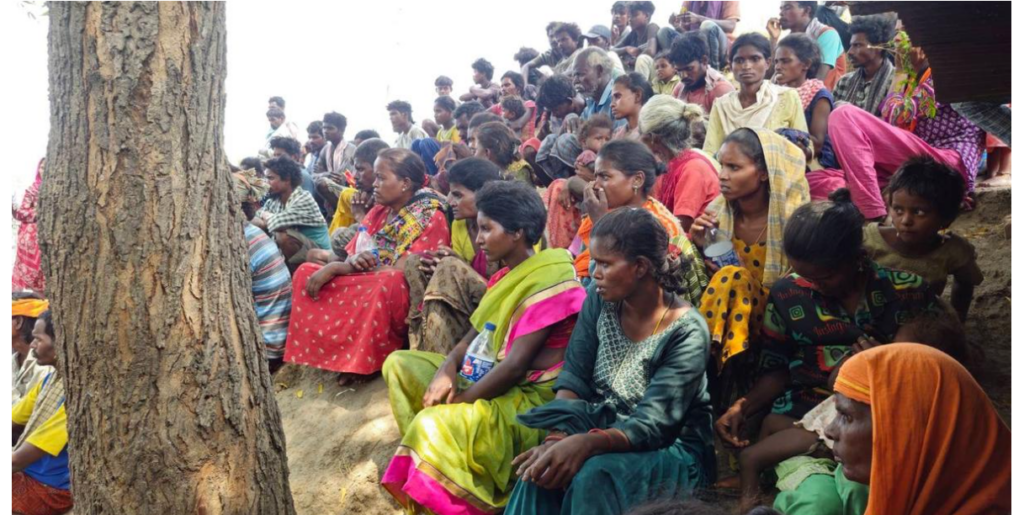
- More than 400 labourers, including nearly 100 children, were rescued from alleged bonded labour conditions at brick kilns in Armoor mandal of Nizamabad district, Telangana. The workers were reportedly from Telangana, Andhra Pradesh, Tamil Nadu and Odisha. The rescue operation was carried out after authorities received information from relatives of one of the labourers.
What Happened in Nizamabad?
- The operation was conducted at four brick kilns in Degam village, also known as Degaon.
- Three special police teams, with nearly 30 personnel from the Armoor division, were deployed.
- Around 200 persons were formally counted by evening, while identification and verification continued.
- Several rescued persons included women and children, and many showed signs of malnourishment.
Nature of Exploitation
- Workers were allegedly kept in bondage-like conditions.
- They were denied regular wages.
- Instead of direct wages, they were reportedly given vouchers that could be exchanged only for essential goods.
- One labourer from Tamil Nadu alleged that he worked for nearly four years without direct wages and survived on a grocery voucher worth ₹200 per week.
- Labourers also alleged:
- Restrictions on movement
- Denial of minimum wages
- Inability to change employment freely
- No freedom to negotiate wages
- Intimidation
- Physical violence
- Sexual abuse
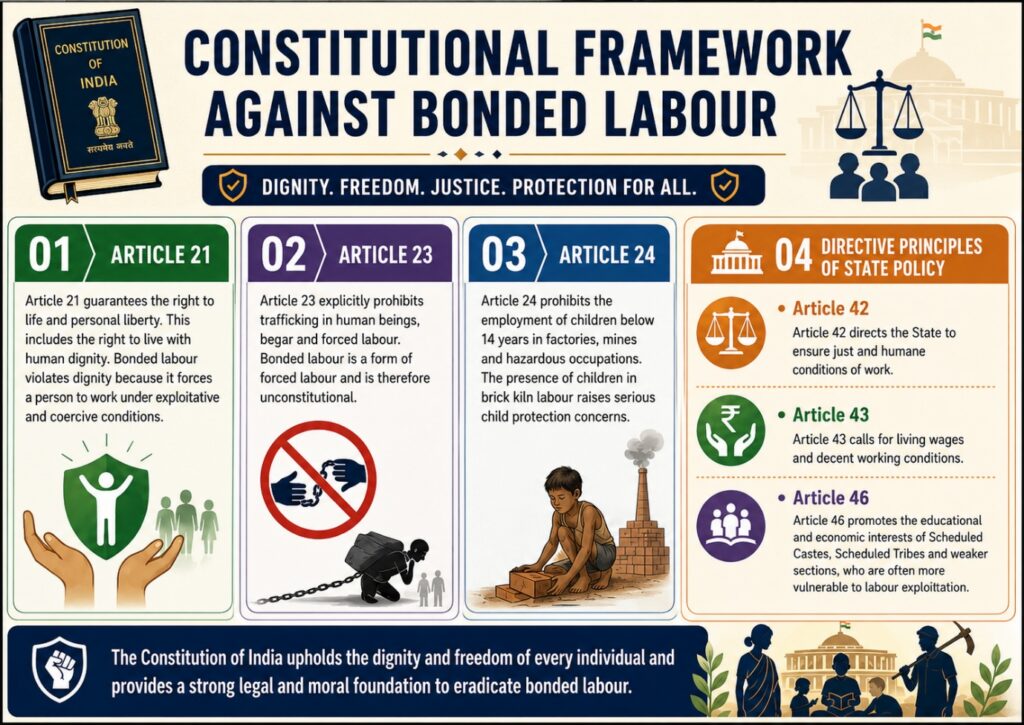
Constitutional Framework Against Bonded Labour
Legal Framework in India
Bonded Labour System (Abolition) Act, 1976
This Act abolishes bonded labour, frees bonded labourers from obligations and criminalises bonded labour practices.
Child and Adolescent Labour Act, 1986, amended in 2016
This law prohibits employment of children below 14 years and restricts adolescents aged 14–18 years from hazardous occupations.
Juvenile Justice Act, 2015
This Act provides for care, protection, rehabilitation and reintegration of children in need, including rescued children.
Bharatiya Nyaya Sanhita, 2023
The BNS addresses offences related to unlawful compulsory labour and provides legal provisions to punish forced labour practices.
Human Trafficking Provisions
If workers were transported, confined or exploited through coercion or deception, human trafficking-related provisions may also apply after investigation.
International Obligations
India is bound by international commitments to prevent forced labour and child exploitation.
Important instruments include:
- United Nations Convention on the Rights of the Child, 1989: Article 32 protects children from economic exploitation and hazardous work.
- ILO Convention 182: It deals with the worst forms of child labour and has been ratified by India.
These obligations strengthen India’s duty to protect children and vulnerable workers from exploitation.
Vulnerability of Migrant Labourers
- Migrant labourers are often vulnerable due to poverty, lack of local support and dependence on employers.
- Many work in informal sectors such as brick kilns, construction and agriculture.
- They may not have proper wage records, identity support, social security or access to legal help.
- Children of migrant workers are at risk of malnutrition, lack of schooling and child labour.
Rehabilitation Measures
- Authorities are expected to:
- Record testimonies
- Identify vulnerable persons
- Issue release certificates to bonded labour survivors
- Facilitate financial assistance
- Support repatriation of inter-State migrant workers
- Ensure rehabilitation under relevant schemes
- Rehabilitation is essential because rescue alone does not end economic vulnerability.
Challenges
- Bonded labour is often hidden behind informal work arrangements.
- Migrant workers may lack documents, awareness and local support.
- Wage payments through vouchers make exploitation difficult to track.
- Fear of employers may prevent victims from speaking openly.
- Children in such families may remain outside school systems.
- Verification of records and proof of bondage may take time.
- Rehabilitation becomes difficult if workers return to poverty without livelihood support.
Way Forward
- Conduct regular inspections of brick kilns and high-risk worksites.
- Maintain proper registration of migrant workers.
- Ensure direct wage payment into bank accounts.
- Strengthen enforcement of minimum wages and labour laws.
- Provide education, nutrition and protection for children of rescued families.
- Issue release certificates quickly after verification.
- Ensure financial assistance, housing support and livelihood rehabilitation.
- Improve coordination among police, labour, revenue and child welfare departments.
- Create helplines and awareness programmes for migrant workers.
- Monitor rescued workers after repatriation to prevent re-bondage.
Conclusion
The rescue of over 400 labourers from brick kilns in Nizamabad shows that bonded labour remains a serious social justice concern. Such exploitation violates human dignity, constitutional rights and labour laws.
A strong response requires more than rescue operations. It needs regular monitoring, strict prosecution of offenders, protection of children, direct wage systems and long-term rehabilitation. Protecting migrant workers from bondage is essential for inclusive development and constitutional governance
CARE MCQ
Q. International Labour Organization’s Conventions 138 and 182 are related to:
A. Child labour
B. Gender parity at the workplace
C. Regulation of food security
D. Adaptation of agriculture to climate change
Answer: A
Explanation:
- ILO Convention No. 138 deals with the minimum age for admission to employment. It aims to prevent children from entering employment before a legally permitted age.
- ILO Convention No. 182 deals with the worst forms of child labour, such as slavery, trafficking, forced labour, use of children in armed conflict, prostitution, pornography and hazardous work.
- Together, these two conventions form the core international legal framework against child labour.
Additional Information:
- The International Labour Organization (ILO) is a specialised agency of the United Nations.
- It was established in 1919.
- Its major objective is to promote social justice and decent work.
FAQs
1) What is bonded labour and which law abolishes it in India?
Bonded labour refers to a system where a person is forced to work to repay a debt or due to coercion and exploitation. It was abolished under the Bonded Labour System (Abolition) Act, 1976.
2) Why are migrant workers more vulnerable to bonded labour?
Migrant workers often face poverty, lack of local support, absence of legal awareness, irregular wage records and dependence on employers, making them vulnerable to exploitation in informal sectors like brick kilns.
3) Which constitutional provision prohibits forced labour in India?
Article 23 of the Indian Constitution prohibits human trafficking, begar and all forms of forced labour.
4) Why is rehabilitation important after rescuing bonded labourers?
Rehabilitation is important because rescue alone does not remove economic vulnerability. Financial assistance, livelihood support, housing, education and social protection help prevent workers from falling back into bondage.