Relevance: APPSC Group 1 Mains paper II – Governance, Education, Human Resource Development, Welfare Schemes,
For Prelims:
- Andhra Model of Education, 100% Enrolment, One Class-One Teacher, GFLN, Clicker Technology, Chromebooks, Star-Rating System, Smart Kitchens, LEAP App
For Mains:
- Public Education Reform, Learning Outcomes, School Dropouts, Digital Classrooms, Foundational Literacy, Gender Sensitivity, Value-Based Education, Educational Equity
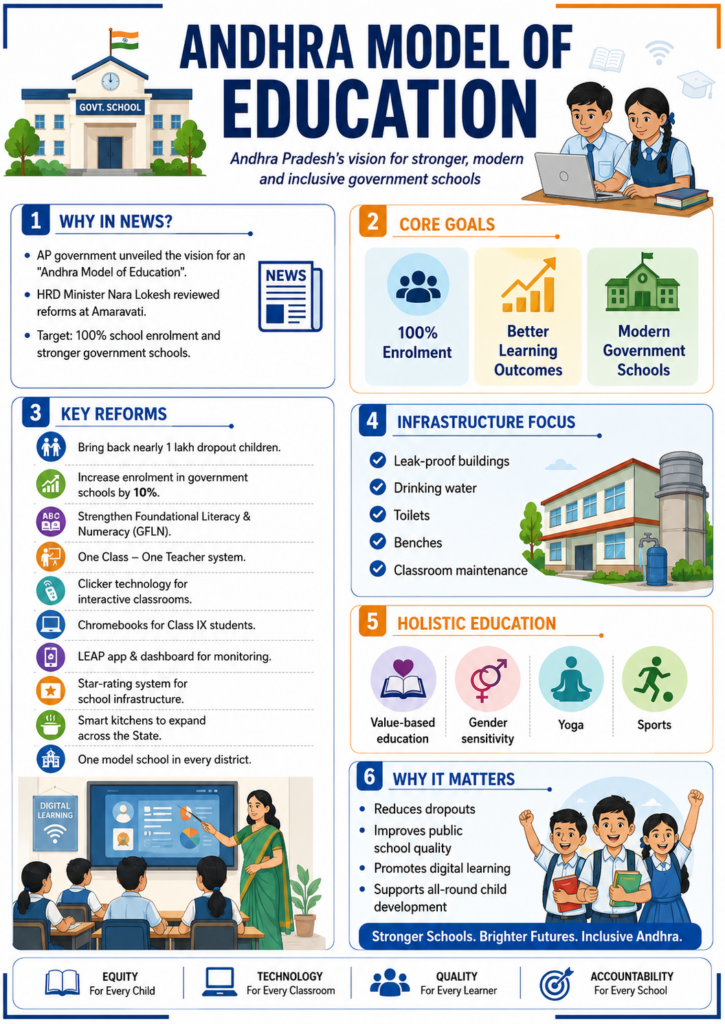
The Andhra Pradesh government has announced its vision to develop an “Andhra Model of Education” as a role model for the country. HRD Minister Nara Lokesh reviewed education reforms with District Education Officers and other officials at the Secretariat in Amaravati.
The government has set a target of 100% school enrolment and aims to strengthen government schools through better infrastructure, digital tools, teacher training and improved learning outcomes.
What is the Andhra Model of Education?
The Andhra Model of Education is a proposed school education reform model focused on making government schools strong, modern, inclusive and student-friendly.
It aims to ensure that government schools compete with private institutions in terms of teaching quality, infrastructure, technology and learning outcomes.
The model focuses on three major goals:
- 100% enrolment of children
- Improvement of learning outcomes
- Modernisation of government schools

Key Features
1. Goal of 100% School Enrolment
- The State government expressed concern over nearly one lakh school dropouts. Officials were directed to identify children who were never enrolled or who had left school and bring them back into the education system.
- The government also aims to increase enrolment in government schools by at least 10%.
2. Focus on Learning Outcomes
- The government will strengthen the Guaranteed Foundational Literacy and Numeracy Programme. This is important because even a small learning gap can affect lakhs of students.
- Foundational literacy means the ability to read and understand basic text. Foundational numeracy means the ability to do basic calculations.
3. Digital Learning Measures
The government plans to introduce:
- Clicker technology for interactive classroom learning
- Chromebooks for Class IX students
- LEAP app and dashboard system for better monitoring and transparency
These measures aim to make classroom teaching more student-centred and technology-driven.
4. One Class-One Teacher System
- The government is implementing the One Class-One Teacher system. This can improve classroom responsibility and help teachers understand the learning level of students better.
5. School Infrastructure Reform
A star-rating system has been introduced for government school infrastructure. Schools will be assessed on basic facilities such as:
- Leak-proof buildings
- Drinking water
- Toilets
- Benches
- Proper classroom maintenance
This will help improve accountability and infrastructure quality.
6. Smart Kitchens
- Smart kitchens, already introduced in Kadapa schools, will be expanded across Andhra Pradesh within two years. This can improve hygiene and efficiency in school meal preparation.
7. Model Schools in Every District
- The Minister cited the example of Nidamarru school in Mangalagiri, which is being developed as an international school. The government has urged officials to develop at least one model school in every district.
8. Holistic Education
The government also wants schools to give importance to:
- Value-based education
- Gender sensitivity
- Yoga
- Sports
This reflects a shift from only marks-based education to all-round development.
Significance
Educational Significance
- The reforms can improve access, enrolment and learning quality in government schools. Focus on foundational literacy and numeracy will help students build strong basic skills.
Social Significance
- The 100% enrolment goal is important for children from poor families, migrant households and vulnerable communities. It can reduce child labour and prevent children from being pushed into agricultural or informal work.
Governance Significance
- The LEAP app, dashboard monitoring and star-rating system can improve transparency and accountability in school administration.
Technological Significance
- Clicker technology and Chromebooks can help modernise classroom learning. They can also reduce the gap between government and private schools.
Challenges
- Bringing back nearly one lakh dropouts may require strong field-level tracking.
- Digital learning may face problems such as lack of internet, device maintenance and teacher training.
- Infrastructure reforms need continuous funding and monitoring.
- Learning outcomes cannot improve only through technology; teacher quality and classroom methods are equally important.
- Migrant children and poor families may need additional social support to continue education.
Way Forward
- Conduct regular surveys to identify out-of-school children.
- Strengthen bridge courses for dropouts and first-generation learners.
- Provide proper training to teachers in digital tools and modern teaching methods.
- Ensure internet, electricity and device maintenance in all schools.
- Link education reforms with nutrition, health and social welfare schemes.
- Develop model schools in every district without neglecting ordinary rural schools.
Conclusion
The Andhra Model of Education aims to make government schools more inclusive, modern and outcome-oriented. Its focus on 100% enrolment, digital learning, foundational literacy, infrastructure improvement and value-based education can strengthen public education in Andhra Pradesh. Effective implementation, teacher support and continuous monitoring will decide its long-term success.
CARE MCQ
Q. With reference to the Andhra Model of Education, consider the following statements:
- It aims to achieve 100% school enrolment in Andhra Pradesh.
- The State government plans to introduce Chromebooks for Class IX students.
- Smart kitchens introduced in Kadapa schools will be expanded across the State.
Which of the above statements are correct?
A. 1 and 2 only
B. 2 and 3 only
C. 1 and 3 only
D. 1, 2 and 3
Answer: D
Explanation:
- Statement 1 is correct: The government has set a goal of achieving 100% school enrolment.
- Statement 2 is correct: Chromebooks are proposed for Class IX students to improve classroom learning.
- Statement 3 is correct: Smart kitchens, already introduced in Kadapa, will be expanded across the State.
Additional Information: The reforms aim to improve enrolment, reduce dropouts, strengthen learning outcomes and modernise government schools.
Q. With reference to the school education reforms in Andhra Pradesh, consider the following pairs:
| Reform | Purpose |
| 1. Star-rating system | Assessment of school infrastructure |
| 2. GFLN programme | Foundational literacy and numeracy |
| 3. LEAP app | Monitoring and transparency |
How many of the above pairs are correctly matched?
A. Only one
B. Only two
C. All the three
D. None
Answer: C
Explanation:
- Pair 1 is correctly matched: The star-rating system assesses facilities such as buildings, toilets, drinking water and classrooms.
- Pair 2 is correctly matched: GFLN focuses on Foundational Literacy and Numeracy.
- Pair 3 is correctly matched: The LEAP app and dashboard aim to improve monitoring and transparency.
Additional Information: These reforms combine infrastructure development, learning improvement and technology-based governance.
FAQs
1. What is the Andhra Model of Education?
It is a proposed education reform model of Andhra Pradesh focused on 100% enrolment, better learning outcomes, digital classrooms and improved school infrastructure.
2. What is the main goal of the model?
The main goal is to achieve 100% school enrolment and improve the quality of government school education.
3. What is clicker technology?
Clicker technology allows students to answer classroom questions digitally, helping teachers check learning levels quickly.
4. Why are smart kitchens important?
Smart kitchens improve hygiene, quality and efficiency in preparing school meals, which can support better attendance and student health.
Relevance: UPSC GS Paper II: Governance, Statutory Bodies, Transparency and Accountability, RTI Act.
For Prelims:
- BCCI, Right to Information Act, 2005, Section 2(h), Public Authority, Article 12, Central Information Commission, Lodha Committee, Law Commission 275th Report, Zee Telefilms Case, Article 226
For Mains:
- Transparency in sports governance, public function doctrine, Autonomy of sports bodies, Judicial review, Accountability of private bodies, Good governance
Why in News?
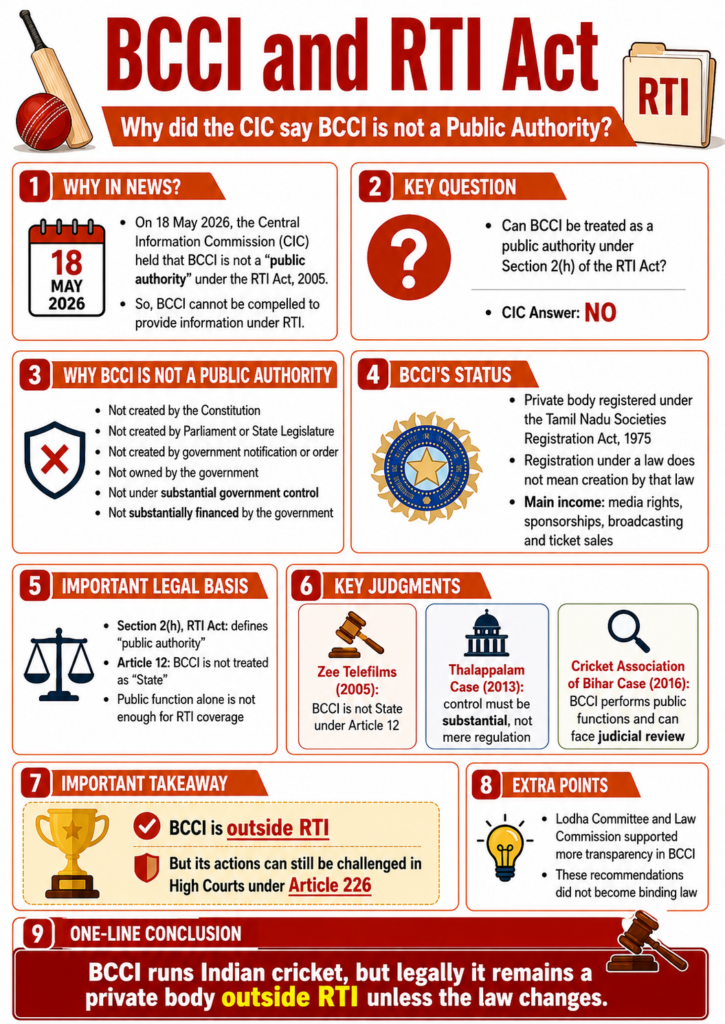
- The Central Information Commission (CIC) held on May 18, 2026 that the Board of Control for Cricket in India (BCCI) is not a “public authority” under the Right to Information Act, 2005.
- This means the BCCI cannot be compelled to provide information under the RTI Act.
- The case arose from an RTI application filed by a Delhi resident, who wanted to know under what authority the BCCI selects players for India and whether the government has any legal control over cricket administration in India.
Key Issue
The main question before the CIC was:
Can BCCI be treated as a public authority under Section 2(h) of the RTI Act?
The CIC answered No, because the BCCI is NOT:
- created by the Constitution,
- created by Parliament or State Legislature,
- created through government notification,
- owned by the government,
- substantially controlled by the government,
- substantially financed by the government.
Background
The BCCI is the most powerful cricket body in India. It selects the Indian cricket team, conducts tournaments, controls cricket administration and manages large commercial revenues.
Earlier, in 2018, a CIC bench under Information Commissioner M. Sridhar Acharyulu had held that the BCCI should be treated as a public authority under the RTI Act. It directed the BCCI to appoint Central Public Information Officers and disclose information.
However, the Madras High Court later set aside that order and sent the matter back for fresh consideration. The 2026 CIC order came after this reconsideration.
Legal Framework
Section 2(h) of the RTI Act, 2005
Section 2(h) defines a public authority as any authority, body or institution established or constituted by:
- the Constitution;
- any law made by Parliament;
- any law made by a State Legislature;
- government notification or order.
It also includes bodies that are:
- owned by the government;
- controlled by the government;
- substantially financed by the government;
- non-government organisations substantially financed by public funds.
Article 12 of the Constitution
Article 12 defines the term State for the purpose of Fundamental Rights. It includes the government, Parliament, State Legislatures and other authorities under government control.
The BCCI has not been treated as State under Article 12, though courts have recognised that it performs important public functions.
What the Central Information Commission (CIC) Said
1. BCCI is Not Created by Law
- The CIC held that the BCCI is a private association registered under the Tamil Nadu Societies Registration Act, 1975.
- The Commission clarified that registration under a statute does not mean that the body is created by that statute.
- For example, the State Bank of India was created by Parliament. But the BCCI was formed by cricket administrators and later registered as a society.
- Therefore, it has legal recognition, but not statutory status.
2. No Substantial Government Control
- The CIC said that the government does not exercise substantial and pervasive control over the BCCI.
- The BCCI’s office-bearers are elected internally. There is no government nominee in its committees. Government approval is not required for its decisions.
- The Commission relied on the principle that ordinary regulatory supervision is not enough. Control must be strong and deep over management, policy, administration and finance.
3. No Substantial Government Financing
The CIC held that the BCCI is not substantially financed by the government.
The BCCI mainly earns revenue through:
- media rights,
- sponsorships,
- broadcasting agreements,
- ticket sales,
- cricket-related commercial activities.
The use of government-owned stadiums or police deployment during matches was not considered substantial government financing.
4. Public Function Alone is Not Enough
- The BCCI performs important public functions such as selecting the Indian cricket team and regulating cricket in India.
- However, the CIC held that performing a public function alone does not automatically make a body a public authority under the RTI Act.
- To come under RTI, the body must satisfy the legal conditions mentioned under Section 2(h).
Supreme Court Judgments
Zee Telefilms Ltd. v. Union of India, 2005
- In this case, the Supreme Court held that the BCCI is not “State” under Article 12.
- The Court observed that the BCCI was not financially, functionally or administratively dominated by the government. It had no government shareholding and did not receive significant financial assistance from the State.
- This judgment formed the constitutional basis for the CIC’s reasoning.
Thalappalam Service Cooperative Bank Ltd. v. State of Kerala, 2013
- The Supreme Court held that “control” under Section 2(h) of the RTI Act must mean substantial control, not mere supervision or regulation.
- The CIC used this principle to hold that the BCCI is not under substantial government control.
BCCI v. Cricket Association of Bihar, 2016
- In this case, the Supreme Court imposed governance reforms on the BCCI through the Lodha Committee recommendations.
- The Court held that even if the BCCI is not “State” under Article 12, it can still be subject to judicial review under Article 226 because it performs public functions.
- This means High Courts can examine BCCI actions if they are arbitrary or against public interest.
Role of Lodha Committee and Law Commission
The Lodha Committee recommended major reforms in BCCI governance, including:
- tenure limits,
- one-state-one-vote principle,
- conflict-of-interest norms,
- structural reforms.
The Law Commission of India, in its 275th Report, 2018, recommended that the BCCI should be brought under the RTI Act because it performs functions similar to a National Sports Federation.
However, these recommendations did not become binding law.
National Sports Governance Act, 2025
The National Sports Governance Act, 2025 provides that sports bodies receiving grants from the government may be treated as public authorities under the RTI Act, but only to the extent of utilisation of those funds.
Since the BCCI does not receive such government grants, it falls outside this provision.
Significance
1. Clarifies the Scope of RTI
- The decision explains that not every powerful or influential body automatically comes under RTI. The body must satisfy the conditions under Section 2(h).
2. Distinguishes Public Function from Public Authority
- The BCCI performs public functions, but that alone is not enough to classify it as a public authority under the RTI Act.
3. Protects Institutional Autonomy
- The order protects the autonomy of a private sports body from direct RTI obligations, unless Parliament clearly provides otherwise.
4. Highlights Sports Governance Issues
- The decision has again raised questions about transparency, accountability and fairness in sports administration.
Concerns
1. Accountability Gap
- The BCCI selects players who represent India and controls cricket administration. But people cannot seek information from it under RTI.
2. Lack of Transparency
- Information related to selection process, financial contracts, conflict of interest and governance may remain outside public scrutiny.
3. Public Importance of Cricket
- Cricket is not merely a private sport in India. It has national importance and large public participation.
4. Limits of Existing RTI Law
- The case shows that the RTI Act may not fully cover private bodies performing functions of high public importance.
5. Need for Legislative Clarity
- The issue requires a clear law on whether private bodies performing national-level public functions should follow transparency norms.
Way Forward
- The BCCI can voluntarily publish important information such as audited accounts, selection procedures, conflict-of-interest declarations and governance decisions.
- Parliament may consider a balanced transparency framework for sports bodies performing public functions.
- Sports governance reforms should protect autonomy while ensuring public accountability.
- The government should avoid excessive interference but promote minimum disclosure standards for bodies of national importance.
- A separate sports transparency framework may be developed for large sports bodies without converting them fully into government-controlled institutions.
Conclusion
The CIC’s 2026 decision keeps the BCCI outside the RTI Act because it is not created, controlled or substantially financed by the government. However, the BCCI performs important public functions and affects millions of citizens, players and fans.
Therefore, the issue is not only legal but also ethical and governance-related. India needs a balanced framework that ensures transparency, accountability and autonomy in sports administration.
UPSC PYQ
Q. Information under the RTI Act, 2005 can be provided in respect of which of the following? (CDS-I, 2015)
A. National Security Council Secretariat
B. Assam Rifles
C. Border Road Development Board
D. Border Road Organisation
Answer: D
Explanation
Under Section 24 of the Right to Information Act, 2005, certain intelligence and security organisations listed in the Second Schedule are exempted from providing information under RTI.
- National Security Council Secretariat is exempted under the Second Schedule.
- Assam Rifles is also exempted.
- Border Road Development Board is exempted.
- Border Road Organisation is not covered in the same exempted manner here; therefore, information can be provided under the RTI Act, subject to normal restrictions under the Act.
However, even exempted organisations have to provide information if the matter relates to corruption or human rights violations.
Therefore, the correct answer is D. Border Road Organisation.
CARE MCQ
Q. With reference to the BCCI and the RTI Act, consider the following statements:
- The CIC held in 2026 that the BCCI is not a public authority under Section 2(h) of the RTI Act.
- The BCCI is registered under the Tamil Nadu Societies Registration Act, 1975.
- The BCCI receives substantial government grants for its regular functioning.
How many of the above statements are correct?
A. Only one
B. Only two
C. All the three
D. None
Answer: B
Explanation:
- Statement 1 is correct: The CIC held that the BCCI does not fall under the definition of public authority under Section 2(h) of the RTI Act.
- Statement 2 is correct: The BCCI is registered as a society under the Tamil Nadu Societies Registration Act, 1975.
- Statement 3 is incorrect: The CIC noted that the BCCI does not receive substantial government grants. It earns mainly through media rights, sponsorships, broadcasting agreements and ticket sales.
Additional Information:
A body does not become a public authority merely because it performs important public functions. It must satisfy the conditions under Section 2(h) of the RTI Act.
FAQs
1. Why is the BCCI not covered under RTI?
Because it is not created, owned, controlled or substantially financed by the government under Section 2(h) of the RTI Act.
2. Is BCCI a government body?
No. It is a private society registered under the Tamil Nadu Societies Registration Act, 1975.
3. Can courts examine BCCI decisions?
Yes. High Courts can examine BCCI decisions under Article 226 if they involve public function or public interest.
4. Did any committee recommend bringing BCCI under RTI?
Yes. The Lodha Committee and the Law Commission’s 275th Report recommended greater transparency, including bringing BCCI under RTI.
Relevance: GS Paper III – Energy, Infrastructure, Climate Change and Science & Technology
For Prelims:
- Energy Storage, Battery Energy Storage System, Pumped Hydro Storage, Lithium Iron Phosphate Battery, Grid Stability, Concentrating Solar-Thermal Storage, Compressed-Air Energy Storage, Flywheel Storage, Gravity Storage, Central Electricity Authority.
For Mains:
- Renewable Energy Integration, Grid Stability, Energy Security, Storage Infrastructure, Clean Energy Transition, Import Dependence, Battery Manufacturing, Round-the-Clock Renewable Power, Climate Commitments.
Why in News?
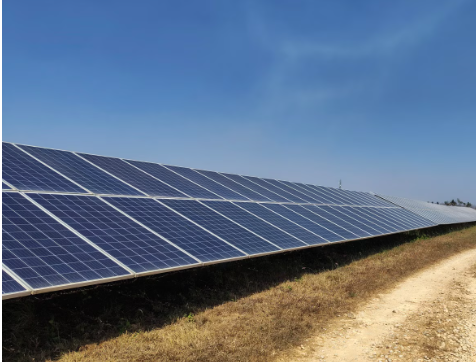
India is rapidly expanding renewable energy to meet its clean energy goals. However, solar and wind power are intermittent, as solar generation stops after sunset and wind output depends on weather.This creates a gap between power generation and demand. Hence, energy storage has become essential for grid stability, reliable electricity supply and better integration of renewable energy.
Need for Energy Storage
- Renewable power generation is not available uniformly throughout the day.
- Solar power is available mainly during daylight hours and falls to zero after sunset.
- Wind power changes according to weather and seasonal conditions.
- Electricity demand may peak during evening or night when solar generation is unavailable.
- Without storage, excess power during high-generation hours may be wasted.
- Storage helps supply electricity when renewable generation is low.
- It reduces stress on the grid and supports stable power supply.
What is Energy Storage?
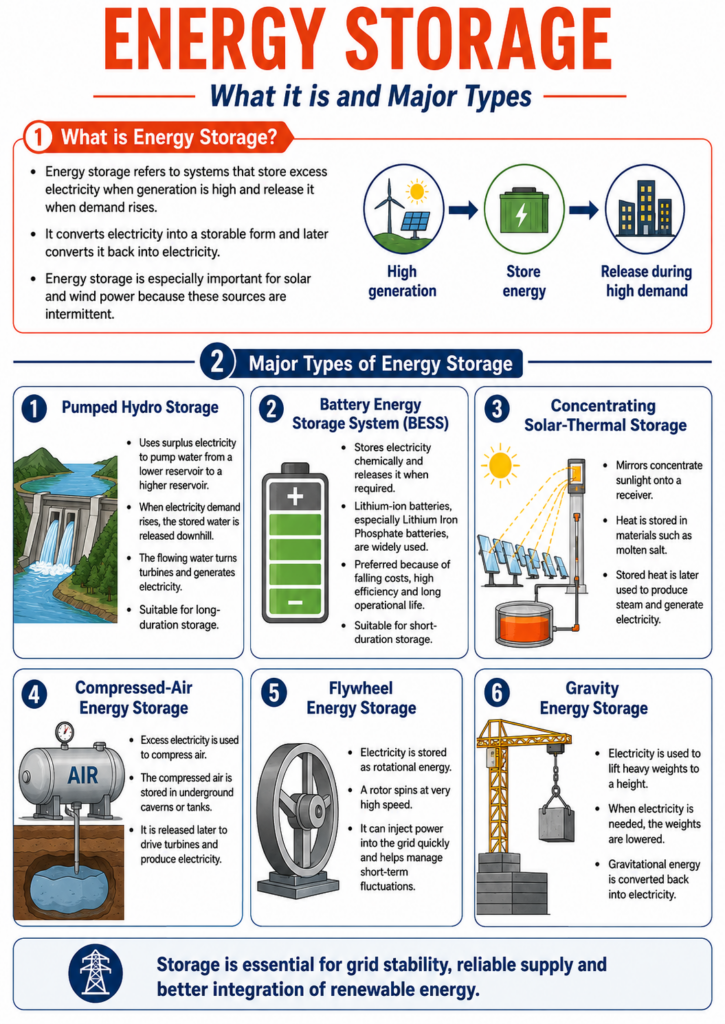
- Energy storage refers to systems that store excess electricity when generation is high and release it when demand rises.
- It converts electricity into a storable form and later converts it back into electricity.
- Energy storage is especially important for solar and wind power because these sources are intermittent.
Major Types of Energy Storage
1. Pumped Hydro Storage
- Pumped Hydro Storage uses surplus electricity to pump water from a lower reservoir to a higher reservoir.
- When electricity demand rises, the stored water is released downhill.
- The flowing water turns turbines and generates electricity.
- It is suitable for long-duration storage.
2. Battery Energy Storage System
- Battery Energy Storage System stores electricity chemically and releases it when required.
- Lithium-ion batteries, especially Lithium Iron Phosphate batteries, are widely used.
- They are preferred because of falling costs, high efficiency and long operational life.
- BESS is suitable for short-duration storage.
3. Concentrating Solar-Thermal Storage
- Mirrors concentrate sunlight onto a receiver.
- Heat is stored in materials such as molten salt.
- Stored heat is later used to produce steam and generate electricity.
4. Compressed-Air Energy Storage
- Excess electricity is used to compress air.
- The compressed air is stored in underground caverns or tanks.
- It is released later to drive turbines and produce electricity.
5. Flywheel Energy Storage
- Electricity is stored as rotational energy.
- A rotor spins at very high speed.
- It can inject power into the grid quickly and helps manage short-term fluctuations.
6. Gravity Energy Storage
- Electricity is used to lift heavy weights to a height.
- When electricity is needed, the weights are lowered.
- Gravitational energy is converted back into electricity.
India’s Present Energy Storage Capacity
- India has rapidly expanded renewable power generation.
- Renewable sources account for about 53% of India’s total installed power generation capacity.
- India’s total installed capacity is around 532 GW.
- Renewable capacity is around 283 GW.
- Solar power alone contributes over 150 GW.
- However, energy storage capacity remains low.
- India’s installed BESS capacity is around 0.27 GW.
- India’s Pumped Hydro Storage capacity is about 7.2 GW.
India’s Future Storage Targets
- The Central Electricity Authority has projected a major rise in energy storage needs.
- India’s total energy storage capacity is projected to reach 174 GW / 888 GWh by 2035–36.
- This includes:
- 80 GW / 321 GWh of Battery Energy Storage System
- 94 GW / 567 GWh of Pumped Hydro Storage
- Storage systems with four to six hours duration will become more important after 2030.
- India’s non-fossil fuel installed capacity is projected to rise from 283 GW to 786 GW by 2035–36.
Project Pipeline
Pumped Hydro Storage
- Around 13,120 MW / 78,720 MWh of Pumped Hydro Storage capacity is under construction.
- Another 9,580 MW / 57,480 MWh has received concurrence and is awaiting construction.
- Projects of nearly 75,000 MW are under survey and investigation.
Battery Energy Storage
- Around 10,658.94 MW / 28,739.32 MWh of BESS capacity is under construction.
- Projects of 22,347.15 MW / 69,836.70 MWh are at the tendering stage.
Import Dependence Challenge
- India depends heavily on imports for battery storage systems.
- India imports nearly 75–80% of lithium-ion cells.
- Lithium-ion cells account for around 80% of the total cost of a battery storage system.
- One Asian country dominates over 75–80% of global battery manufacturing.
- This creates risks related to:
- Geopolitical tensions
- Trade restrictions
- Price volatility
- Supply chain dependence
Global Energy Storage Scenario
- Globally, the two most widely used electricity storage technologies are:
- Pumped Hydro Storage
- Battery Energy Storage System
- Global installed Pumped Hydro Storage capacity is around 160 GW.
- Major countries include:
- China – nearly 66 GW
- Japan – 21.8 GW
- United States – 18.9 GW
- Europe – around 28 GW
- Global battery storage capacity is estimated at around 270 GW.
- Around 108 GW of new battery storage capacity was added globally in 2025.
- China accounted for nearly 60% of global battery storage additions in 2025.
Challenges
- India’s storage deployment is far behind renewable energy growth.
- Battery storage remains dependent on imported lithium-ion cells.
- Pumped Hydro Storage requires suitable geography and environmental clearances.
- Large storage projects require high capital investment.
- Battery supply chains are vulnerable to geopolitical risks.
- Grid planning must adapt to variable renewable power.
- Recycling and disposal of batteries can create environmental concerns.
- Long-duration storage technology is still developing.
Way Forward
- Scale up both BESS and Pumped Hydro Storage.
- Promote domestic battery cell manufacturing.
- Diversify battery supply chains and critical mineral sources.
- Support research in alternatives such as sodium-ion, flow batteries and gravity storage.
- Develop clear policies for grid-scale storage procurement.
- Encourage storage-linked renewable energy projects.
- Improve pumped storage project clearances with environmental safeguards.
- Promote battery recycling and circular economy.
- Use storage to provide round-the-clock renewable power to industries.
- Strengthen grid management through digital forecasting and smart dispatch systems.
Conclusion
India has made strong progress in solar and wind energy, but renewable power needs large-scale storage to ensure reliable supply. Pumped Hydro Storage and Battery Energy Storage Systems will be crucial for grid stability, reducing intermittency and providing round-the-clock clean power. India must now focus on storage infrastructure, domestic battery manufacturing, supply-chain security and grid modernisation
UPSC PYQ
Q. Consider the following statements: (2016)
- The International Solar Alliance was launched at the United Nations Climate Change Conference in 2015.
- The Alliance includes all the member countries of the United Nations.
Which of the statements given above is/are correct?
A. 1 only
B. 2 only
C. Both 1 and 2
D. Neither 1 nor 2
Answer: A
Explanation
- Statement 1 is correct: The International Solar Alliance (ISA) was launched by India and France at the UN Climate Change Conference, COP21, held in Paris in 2015.
- Statement 2 is incorrect: The ISA does not automatically include all UN member countries. It was initially focused on solar-resource-rich countries located between the Tropic of Cancer and Tropic of Capricorn. Later, membership was opened more widely, but it is still not the same as including all UN members by default.
Additional Information
The International Solar Alliance aims to promote solar energy cooperation, reduce the cost of solar power, mobilise investment and support clean energy transition, especially in developing and tropical countries.
CARE MCQ
Q. Consider the following in the context of energy storage systems:
- Pumped Hydro Storage
- Battery Energy Storage Systems
- Compressed-air energy storage systems
- Flywheel energy storage systems
Which of the above are types of energy storage systems?
A. 1 and 2 only
B. 1, 2 and 3 only
C. 2, 3 and 4 only
D. 1, 2, 3 and 4
Answer: D
Explanation:
- Pumped Hydro Storage – Correct. It stores energy by pumping water from a lower reservoir to a higher reservoir and releases it through turbines when demand rises.
- Battery Energy Storage Systems – Correct. These systems store electricity chemically and discharge it when needed.
- Compressed-air energy storage systems – Correct. These systems use excess electricity to compress air and store it for later power generation.
- Flywheel energy storage systems – Correct. They store electricity as rotational energy by spinning a rotor at very high speed.
Additional Information:
Other storage systems mentioned in the content include:
- Concentrating solar-thermal storage systems
- Gravity energy storage systems
The content also notes that Pumped Hydro Storage (PHS) and Battery Energy Storage Systems (BESS) are currently the most widely used technologies.Top of FormBottom of Form
FAQs
1. What is energy storage?
Energy storage means storing extra electricity when power generation is high and releasing it when electricity demand increases.
2. Why is energy storage important for renewable energy?
Solar and wind power are intermittent. Solar power stops after sunset and wind power changes with weather. Energy storage helps provide stable power when renewable generation is low.
3. What are the main types of energy storage?
The major types are Pumped Hydro Storage, Battery Energy Storage System, Solar-Thermal Storage, Compressed-Air Energy Storage, Flywheel Energy Storage and Gravity Energy Storage.
4. What is Pumped Hydro Storage?
Pumped Hydro Storage uses surplus electricity to pump water to a higher reservoir. When power is needed, the water flows down through turbines to generate electricity.
5. What is Battery Energy Storage System?
Battery Energy Storage System stores electricity chemically and releases it when needed. Lithium-ion batteries, especially Lithium Iron Phosphate batteries, are widely used.
6. Which storage system is suitable for long-duration storage?
Pumped Hydro Storage is generally suitable for long-duration energy storage.