Table of Contents
Relevance: UPSC GS Paper II: International Relations, Effect of Policies of Developed Countries, India and Global Powers
For Prelims:
- U.S.–China Trade War, Trump–Xi Summit, Agricultural Trade, Soybeans, Beef Imports, Poultry Imports, Non-Tariff Barriers, Taiwan Arms Sale, One-China Principle, HIMARS, Grey-Zone Warfare, Taiwan Strait
For Mains:
- Economic Interdependence, Strategic Rivalry, Food Security, National Security, Trade Diplomacy, Market Access, Tariff War, Indo-Pacific Security, Deterrence, Supply Chain Resilience
Why in News?
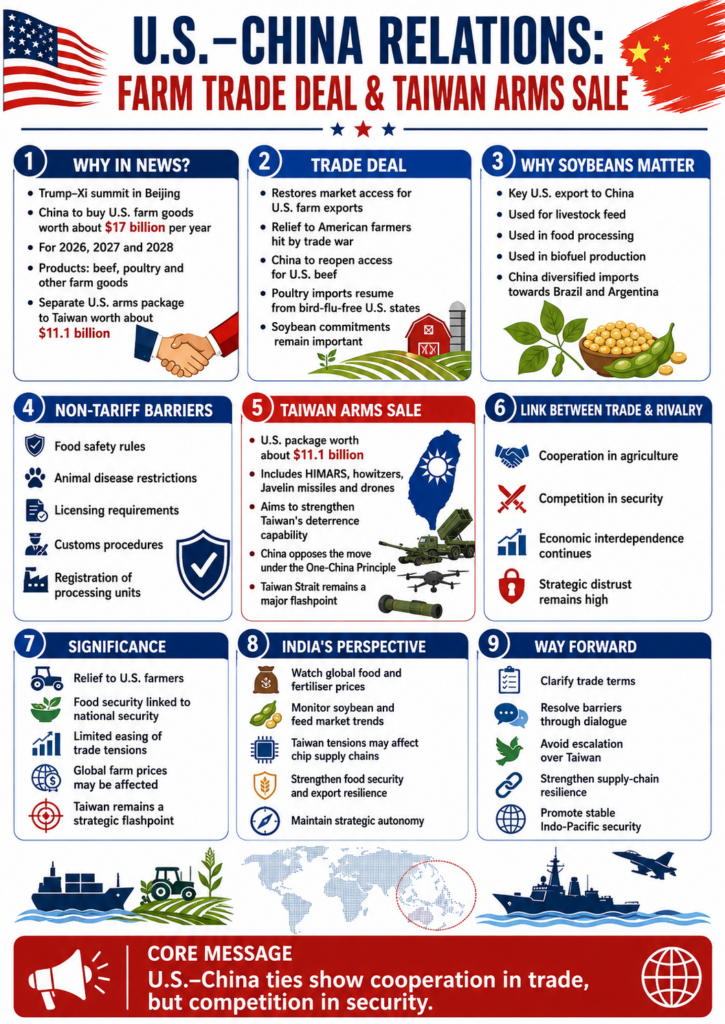
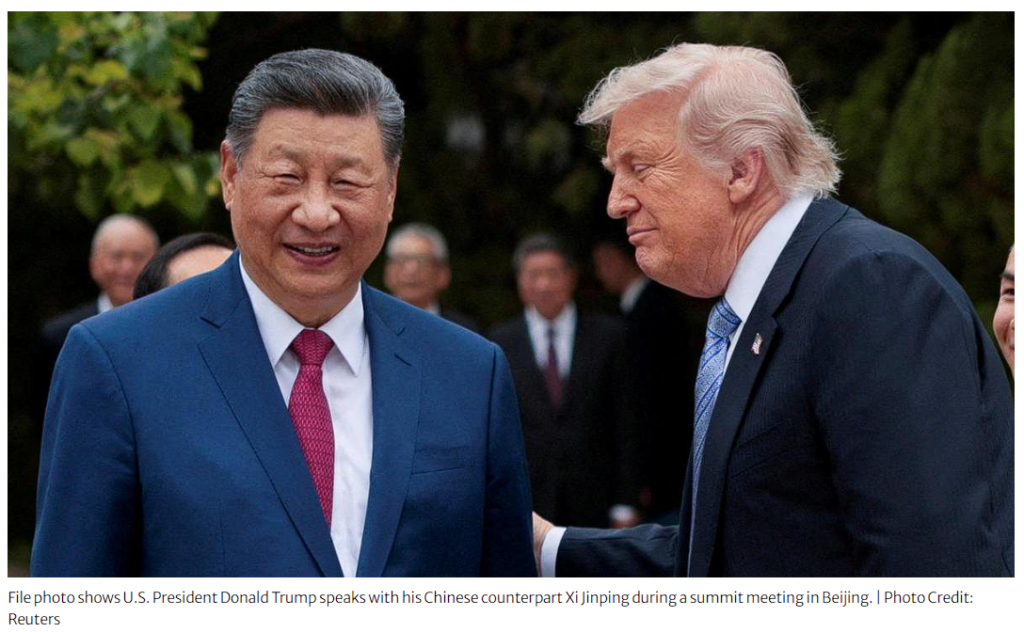
China has agreed to increase imports of U.S. agricultural products after the recent Trump–Xi summit in Beijing.
According to the White House, China will buy U.S. agricultural products at an annualised rate of about $17 billion per year for 2026, 2027 and 2028. The products include beef, poultry and other farm goods, while soybean commitments are being treated separately.
At the same time, U.S.–China tensions remain high over Taiwan, as the United States approved a major arms package worth around $11.1 billion for Taiwan in December 2025. The package includes systems such as HIMARS rocket systems, howitzers, Javelin anti-tank missiles and drones.
Key Highlights
- The U.S.–China agricultural agreement is aimed at restoring market access for American farm products that were badly affected during the trade war.
- China will restore access for U.S. beef and resume imports of poultry from U.S. states declared free from bird flu by the U.S. Department of Agriculture.
- The deal also focuses on resolving non-tariff barriers, including issues related to licensing, inspection rules, animal disease restrictions and registration of processing facilities.
- China had sharply reduced U.S. agricultural imports during the trade war. U.S. agricultural exports to China declined to about $8.4 billion in 2025, showing the deep impact of tariff conflicts.
- The agreement may raise total U.S. farm exports to China to nearly $28–30 billion annually, though this would still remain below the 2022 peak of about $38 billion.
- The Taiwan arms sale shows that while the U.S. and China are trying to manage trade tensions, their strategic rivalry remains serious.
U.S.–China Agricultural Trade Deal
What Has China Agreed To?
China has agreed to increase imports of U.S. farm products for three years. The agreement covers agricultural goods such as beef and poultry.
This is important because China was once one of the biggest buyers of American farm products. However, the trade war reduced Chinese demand for U.S. agricultural goods.
The agreement is expected to provide relief to American farmers, especially those affected by the decline in soybean and meat exports.
Importance of Soybeans
Soybeans are one of the most important U.S. agricultural exports to China.
China uses soybeans mainly for:
- Livestock feed
- Food processing
- Biofuel production
During the trade war, China reduced soybean purchases from the U.S. and shifted towards countries such as Brazil and Argentina. This shows that food imports are now closely linked with national security and supply-chain strategy.
Beef and Poultry Market Access
China had allowed licences for many U.S. beef plants to expire earlier. This reduced U.S. beef exports to China.
The new agreement may allow several U.S. beef processing plants to export again to China.
China will also resume poultry imports from U.S. states that are free from bird flu. This shows the importance of health certification and disease-free status in agricultural trade.
Role of Non-Tariff Barriers
Non-tariff barriers are restrictions other than tariffs. They include:
- Food safety standards
- Animal disease restrictions
- Licensing rules
- Customs procedures
- Registration of processing units
In agricultural trade, such barriers are very important because countries use them to protect food safety, animal health and domestic markets.
Taiwan Arms Sale Issue
What Has the U.S. Approved?
The United States approved a major arms package for Taiwan worth around $11.1 billion.
The package includes:
- HIMARS rocket systems
- Howitzers
- Javelin anti-tank missiles
- Loitering munition drones
- Other defence equipment and support systems
The aim is to strengthen Taiwan’s defence and deterrence capability against possible Chinese military pressure.
Why Has China Opposed It?
China claims Taiwan as part of its territory under the One-China Principle.
Beijing strongly opposed the U.S. arms sale and warned that arming Taiwan affects China’s sovereignty and regional stability.
China has also increased military activity around Taiwan. Such actions are often described as grey-zone operations, meaning pressure tactics that remain below the level of full-scale war.
Why Taiwan Matters
Taiwan is important because of its:
- Strategic location in the Western Pacific
- Position near major sea routes
- Role in global semiconductor supply chains
- Central place in U.S.–China rivalry
- Importance for Indo-Pacific security
The Taiwan Strait is one of the most sensitive flashpoints in global politics.
Link Between Trade and Strategic Rivalry
- The two developments show the dual nature of U.S.–China relations.
- On one side, the U.S. and China are trying to cooperate in agricultural trade because both economies benefit from stable trade relations.
- On the other side, Taiwan remains a major strategic dispute. The U.S. continues to support Taiwan’s defence, while China strongly opposes any foreign military support to Taiwan.
- Therefore, U.S.–China relations are marked by both economic interdependence and strategic competition.
Significance
Relief to American Farmers
- The agricultural deal may help American farmers regain access to the Chinese market. Farmers need stable export demand for crops such as soybeans and for products such as beef and poultry.
Food Security as National Security
- China’s diversification of farm imports shows that countries increasingly treat food security as part of national security. Dependence on one supplier can become risky during trade wars or geopolitical tensions.
Limited Easing of Trade Tensions
- The agreement shows that both sides are willing to reduce tensions in selected sectors. It may create space for further dialogue on market access and tariff reductions.
Taiwan as a Continuing Flashpoint
- The Taiwan arms sale shows that deeper strategic distrust remains. Even if trade improves, security issues can quickly create fresh tensions.
Impact on Global Agricultural Markets
- China’s large-scale purchases from the U.S. can affect global prices of soybeans, wheat, corn, meat, cotton and animal feed. It may also affect exporters such as Brazil, Australia and Canada.
Challenges and Concerns
No Complete Resolution of U.S.–China Rivalry
- The agricultural agreement does not settle larger disputes related to Taiwan, technology controls, rare earths, military competition and Indo-Pacific influence.
Implementation Uncertainty
- There was no immediate full confirmation of all details from Beijing. This creates uncertainty about how much trade will actually happen.
Non-Tariff Barriers May Continue
- Even after political agreements, agricultural exports can be delayed by licensing, disease restrictions, inspection rules and safety standards.
China’s Diversified Import Strategy
- China has already increased imports from Brazil, Argentina and other countries. Therefore, it may not return fully to earlier dependence on U.S. agricultural goods.
Risk of Taiwan Strait Escalation
- Any rise in military tension around Taiwan can disturb Indo-Pacific stability and global supply chains.
India’s Perspective
- For India, these developments are important because they affect global trade, food prices and strategic balance in the Indo-Pacific.
- India must observe changes in global prices of soybeans, animal feed, meat products and fertilisers. Such changes can indirectly affect Indian farmers, consumers and agri-based industries.
- The U.S.–China trade deal also shows that agricultural exports require strong quality standards, reliable logistics and stable trade policy.
- The Taiwan issue is equally important for India because instability in the Taiwan Strait can affect semiconductor supply chains, shipping routes and Indo-Pacific security.
- India should strengthen its own food security, export competitiveness and supply-chain resilience while maintaining strategic autonomy.
Way Forward
- The U.S. and China should clearly define the terms of the agricultural trade agreement to reduce uncertainty for farmers and exporters.
- Both countries should resolve non-tariff barriers through regular institutional dialogue.
- Taiwan-related tensions should be managed through diplomacy and restraint to avoid conflict in the Indo-Pacific.
- India should diversify export markets, improve agricultural processing, strengthen food storage and build better logistics.
- India should also closely monitor Indo-Pacific security developments because trade, technology and defence issues are now deeply connected.
Conclusion
The U.S.–China agricultural trade agreement shows that economic cooperation is still possible between the world’s two largest economies. However, the Taiwan arms sale shows that strategic rivalry remains strong.
Together, these developments reflect the present nature of U.S.–China relations: cooperation in trade but competition in security.
For India, the key lesson is that food security, supply chains, defence preparedness and diplomacy are now closely linked in global politics.
CARE MCQ
Q. With reference to the recent U.S.–China agricultural trade agreement, consider the following statements:
- China agreed to increase imports of U.S. agricultural products for 2026, 2027 and 2028.
- The agreement includes products such as beef and poultry.
- The agreement completely resolved the Taiwan issue between the U.S. and China.
How many of the above statements are correct?
A. Only one
B. Only two
C. All three
D. None
Answer: B
Explanation
Statement 1 is correct:
China agreed to increase imports of U.S. agricultural products for three years: 2026, 2027 and 2028.
Statement 2 is correct:
The agreement includes products such as beef and poultry.
Statement 3 is incorrect:
The agreement is related to agricultural trade. It does not resolve the Taiwan issue.
Additional Information
U.S.–China relations include both cooperation and competition. Trade cooperation may improve, but strategic issues such as Taiwan remain sensitive.
FAQs
1. What did China agree to buy from the U.S.?
China agreed to increase imports of U.S. agricultural products such as beef, poultry and other farm goods.
2. Why are soybeans important in U.S.–China trade?
Soybeans are used in China for livestock feed, food processing and biofuels.
3. Why is Taiwan a sensitive issue?
China claims Taiwan as part of its territory, while the U.S. supports Taiwan’s defence capability.
4. Why is this issue important for India?
It affects global trade, food prices, Indo-Pacific security and supply-chain stability.