Table of Contents
Relevance: GS Paper II – International Relations, Bilateral Agreements, Indian Diaspora, Global Governance.
For Prelims:
- India-Netherlands Strategic Partnership, Roadmap 2026–2030, Anaimangalam Copper Plates, Leiden Plates, Chola Tiger, Srivijaya Kingdom, National Maritime Heritage Complex, Lothal, Green and Digital Sea Corridor, ASML, Critical Minerals, CBAM, SPS Measures, Migration and Mobility MoU.
For Mains:
- Strategic Partnership, Indo-Pacific Cooperation, Maritime Diplomacy, Heritage Restitution, Cultural Diplomacy, Semiconductor Supply Chains, Technology Transfer, Green Hydrogen, Migration Governance, Water Diplomacy, Cooperative Globalisation
Why in News?
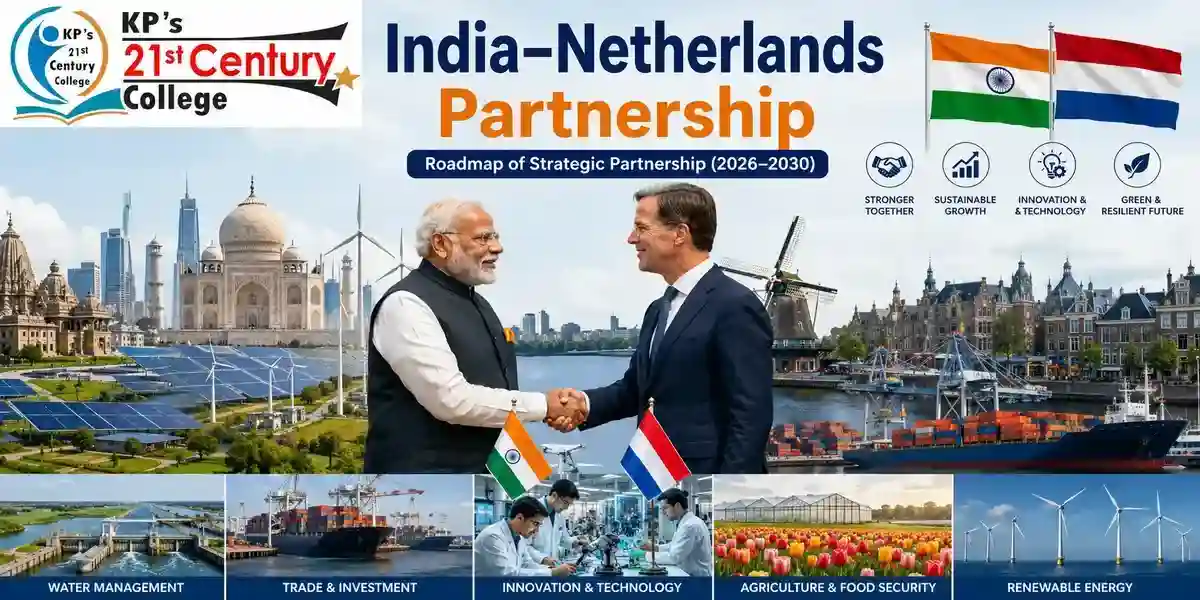
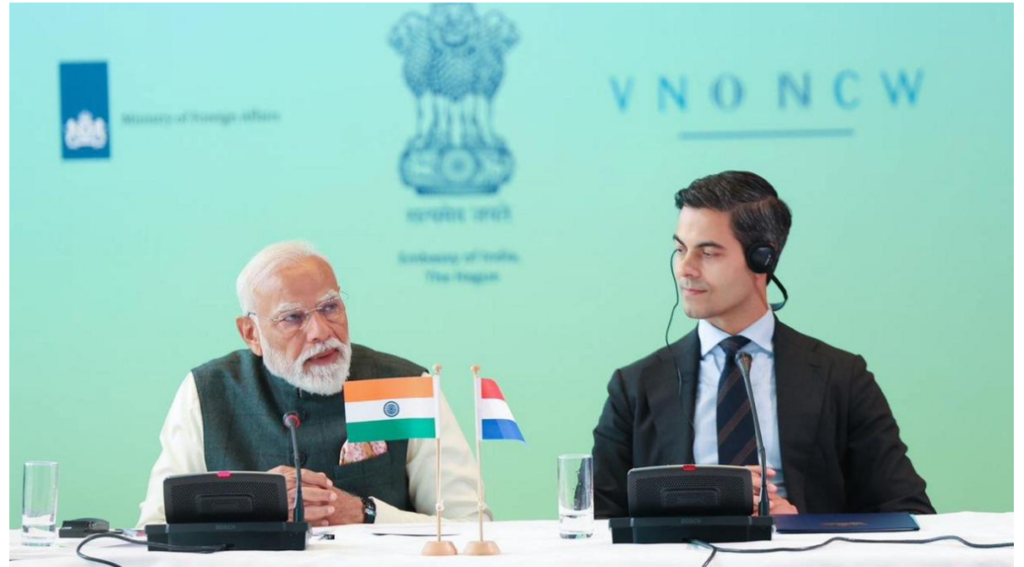
India and the Netherlands adopted the Roadmap for Strategic Partnership 2026–2030 at The Hague to deepen cooperation in trade, water, agriculture, health, technology, energy, defence, security, migration and culture.The partnership also gained cultural importance with the return of the Chola-era Anaimangalam Copper Plates, also known as the Leiden Plates, from the University of Leiden to India.
About the India-Netherlands Strategic Partnership Roadmap
The roadmap is a five-year framework to deepen cooperation between India and the Netherlands.
It moves the relationship beyond traditional trade ties and gives it a broader strategic direction. The partnership combines modern areas such as semiconductors, renewable energy, cyber security, green hydrogen and maritime cooperation with cultural areas such as heritage restitution, museum partnerships and people-to-people exchanges.
Major Areas of Cooperation
Political Dialogue
India and the Netherlands agreed to strengthen regular political engagement.
Important features include:
- Regular meetings between Heads of Government or State and Ministers.
- Annual meeting mechanism at the level of Foreign Ministers.
- Review of progress under the Strategic Partnership Roadmap.
- Greater interaction between ministries of both countries.
This will provide continuous political guidance and help both countries implement the roadmap in a time-bound manner.
Economic Cooperation and Investments
Economic cooperation is one of the main pillars of the partnership.
Focus sectors include:
- Renewable energy, Telecommunications, Maritime sector, Infrastructure and urban development, Innovation, Electronics and semiconductors, Agriculture Pharmaceuticals and medical technology, Organic chemicals, textiles, iron, steel and aluminium
Key initiatives include:
- Use of the Joint Trade and Investment Committee to increase trade and investment.
- Promotion of trade fairs and business forums.
- Review of the Fast Track Mechanism for investment facilitation.
- Cooperation in the Critical Raw Materials value chain.
- Promotion of joint ventures, industrial partnerships and technology collaboration.
This can help both countries build resilient supply chains and support innovation-led growth.
Water Cooperation
India and the Netherlands agreed to renew the Strategic Partnership on Water, originally signed in March 2022.
Focus areas include:
- Integrated water resources management
- Coastal zone management
- Urban water management
- Flood resilience
- River basin management
- Water quality and availability in the Ganga Basin
The Centre of Excellence on Water with the National Mission for Clean Ganga will support knowledge exchange, capacity building, start-ups and urban river management planning.
This is important because the Netherlands has global expertise in water management and flood control.
Agriculture Cooperation
The two countries will continue the Joint Agriculture Working Group.
Focus areas include:
- Climate-resilient agriculture, Animal husbandry, Agri-tech and biotechnology Phytosanitary and veterinary market access, Responsible value chains, Global food security, Clean Plant Centres
The Netherlands is known for advanced agriculture and water-efficient farming. Cooperation can help India improve productivity, sustainability and food safety standards.
Health Cooperation
Health cooperation will focus on public health risks and medical research.
Key areas include:
- Cross-border infectious diseases, antimicrobial resistance, non-communicable diseases, Digital health, AI and cybersecurity in health, Climate change and health One Health and disease surveillance
Important institutions include:
- RIVM – Dutch National Institute for Public Health and the Environment
- ICMR – Indian Council of Medical Research
This cooperation can strengthen disease surveillance, research and global health preparedness.
Emerging Technologies, Innovation, Science and Education
This area is important for India’s technological development.
Focus technologies include:
- Semiconductors, Artificial Intelligence, Cybersecurity, Photonics, Quantum technology, Energy materials, Biomolecular and cell technologies
India and the Netherlands will work to build trusted and resilient semiconductor supply chains.
Important linkages include:
- Dutch Semicon Competence Centre
- Indian Semiconductor Mission
A semiconductor “brain bridge” will be supported between Dutch universities and leading Indian institutions such as:
- IISc Bengaluru, IIT Bombay, IIT Delhi, IIT Gandhinagar, IIT Guwahati, IIT Madras
Industry support includes NXP, ASML, TATA and CG Semi.
Energy Transition, Sustainable Development and Maritime Development
India and the Netherlands agreed to strengthen cooperation in clean energy and sustainable development.
Key areas include:
- Renewable energy, green hydrogen, Bioenergy, Battery storage, Circular economy Waste-to-energy, Climate adaptation and mitigation, Sustainable urban development
Both countries will prepare an action plan for renewable hydrogen, including a green corridor between India and the Netherlands.
A major proposal is the Green and Digital Sea Corridor. It aims to:
- Promote green energy solutions in ports
- Develop sustainable shipping
- Support digital maritime systems
- Improve economic efficiency in maritime trade
- Promote India’s green hydrogen exports to Europe
This supports India’s maritime trade, clean shipping goals and green energy export ambitions.
Defence Cooperation
Defence cooperation will be expanded through structured engagement.
Key areas include:
- Joint tri-services interaction, Maritime cooperation, Naval exercises, Defence industry cooperation, Defence research collaboration, Defence Industrial Roadmap Possible Mutual Logistic Support Agreement
The Netherlands’ growing interest in the Indo-Pacific Region can support India’s maritime and strategic interests.
Security Cooperation
Security cooperation will cover both traditional and non-traditional security areas.
Focus areas include:
- Maritime security, Economic security, Knowledge security, Counterterrorism Cybersecurity, Critical and emerging technologies, Cybercrime prevention
Both countries will work together for the adoption of the Comprehensive Convention on International Terrorism at the United Nations.
They will also continue efforts to conclude:
- Mutual Legal Assistance Treaty
- New Extradition Treaty
Migration, Mobility and Consular Matters
The roadmap focuses on fair and legal migration.
Key points include:
- Facilitation of fair migration and mobility
- Prevention of irregular migration
- Movement of students, academics and researchers
- Mobility of skilled professionals and young professionals
- Implementation of the MoU on Mobility and Migration
- Continuation of the India-Netherlands Consular Dialogue
This is useful for Indian students, researchers and skilled workers seeking opportunities in the Netherlands.
Culture, Mobility and Heritage
- Migration and Mobility: India and the Netherlands signed an MoU to promote fair mobility of students, researchers and highly skilled professionals, while addressing irregular migration.
- Heritage Restitution: India welcomed the return of the Chola-era Anaimangalam Copper Plates from the University of Leiden, marking an important step in heritage restitution.
- Museums and Arts: Both countries expanded cultural cooperation through museum partnerships, exhibitions involving Amrita Sher-Gil and Van Gogh, and cooperation on the National Maritime Heritage Complex, Lothal.
Leiden Plates / Anaimangalam Copper Plates
- The Leiden Plates consist of 21 large copper plates, 3 small copper plates and a royal bronze ring.
- They were taken to the Netherlands in the 18th century during Dutch control of Nagapattinam.
- They record the grant of Anaimangalam village to Chulamanivarma Vihara, a Buddhist monastery built by the Srivijaya ruler Sri Mara Vijayotunga Varman.
- The grant was promised by Raja Raja Chola I and executed by Rajendra Chola I.
Historical Significance
- The plates show Chola maritime diplomacy, India–Southeast Asia links, religious syncretism and strong local administration.
- They used Sanskrit in Grantha script for royal genealogy and Tamil for land boundaries, tax exemptions and local assembly duties.
- The royal seal carried the Chola Tiger, Pandya Fish and Chera Bow, symbolising Chola supremacy over the Tamil Muvendhar.
Other Important Copper Plates
- Sogaura Copperplate: Mauryan-period record on famine relief in Prakrit and Brahmi script.
- Karandai Plates: 57-plate Chola charter on Rajendra I’s expeditions and Brahmadeya grants.
- Tiruvalangadu Plates: Record Rajendra I’s expedition to the Ganga.
- Anbil Plates: Provide early Chola genealogical details.
Significance of the Partnership
- Strengthens India-Netherlands relations from bilateral cooperation to strategic partnership.
- Supports India’s interests in semiconductors, clean energy, water management and maritime connectivity.
- Enhances cooperation in climate-resilient agriculture and global food security.
- Promotes cooperation in health, One Health, disease surveillance and antimicrobial resistance.
- Supports India’s green hydrogen export ambitions through maritime cooperation.
- Deepens defence and Indo-Pacific cooperation.
- Facilitates fair mobility for Indian students, researchers and skilled professionals.
- Encourages cultural diplomacy through museum partnerships and heritage restitution.
- Highlights India’s historical maritime links with Southeast Asia through the Anaimangalam Copper Plates.
Way Forward
- Use the annual Foreign Ministers’ mechanism for regular progress review.
- Align technology cooperation with India’s semiconductor and clean energy priorities.
- Build strong talent pipelines through universities, research institutions and industry partnerships.
- Improve standards and certification to meet European environmental and food safety norms.
- Ensure fair and predictable pathways for students, researchers and skilled workers.
- Strengthen institutional coordination in water and urban infrastructure projects.
- Use the Green and Digital Sea Corridor to promote sustainable maritime trade and green hydrogen exports.
- Promote cultural restitution and museum partnerships as tools of heritage diplomacy.
- Develop the National Maritime Heritage Complex at Lothal as a symbol of India’s long maritime history.
Conclusion
The India-Netherlands Strategic Partnership Roadmap 2026–2030 shows India’s growing cooperation with advanced European countries in trade, technology, water, agriculture, health, defence, security, migration and culture.The return of the Anaimangalam Copper Plates adds historical depth by highlighting India’s civilisational and maritime links.
Its success will depend on effective implementation, regulatory coordination, technology cooperation, strategic trust and respect for India’s strategic autonomy.
UPSC PYQ
Q. Consider the following statements: (2023)
The ‘Stability and Growth Pact’ of the European Union is a treaty that:
- limits the levels of the budgetary deficit of the countries of the European Union
- makes the countries of the European Union to share their infrastructure facilities
- enables the countries of the European Union to share their technologies
How many of the above statements are correct?
A. Only one
B. Only two
C. All three
D. None
Answer: A
Explanation
- Statement 1 is correct: The Stability and Growth Pact is related to fiscal discipline in the European Union. It limits excessive budget deficits and public debt among EU member countries, especially those using the euro.
- Statement 2 is incorrect: It does not deal with sharing infrastructure facilities among EU countries.
- Statement 3 is incorrect: It does not deal with sharing technologies among EU countries.
Additional Information
The Stability and Growth Pact was created to ensure that EU countries maintain sound public finances. It is mainly linked to budget deficit, public debt and fiscal stability, not infrastructure or technology sharing.
CARE MCQ
Q. With reference to the India-Netherlands Strategic Partnership, consider the following statements:
- The Roadmap of India-Netherlands Strategic Partnership covers the period 2026–2030.
- Water, Agriculture and Health are among the core pillars of India-Netherlands cooperation.
- The Netherlands is India’s largest merchandise export destination in Europe.
Which of the statements given above are correct?
A. 1 and 2 only
B. 2 and 3 only
C. 1 and 3 only
D. 1, 2 and 3
Answer: D
Explanation:
- Statement 1 is correct:
India and the Netherlands adopted the Roadmap of India-Netherlands Strategic Partnership for 2026–2030 during the Prime Minister’s official visit to the Netherlands. - Statement 2 is correct:
Water, Agriculture and Health (WAH) are important pillars of cooperation between India and the Netherlands. These include areas such as water management, agri-tech innovation, public health, One Health and anti-microbial resistance. - Statement 3 is correct:
The Netherlands is India’s largest merchandise export destination in Europe. India also enjoys a substantial trade surplus with the Netherlands.
Therefore, all three statements are correct.Top of FormBottom of Form
FAQs
1. What is the India-Netherlands Strategic Partnership Roadmap?
It is a five-year framework for cooperation between India and the Netherlands from 2026 to 2030.
2. Which sectors are covered under the roadmap?
It covers trade, investment, water, agriculture, health, semiconductors, education, renewable energy, maritime development, defence, security, migration and culture.
3. What are the Leiden Plates?
The Leiden Plates are Chola-era copper plate inscriptions, also known as the Anaimangalam Copper Plates.
4. What do the Anaimangalam Copper Plates record?
They record the grant of Anaimangalam village to Chulamanivarma Vihara, a Buddhist monastery linked to the Srivijaya Kingdom.